Slowest home sales since 2010. Why I'm making offers in December, not spring

Slowest home sales since 2010. Why I'm making offers in December, not spring

Real Estate Agent · Louisville, KY · Member since 2017 · 1k+ posts · 1k+ votes

Existing-home sales nationally just hit their slowest pace since 2010, and rates are a full point higher than they were this time last year. A lot of people are sitting on the couch waiting for "a better time."

I get it. But when everybody else is on the couch, there's more room at the table.

Fewer buyers means sellers listen. Price cuts. Closing-cost credits. Rate buydowns, where the seller pays to lower your interest rate. Seller financing on properties that have been sitting. December is the month where the sellers who have to sell are still listed, and the ones who were just "testing the market" have pulled their signs.

Nobody rings a bell. You just have to be at the table.

And when rates do come down, the couch empties out fast. Everybody who waited shows up at once, and now you're competing with all of them instead of negotiating one-on-one with a motivated seller in the quiet.

You can change your rate later. You can't go back and buy the house at December's price.

Here's what taking action actually looks like this month:

  1. If you're buying a home, get pre-approved now, while lenders are quiet and have time for you.

  2. If you're investing, make the offer on the house that's been sitting 90 days. Lowball it. Seller-finance it. Get creative. The worst they say is no, and in December a lot of them say yes.

  3. If you're selling in the spring, the prep starts now. Small repairs, a pre-listing inspection, a real pricing plan. Spring sellers who start in March are already behind.

One data point from my market. I ran a quick poll this week in Louisville: buying a small apartment building, what's the lowest cap rate you'd take? 67% said 8% to 10%. 17% said 6% to 8%, and 17% said teach me first. Nobody would take under 6%, and nobody needed more than 10%.

So if you own a small multifamily building and want it sold this winter, price it at an 8 or better and it moves. If you're buying, you've got company at 8 to 10, so when one hits that number, have your lender lined up before you ever walk it.

The honest catch: a house that's been sitting 90 days is sometimes sitting for a reason. Read the disclosures and the price history before you fall in love with the discount.

What's the one move you want to make in the first 90 days of 2027? Drop it below and I'll tell you the first step I'd take.

3Reply
855 views

18 Replies

Jump to latestLatest
  • Jim BlackburnBusiness Member
    Lender · Florida Based (48 states Puerto Rico) · Member since 2017 · 367 posts · 136 votes
    2d

    Agree with this, Rob. One thing I'd add from the lending side: when a seller offers money, how you use it matters as much as how much you get.

    1. Price cut vs closing-cost credit vs rate buydown. Each one helps differently. A price cut lowers the loan amount for good. A credit lowers cash to close. A buydown lowers the payment. Run all three in dollars over the years you actually plan to keep the loan.

    2. Know the concession limits. Each loan type caps how much a seller can contribute (FHA, VA and conventional all have their own rules, and conventional depends on your down payment). Offering more than the loan allows just wastes negotiating room.

    3. Temporary vs permanent buydowns. A temporary buydown lowers the payment for a year or two, then it steps up. Make sure the buyer qualifies and is comfortable at the full payment.

    4. Get pre-approved first. In a quiet month, a clean approval letter makes a lowball offer look a lot more serious.

    Are you seeing sellers lean more toward credits or price cuts right now?

    Stairway Mortgage, a Division of NEXA Mortgage LLC598 Reviews
    • Real Estate Agent · Louisville, KY · Member since 2017 · 1k+ posts · 1k+ votes
      2d

      Good list, Jim. The buydown point is the one buyers skip most. They see a dollar amount and assume a price cut is the win, and if they plan to keep the loan a while, it often isn't. Running all three in dollars over the actual hold is the right way to settle it.

      On credits vs. price cuts, it depends on the seller more than the month. A seller who needs a certain number on paper, maybe for an estate or because they're comparing it to what a neighbor got, would rather give a credit and keep the price. A seller who's been sitting since summer usually just wants it done and will take either. That's why I try to find out whether they care more about the price or the net before I write the offer.

      Your concession limit point matters too. Asking for more credit than the loan allows just burns negotiating room you could have used on price or repairs. Do you find buyers usually know their cap going in, or does it come up late in the process?

  • Stacy RaskinBusiness Member
    Lender · Member since 2022 · 1k+ posts · 538 votes
    2d

    December is the best time of the year to buy a property for a buyer as it's generally the slowest time of the year due to the holidays and in some parts of the country, the colder weather. Because of that a better deal can be made for a buyer. That's true for any type of market but because it's a slower market overall with less competition, buyers can get even better deals. Properties can be refinanced later. Important for the deal to work now- this is the time to make an offer as sellers in many markets are ready to negotiate and seller concessions can help to lower a buyer's closing costs and lower the rate. For some DSCR programs for non owner occupy rental properties, a buyer can get a seller to pay up to 6% of the purchase price in seller credits. For a $200K purchase price, that's $12K so that can make a difference. Happy to connect to discuss further.

  • MD/DC · Member since 2024 · 2k+ posts · 1k+ votes
    2d

    I intentionally make offers between Thanksgiving and Christmas when most properties will remain on the market until January if not sold before holidays.

  • Lender · Tampa, FL · Member since 2018 · 50 posts · 12 votes
    2d

    Agree. December sellers are usually the ones who have to sell, not the ones testing the market, and there's a lot less competition from other buyers.

    The one thing I'd add is have your financing lined up before you make the offers. If you're going to ask a motivated seller for a discount, a fast and certain close is part of what you're paying with. Get your lender to look at your numbers now so you can close in a couple of weeks, and don't plan on everyone being available the week between Christmas and New Year's.

  • Real Estate Agent · Houston, TX · Member since 2026 · 87 posts · 15 votes
    2d

    Houston backs this up: HAR had 5.5 months of supply in September and homes averaged 58 days on market, and the median Texas price cut in August was about 4% of the original list (TRERC). Are your December buyers putting concessions toward a rate buydown or closing costs?

    • Real Estate Agent · Louisville, KY · Member since 2017 · 1k+ posts · 1k+ votes
      1d

      Mostly closing costs here, with some going to a buydown. Louisville price points run lower than Houston, so a seller credit covers a bigger share of what a buyer has to bring to closing. That's often what gets a buyer over the line.

      A buydown makes more sense when the buyer has the cash to close and it's the monthly payment that's tight. A temporary buydown helps the first couple of years, but you're betting on a refinance, so if the credit is big enough I'd rather see it go to a permanent buydown.

      Either way, I'd ask for the concession in the offer, not after inspection. A December seller would rather give a credit up front than renegotiate in January.

      Which is working better for your buyers down there?

  • Real Estate Agent · Portland, ME · Member since 2021 · 35 posts · 11 votes
    2d

    Rob, the seller side of this gets less attention, so I'll add to your spring point. For an owner planning to list in March or April, winter is when the slow items get handled. Pull the permits for past work and confirm they were closed out, since an open permit or an unpermitted finished basement tends to surface during the buyer's inspection and turns into a negotiation. Gather what buyers will ask for: a year of heating and utility costs, service records for the heating system, the roof's age, and any warranties. Small repairs flagged by a pre-listing inspection are also easier to schedule now, before contractors fill up in spring.

    The pricing plan you mention is where I'd start. Looking at how comparable homes actually sold after last spring's rush, including the ones that needed price cuts to move, sets a more realistic list price than early-season headlines do.

    • Real Estate Agent · Louisville, KY · Member since 2017 · 1k+ posts · 1k+ votes
      17h

      Levi, that's a great list, and it carries over to Louisville almost word for word. A lot of our housing stock is older, and finished basements and older additions done without permits come up all the time once the buyer's inspector starts looking.

      In Kentucky the seller disclosure form asks about past repairs and work done, so pulling the permit history before listing helps the seller answer it accurately instead of guessing. If something was never closed out, winter gives them time to get it inspected and signed off with the city before a buyer turns it into a price conversation.

      I'd add the sewer line to your list for older homes here. A camera scope before listing is cheap compared to finding out in the middle of a contract.

      Do sellers in your market actually go for a pre-listing inspection, or do most still wait and take their chances with the buyer's?

  • Ken WadePro Member
    Developer · Ocala, FL · Member since 2009 · 12 posts · 4 votes
    1d

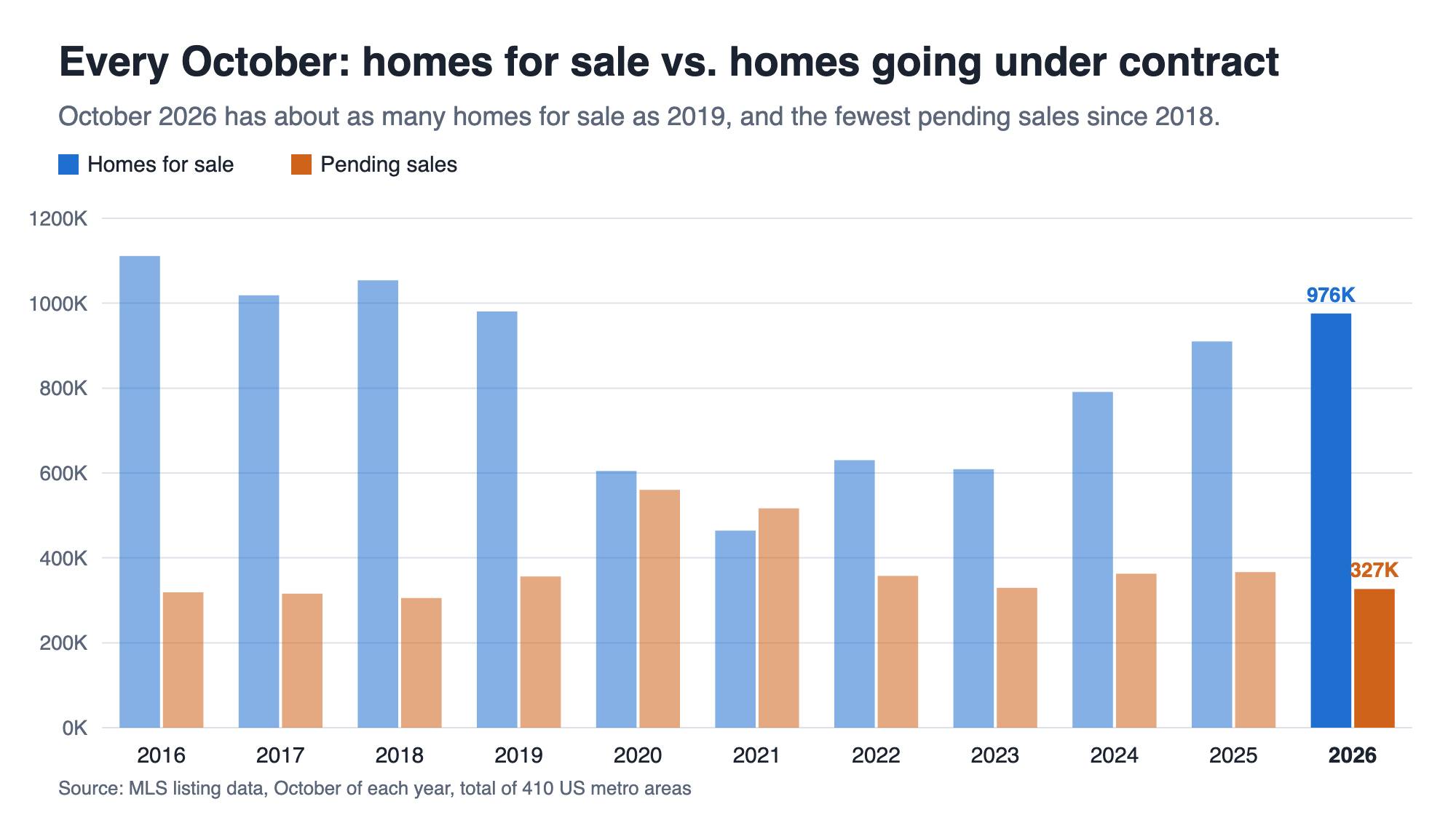
    @Rob Bergeron agreed, and the slowdown is broader than most people think. I looked at October listing data for about 400 metros. In roughly 7 out of 10 of them there are more homes for sale than a year ago and fewer going under contract. Charos mentioned Houston, but you see the same thing almost everywhere.

    The chart shows every October since 2016. Listings are back to about where they were in 2019, while pending sales are the lowest for an October since 2018.

    December adds to it. Last year pending sales fell about 15% from November to December, while listings only fell about 9%, so buyers step away faster than sellers do.

    Are the December sellers you're talking to giving on price, or mostly on credits and buydowns?

    • Real Estate Agent · Louisville, KY · Member since 2017 · 1k+ posts · 1k+ votes
      18h

      Ken, it's been a mix, and a lot of it depends on how long the house has sat. A seller who already took one price cut usually doesn't want to take a second one. Paying toward the buyer's rate or closing costs feels easier to them, even when the cost ends up close to the same.

      Where I see real movement on price in Louisville is the listings that have sat the longest, especially older homes and small multifamily that need work. Those owners are tired, and the conversation shifts from protecting a number to just getting it done.

      Your point about buyers stepping away faster than sellers in December lines up with what I see here. Fewer people writing offers means the ones who do get a real conversation.

      In your data, do the metros with the biggest jump in listings also show more price cuts, or are homes mostly just sitting longer?

  • Real Estate Coach · Sacramento Area · Member since 2026 · 75 posts · 43 votes
    1d

    Good point on seller financing for properties that have sat. On small commercial and storage I underwrite to roughly an 8% going-in cap with about 35% expenses, and I cap my offer at 75% of stabilized value, so a motivated seller willing to carry paper gives me room to make the numbers work. Quiet months help because sellers actually pick up the phone. With the 90-day sitters, are sellers open to carrying financing, or do you usually have to bring it up first?

    • Real Estate Agent · Louisville, KY · Member since 2017 · 1k+ posts · 1k+ votes
      1d

      Usually I have to bring it up. Most sellers on a 90-day sitter haven't thought about carrying paper, and their agent hasn't raised it either. The ones most open to it tend to be older owners who own the building free and clear and don't need a lump sum. In Louisville that describes a lot of the small multifamily owners who've held for decades.

      I don't lead with it. I ask what they plan to do with the money after closing. If the answer is pay the taxes and put the rest in the bank, a conversation about steady monthly payments at a fair rate tends to go well. If they still owe on it, it usually stops there, since most lenders won't allow a wrap.

      Do you find owners on commercial and storage more comfortable carrying than residential owners?

  • Philadelphia, PA · Member since 2026 · 3 posts · 0 votes
    1d

    Agree on winter. The small multifamily owners who keep their listings up in December are usually the ones who actually need to sell. I'd add some detail to your "sitting for a reason" caveat, at least for Philly. On a small building, the reason is often paperwork, not price. Before you lowball a 2-4 unit that's been sitting, confirm it's legally the number of units it's being sold as, check whether it has a current rental license, and look up open L&I violations. Philly's Safe Healthy Homes Act took effect Nov 1, and it puts more focus on repairs that older C-class buildings have often put off. Those are the deals where a lower price can still be a bad buy. But if the units and licenses check out and the seller is just tired, December is a great time to have that conversation.

    (Written with help from AI.)

    • Real Estate Agent · Louisville, KY · Member since 2017 · 1k+ posts · 1k+ votes
      17h

      Andrew, that's the right caveat, and it's the same story here. In Louisville a lot of older houses were split into two or three units decades ago, and not all of them were ever approved that way. A building marketed as a triplex can be a legal duplex with an extra unit in the basement, and that changes the value, the financing and the insurance.

      Before I'd send a low offer on a small building that's been sitting, I check the zoning and permit history with the city for the unit count, look for any open code cases, and see whether the units are separately metered. I also confirm the rentals are registered the way the city requires, since that's easy to miss on an older building.

      If all of that checks out and the owner is just tired, I agree, December is a good time for that conversation.

      On the Philly side, how long does it usually take a new owner to get a rental license in hand after closing?

  • Richard NeesePro Member
    Rental Property Investor · South Vinemont, AL · Member since 2026 · 117 posts · 40 votes
    1d

    I love the motivation. We are making offers daily on investment properties SFH in North Alabama. We are seeing 50-70k off of list price. Staying power is the key. make sure you can swing it and worry less about the rate and more about the strategy to secure it and hold it. Thank you for contributing to the community.

  • Real Estate Agent · Louisville, KY · Member since 2017 · 1k+ posts · 1k+ votes
    23h

    @Ken Wade thanks for pulling 400 metros, that chart says it better than I did. Here it's mostly closing-cost credits, with some going to a buydown, more than straight price cuts. @Jeff Wills and @Stacy Raskin, agreed: a lender who's already seen your numbers is part of what makes a December lowball work. @Levi Rawlings, good list for spring sellers, especially closing out old permits. @Andrew Loonstyn, the legal unit count check is a great add for small buildings anywhere. @Jules Aton and @Richard Neese, that's the play. Staying power beats timing the rate.

  • Real Estate Agent · Chicago, IL · Member since 2017 · 2k+ posts · 2k+ votes
    22h

    Just brokered a brick 4 at 12% off for a client and it sold lower then comps (most deals go within 2% of list often over here its hot market). Some good deals out there now forsure.

Join the conversationCreate a free account to reply, vote on answers and follow this thread.