Cost segregation Study-Worth it???

Cost segregation Study-Worth it???

Investor · Beaver Falls, PA · Member since 2015 · 275 posts · 82 votes

Hi we currently own 8 SFR's, 1 Duplex, 2 Commercial buildings and a 4 plex. We bought all these since 2019. I understand the basics of a CSS but I was wondering if it would be worth the squeeze? We have made significant improvements to all the properties. We plan to hold the properties long term. I hold mortgages on almost all the properties and the portfolio is probably worth close to 2.2m and we have around 1Mil in equity.

2Reply
300 views

Most Popular Reply

CPA · Member since 2025 · 8 posts · 6 votes
9mo

When you’re thinking about doing a cost segregation study, the first thing to figure out is what income you’re trying to offset. A cost seg is a timing strategy, so it only provides value if there’s income it can be applied against.

That income can be either passive or non-passive. Rental real estate is passive by default, so if you already have taxable passive income from your properties, cost segregation is often the most straightforward win because accelerated depreciation can directly offset that income.

If instead the goal is to offset non-passive income like your 95k salary, you need to determine whether the rental activity can be treated as non-passive. That generally means qualifying for either Real Estate Professional status or the short-term rental exception.

With a full-time nursing job, qualifying as a real estate professional is unfortunately not realistic since it requires more than 750 hours and more than half of your total working time to be spent in real estate activities. Without REP or another exception, additional depreciation from a cost segregation study will not reduce W-2 taxes. Those losses simply carry forward until you have passive income or eventually sell the properties.

The main exception to this is if any of the properties qualify as short-term rentals with an average stay of seven days or less and you materially participate. In that case, the losses can be treated as non-passive and can offset W2 income.

Once you’ve identified the type of income you have and what you’re trying to offset, you can then run the numbers to see if accelerating depreciation today makes financial sense. Higher marginal tax brackets generally increase the value of cost segregation, while lower brackets reduce the immediate benefit. As @Bob Solak pointed out, having less deprecation available in the future and depreciation recapture upon sale also needs to be factored into the analysis as well.

See this reply in the discussion

22 Replies

Jump to latestLatest
  • Member since 2025 · 4 posts · 2 votes
    9mo

    The first question is do you have income to offset. I just did my first study with re cost seg. Cost about $2k and will save me $17k in taxes because I have income to offset. Here's an example. 

    1. Start with the Purchase Price: for example, let’s assume $1,000,000.
    2. Subtract Land Value: say the land allocation is 20%, or $200,000. That leaves a depreciable basis of $800,000.
    3. Apply Cost Segregation Estimate: on average, 20%–30% of that depreciable basis can be reclassified into shorter recovery periods. That means roughly $160,000 to $240,000 would be eligible for accelerated depreciation.
    4. Bonus Depreciation: since 100% bonus depreciation is available (for properties placed in service after January 19, 2025), you could deduct the entire $160,000–$240,000 in the first year.


    So, in this example, the “accelerated depreciation benefit” would be $160,000–$240,000 in year one, compared to spreading that amount over 39 years under standard depreciation.

  • Investor · Beaver Falls, PA · Member since 2015 · 275 posts · 82 votes
    9mo

    @John Zinno Are CSS only for high income earners or does it make sense for low income earners also ? I’m a nurse and I prob only gross 95,000 / year

    • Member since 2025 · 4 posts · 2 votes
      9mo
      Quote from @John Matthew Johnston:

      @John Zinno Are CSS only for high income earners or does it make sense for low income earners also ? I’m a nurse and I prob only gross 95,000 / year


       For me, I have income from a secondary business that is considered active income. I also am an active real estate professional so I am able to use expenses and losses from real estate to offset my active income. To be an active real estate professional you need to work 750 hrs a year in real estate. If you qualify then you can offset your $95,000 a year in income from being a nurse. My CSS gave me $50k in depreciation for this year on a building I bought for $170k. I was able to use that $50k to offset my income and it saves me from paying taxes. 

      If you have income from real estate that you are going to pay taxes on and if you are going to hold the property for a long time then it would make sense. Probably not worth it if you are not a real estate professional, since it wouldn't be able to offset your nurse income. 

  • Jaron WallingPro Member
    Rental Property Investor · Indianapolis, IN · Member since 2018 · 4k+ posts · 4k+ votes
    9mo

    Piggy backing onto @John Zinno responses here this post got me going down a rabbit hole on cost segregation studies. I found a really nice website that describes the pros and cons for why investors should choose to do one. 

    https://iota-finance.com/iota-finance-blog/cost-segregation-....

    It also reminded me why we haven't done one personally. If you don't have REPS and investment properties worth at least $300k+ (we don't have either) the ROI for tax saving purposes isn't there. My wife and I don't own any commercial RE either which is where I see most investors benefiting on a CCS. Since I can't reduce my active income I don't see the benefit. The OP's portfolio larger than ours but the same pros and cons apply to everyone.

  • Investor · N.E. Illinois · Member since 2019 · 49 posts · 39 votes
    9mo

    Remember that cost seg helps offset other income NOW through accelerated depreciation, but down the road you will have less depreciation to offset income in future tax years.   And if you aren't holding the properties long-term and you go to sell, there will be depreciation recapture - unless you are going to kick the can down the road further using 1031 swaps.  So you won't be left with as much cash after the sale as you might think you would be.  In short, cost seg is not a magic bullet to avoid the tax man unless you "swap till you drop", at which point all that avoidance just helps your heirs. 

    The other short term benefit would be to provide you with more cash flow now (because you didn't give it to the tax man) to fund the next purchase and scale quicker.  Will you actually do that or will you just pocket it or spend it?   

  • CPA · Member since 2025 · 8 posts · 6 votes
    9mo

    When you’re thinking about doing a cost segregation study, the first thing to figure out is what income you’re trying to offset. A cost seg is a timing strategy, so it only provides value if there’s income it can be applied against.

    That income can be either passive or non-passive. Rental real estate is passive by default, so if you already have taxable passive income from your properties, cost segregation is often the most straightforward win because accelerated depreciation can directly offset that income.

    If instead the goal is to offset non-passive income like your 95k salary, you need to determine whether the rental activity can be treated as non-passive. That generally means qualifying for either Real Estate Professional status or the short-term rental exception.

    With a full-time nursing job, qualifying as a real estate professional is unfortunately not realistic since it requires more than 750 hours and more than half of your total working time to be spent in real estate activities. Without REP or another exception, additional depreciation from a cost segregation study will not reduce W-2 taxes. Those losses simply carry forward until you have passive income or eventually sell the properties.

    The main exception to this is if any of the properties qualify as short-term rentals with an average stay of seven days or less and you materially participate. In that case, the losses can be treated as non-passive and can offset W2 income.

    Once you’ve identified the type of income you have and what you’re trying to offset, you can then run the numbers to see if accelerating depreciation today makes financial sense. Higher marginal tax brackets generally increase the value of cost segregation, while lower brackets reduce the immediate benefit. As @Bob Solak pointed out, having less deprecation available in the future and depreciation recapture upon sale also needs to be factored into the analysis as well.

  • Investor · Beaver Falls, PA · Member since 2015 · 275 posts · 82 votes
    9mo

    @Sean Culloden My wife personally manages our 16 units and spend countless hours on it. I think we can qualify.

  • Dan H.Pro Member
    Investor · Poway, CA · Member since 2015 · 7k+ posts · 8k+ votes
    9mo

     not a CPA, tax professional, etc.  consult your own expert.

    Here are some things to consider/note:

    - OBBB restored the CSS to 100%.  If it was not purchased this year (2025), you could have CSS benefit of as low as 40%.

    - anyone can write off the passive income via CSS but few have enough passive income to justify this. That implies that it typically is most beneficial for those that can write off active income. I know 2 ways to use css to write off active income: 1) RE Professional REP) 2) STR exception (sometime erroneously referred to as STR loophole). REP is virtually impossible with a full time job, but maybe spouse can qualify.
    - if you are not in at least a moderately high tax bracket, css is unlikely to be worth it.  For example if you make $100k, your tax is ~19%, but if you write off more than $52k you are only saving 12% vs 22% for the first $52k.

    - note the depreciation is simply accelerated.   You get it earlier than if you used standard depreciation.   This implies there is less deprecation to take later.

    - If you sell without a 1031, the depreciation is recaptured.

    So why do I use css?

    - we are in full control of our tax bracket.  I can always get to a high bracket to be in a position to save substantially by CSS.

    - we have significant passive income and either my wife or I can qualify as REP and, if we desired, for the STR exemption (we have no need so our cohost spends more time on each unit than we do but if we needed it we could reduce her role in one unit).

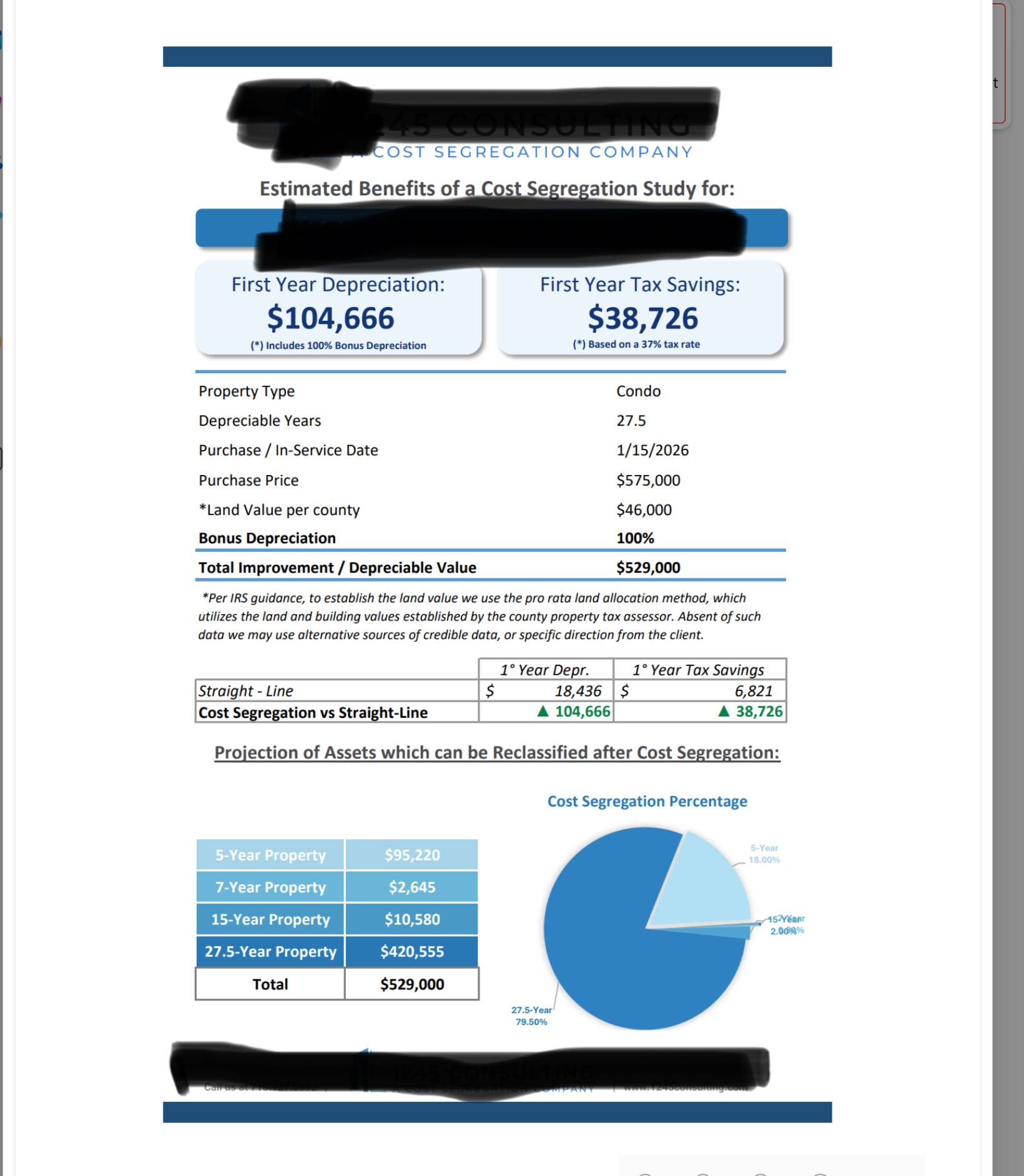
    - I look at the first year css savings as a means to increase effective LTV. For example if I purchase at 75% LTV at 145k ($575k purchase), but save $30k off my taxes I have an effective LTV of 80%. The higher the leverage, the better the projected return.

    I am including a css estimate that I received today.  Note the 37% number really is not accurate even if you enter the 37% tax bracket, the first $600k earned is in lower brackets.   So it is a bogus number that makes the css look better than reality.  However the $104k likely will be close to accurate and you can calculate various first year savings based on this and your income.  If you have full control of your income (like I do) you can have high income years when you have a lot of write offs and lower income years when you have less write off.  Of course you can always create write off via donations to charitable organizations. 

    Good luck
  • Ashish AcharyaBusiness Member
    CPA, CFP®, PFS · FL · Member since 2017 · 5k+ posts · 3k+ votes
    9mo

    @John Matthew Johnston, Thanks for sharing that, John. From a tax perspective, yes, this portfolio is very much in “worth the squeeze” territory.

    A cost segregation study can still be done even though you bought the properties going back to 2019. Through a lookback study, you can catch up missed depreciation in one year without amending prior returns. The fact that you made significant improvements actually helps, because those costs are often reclassified into shorter life assets and accelerated.

    Since you plan to hold long term and have mortgages, accelerated depreciation can create large paper losses now while the properties are appreciating. That improves cash flow, offsets other income depending on your tax profile, and does not change your economics. Depreciation recapture is usually far less painful than people fear when you hold long term and continue exchanging or refinancing.

    With roughly $1M in equity and multiple property types, the real question is not “does cost seg work” but “how much and where first.” Typically the duplex, fourplex, and commercial buildings are the biggest wins.

    At this level, a high level feasibility analysis is the next smart step before ordering any studies. Goodluck and happy to connect!

    INVESTOR FRIENDLY CPA®5240 Reviews
    TaxMD® | Tax Planning Software
  • Aaron ZimmermanBusiness Member
    Accountant · Chicago, IL · Member since 2018 · 2k+ posts · 1k+ votes
    9mo
    John - you mention being married and making $95k gross. Does your spouse make any income? If no, which is how I’m reading the above messages, you would want to see if this is worth it for You in the long run. Assuming you’re mfj, at $95k, you could deduct $25k without being a real estate professional should you have the losses. So now your AGI is down to $70k. Factor in standard deduction of $31,500, you’re now at $38,250 for taxable income. At this point there’s not much tax left to pay. You’re in the 12% tax bracket so at most you’re probably paying about $4k in federal taxes. Depreciation can be recaptured at rates up to 25% and sometimes more depending on classification of the property (I.e. personal property). That said, there could be opportunities to put yourself in a better financial position with this lowered income. Id connect with a real estate cpa to discuss your situation in more detail.
  • Patrick DruryBusiness Member
    Real Estate Agent · Columbus, OH & Cleveland OH · Member since 2021 · 1k+ posts · 2k+ votes
    9mo

    @John Matthew Johnston
    Since you bought them in 2019, and let's just assume they were in service that year as well you'll need to file for a change of accounting method since you are changing the depreciation schedules. I would check with your accountant and ask them what they charge for this. Once you have that cost, you can weigh the options of the cost of the cost segg, which is (price of the study + cost of change of accounting method), then compare it to the savings you would get. Other people already commented on the requirements of real estate professional status so I don't think it's necessary for me to put that here, but check with your account to see where you stand and if this makes sense for you and your financial situation 

  • CPA| New Clients Welcome| 50 States · Member since 2016 · 440 posts · 94 votes
    9mo

    @John Matthew Johnston, hi. Nice portfolio, at that scale a cost seg can absolutely be “worth the squeeze,” but it depends on a few quick variables. A simple way to sanity-check it:

    • Timing / taxable income: Do you (or your spouse) have enough taxable income to actually use the extra depreciation this year?

    • Property type + age: The 4-plex and duplex often have the most “reclassifiable” components. Commercial can be great too, but results vary by use/buildout.

    • Improvements matter: Big rehabs can be a huge driver, sometimes the better play is a cost seg on the building plus a review of repairs vs. capital improvements, and whether any prior components can be disposed when you replaced them.

    • Hold long term: That’s fine,just remember it’s mostly a time-value-of-money play. You are accelerating deductions now; some of that is typically “paid back” later via lower depreciation or potential recapture on sale.

    • State taxes + financing: If you’re in a high-tax state and still actively acquiring, front-loading depreciation can improve after-tax cash flow and lending optics.

    • If you want a quick rule of thumb: when you have multiple doors + meaningful improvements + solid current income, it’s often worth at least pricing a study (or doing a “lite” feasibility estimate) before deciding.

  • Dr · VA · Member since 2025 · 154 posts · 34 votes
    9mo

    Absolutely, you may pursue a cost segregation study. However, it should not be viewed as free money or a gift from the federal government. Cost segregation accelerates depreciation and will reduce your basis, resulting in depreciation recapture in the future. That said, if you are currently in a high tax bracket, it may still be a strategic option to consider.

  • Member since 2025 · 29 posts · 7 votes
    9mo

    For a portfolio like yours, cost segregation is usually worth a serious look, but only if it’s done selectively and with intent. With properties acquired since 2019, meaningful improvements, and a mix of residential and commercial, you likely have enough depreciable basis to generate real front-loaded losses especially on the commercial buildings and the 4-plex. The key isn’t “doing cost seg everywhere,” it’s targeting the assets where accelerated depreciation actually moves the needle relative to your income and future plans. Since you’re holding long term, recapture is more of a timing issue than a deal-breaker, and bonus depreciation can still make the math work. Just make sure your studies are defensible and your participation/status aligns with how you plan to use the losses. I’ve found automated tools more helpful for sanity-checking whether the depreciation strategy actually lines up with REPS/material participation and audit risk, rather than chasing paper losses that don’t fully stick.

  • Real Estate Investor · Austin, TX · Member since 2017 · 100 posts · 25 votes
    9mo

    Based on your portfolio size and mix, cost seg could make sense, but the real question is whether you can actually use the losses. Since you're a nurse with W-2 income, the depreciation won't help unless you or your wife qualify as a Real Estate Professional (750+ hours, more than half your working time) or if any units qualify as STRs with material participation. If your wife is managing 16 units and can hit those REP hours, that's your path forward. Otherwise, the losses just carry forward until you have passive income to offset. One practical tip: if you're close to qualifying for REP but not quite there, consider focusing your cost seg on the commercial buildings and 4-plex first. They typically have the highest reclassification percentages and give you the most bang for your buck. You can always add the SFRs later if the tax situation changes.

  • Patrick DruryBusiness Member
    Real Estate Agent · Columbus, OH & Cleveland OH · Member since 2021 · 1k+ posts · 2k+ votes
    9mo

    @Aaron Zimmerman
    I believe it depends on who you use. If you use DIY cost segg I don't believe they offer that service. More than likely, if you are having a company that comes out in person, and walks through the property and puts together a report they may offer that service as well, but that report will cost more. I am by no means a tax professional, but from my understanding, depending on the complexity of the building, the DIY cost segg could be better, especially for the simpler residential properties. This topic could probably be a whole different thread on who to use for the report. lol

  • Sean GrahamBusiness Member
    Investor , CPA · Detroit, MI · Member since 2016 · 586 posts · 249 votes
    9mo

    Hey John, owner of Maven Cost Segregation here.
    With a $2.2M portfolio, you’re definitely in the range where a study pays for itself many times over. Commercial buildings have a much higher basis to work with, and since you bought post-2019, you’re hitting that window where bonus depreciation is still really impactful.
    One thing people often overlook is the renovations. You can actually use Partial Asset Disposition (PAD) to write off the remaining book value of the old materials you ripped out, while you start depreciating the new stuff you put in. It’s essentially a double win on the tax side.
    At that price point, the tax savings usually dwarf the cost of the study by a significant margin. I’m happy to run a free estimate (EOB) for you so you can see the actual projected numbers before you spend a dime on a study.
    Hope that helps!

    Maven Cost Segregation Tax Advisors554 Reviews
  • Jason MalabuteBusiness Member
    Accountant · Los Angeles, CA · Member since 2016 · 2k+ posts · 906 votes
    9mo

    When considering a cost segregation study, the first step is understanding what income you’re trying to offset. Cost seg is a timing strategy, so it only makes sense if there’s income it can actually reduce.

    Rental income is passive by default, so accelerated depreciation usually works best when you already have passive income to offset. If your goal is to offset W-2 or other active income, you generally need to qualify as a real estate professional or meet the short-term rental exception.

    Without REP status or an STR exception, the extra depreciation won't reduce W-2 income—it simply carries forward until you have passive income or sell the property.

    Once you know the income type, the next step is running the numbers. Tax bracket, future depreciation, and potential recapture all matter when deciding whether cost segregation actually makes financial sense.

    Malabute & Company CPAs525 Reviews
  • Basit SiddiqiBusiness Member
    Accountant · New York, NY · Member since 2015 · 8k+ posts · 3k+ votes
    9mo

    One thing to consider also is that PA is a gross income state(no deductions).

    One thing you want to avoid is a situation where you report a large loss for Fed/PA in one year and then report positive income going forward in PA where it would be subject to the 3.07% state tax rate. While the rate is low, it is something to consider.

    One of the things that sucks about PA state income tax.

    Best of luck!

Join the conversationCreate a free account to reply, vote on answers and follow this thread.