Investor · Wethersfield, CT · Member since 2013 · 371 posts · 191 votes
I invest out of state in C-class neighborhoods in the Midwest. One of my units MAY be in an area that is going down hill, but I could absolutely be wrong. From several states away, how can I be sure? I'd hate for a temporary dip in the quality of the tenant pool to be giving my landlord "spidey sense" false alarms on account of taking an extra month or two to fill a unit. I'm happy to rent in a C-class area, even though it can take some work to stabilize a property. I don't really want to invest in a D-class area.
Tangentially, what are some of your "it's time to sell this property" red lines when it comes to the changing economic conditions of an area?
Real Estate Agent · Los Angeles, CA · Member since 2018 · 2k+ posts · 1k+ votes
1y
This is a really interesting question. We also have to remind ourselves that real estate is for the long run, meaning a D class neighborhood today could be a B class neighborhood in a few years.
One thing you can check is crime stats in an area. If it is trending up, that could be a sign. Take it with a grain of salt as safety is subjective.
You could also ask your Realtor and property manager their thoughts and maybe next time they are in the area to take photos. They are your boots on the ground.
You can also see what is being built in the area. For example, let's say a prison is being built nearby, that could affect the desirability of an area. Or maybe a liquor store, which may seem innocent, but could bring in a different crowd.
In terms of "when to sell," it's all about what you plan on doing with the money. Keep in mind if there are economic shifts that you are seeing, so is everyone else, so you may have missed the boat.
Rental Property Investor · Seattle, WA · Member since 2013 · 2k+ posts · 1k+ votes
1y
I'm managing D class properties with a property manager and am making a profit. Last year was the first and only year we had a negative cash flow, and that is driven by the anti-landlord west coast sentiment.
But we invested several years of blood sweat and tears to get things stabilized and learn the space before we turned them over to property managers. And I will be the first to admit that it is not for everyone. And we went in eyes wide open, intentionally inveting in class D, not sliding into it as demographics changed. The property manager can make or break you, it has to be a PM that is working in that space and is comfortable there.
I agree with earlier comments to look in the front and back yards to see how many old cars, abandoned junk, or treasures that aren't treasures are piling up. Also try to get a guage on how much people are out and about and living on their front porches. Class C stay indoors, don't answer the door for solicitors, and don't spend a lot of time with neighbors. Class D is mostly rentals (another tip to look at owner occupied stats and/or if the neighborhood is identified for revitalization), the tenants are outside smoking, they are talking to neighbors and solicitors, it is a completely different vibe that is pretty noticeable just driving through.
Real Estate Broker · Cody, WY · Member since 2010 · 28k+ posts · 41k+ votes
1y
Unkempt lawns, trashy or broken down vehicles, mattresses and trash on empty lots, boarded up houses, bars on windows, dealers and hookers on the corners, the lack of stores or gas stations, occupied properties are dilapidated, etc.
Or when Google maps shows stuff like this:
If those are drug zombies, as they appear to be, that's an "F" class neighborhood where nobody pays rent and structure burnouts are common. If you intended me to take something else from that picture, such as an unfortunate motor vehicle accident, let me know.
So, while I do agree with the above characteristics of a D class neighborhood by responders, I don't think that is the whole story.
People who live in an area their whole lives (most people), have a certain set idea in their head about the character of different towns and different neighborhoods. Even if those things change over time, that idea in their head often does not change along with it or at least changes more slowly.
So, an area might have been D class 20 years ago and is C class today in terms of what the property condition, crime etc show you BUT if the tenants still stigmatize the area in their mind then mostly D class tenants will be applying there because they have less choices.
That works BOTH ways. An area might be doing downhill somewhat but as long as the tenant pool thinks of it as C class, then C class renters will apply and live there.
So, what matters is the PEOPLE. Are you attractive tenants that meet your screening criteria readily and keeping them as long as you budget for (vacancy rate)? Are surrounding properties doing the same? Do people talk about that neighborhood as being stigmatized? A D class neighborhood will carry a stigma with local residents.
So, I would try to gauge the perception because that is mostly actually affects you.
Also, note that it is hard to accurately judge an area from afar based on exterior physical characteristics. A C class neighborhood in the rust belt might look like a D class in another area because the rust belt has older housing stock and has a different look and feel to neighborhoods.
Property Manager · Royal Oak, MI · Member since 2012 · 12k+ posts · 9k+ votes
1y
@Jeff G.@Jeff G. some well intended and mostly true assistance posted so far.
Let's look at "logical" answers:
We're going to assume only 4 Classes - A, B, C & D. - Some people go to F, but what's the point?
There are two main factors that you can use to track gentrification, so why can't they be used to track the reverse?
TENANT PROFILE: tenants are the biggest influence on Neighborhood and Property Class. - If you don't believe us, think about what will happen if you put several Class D tenants in a Class A apartment building. Or try the reverse - rehab a property in a Class D Neighborhood to Class A standards and see what Class of tenant you'll get.
So, you want to watch tenant credit scores, see the default chart below:
FICO Score
Pct of Population
Default Probability
800 or more
13.00%
1.00%
750-799
27.00%
1.00%
700-749
18.00%
4.40%
650-699
15.00%
8.90%
600-649
12.00%
15.80%
550-599
8.00%
22.50%
500-549
5.00%
28.40%
Less than 499
2.00%
41.00%
PROPERTY VALUES: What are buyers willing to pay for a property?
What's key with this metric is it has to be taken in context. How are values changing compared to the rest of the local market? - Dont be fooled by rising prices - they may be lagging the rest of the area for a reason! - The same can be said of high percentage increases. We watched City of Detroit properties crash to $500 or less in Class D Neighborhoods. We weren't fooled when they increased to $5,000 and kept going up. The percentage increase was off the charts, but the dollar amounts - not so much.
RENT PRICES: here's another useful metric with all of the above about Property Values applying.
Do you have some tool for determining the median credit score for a given neighborhood? I think there is a way to do it by zip code but that's not really granular enough. Right now I use school ranking as a means of inferring neighborhood quality. It's not perfect, but it helps. I'd like more tools in my toolbox though.
This is a really interesting question. We also have to remind ourselves that real estate is for the long run, meaning a D class neighborhood today could be a B class neighborhood in a few years.
One thing you can check is crime stats in an area. If it is trending up, that could be a sign. Take it with a grain of salt as safety is subjective.
You could also ask your Realtor and property manager their thoughts and maybe next time they are in the area to take photos. They are your boots on the ground.
You can also see what is being built in the area. For example, let's say a prison is being built nearby, that could affect the desirability of an area. Or maybe a liquor store, which may seem innocent, but could bring in a different crowd.
In terms of "when to sell," it's all about what you plan on doing with the money. Keep in mind if there are economic shifts that you are seeing, so is everyone else, so you may have missed the boat.
Unkempt lawns, trashy or broken down vehicles, mattresses and trash on empty lots, boarded up houses, bars on windows, dealers and hookers on the corners, the lack of stores or gas stations, occupied properties are dilapidated, etc.
I invest out of state in C-class neighborhoods in the Midwest. One of my units MAY be in an area that is going down hill, but I could absolutely be wrong. From several states away, how can I be sure? I'd hate for a temporary dip in the quality of the tenant pool to be giving my landlord "spidey sense" false alarms on account of taking an extra month or two to fill a unit. I'm happy to rent in a C-class area, even though it can take some work to stabilize a property. I don't really want to invest in a D-class area.
Tangentially, what are some of your "it's time to sell this property" red lines when it comes to the changing economic conditions of an area?
A lot of subjective/anecdotal criteria here. Better to look at data. Home prices always reflect how desirable a neighborhood is.
Median home price is the deviding line in every metro area. A and B neighborhoods are above median price, C and D are below median price. Most investors have rose-colored-glasses when it comes to their neighborhood quality. Most think they invest in a B, but it is really below median, so a C plus or even C minus.
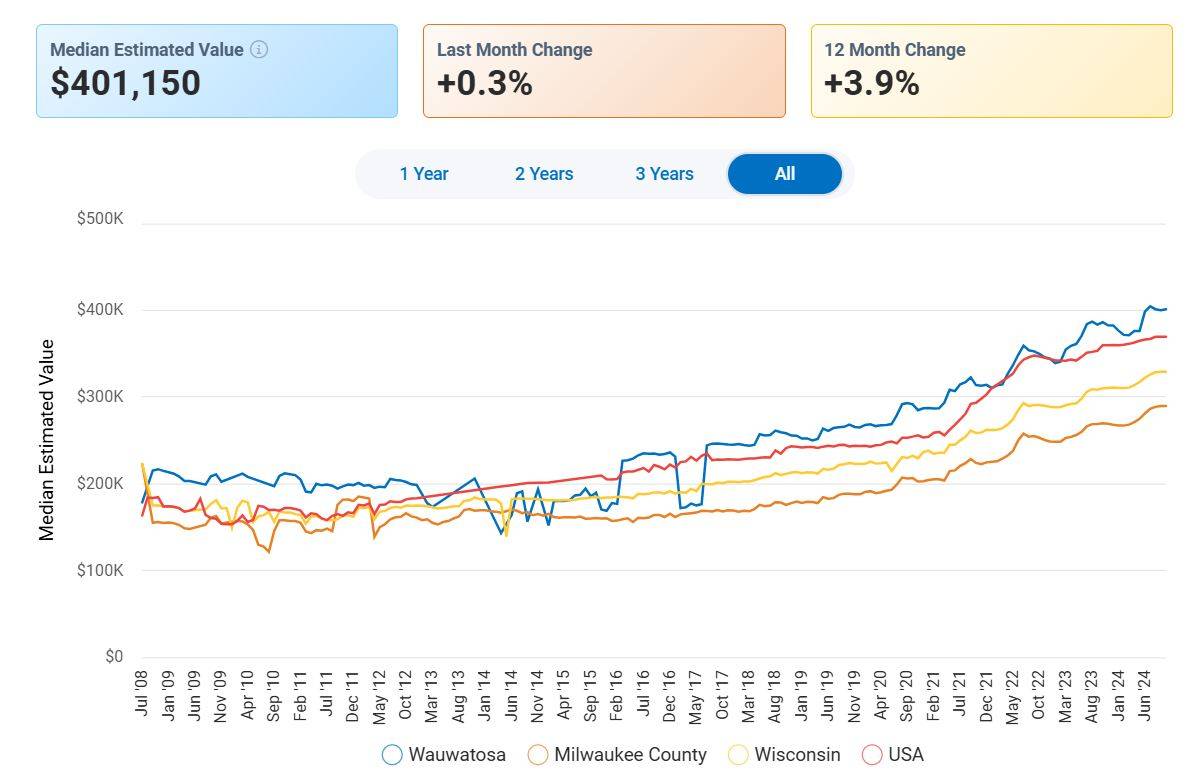
If you want to know if your neighborhood is slipping, track the median price of that municipality/neighborhood against the median price of the metro area or State if you want to Zoom out.
Here is an example: Wauwatosa (blue) has been outperforming Milwaukee County, Wisconsin and the US. If that blue line would start falling relative to the orange one (County) you'd know that neighborhood desirability is slipping.