Out of state for easier entry? Would you do this deal?

Out of state for easier entry? Would you do this deal?

Member since 2023 · 34 posts · 13 votes

Investments don't cash flow where I live without a very large down or very lucky off market BRRRR find, but future values are high. Appreciation used to be guaranteed but starting to get overbuilt so no longer.

I'm looking OOS and trying to decide if it's worth it. I've found an area I like with low property taxes, easy entry, and low rental inventory and it has a great one stop shop property manager that will do everything - purchase, light rehab, rent, maintenance, future sale but the long term numbers in the area aren't that exciting other than easy entry.

Example of what I'm finding:

Purchase price: $100K

Forced equity by getting it rent ready also adds 20%-30% to value with a few weeks of work

Two months average time on market to rent

$1200 - $1400 monthly

Cash flow $100 month after all expenses, PM, vacancies, CAP/EX etc.

The trade off for easy entry is low rental increases and low appreciation 

Do these numbers look worthwhile assuming adding multiple properties per year?

1Reply
186 views

Most Popular Reply

Real Estate Broker · Northeast PA · Member since 2017 · 2k+ posts · 2k+ votes
7mo

@Richard F. understands the nuances of a 'one-stop' shop.  So pay attention to his advice.

It all looks good on a napkin--until the real world happens.  For a net/net estimate of $100/mo?  No, I wouldn't do the deal based on what you supplied in your post.  I'd keep looking.

See this reply in the discussion

9 Replies

Jump to latestLatest
  • Honolulu, HI · Member since 2008 · 3k+ posts · 2k+ votes
    7mo
    Regarding "great one stop shop", is this description based on referrals, or actual due diligence on your part? You don't have to read too many posts in these forums to realize that caliber of PM is pretty rare. No one is ever happy with them. Are they duly licensed and properly insured and Bonded in the State of the property? Or are they other, unlicensed, investor's operating fast and loose?  Do you know critical details of their various internal processes? Have you reviewed a Management Agreement of theirs? Do they have in-house maintenance staff, or all Independent Contractors? Properly licensed and insured? When do they distribute Net Rentals? How do they handle true emergencies, and at what cost to you? So many questions...you need answers before writing an offer.
  • Real Estate Broker · Northeast PA · Member since 2017 · 2k+ posts · 2k+ votes
    7mo

    @Richard F. understands the nuances of a 'one-stop' shop.  So pay attention to his advice.

    It all looks good on a napkin--until the real world happens.  For a net/net estimate of $100/mo?  No, I wouldn't do the deal based on what you supplied in your post.  I'd keep looking.

    • Investor · Costa Mesa, CA · Member since 2016 · 1k+ posts · 1k+ votes
      7mo
      Quote from @Marc Winter:

      @Richard F. understands the nuances of a 'one-stop' shop.  So pay attention to his advice.

      It all looks good on a napkin--until the real world happens.  For a net/net estimate of $100/mo?  No, I wouldn't do the deal based on what you supplied in your post.  I'd keep looking.


       This. Your margins are too thin and maintenance, vacancy and evictions will likely put you in the negative......

  • Arman AhmedPro Member
    Real Estate Agent · Columbus Cleveland Dayton, OH · Member since 2024 · 2k+ posts · 953 votes
    7mo
    Quote from @Eric M.:

    Investments don't cash flow where I live without a very large down or very lucky off market BRRRR find, but future values are high. Appreciation used to be guaranteed but starting to get overbuilt so no longer.

    I'm looking OOS and trying to decide if it's worth it. I've found an area I like with low property taxes, easy entry, and low rental inventory and it has a great one stop shop property manager that will do everything - purchase, light rehab, rent, maintenance, future sale but the long term numbers in the area aren't that exciting other than easy entry.

    Example of what I'm finding:

    Purchase price: $100K

    Forced equity by getting it rent ready also adds 20%-30% to value with a few weeks of work

    Two months average time on market to rent

    $1200 - $1400 monthly

    Cash flow $100 month after all expenses, PM, vacancies, CAP/EX etc.

    The trade off for easy entry is low rental increases and low appreciation 

    Do these numbers look worthwhile assuming adding multiple properties per year?

     Sounds like you’re running into the classic “high price, low cash flow” dilemma. For out-of-state investors, The midwest are great alternative, purchase prices are still well below replacement cost, cash flows are strong from day one, and you can scale faster with multiple small multis or duplexes. You can still get some forced appreciation with light rehabs, but the biggest advantage is predictable monthly income without paying a premium upfront. Pair that with a local team, property managers, contractors, and investor-friendly lenders, and you can grow a portfolio efficiently without living there.

  • Real Estate Agent · Memphis · Member since 2026 · 580 posts · 343 votes
    7mo

    This is a good, disciplined question — you’re thinking about structure, not just “can I buy it?”

    At $100K purchase and $100/month true cash flow after all expenses, you’re looking at roughly $1,200/year per property. On paper that works, but the margin is thin relative to risk — especially OOS.

    A few things I’d pressure test:

    1. Vacancy reality.
    Two months average time on market is not nothing. In a lower-rent market, longer lease-ups can quickly erase a year’s profit.

    2. Management dependency.
    A “one-stop shop” PM is convenient, but that also concentrates risk. If performance slips, your entire model depends on them. OOS investing works best when you have redundancy and oversight, not just trust.

    3. Exit liquidity.
    In lower appreciation markets, your return leans heavily on cash flow. If appreciation is modest and rent growth is limited, your upside is capped — while operational risk remains.

    4. Scaling math.
    If you add 5 properties, that’s ~$6K/year in net cash flow — before unexpected repairs or a rough year. The question becomes: does that justify the complexity and capital deployed?

    That said, lower volatility markets with stable rents can be attractive if your goal is slow, steady accumulation. Just make sure you’re being compensated for:

    • OOS oversight risk
    • Slower equity growth
    • Thin margins

    The real question isn’t “Does it cash flow?” It’s “Is this return strong enough for the risk and effort involved?”

    Easy entry is nice. Durable performance matters more.

  • Drew SygitBusiness Member
    Property Manager · Royal Oak, MI · Member since 2012 · 12k+ posts · 9k+ votes
    7mo
    Quote from @Eric M.:

    Investments don't cash flow where I live without a very large down or very lucky off market BRRRR find, but future values are high. Appreciation used to be guaranteed but starting to get overbuilt so no longer.

    I'm looking OOS and trying to decide if it's worth it. I've found an area I like with low property taxes, easy entry, and low rental inventory and it has a great one stop shop property manager that will do everything - purchase, light rehab, rent, maintenance, future sale but the long term numbers in the area aren't that exciting other than easy entry.

    Example of what I'm finding:

    Purchase price: $100K

    Forced equity by getting it rent ready also adds 20%-30% to value with a few weeks of work

    Two months average time on market to rent

    $1200 - $1400 monthly

    Cash flow $100 month after all expenses, PM, vacancies, CAP/EX etc.

    The trade off for easy entry is low rental increases and low appreciation 

    Do these numbers look worthwhile assuming adding multiple properties per year?


     At that price point, you're probably buying a Class C or D rental.

    What metrics are you using for:
    - Vacancy
    - Maintenance
    - Tenant nonperformance & damages

  • Investor · IN/KY · Member since 2025 · 10 posts · 0 votes
    7mo
    That thin amount of cashflow only works if you rehabbed the entire house and made it bullet proof and you’re ready for a 10 year run. IMO
  • Member since 2023 · 34 posts · 13 votes
    7mo

    Thank you for all of the great replies, especially about thoroughly vetting a PM. 

    I thought I was underwriting conservatively but you all pointed out a few areas I was missing. 

    The thin cash flow is definitely the road block here, and putting more down on a sub 200k property with low appreciation would provide lower COC return than less risky investments. And far less than using my cash for more rehabs locally. I'd really like to add long-term investments this year in addition to doing local rehabs so I'll keep crunching numbers on different areas and probably reconsider BRRRing locally.

  • Eric FernwoodBusiness Member
    Realtor · Las Vegas, NV · Member since 2014 · 997 posts · 1k+ votes
    7mo

    Hello @Eric M.,

    Whether these properties make sense depends on your goal. If your goal is short-term cash flow, these properties may work. If your goal is long-term financial independence, the properties you purchase must meet a different set of requirements, as shown below.

    Requirement Why? Determined By
    Rents must increase faster than inflation Costs rise due to inflation. Unless rents increase faster, you will be forced back to work to make up for the difference in prices and your rental income The city where the property is located
    Must continue throughout your lifetime You do not wan to run out of money during retirement The city where the property is located (job availability)
    Must be reliable The income must continue even during recessions. The tenant who occupies your property and the nature of their jobs

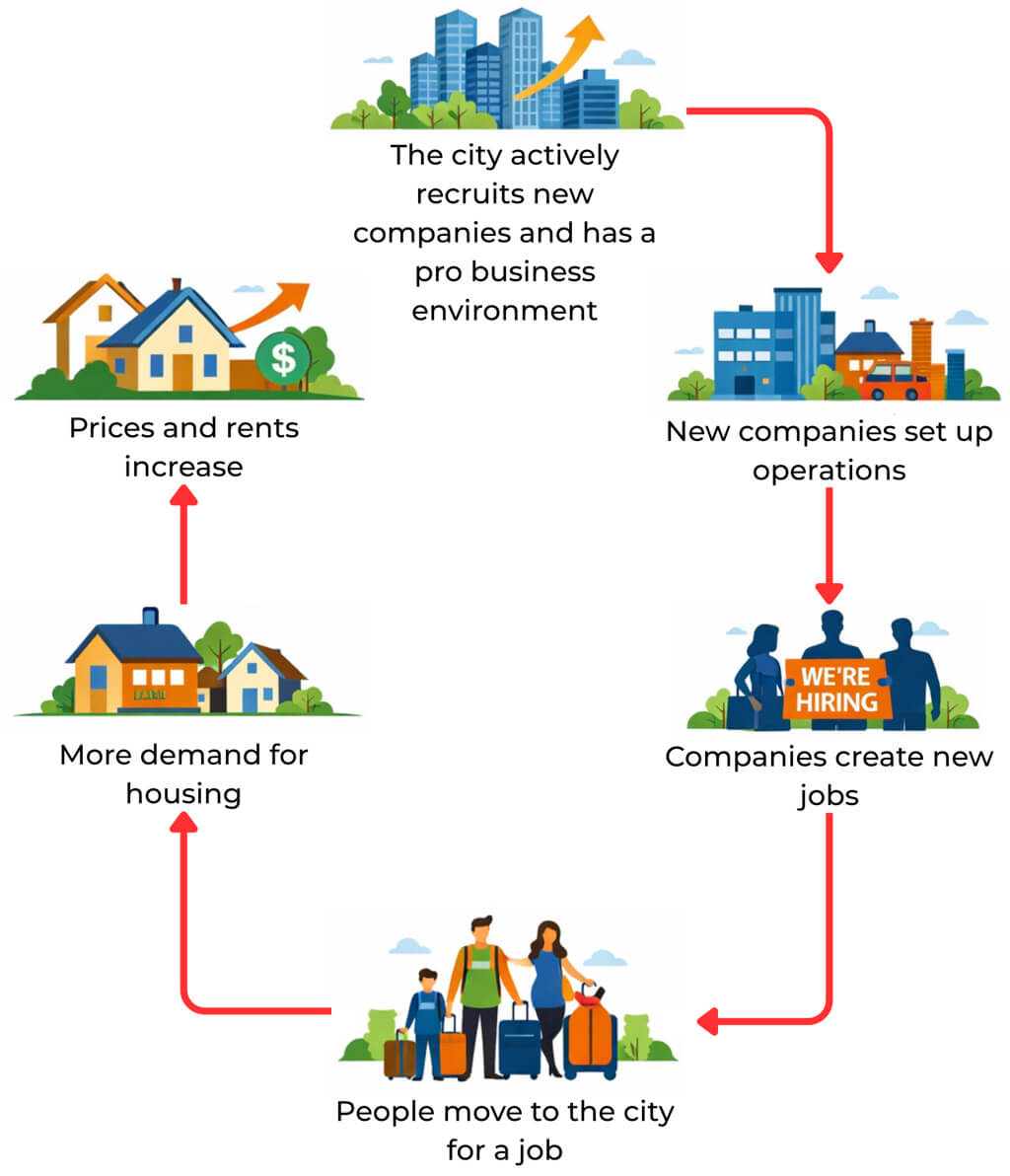
    Prices are determined by supply and demand. When demand exceeds supply, prices rise. When supply exceeds demand, prices fall. Population growth drives demand. As more people move into a city, demand increases and prices typically rise. When people leave a city, demand falls and prices decline.

    Rents follow prices. When home prices are high, fewer people can afford to buy, so more people rent. This drives up rents. When home prices are low, more people buy, reducing rental demand and pushing rents down. Rents and prices don't move simultaneously—in most cities, rents lag behind prices by two to five years.

    Below is an illustration of the flow from jobs to increased rents.

    So, whether these properties you mentioned are good investments depends on your goal.

    FERNWOOD Team, KW VIP Realty520 Reviews
Join the conversationCreate a free account to reply, vote on answers and follow this thread.