Two 1bed/1bath or one 3bed/2bath ?

Two 1bed/1bath or one 3bed/2bath ?

Member since 2022 · 19 posts · 5 votes

Hi,

I'm renovating a house, it's legally zoned for up to 4 units.

The current mix is:

ground+basement = 4bed/3bath + garden

2nd floor: 3bed/2bath

3rd floor: Two 1bed/1bath

I can change the third floor to be a 3bed/2bath or potentially 3bed/3bath and possibly give it roof access.

I estimate rents to be around 1300-1400 for a 1bed and 2200-2400 for a 3-bed but maybe vacancy will be lower / other considerations I should take into account?

There are two large universities, and I aim to target students / researchers and maybe families for the larger units

Thoughts?

3Reply
149 views

Most Popular Reply

Honolulu, HI · Member since 2008 · 3k+ posts · 2k+ votes
6mo

The last thing I want is to give any Tenants, let alone student Tenants, access to the roof. Liability is bad enough without it. You would need a very secure railing system, properly installed to all codes, and you will likely end up with either stored items or a night time noise issue for neighbors. 

Why do you want to change floorplan? What is the quality of current finish? Do you have laundry facilities in/on the property? Perhaps investigate a coin/card-op system to generate a little more income, from usage and additional convenience for existing Tenants.

Larger families is more wear, tear, and noise. How will that be for the Tenants directly below?

See this reply in the discussion

13 Replies

Jump to latestLatest
  • Member since 2026 · 11 posts · 4 votes
    6mo

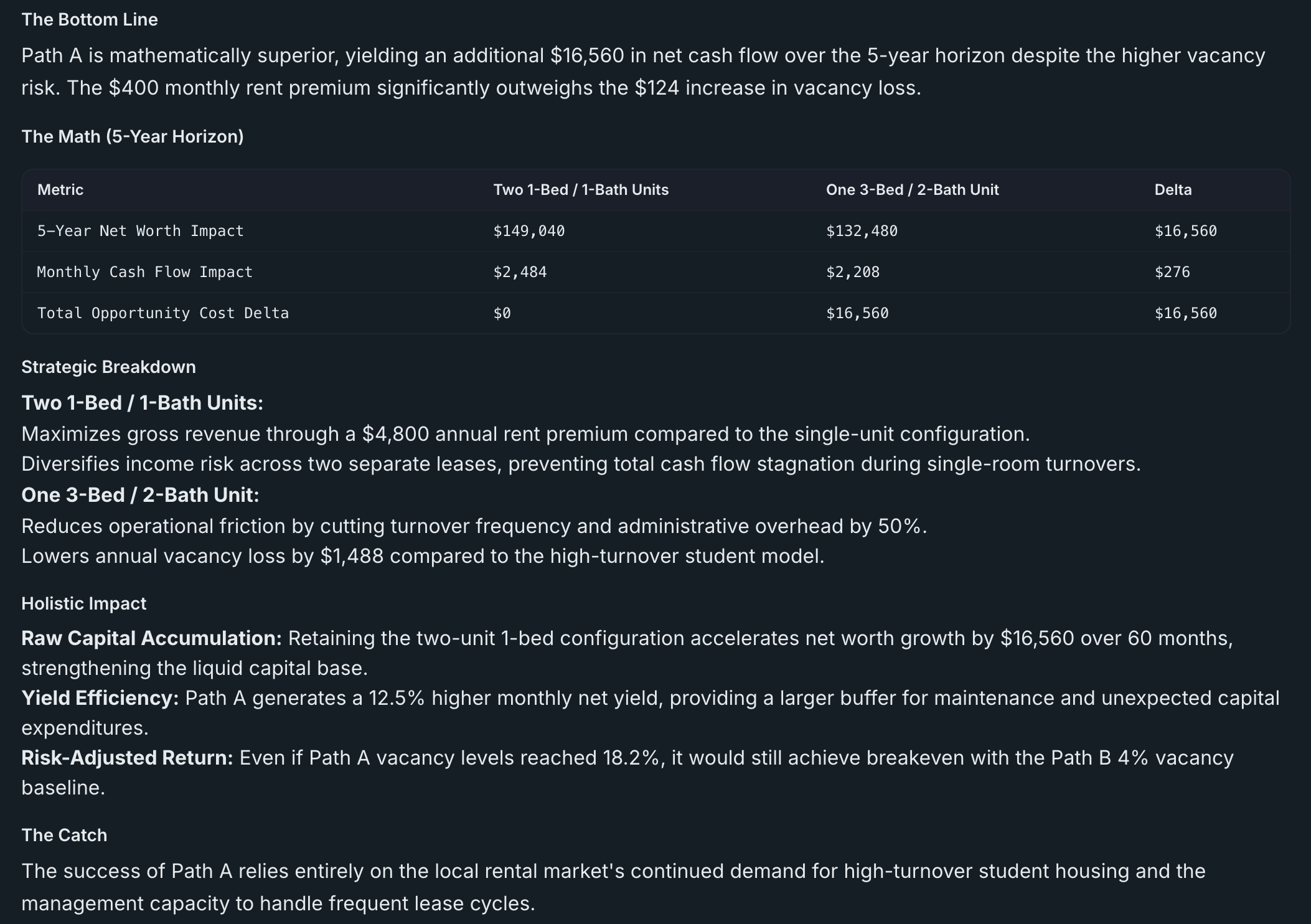
    Ron, this is a classic optimization problem. In university hubs, 1-beds almost always pull a massive premium per square foot because students will pay up for privacy to avoid roommates.

    I just ran your exact rent estimates through a custom financial modeling engine I built to see the 5-year cash flow delta between the two floor plans, factoring in vacancy risk.

    Option 1 (Keep the Two 1-Beds): Assuming an average of $1,350/mo per unit, you gross $2,700/mo. Even if you heavily penalize this option with an 8% vacancy rate for student turnover, you still clear roughly $29,800 a year in net cash flow.

    Option 2 (Convert to One 3-Bed): Assuming $2,300/mo, and giving it a much safer 4% vacancy rate (targeting families), you only clear about $26,400 a year.

    The math shows that converting to the 3-bed costs you roughly $3,300 a year in lost rent. Over a 5-year hold, you are giving up over $16,500 in pure cash flow. And that doesn't even factor in the massive construction costs you'd have to pay upfront to tear down walls and combine the units!

    Unless your city has strict zoning limits on the number of unrelated students per dwelling, keeping the two 1-beds is mathematically superior. I attached the 5-year cash flow comparison and AI risk analysis from the software below so you can see how the numbers stack up.

    • Member since 2022 · 19 posts · 5 votes
      6mo
      Quote from @Ian Howard:

      Ron, this is a classic optimization problem. In university hubs, 1-beds almost always pull a massive premium per square foot because students will pay up for privacy to avoid roommates.

      I just ran your exact rent estimates through a custom financial modeling engine I built to see the 5-year cash flow delta between the two floor plans, factoring in vacancy risk.

      Option 1 (Keep the Two 1-Beds): Assuming an average of $1,350/mo per unit, you gross $2,700/mo. Even if you heavily penalize this option with an 8% vacancy rate for student turnover, you still clear roughly $29,800 a year in net cash flow.

      Option 2 (Convert to One 3-Bed): Assuming $2,300/mo, and giving it a much safer 4% vacancy rate (targeting families), you only clear about $26,400 a year.

      The math shows that converting to the 3-bed costs you roughly $3,300 a year in lost rent. Over a 5-year hold, you are giving up over $16,500 in pure cash flow. And that doesn't even factor in the massive construction costs you'd have to pay upfront to tear down walls and combine the units!

      Unless your city has strict zoning limits on the number of unrelated students per dwelling, keeping the two 1-beds is mathematically superior. I attached the 5-year cash flow comparison and AI risk analysis from the software below so you can see how the numbers stack up.


      Hi Ian, thanks for the reply. I ran a similar analysis with the same underwriting as you. The other consideration I had was less financial (fewer headaches, same trusty tenant) and also potentially lower costs since I don't need to install two kitchens and two sets of appliances and washer/dryers etc so upfront costs are lower as well for potentially better cash-on-cash returns if I DSCR it.

    • Member since 2026 · 11 posts · 4 votes
      6mo
      Quote from @Ron S.:
      Quote from @Ian Howard:

      Ron, this is a classic optimization problem. In university hubs, 1-beds almost always pull a massive premium per square foot because students will pay up for privacy to avoid roommates.

      I just ran your exact rent estimates through a custom financial modeling engine I built to see the 5-year cash flow delta between the two floor plans, factoring in vacancy risk.

      Option 1 (Keep the Two 1-Beds): Assuming an average of $1,350/mo per unit, you gross $2,700/mo. Even if you heavily penalize this option with an 8% vacancy rate for student turnover, you still clear roughly $29,800 a year in net cash flow.

      Option 2 (Convert to One 3-Bed): Assuming $2,300/mo, and giving it a much safer 4% vacancy rate (targeting families), you only clear about $26,400 a year.

      The math shows that converting to the 3-bed costs you roughly $3,300 a year in lost rent. Over a 5-year hold, you are giving up over $16,500 in pure cash flow. And that doesn't even factor in the massive construction costs you'd have to pay upfront to tear down walls and combine the units!

      Unless your city has strict zoning limits on the number of unrelated students per dwelling, keeping the two 1-beds is mathematically superior. I attached the 5-year cash flow comparison and AI risk analysis from the software below so you can see how the numbers stack up.


      Hi Ian, thanks for the reply. I ran a similar analysis with the same underwriting as you. The other consideration I had was less financial (fewer headaches, same trusty tenant) and also potentially lower costs since I don't need to install two kitchens and two sets of appliances and washer/dryers etc so upfront costs are lower as well for potentially better cash-on-cash returns if I DSCR it.


      100% Ron, the upfront CapEx savings of skipping that second kitchen is a massive factor for your Cash-on-Cash return. Plus, you can't put a price tag on lower management headaches. It sounds like the 3-bed aligns perfectly with your goals. Keep us posted on how the project turns out!
  • Honolulu, HI · Member since 2008 · 3k+ posts · 2k+ votes
    6mo

    The last thing I want is to give any Tenants, let alone student Tenants, access to the roof. Liability is bad enough without it. You would need a very secure railing system, properly installed to all codes, and you will likely end up with either stored items or a night time noise issue for neighbors. 

    Why do you want to change floorplan? What is the quality of current finish? Do you have laundry facilities in/on the property? Perhaps investigate a coin/card-op system to generate a little more income, from usage and additional convenience for existing Tenants.

    Larger families is more wear, tear, and noise. How will that be for the Tenants directly below?

  • Investor · Member since 2023 · 73 posts · 32 votes
    6mo

    I'd just leave it as is. I think having a diversified property gives you more options and attracts more tenants. 

  • Mechanicsburg, PA · Member since 2013 · 3k+ posts · 2k+ votes
    6mo

    Some municipalities require fire escapes for third floor units.  I one where we did much work they third floor did not need a fire escape if it was NOT a separate unit, such as part of the second floor unit.  But require fire escapes if a separate unit was on the third floor.  Metal fire escapes add $20,000 or more , as obviously they have to be metal, durable and fire resistant. 

    • Member since 2022 · 19 posts · 5 votes
      6mo
      Quote from @David Krulac:

      Some municipalities require fire escapes for third floor units.  I one where we did much work they third floor did not need a fire escape if it was NOT a separate unit, such as part of the second floor unit.  But require fire escapes if a separate unit was on the third floor.  Metal fire escapes add $20,000 or more , as obviously they have to be metal, durable and fire resistant. 


       Thanks David, this is in Philly and the building will adhere to new fire safety standards, and will not require an external fire escape (but will require sprinklers)

  • Mechanicsburg, PA · Member since 2013 · 3k+ posts · 2k+ votes
    6mo

    @Ron S. Sprinklers are expensive also. One municipality also requires sprinklers in new single family houses.  In Philly do they require internal fire escapes? 

  • Colleen F.Pro Member
    Investor · Narragansett, RI · Member since 2013 · 8k+ posts · 4k+ votes
    6mo

    @Ron S.  Also two 1 bedrooms above the other units is probably a better fit noise wise especially if you are talking students.   Students who rent one bedrooms are more likely to be your more serious group such as grad students in my experience. And you may get your share of young professionals.

  • Real Estate Agent · Memphis · Member since 2026 · 546 posts · 316 votes
    6mo

    Good question — this is really a strategy decision more than a rent comparison.

    On paper, two 1-beds may slightly outperform:

    • 1-bed: $1,300–$1,400 × 2 = ~$2,600–$2,800
    • vs 3-bed: ~$2,200–$2,400

    But the bigger difference is operational:

    Two 1-beds:

    • More tenant turnover (especially with students)
    • More leasing, cleaning, and admin cycles
    • Vacancy risk is spread (one unit vacant ≠ zero income)

    One 3-bed:

    • Typically longer stays (families or stable groups)
    • Fewer turnovers and lower management load
    • Higher impact if vacant (100% vs partial)

    Since you’re near universities, 1-beds can be very liquid, but also more transient. A 3-bed can work well if you attract a stable group (grad students, researchers, small families).

    It usually comes down to what you want to optimize:

    • Max rent + flexibility → 1-beds
    • Stability + lower management intensity → 3-bed

    Also worth considering: utility setup, noise between units, and how easy each layout is to lease repeatedly — those operational details often matter more than the rent spread.

  • Drew SygitBusiness Member
    Property Manager · Royal Oak, MI · Member since 2012 · 12k+ posts · 9k+ votes
    6mo
    Quote from @Ron S.:

    Hi,

    I'm renovating a house, it's legally zoned for up to 4 units.

    The current mix is:

    ground+basement = 4bed/3bath + garden

    2nd floor: 3bed/2bath

    3rd floor: Two 1bed/1bath

    I can change the third floor to be a 3bed/2bath or potentially 3bed/3bath and possibly give it roof access.

    I estimate rents to be around 1300-1400 for a 1bed and 2200-2400 for a 3-bed but maybe vacancy will be lower / other considerations I should take into account?

    There are two large universities, and I aim to target students / researchers and maybe families for the larger units

    Thoughts?


    Massive party, drunk students, roof access, what could go wrong? 

  • Alan AsriantsBusiness Member
    Real Estate Agent · Philadelphia, PA · Member since 2019 · 1k+ posts · 1k+ votes
    6mo

    It really depends on the following:
    How much will that improvement increase your value on the rental and appreciation side? You mentioned it will give you close to 900/m for cash flow. If it costs less than 87k could be worth it. Will it increase your value by the same amount or will you create "sweat equity." this will depend on neighborhood 

    Is the money you put into that renovation going to give you a good return? 7-8 years or less I think is best.

    Does that improvement fit the local market or is it an "over improvement"?

    Does that renovation trigger sprinkler system upgrade - could be a huge expense when not working with a shell. 

    Happy to analyze this with you reach out anytime

    Alan Asriants - New Century Real Estate 590 Reviews
    View Page
  • Patrick O'SullivanBusiness Member
    Property Manager · Phoenix, AZ · Member since 2024 · 525 posts · 197 votes

    6mo

    @Ron S., it sounds like you’re weighing cash flow against simplicity, and both approaches have merit. Keeping the two 1-beds might bring in more rent, but the extra kitchens and turnover can add hassle, while a 3-bed is simpler to manage and could attract more stable tenants. I’d lean toward whatever aligns best with how hands-on you want to be long-term, and it sounds like the 3-bed could fit that goal nicely.

    get MULTIfamily Property Management4.7220 Reviews
Join the conversationCreate a free account to reply, vote on answers and follow this thread.