Indianapolis Real Estate Market
Member since 2025 · 12 posts · 5 votes
Hello everyone,
I'm currently researching Indianapolis market for a Buy & Hold investment strategy and would appreciate your insights .
I'm looking for areas where I can invest on properties in the ~$100,000 range. I'm particularly interested in neighborhoods with:
Strong potential for growth and development
Relatively low crime rates
Consistent demand from reliable tenants
If you're a local investor, agent, or property manager — or just know the area well — I’d be grateful to hear:
Which neighborhoods in Indianapolis would you recommend (or avoid) for long-term rentals?
Are there specific zip codes that are still undervalued but showing signs of growth?
Any red flags or important factors I should be aware of?
Thanks in advance for your help. Looking forward to learning from your experience.
Recommend you first figure out the property Class you want to invest in, THEN figure out the corresponding location/neighborhoods to invest in.
Why is Property Class so important for investors to understand and apply in their investing strategies?
Because the Property Class dictates the Class of the tenant pool that the property will attract.
The Tenant Class greatly impacts rental income stability and property maintenance/damage by tenants.
Both Property Class and Tenant Class affect what type of contractors, handymen and property management companies will work on a property.
If you buy & renovate a property in Class D area to Class A standards, what Tenant Class will rent it?
Or, if you put several Class D tenants in a Class A four-plex, what do you think will happen to the property?
So, if you fail to apply the correct assumptions to a property, your expectations won’t be met and it may even be a financial disaster.
We use the following to rank Property Classes, in order of importance:
Key metrics for each Property Class:
Class A Properties:
Tenant Pool: Majority of FICO scores 680+, no convictions/evictions in last 7 years.
Tenant Default: 0-5% probability of eviction or early lease termination.
Section 8: Class A rents are too high and won’t be approved.
Vacancies: 5-10%, depending on market conditions.
Cashflow vs Appreciation: Typically, 3-5 years for positive cashflow, but you get highest relative rent & value appreciation.
Class B Properties:
Tenant Pool: Majority of FICO scores 620-680, some blemishes, no convictions/evictions in last 5 years.
Tenant Default: 5-10% probability of eviction or early lease termination.
Vacancies: 10-15%, depending on market conditions.
Cashflow vs Appreciation: Typically, 1-3 years for positive cashflow, balanced amounts of relative rent & value appreciation.
Section 8: Class B rents are usually too high for the Section 8 program.
Class C Properties:
Tenant Pool: Majority of FICO scores 560-620, many blemishes, but should have no convictions/evictions in last 3 years. Verifying recent 2-years of rental history very important! Same for 2-years of job/income stability.
Tenant Default: 10-20% probability of eviction or early lease termination.
Section 8: Class C rents usually meet program requirements, proper screening still recommended.
Vacancies: 10-20%, depending on market conditions and tenant screening.
Cashflow vs Appreciation: Should cashflow immediately, at the lower end of relative rent & value appreciation.
Class D Properties:
Tenant Pool: Majority of FICO scores under 560, little to no good tradelines, lots of collections & chargeoffs, but should have no convictions/evictions in last 12 months. Verifying last 2-years of rental history and income/employment extremely important to find the “best of the worst”.
Tenant Default: 20-30% probability of eviction or early lease termination.
Section 8: Class D rents meet program requirements, often challenges to pass Section 8 inspection.
Vacancies: 20%+, depending on market conditions and tenant screening.
Cashflow vs Appreciation: Typically, all cashflow with little, maybe even negative, relative rent & value appreciation.
Where did we get our FICO credit score information from?
Check out this chart:
|
FICO Score |
Pct of Population |
Default Probability |
|
800 or more |
13.00% |
1.00% |
|
750-799 |
27.00% |
1.00% |
|
700-749 |
18.00% |
4.40% |
|
650-699 |
15.00% |
8.90% |
|
600-649 |
12.00% |
15.80% |
|
550-599 |
8.00% |
22.50% |
|
500-549 |
5.00% |
28.40% |
|
Less than 499 |
2.00% |
41.00% |
Make sure you understand the Class of properties you are looking at and the corresponding results to expect.
Metro Detroit has 132 cities, the City of Detroit 183 Neighborhoods, which we’re analyzing and classifying. Check out the map on our website where we’ve made this all easy to follow.
We can also share numerous examples of properties & portfolios we’ve assisted investors with!
DM us if you’d like to discuss this logical approach in greater detail!

Looking at Zillow today, if you search all of Indianapolis, there are only 74 houses that are selling for $100,000 or less. Eliminating the 1Bd houses, you are left with exactly 62 houses, and some of those are boarded up. My point is if you are looking for a $100,000 house with the qualifications your provided, you are looking for a needle in a haystack.
Searching for properties in the $100,000 to $200,000 range with at least 2BRs, gives you over 465 choices. Most are in the older parts of town, but not the ones that have had strong gentrification. Some have higher crime. While Indy is growing, predicting the growth of an older submarket would require block by block knowledge.
If I were buying today, I would look for at least a 3Bd 2Ba, in the price range of $200,000 to $300,000. Today, that would give you 712 choices many in growing submarkets with low crime and higher income.
PS. The roughest part of town is the East side, near 465. Post Road is notorious for being a scary place to be after dark.
Hi Greg,
First of all, thank you very much for taking the time to consider my post — I truly appreciate it!
I'm currently looking into investment opportunities and would really appreciate your insight on relevant areas in Indianapolis with relatively low crime rates, where the ARV is between $100K–$200K.
If you know of any neighborhoods that align with this, I'd be grateful for your recommendations.
Thanks again, and I look forward to hearing your thoughts.
In addition, to the area I marked, you describe it as the dark area of Indianapolis?
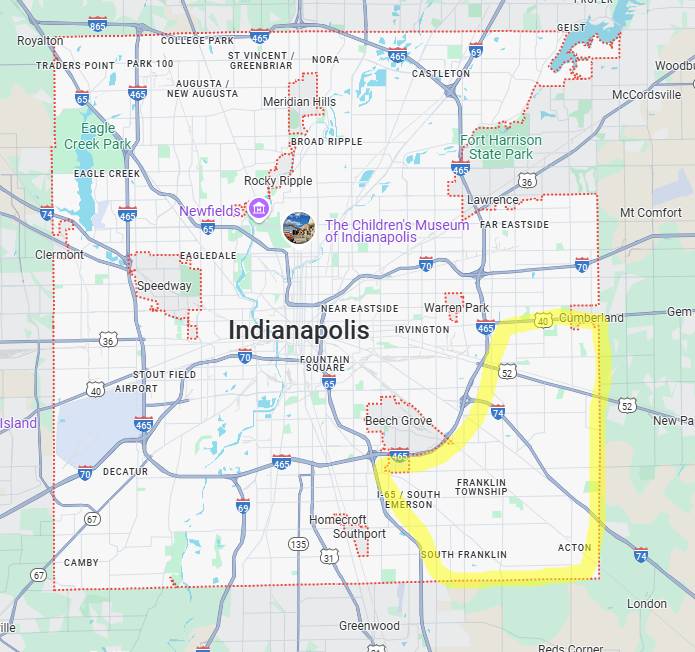
I know that part of Indy very well. In the map you provided, these are my thoughts:
- North of I-74, particularly near I-465, I would generally stay away from.
- That corner of Indianapolis is really on the fringe of the city. The East border is mostly rural. The South border they are building a lot of big-box warehouses and there are not many neighborhoods.
- South Emerson and South Franklin are fine.
- It seems somewhat arbitrary to select that corner. You might want to look at North Johnson County instead. That is not technically part of the City of Indy, but is in the metro. It has less crime and more growth and is more business friendly.
- Most of what you outlined is in Franklin Township. The Judge there is fairly landlord friendly but the court docket is packed so it takes about 45 days to get a court date. Beware of Lawrence Township in the NE corner. That judge has been so horribly anti-landlord that nobody takes an eviction to her court any more. Almost everybody takes their evictions to Superior court. It has gotten so bad that the City is, humorously, losing money in that Township because there are no court fees coming in. They have a proposal for the other courts to subsidize the courtroom of that judge now, since it is basically insolvent.
Are you actually researching the Indy market or just posting here to have others do the work for you?
Recommend you first figure out the property Class you want to invest in, THEN figure out the corresponding location/neighborhoods to invest in.
Why is Property Class so important for investors to understand and apply in their investing strategies?
Because the Property Class dictates the Class of the tenant pool that the property will attract.
The Tenant Class greatly impacts rental income stability and property maintenance/damage by tenants.
Both Property Class and Tenant Class affect what type of contractors, handymen and property management companies will work on a property.
If you buy & renovate a property in Class D area to Class A standards, what Tenant Class will rent it?
Or, if you put several Class D tenants in a Class A four-plex, what do you think will happen to the property?
So, if you fail to apply the correct assumptions to a property, your expectations won’t be met and it may even be a financial disaster.
We use the following to rank Property Classes, in order of importance:
Key metrics for each Property Class:
Class A Properties:
Tenant Pool: Majority of FICO scores 680+, no convictions/evictions in last 7 years.
Tenant Default: 0-5% probability of eviction or early lease termination.
Section 8: Class A rents are too high and won’t be approved.
Vacancies: 5-10%, depending on market conditions.
Cashflow vs Appreciation: Typically, 3-5 years for positive cashflow, but you get highest relative rent & value appreciation.
Class B Properties:
Tenant Pool: Majority of FICO scores 620-680, some blemishes, no convictions/evictions in last 5 years.
Tenant Default: 5-10% probability of eviction or early lease termination.
Vacancies: 10-15%, depending on market conditions.
Cashflow vs Appreciation: Typically, 1-3 years for positive cashflow, balanced amounts of relative rent & value appreciation.
Section 8: Class B rents are usually too high for the Section 8 program.
Class C Properties:
Tenant Pool: Majority of FICO scores 560-620, many blemishes, but should have no convictions/evictions in last 3 years. Verifying recent 2-years of rental history very important! Same for 2-years of job/income stability.
Tenant Default: 10-20% probability of eviction or early lease termination.
Section 8: Class C rents usually meet program requirements, proper screening still recommended.
Vacancies: 10-20%, depending on market conditions and tenant screening.
Cashflow vs Appreciation: Should cashflow immediately, at the lower end of relative rent & value appreciation.
Class D Properties:
Tenant Pool: Majority of FICO scores under 560, little to no good tradelines, lots of collections & chargeoffs, but should have no convictions/evictions in last 12 months. Verifying last 2-years of rental history and income/employment extremely important to find the “best of the worst”.
Tenant Default: 20-30% probability of eviction or early lease termination.
Section 8: Class D rents meet program requirements, often challenges to pass Section 8 inspection.
Vacancies: 20%+, depending on market conditions and tenant screening.
Cashflow vs Appreciation: Typically, all cashflow with little, maybe even negative, relative rent & value appreciation.
Where did we get our FICO credit score information from?
Check out this chart:
|
FICO Score |
Pct of Population |
Default Probability |
|
800 or more |
13.00% |
1.00% |
|
750-799 |
27.00% |
1.00% |
|
700-749 |
18.00% |
4.40% |
|
650-699 |
15.00% |
8.90% |
|
600-649 |
12.00% |
15.80% |
|
550-599 |
8.00% |
22.50% |
|
500-549 |
5.00% |
28.40% |
|
Less than 499 |
2.00% |
41.00% |
Make sure you understand the Class of properties you are looking at and the corresponding results to expect.
Metro Detroit has 132 cities, the City of Detroit 183 Neighborhoods, which we’re analyzing and classifying. Check out the map on our website where we’ve made this all easy to follow.
We can also share numerous examples of properties & portfolios we’ve assisted investors with!
DM us if you’d like to discuss this logical approach in greater detail!
Hello everyone,
I'm currently researching Indianapolis market for a Buy & Hold investment strategy and would appreciate your insights .
I'm looking for areas where I can invest on properties in the ~$100,000 range. I'm particularly interested in neighborhoods with:
Strong potential for growth and development
Relatively low crime rates
Consistent demand from reliable tenants
If you're a local investor, agent, or property manager — or just know the area well — I’d be grateful to hear:
Which neighborhoods in Indianapolis would you recommend (or avoid) for long-term rentals?
Are there specific zip codes that are still undervalued but showing signs of growth?
Any red flags or important factors I should be aware of?
Thanks in advance for your help. Looking forward to learning from your experience.
Just connect with an investor-friendly realtor, and they should be able to help you with recommendations for neighborhoods and the team you need to become successful.

Don't forget the surrounding areas like Anderson & Muncie. Prices are cheaper and seems to be a good area also.
Hey, great to see you're looking into Indy—it's still one of the more accessible markets for buy-and-hold, especially around that $100K range. You're asking the right questions.
There are definitely pockets here that offer solid rental demand and decent appreciation potential, but it really comes down to street-by-street analysis. Some areas might look good on paper but come with hidden risks like high turnover, crime spillover, or weak tenant pools.
Rather than listing zip codes here (which can change quickly), I’d recommend focusing on neighborhoods with stable working-class tenant bases, access to public transit or employers, and homes that are in decent condition or need only light value-add work.
I work closely with out-of-state investors doing exactly what you're trying to do, so I’m happy to share insights on what’s actually performing well right now, and what to watch out for.
