Policy finally push back on Hedge funds...
Jorge VazquezBusiness Member
Real Estate Broker · Tampa, FL · Member since 2017 · 1k+ posts · 684 votes
Graystone Investment Group4.6271 Reviews
We’ve worked directly with hedge funds before, and here’s the part most people never see. They don’t build healthy long-term relationships with contractors, agents, or local teams. Everyone gets squeezed. Pricing, timelines, fees. It works great for spreadsheets, not for neighborhoods or people.
That’s why seeing policy finally push back matters. Real housing stability comes from owners and buyers who actually live in the homes, not institutions chasing quarterly returns. I believe this brings supply and demand back into balance and creates a healthier market overall.
Will there be short-term pain? Absolutely. But long-term, this is how you rebuild a sustainable housing market. I say this from personal experience. I was one of the exclusive agents in Florida for Blackstone Invitation Homes, and I’ve seen exactly how these cycles start and how they end.
Curious to hear your thoughts.
Yeah. Screw landlords and renters. Get them back in to apartment buildings where they belong and out of owner occupant neighborhoods. Nobody should own more than 1, maybe 2 homes, MAX. We all know owner occupants are more important than renters. They are literally better people. Just like we know owner occupants take better care of homes than landlords. This will DEFINITELY have a HUGE impact on lowering home values. Who cares if we have to take away some people’s rights. They didn’t deserve them anyway. Plus. Like the federal income tax. This only affects the ultra wealthy, and it will never come back to bite the ordinary citizen.
Yeah. Screw landlords and renters. Get them back in to apartment buildings where they belong and out of owner occupant neighborhoods. Nobody should own more than 1, maybe 2 homes, MAX. We all know owner occupants are more important than renters. They are literally better people. Just like we know owner occupants take better care of homes than landlords. This will DEFINITELY have a HUGE impact on lowering home values. Who cares if we have to take away some people’s rights. They didn’t deserve them anyway. Plus. Like the federal income tax. This only affects the ultra wealthy, and it will never come back to bite the ordinary citizen.
Yeah. Screw landlords and renters. Get them back in to apartment buildings where they belong and out of owner occupant neighborhoods. Nobody should own more than 1, maybe 2 homes, MAX. We all know owner occupants are more important than renters. They are literally better people. Just like we know owner occupants take better care of homes than landlords. This will DEFINITELY have a HUGE impact on lowering home values. Who cares if we have to take away some people’s rights. They didn’t deserve them anyway. Plus. Like the federal income tax. This only affects the ultra wealthy, and it will never come back to bite the ordinary citizen.
@Bill B. Exactly. The last thing we need is more govt interference in what little is left of the free market. "Policy" is just a cover for some people wanting to enforce their ideological beliefs on others.
We’ve worked directly with hedge funds before, and here’s the part most people never see. They don’t build healthy long-term relationships with contractors, agents, or local teams. Everyone gets squeezed. Pricing, timelines, fees. It works great for spreadsheets, not for neighborhoods or people.
That’s why seeing policy finally push back matters. Real housing stability comes from owners and buyers who actually live in the homes, not institutions chasing quarterly returns. I believe this brings supply and demand back into balance and creates a healthier market overall.
Will there be short-term pain? Absolutely. But long-term, this is how you rebuild a sustainable housing market. I say this from personal experience. I was one of the exclusive agents in Florida for Blackstone Invitation Homes, and I’ve seen exactly how these cycles start and how they end.
Curious to hear your thoughts.
I’m not against large investors at all, but there should be some kind of cap. It took me a long time to land on that opinion. In the long run, a more balanced market matters more to a region than the short-term financial boost big money brings.
We’ve worked directly with hedge funds before, and here’s the part most people never see. They don’t build healthy long-term relationships with contractors, agents, or local teams. Everyone gets squeezed. Pricing, timelines, fees. It works great for spreadsheets, not for neighborhoods or people.
That’s why seeing policy finally push back matters. Real housing stability comes from owners and buyers who actually live in the homes, not institutions chasing quarterly returns. I believe this brings supply and demand back into balance and creates a healthier market overall.
Will there be short-term pain? Absolutely. But long-term, this is how you rebuild a sustainable housing market. I say this from personal experience. I was one of the exclusive agents in Florida for Blackstone Invitation Homes, and I’ve seen exactly how these cycles start and how they end.
Curious to hear your thoughts.
Look at statistics of how many single family homes are owned by large corporations. Institutional investors are currently selling more SFRs then they are buying (according to CNBC which is left leaning)
If investors were not buying homes in 2025 the market would tank. There is always this issue of not enough housing. I am curious how we were not building any homes in 2009-2012 but we went from housing crisis in 2007 to you couldnt give away a home during 2009-2012 when population continued to increase but housing units did not? The issue is not housing numbers it is housing affordability and the only people to blame that on is the govt since they are the ones printing all the $ and then make it impossible to get a permit. But lets blame institutions who own less than 3% of all SFR

Quote from @Chris Seveney:
We’ve worked directly with hedge funds before, and here’s the part most people never see. They don’t build healthy long-term relationships with contractors, agents, or local teams. Everyone gets squeezed. Pricing, timelines, fees. It works great for spreadsheets, not for neighborhoods or people.
That’s why seeing policy finally push back matters. Real housing stability comes from owners and buyers who actually live in the homes, not institutions chasing quarterly returns. I believe this brings supply and demand back into balance and creates a healthier market overall.
Will there be short-term pain? Absolutely. But long-term, this is how you rebuild a sustainable housing market. I say this from personal experience. I was one of the exclusive agents in Florida for Blackstone Invitation Homes, and I’ve seen exactly how these cycles start and how they end.
Curious to hear your thoughts.
Look at statistics of how many single family homes are owned by large corporations. Institutional investors are currently selling more SFRs then they are buying (according to CNBC which is left leaning)
If investors were not buying homes in 2025 the market would tank. There is always this issue of not enough housing. I am curious how we were not building any homes in 2009-2012 but we went from housing crisis in 2007 to you couldnt give away a home during 2009-2012 when population continued to increase but housing units did not? The issue is not housing numbers it is housing affordability and the only people to blame that on is the govt since they are the ones printing all the $ and then make it impossible to get a permit. But lets blame institutions who own less than 3% of all SFR
I actually agree with you on the mechanism, just not the conclusion. You’re right that if investors weren’t buying homes in 2025, the market would tank. That’s exactly the problem I’m pointing at. When a market can’t stand on its own without a specific buyer class propping it up, that’s not organic supply and demand anymore. That’s dependence.
I’ve been in this business since 2005 and I work with institutions, vendors, and builders. I’m not anti-investor and I’m not saying large players should disappear. But hedge funds are different. Their priority is always the shareholder. Period. They don’t build culture, karma, or long-term win-win relationships with agents, wholesalers, builders, or contractors.
I know this firsthand. I’ve been a vendor with them and an agent with them. The moment they find a way to squeeze you, they do. Commissions get cut. Margins shrink. Loyalty vanishes.
That leads to my two core issues. First, they have too much power to delay or prevent natural market corrections, which keeps prices artificially high and stops the market from resetting organically. Second, they don’t create lasting or shared wealth in the housing ecosystem. When profits dry up, they exit. They don’t stay to stabilize neighborhoods or support partners. They leave, and everything around them is left in chaos.
Builders, agents, and contractors stay. Hedge funds extract and move on. That’s the difference.
We’ve worked directly with hedge funds before, and here’s the part most people never see. They don’t build healthy long-term relationships with contractors, agents, or local teams. Everyone gets squeezed. Pricing, timelines, fees. It works great for spreadsheets, not for neighborhoods or people.
That’s why seeing policy finally push back matters. Real housing stability comes from owners and buyers who actually live in the homes, not institutions chasing quarterly returns. I believe this brings supply and demand back into balance and creates a healthier market overall.
Will there be short-term pain? Absolutely. But long-term, this is how you rebuild a sustainable housing market. I say this from personal experience. I was one of the exclusive agents in Florida for Blackstone Invitation Homes, and I’ve seen exactly how these cycles start and how they end.
Curious to hear your thoughts.
Look at statistics of how many single family homes are owned by large corporations. Institutional investors are currently selling more SFRs then they are buying (according to CNBC which is left leaning)
If investors were not buying homes in 2025 the market would tank. There is always this issue of not enough housing. I am curious how we were not building any homes in 2009-2012 but we went from housing crisis in 2007 to you couldnt give away a home during 2009-2012 when population continued to increase but housing units did not? The issue is not housing numbers it is housing affordability and the only people to blame that on is the govt since they are the ones printing all the $ and then make it impossible to get a permit. But lets blame institutions who own less than 3% of all SFR
I actually agree with you on the mechanism, just not the conclusion. You’re right that if investors weren’t buying homes in 2025, the market would tank. That’s exactly the problem I’m pointing at. When a market can’t stand on its own without a specific buyer class propping it up, that’s not organic supply and demand anymore. That’s dependence.
I’ve been in this business since 2005 and I work with institutions, vendors, and builders. I’m not anti-investor and I’m not saying large players should disappear. But hedge funds are different. Their priority is always the shareholder. Period. They don’t build culture, karma, or long-term win-win relationships with agents, wholesalers, builders, or contractors.
I know this firsthand. I’ve been a lender with them and an agent with them. The moment they find a way to squeeze you, they do. Commissions get cut. Margins shrink. Loyalty vanishes.
That leads to my two core issues. First, they have too much power to delay or prevent natural market corrections, which keeps prices artificially high and stops the market from resetting organically. Second, they don’t create lasting or shared wealth in the housing ecosystem. When profits dry up, they exit. They don’t stay to stabilize neighborhoods or support partners. They leave, and everything around them is left in chaos.
Builders, agents, and contractors stay. Hedge funds extract and move on. That’s the difference.
I would be interested to see the data where an institution bought single family homes in a neighborhood and left and it left chaos or it caused prices to artifically inflate?
There is of course "some neighborhood" but this is not a rampant issue which is my point. To me its a joke to blame anything to do with housing on institutions. its basically the only thing we cannot blame on institutions which you can easily blame most other industries on
We’ve worked directly with hedge funds before, and here’s the part most people never see. They don’t build healthy long-term relationships with contractors, agents, or local teams. Everyone gets squeezed. Pricing, timelines, fees. It works great for spreadsheets, not for neighborhoods or people.
That’s why seeing policy finally push back matters. Real housing stability comes from owners and buyers who actually live in the homes, not institutions chasing quarterly returns. I believe this brings supply and demand back into balance and creates a healthier market overall.
Will there be short-term pain? Absolutely. But long-term, this is how you rebuild a sustainable housing market. I say this from personal experience. I was one of the exclusive agents in Florida for Blackstone Invitation Homes, and I’ve seen exactly how these cycles start and how they end.
Curious to hear your thoughts.
Look at statistics of how many single family homes are owned by large corporations. Institutional investors are currently selling more SFRs then they are buying (according to CNBC which is left leaning)
If investors were not buying homes in 2025 the market would tank. There is always this issue of not enough housing. I am curious how we were not building any homes in 2009-2012 but we went from housing crisis in 2007 to you couldnt give away a home during 2009-2012 when population continued to increase but housing units did not? The issue is not housing numbers it is housing affordability and the only people to blame that on is the govt since they are the ones printing all the $ and then make it impossible to get a permit. But lets blame institutions who own less than 3% of all SFR
I actually agree with you on the mechanism, just not the conclusion. You’re right that if investors weren’t buying homes in 2025, the market would tank. That’s exactly the problem I’m pointing at. When a market can’t stand on its own without a specific buyer class propping it up, that’s not organic supply and demand anymore. That’s dependence.
I’ve been in this business since 2005 and I work with institutions, vendors, and builders. I’m not anti-investor and I’m not saying large players should disappear. But hedge funds are different. Their priority is always the shareholder. Period. They don’t build culture, karma, or long-term win-win relationships with agents, wholesalers, builders, or contractors.
I know this firsthand. I’ve been a lender with them and an agent with them. The moment they find a way to squeeze you, they do. Commissions get cut. Margins shrink. Loyalty vanishes.
That leads to my two core issues. First, they have too much power to delay or prevent natural market corrections, which keeps prices artificially high and stops the market from resetting organically. Second, they don’t create lasting or shared wealth in the housing ecosystem. When profits dry up, they exit. They don’t stay to stabilize neighborhoods or support partners. They leave, and everything around them is left in chaos.
Builders, agents, and contractors stay. Hedge funds extract and move on. That’s the difference.
I would be interested to see the data where an institution bought single family homes in a neighborhood and left and it left chaos or it caused prices to artifically inflate?
There is of course "some neighborhood" but this is not a rampant issue which is my point. To me its a joke to blame anything to do with housing on institutions. its basically the only thing we cannot blame on institutions which you can easily blame most other industries on
Chris, I probably see this differently because I’ve actually worked with institutions like Blackstone. Funny enough, that’s even where the name Graystone came from. I’ve been in their meetings, I’ve seen how they think, and trust me, they’re not there for the city or the neighborhood. They’re there for the spreadsheet. I watched them go into places like Seminole Heights, buy in size, push prices up fast, and create what looked like growth, but it was artificial. A lot of smaller investors who bought after that run-up got burned once the momentum slowed. There isn’t clean data on the long-term damage yet because this cycle hasn’t fully played out, and that’s exactly my point. When one player gets that much influence, the pain always shows up later. I get that the easiest position for anyone pro-capitalism is to say “let the market work,” but ask yourself why even Trump is talking about this. When you have monopoly-like power, you don’t have a fair market. And if panic hits during a real correction, it won’t look like 2008, it could be worse. These groups can exit fast, take the smallest loss, and leave everyone else paying for the risk they created. That’s the line I don’t want to cross.
We’ve worked directly with hedge funds before, and here’s the part most people never see. They don’t build healthy long-term relationships with contractors, agents, or local teams. Everyone gets squeezed. Pricing, timelines, fees. It works great for spreadsheets, not for neighborhoods or people.
That’s why seeing policy finally push back matters. Real housing stability comes from owners and buyers who actually live in the homes, not institutions chasing quarterly returns. I believe this brings supply and demand back into balance and creates a healthier market overall.
Will there be short-term pain? Absolutely. But long-term, this is how you rebuild a sustainable housing market. I say this from personal experience. I was one of the exclusive agents in Florida for Blackstone Invitation Homes, and I’ve seen exactly how these cycles start and how they end.
Curious to hear your thoughts.
Look at statistics of how many single family homes are owned by large corporations. Institutional investors are currently selling more SFRs then they are buying (according to CNBC which is left leaning)
If investors were not buying homes in 2025 the market would tank. There is always this issue of not enough housing. I am curious how we were not building any homes in 2009-2012 but we went from housing crisis in 2007 to you couldnt give away a home during 2009-2012 when population continued to increase but housing units did not? The issue is not housing numbers it is housing affordability and the only people to blame that on is the govt since they are the ones printing all the $ and then make it impossible to get a permit. But lets blame institutions who own less than 3% of all SFR
I actually agree with you on the mechanism, just not the conclusion. You’re right that if investors weren’t buying homes in 2025, the market would tank. That’s exactly the problem I’m pointing at. When a market can’t stand on its own without a specific buyer class propping it up, that’s not organic supply and demand anymore. That’s dependence.
I’ve been in this business since 2005 and I work with institutions, vendors, and builders. I’m not anti-investor and I’m not saying large players should disappear. But hedge funds are different. Their priority is always the shareholder. Period. They don’t build culture, karma, or long-term win-win relationships with agents, wholesalers, builders, or contractors.
I know this firsthand. I’ve been a lender with them and an agent with them. The moment they find a way to squeeze you, they do. Commissions get cut. Margins shrink. Loyalty vanishes.
That leads to my two core issues. First, they have too much power to delay or prevent natural market corrections, which keeps prices artificially high and stops the market from resetting organically. Second, they don’t create lasting or shared wealth in the housing ecosystem. When profits dry up, they exit. They don’t stay to stabilize neighborhoods or support partners. They leave, and everything around them is left in chaos.
Builders, agents, and contractors stay. Hedge funds extract and move on. That’s the difference.
I would be interested to see the data where an institution bought single family homes in a neighborhood and left and it left chaos or it caused prices to artifically inflate?
There is of course "some neighborhood" but this is not a rampant issue which is my point. To me its a joke to blame anything to do with housing on institutions. its basically the only thing we cannot blame on institutions which you can easily blame most other industries on
Theme of the 2020's: "It's so-n-so's fault...."
Quote from @Chris Seveney:
We’ve worked directly with hedge funds before, and here’s the part most people never see. They don’t build healthy long-term relationships with contractors, agents, or local teams. Everyone gets squeezed. Pricing, timelines, fees. It works great for spreadsheets, not for neighborhoods or people.
That’s why seeing policy finally push back matters. Real housing stability comes from owners and buyers who actually live in the homes, not institutions chasing quarterly returns. I believe this brings supply and demand back into balance and creates a healthier market overall.
Will there be short-term pain? Absolutely. But long-term, this is how you rebuild a sustainable housing market. I say this from personal experience. I was one of the exclusive agents in Florida for Blackstone Invitation Homes, and I’ve seen exactly how these cycles start and how they end.
Curious to hear your thoughts.
Look at statistics of how many single family homes are owned by large corporations. Institutional investors are currently selling more SFRs then they are buying (according to CNBC which is left leaning)
If investors were not buying homes in 2025 the market would tank. There is always this issue of not enough housing. I am curious how we were not building any homes in 2009-2012 but we went from housing crisis in 2007 to you couldnt give away a home during 2009-2012 when population continued to increase but housing units did not? The issue is not housing numbers it is housing affordability and the only people to blame that on is the govt since they are the ones printing all the $ and then make it impossible to get a permit. But lets blame institutions who own less than 3% of all SFR
I actually agree with you on the mechanism, just not the conclusion. You’re right that if investors weren’t buying homes in 2025, the market would tank. That’s exactly the problem I’m pointing at. When a market can’t stand on its own without a specific buyer class propping it up, that’s not organic supply and demand anymore. That’s dependence.
I’ve been in this business since 2005 and I work with institutions, vendors, and builders. I’m not anti-investor and I’m not saying large players should disappear. But hedge funds are different. Their priority is always the shareholder. Period. They don’t build culture, karma, or long-term win-win relationships with agents, wholesalers, builders, or contractors.
I know this firsthand. I’ve been a vendor with them and an agent with them. The moment they find a way to squeeze you, they do. Commissions get cut. Margins shrink. Loyalty vanishes.
That leads to my two core issues. First, they have too much power to delay or prevent natural market corrections, which keeps prices artificially high and stops the market from resetting organically. Second, they don’t create lasting or shared wealth in the housing ecosystem. When profits dry up, they exit. They don’t stay to stabilize neighborhoods or support partners. They leave, and everything around them is left in chaos.
Builders, agents, and contractors stay. Hedge funds extract and move on. That’s the difference.
>hedge funds are different. Their priority is always the shareholder. Period. They don’t build culture, karma, or long-term win-win relationships with agents, wholesalers, builders, or contractors
What I see here is you are against free market and capitalism. Any publicly traded business should have their shareholders as a business. I will go further that if they do not, they can be held legally accountable for not acting in best interest of the shareholders holders.
Monopoly: as long as there is competition there is not a monopoly. Every stat I have seen on the subject shows small time rental operators have a share many times larger than the various large industrial residential rental holders. This alone implies there is no monopoly. There are other reasons that monopoly tests fail, but if it fails the primary test there is no need to look further.
My question is have you been to a communist country? If so which one, when, and what were your thoughts?
In general, I believe the most efficient market is a free market driven by competition. I see undesired side effects in virtually every government meddling in the free market. Example, do you believe homes would be as high priced if the interest was not a write off? Same for 2/5 gains rule or re-baseline of value at death? Who do these policies favor? My view is existing RE owners (mostly OO owners). Extreme rent control leads to blight and empty units.
In addition any proposal to limit large scale industrial ownership is trivial to circumvent by simply creating a new business entity. In most states it is cheap to create a business entity. Instead of one entity owning 1000, 2 own 500. How can that be prevented at that is obvious work around. I suspect there are dozens of ways to by pass this silly, unenforceable, likely illegal proposal
In addition, I have zero confidence that the proposal if it could be implemented and enforced would not have unexpected, undesired consequences.
Best wishes
Quote from @Chris Seveney:
We’ve worked directly with hedge funds before, and here’s the part most people never see. They don’t build healthy long-term relationships with contractors, agents, or local teams. Everyone gets squeezed. Pricing, timelines, fees. It works great for spreadsheets, not for neighborhoods or people.
That’s why seeing policy finally push back matters. Real housing stability comes from owners and buyers who actually live in the homes, not institutions chasing quarterly returns. I believe this brings supply and demand back into balance and creates a healthier market overall.
Will there be short-term pain? Absolutely. But long-term, this is how you rebuild a sustainable housing market. I say this from personal experience. I was one of the exclusive agents in Florida for Blackstone Invitation Homes, and I’ve seen exactly how these cycles start and how they end.
Curious to hear your thoughts.
Look at statistics of how many single family homes are owned by large corporations. Institutional investors are currently selling more SFRs then they are buying (according to CNBC which is left leaning)
If investors were not buying homes in 2025 the market would tank. There is always this issue of not enough housing. I am curious how we were not building any homes in 2009-2012 but we went from housing crisis in 2007 to you couldnt give away a home during 2009-2012 when population continued to increase but housing units did not? The issue is not housing numbers it is housing affordability and the only people to blame that on is the govt since they are the ones printing all the $ and then make it impossible to get a permit. But lets blame institutions who own less than 3% of all SFR
I actually agree with you on the mechanism, just not the conclusion. You’re right that if investors weren’t buying homes in 2025, the market would tank. That’s exactly the problem I’m pointing at. When a market can’t stand on its own without a specific buyer class propping it up, that’s not organic supply and demand anymore. That’s dependence.
I’ve been in this business since 2005 and I work with institutions, vendors, and builders. I’m not anti-investor and I’m not saying large players should disappear. But hedge funds are different. Their priority is always the shareholder. Period. They don’t build culture, karma, or long-term win-win relationships with agents, wholesalers, builders, or contractors.
I know this firsthand. I’ve been a vendor with them and an agent with them. The moment they find a way to squeeze you, they do. Commissions get cut. Margins shrink. Loyalty vanishes.
That leads to my two core issues. First, they have too much power to delay or prevent natural market corrections, which keeps prices artificially high and stops the market from resetting organically. Second, they don’t create lasting or shared wealth in the housing ecosystem. When profits dry up, they exit. They don’t stay to stabilize neighborhoods or support partners. They leave, and everything around them is left in chaos.
Builders, agents, and contractors stay. Hedge funds extract and move on. That’s the difference.
>hedge funds are different. Their priority is always the shareholder. Period. They don’t build culture, karma, or long-term win-win relationships with agents, wholesalers, builders, or contractors
What I see here is you are against free market and capitalism. Any publicly traded business should have their shareholders as a business. I will go further that if they do not, they can be held legally accountable for not acting in best interest of the shareholders holders.
Monopoly: as long as there is competition there is not a monopoly. Every stat I have seen on the subject shows small time rental operators have a share many times larger than the various large industrial residential rental holders. This alone implies there is no monopoly. There are other reasons that monopoly tests fail, but if it fails the primary test there is no need to look further.
My question is have you been to a communist country? If so which one, when, and what were your thoughts?
In general, I believe the most efficient market is a free market driven by competition. I see undesired side effects in virtually every government meddling in the free market. Example, do you believe homes would be as high priced if the interest was not a write off? Same for 2/5 gains rule or re-baseline of value at death? Who do these policies favor? My view is existing RE owners (mostly OO owners). Extreme rent control leads to blight and empty units.
In addition any proposal to limit large scale industrial ownership is trivial to circumvent by simply creating a new business entity. In most states it is cheap to create a business entity. Instead of one entity owning 1000, 2 own 500. How can that be prevented at that is obvious work around. I suspect there are dozens of ways to by pass this silly, unenforceable, likely illegal proposal
In addition, I have zero confidence that the proposal if it could be implemented and enforced would not have unexpected, undesired consequences.
Best wishes
I’m pro-capitalism. It took me 20 years to get here. I own 40 properties, manage about 300, and lead a team of 80 people. So pointing out flaws in the system doesn’t mean someone wants communism. That label is just lazy thinking. You can believe in free markets and still call out distortions when they show up. I agree investors matter, and the large players were opportunistic I don’t blame them for that. But part of why prices didn’t correct more was the buy-everything approach at scale. In Tampa alone, Invitation Homes reportedly owned around 7,989 homes, not even counting other institutional players, and that kind of concentration absolutely affects how fast a market can reset. So here’s the real question. If we had a collapse like 2007, which I lived through, don’t they have the power in Tampa alone to slash prices, absorb the losses, and move on? How is that any different than a bank dumping a pile of non-performing notes into one city? And if a major collapse happens, what do you think that level of concentrated ownership does to pricing, neighborhoods, and everyone else in the ecosystem? Just entertain it hypothetically.
Going to sleep now! lol but enjoyed the debate!
The question is how will they draw the line of institutional investor that is prohibited from buying the houses ? Still vast amount over 90% of SFH rentals are owned by mom and pops with less then 100 homes. Funds are just pools of capital organized as limited partnerships.
The question is how will they draw the line of institutional investor that is prohibited from buying the houses ? Still vast amount over 90% of SFH rentals are owned by mom and pops with less then 100 homes. Funds are just pools of capital organized as limited partnerships.
That’s a fair question, and honestly this is where it gets messy. I struggle with it too. Drawing a clean line around “institutional investor” isn’t simple, because most funds are just pools of capital set up as limited partnerships. Meanwhile, over 90 percent of single-family rentals are still owned by mom-and-pop investors with under 100 homes, so lumping everyone together doesn’t make sense. If a line ever gets drawn, it probably wouldn’t be about who you are, but how much control you have. Things like market share in a city, zip code concentration, or whether one group can actually move prices by itself. Another angle is community impact. Small investors recycle money locally. We hire contractors, handymen, property managers, landscapers. That’s real jobs and real wealth staying on Main Street. With large funds, a lot of that value gets extracted and sent elsewhere. So yeah, it’s a tough one. I don’t think the answer is banning “institutions” outright. The real concern is concentration and behavior, not structure. When ownership gets so concentrated that it distorts prices or creates systemic risk, that’s when it stops looking like a free market and starts looking like something else entirely.
The #1 central fundamental to all this, that everyone likes to obfuscate or ignore is; Are we a Free Market Economy or not?
If we ARE a free market economy, and you believe that WORKS.... And if you believe home prices are UP because i-buyers bought up "all the inventory"..... Wouldn't a working free market economy MEET THAT DEMAND via producing more? And thus, problem solved.
OR..... Are you saying supply CAN'T meet demand?
Ok, so then you lay fault of inability to create supply at feet of those who did buy?
Stating in the most passive agressive way: if we just TAKE IT FROM "them", then it will all be better.....
Or are you arguing the free market economy is broken and not working?
See, any which way you dice it things always come back to source of problems is at feet of big Gov and not any 1 player in the economy.
If inability to add supply, it's fault of the things making such blocks.
If inability to affordability, again, what is the root cause not blaming those who can afford.
The entire ethos of "Blame The Rich" is a Marxist one. Please, name me just 1 nation that Marxist actions have ever worked out and benefited "We The People", just 1.....
Marxism has never, and never will work out for good ends for the people because Marxism is Modern-Monarchy via Political instead of heretical chain (meaning party member vs descendant of".
Centralization of power always has, and always will, result in corruption, abuse, misuse, and a lessor life for the masses.
The answer should be obvious; decentralization.
Decentralization = more power to main street. This is central ethos to the free market economy. If there is an inefficiency int he economy that inefficiency or need will equally create opportunity for persons to emerge to meet the demand, create efficiency.
The answer is NOT more control, it's eliminating roadblocks.
Redaction, not addition.
Addition, by any number, never results in a LOWER end number, EVER.
You want more housing supply, lower cost of housing, the how-to is not some mystery, it's via subtraction. And letting the free market economy do what it does.
You do not need to regulate people out of the economy, that's literally empowering the problem. You simply need to remove the blockades to competitors.
All of this is simply the ongoing debate of the day in USA which is a Marxist Communist sentiment vs a Libertarian Democratic one.
Because our education was abysmal, and usurped. Communism has the best tag-lines and elevator pitch, it really does. Democracy not so great with it's self-accountability and self-reliance. But TRUTH is everything you like, love and rely upon has been brought to you via Democracy NOT communist anything.
Stop thinking that just a touch of Marxism here, a dash of "take from the ___" will be good. It won't. An ounce of poison is still poison.
The #1 central fundamental to all this, that everyone likes to obfuscate or ignore is; Are we a Free Market Economy or not?
If we ARE a free market economy, and you believe that WORKS.... And if you believe home prices are UP because i-buyers bought up "all the inventory"..... Wouldn't a working free market economy MEET THAT DEMAND via producing more? And thus, problem solved.
OR..... Are you saying supply CAN'T meet demand?
Ok, so then you lay fault of inability to create supply at feet of those who did buy?
Stating in the most passive agressive way: if we just TAKE IT FROM "them", then it will all be better.....
Or are you arguing the free market economy is broken and not working?
See, any which way you dice it things always come back to source of problems is at feet of big Gov and not any 1 player in the economy.
If inability to add supply, it's fault of the things making such blocks.
If inability to affordability, again, what is the root cause not blaming those who can afford.
The entire ethos of "Blame The Rich" is a Marxist one. Please, name me just 1 nation that Marxist actions have ever worked out and benefited "We The People", just 1.....
Marxism has never, and never will work out for good ends for the people because Marxism is Modern-Monarchy via Political instead of heretical chain (meaning party member vs descendant of".
Centralization of power always has, and always will, result in corruption, abuse, misuse, and a lessor life for the masses.
The answer should be obvious; decentralization.
Decentralization = more power to main street. This is central ethos to the free market economy. If there is an inefficiency int he economy that inefficiency or need will equally create opportunity for persons to emerge to meet the demand, create efficiency.
The answer is NOT more control, it's eliminating roadblocks.
Redaction, not addition.
Addition, by any number, never results in a LOWER end number, EVER.
You want more housing supply, lower cost of housing, the how-to is not some mystery, it's via subtraction. And letting the free market economy do what it does.
You do not need to regulate people out of the economy, that's literally empowering the problem. You simply need to remove the blockades to competitors.
All of this is simply the ongoing debate of the day in USA which is a Marxist Communist sentiment vs a Libertarian Democratic one.
Because our education was abysmal, and usurped. Communism has the best tag-lines and elevator pitch, it really does. Democracy not so great with it's self-accountability and self-reliance. But TRUTH is everything you like, love and rely upon has been brought to you via Democracy NOT communist anything.
Stop thinking that just a touch of Marxism here, a dash of "take from the ___" will be good. It won't. An ounce of poison is still poison.
I get it, and I’m actually with you more than it might sound. Being pro free market doesn’t mean being pro monopoly. A free market only works when there’s real competition. The moment one hedge fund could theoretically buy all of Tampa, that’s not “winning,” that’s market distortion. That’s not capitalism doing its thing, that’s power piling up in one corner.
And you’re right about incentives. They don’t care about neighborhoods, tenants, or long-term stability. They care about shareholders. Period. When the market is up, they’re geniuses. When the market corrects, because it always does, they panic, dump inventory, and suddenly we’re having the same conversation we had in 2008. And then what? Bailouts? Again? That’s not a free market either. That’s profits kept private and losses handed to everyone else.
So the real position isn’t anti investor or anti success. It’s anti concentration. Free markets break when too much power gets centralized. Competition keeps prices honest. Monopolies wreck the game.
The #1 central fundamental to all this, that everyone likes to obfuscate or ignore is; Are we a Free Market Economy or not?
If we ARE a free market economy, and you believe that WORKS.... And if you believe home prices are UP because i-buyers bought up "all the inventory"..... Wouldn't a working free market economy MEET THAT DEMAND via producing more? And thus, problem solved.
OR..... Are you saying supply CAN'T meet demand?
Ok, so then you lay fault of inability to create supply at feet of those who did buy?
Stating in the most passive agressive way: if we just TAKE IT FROM "them", then it will all be better.....
Or are you arguing the free market economy is broken and not working?
See, any which way you dice it things always come back to source of problems is at feet of big Gov and not any 1 player in the economy.
If inability to add supply, it's fault of the things making such blocks.
If inability to affordability, again, what is the root cause not blaming those who can afford.
The entire ethos of "Blame The Rich" is a Marxist one. Please, name me just 1 nation that Marxist actions have ever worked out and benefited "We The People", just 1.....
Marxism has never, and never will work out for good ends for the people because Marxism is Modern-Monarchy via Political instead of heretical chain (meaning party member vs descendant of".
Centralization of power always has, and always will, result in corruption, abuse, misuse, and a lessor life for the masses.
The answer should be obvious; decentralization.
Decentralization = more power to main street. This is central ethos to the free market economy. If there is an inefficiency int he economy that inefficiency or need will equally create opportunity for persons to emerge to meet the demand, create efficiency.
The answer is NOT more control, it's eliminating roadblocks.
Redaction, not addition.
Addition, by any number, never results in a LOWER end number, EVER.
You want more housing supply, lower cost of housing, the how-to is not some mystery, it's via subtraction. And letting the free market economy do what it does.
You do not need to regulate people out of the economy, that's literally empowering the problem. You simply need to remove the blockades to competitors.
All of this is simply the ongoing debate of the day in USA which is a Marxist Communist sentiment vs a Libertarian Democratic one.
Because our education was abysmal, and usurped. Communism has the best tag-lines and elevator pitch, it really does. Democracy not so great with it's self-accountability and self-reliance. But TRUTH is everything you like, love and rely upon has been brought to you via Democracy NOT communist anything.
Stop thinking that just a touch of Marxism here, a dash of "take from the ___" will be good. It won't. An ounce of poison is still poison.
I get it, and I’m actually with you more than it might sound. Being pro free market doesn’t mean being pro monopoly. A free market only works when there’s real competition. The moment one hedge fund could theoretically buy all of Tampa, that’s not “winning,” that’s market distortion. That’s not capitalism doing its thing, that’s power piling up in one corner.
And you’re right about incentives. They don’t care about neighborhoods, tenants, or long-term stability. They care about shareholders. Period. When the market is up, they’re geniuses. When the market corrects, because it always does, they panic, dump inventory, and suddenly we’re having the same conversation we had in 2008. And then what? Bailouts? Again? That’s not a free market either. That’s profits kept private and losses handed to everyone else.
So the real position isn’t anti investor or anti success. It’s anti concentration. Free markets break when too much power gets centralized. Competition keeps prices honest. Monopolies wreck the game.
"The moment one hedge fund could theoretically buy all of Tampa, that’s not “winning,” that’s market distortion."
To keep this simple; your talking about me, my previous team, as it was us who represented many of these institutional buyers. My knowledge is not theoretical as 99%, apparently yours as well, are.
There is no monopolistic control. Many, many, MANY miles away from such.
When working with 1 i-group, that has been mentioned thought this thread, and market forces indicated a shift in things where our market share projected a potential of hitting as high a 4%, all acquisition operations were paused in that market area.
And that's not 4% of the real estate market, it was 4% of the transacting real estate within that market.
What your assumptions, and all similar arguments fail to comprehend is how BAD it is for the profitability to be a significant portion of a market, to be a "market maker". It brings regulatory issues but also negative impacts too operational and exit liquidity operations.
What the institutional investors wanted is a lot simpler than many think. They simply want to ride the tail-coat of a good market. Not control it, not direct it, not be responsible for it. Just another surfer riding the wave like every other investor.
And the investments itself has always been framework'd as a diversification, not a focused concentration itself. None of them want to be just residential investment holders, NONE. It's just a diversification.
When controlling say 60B in investment capitol, can you comprehend the monumental headache it is operationally speaking to be singularly deployed into residential assets? And then to do it again, and again....
No, there is a reason why it long has, and still is, desired to be in commercial projects vs residential. It makes deployment of capitol so much easier.
Do you know how many residential AUM it takes to deploy 60b? With commercial it's as simple as possibly 250. And one can do that with as few as say 50 operators. So SO much simpler. And better scalable.
An institutional investor is, at simplest form, just a money manager. They take it $ from private investors, deploy the capitol into investments, manage the investments, and clear fee's along the way.
They have a direct incentive to keep it as simple as humanly possible.
This is why we are now into the divestiture phase of things. And Trump knows this. Hell, half the fund managers are from NY, they lunch'd with Trump. Donny knows exactly what he's doing, smart as a fox really. Knows there all divesting but it's not public 411 so, he cashes in the knowledge for some political juice.
It's not all that different from saying your going to order the Gov to buy 200B in mortgages, and then bask in the public praise. Forget fact he just ordered the Fed to STOP buying and sell 200B in mortgages, lol.
A total net 0, but a nice political juice for the "useful idiots".
It's all political theatre.
The #1 central fundamental to all this, that everyone likes to obfuscate or ignore is; Are we a Free Market Economy or not?
If we ARE a free market economy, and you believe that WORKS.... And if you believe home prices are UP because i-buyers bought up "all the inventory"..... Wouldn't a working free market economy MEET THAT DEMAND via producing more? And thus, problem solved.
OR..... Are you saying supply CAN'T meet demand?
Ok, so then you lay fault of inability to create supply at feet of those who did buy?
Stating in the most passive agressive way: if we just TAKE IT FROM "them", then it will all be better.....
Or are you arguing the free market economy is broken and not working?
See, any which way you dice it things always come back to source of problems is at feet of big Gov and not any 1 player in the economy.
If inability to add supply, it's fault of the things making such blocks.
If inability to affordability, again, what is the root cause not blaming those who can afford.
The entire ethos of "Blame The Rich" is a Marxist one. Please, name me just 1 nation that Marxist actions have ever worked out and benefited "We The People", just 1.....
Marxism has never, and never will work out for good ends for the people because Marxism is Modern-Monarchy via Political instead of heretical chain (meaning party member vs descendant of".
Centralization of power always has, and always will, result in corruption, abuse, misuse, and a lessor life for the masses.
The answer should be obvious; decentralization.
Decentralization = more power to main street. This is central ethos to the free market economy. If there is an inefficiency int he economy that inefficiency or need will equally create opportunity for persons to emerge to meet the demand, create efficiency.
The answer is NOT more control, it's eliminating roadblocks.
Redaction, not addition.
Addition, by any number, never results in a LOWER end number, EVER.
You want more housing supply, lower cost of housing, the how-to is not some mystery, it's via subtraction. And letting the free market economy do what it does.
You do not need to regulate people out of the economy, that's literally empowering the problem. You simply need to remove the blockades to competitors.
All of this is simply the ongoing debate of the day in USA which is a Marxist Communist sentiment vs a Libertarian Democratic one.
Because our education was abysmal, and usurped. Communism has the best tag-lines and elevator pitch, it really does. Democracy not so great with it's self-accountability and self-reliance. But TRUTH is everything you like, love and rely upon has been brought to you via Democracy NOT communist anything.
Stop thinking that just a touch of Marxism here, a dash of "take from the ___" will be good. It won't. An ounce of poison is still poison.
I get it, and I’m actually with you more than it might sound. Being pro free market doesn’t mean being pro monopoly. A free market only works when there’s real competition. The moment one hedge fund could theoretically buy all of Tampa, that’s not “winning,” that’s market distortion. That’s not capitalism doing its thing, that’s power piling up in one corner.
And you’re right about incentives. They don’t care about neighborhoods, tenants, or long-term stability. They care about shareholders. Period. When the market is up, they’re geniuses. When the market corrects, because it always does, they panic, dump inventory, and suddenly we’re having the same conversation we had in 2008. And then what? Bailouts? Again? That’s not a free market either. That’s profits kept private and losses handed to everyone else.
So the real position isn’t anti investor or anti success. It’s anti concentration. Free markets break when too much power gets centralized. Competition keeps prices honest. Monopolies wreck the game.
"The moment one hedge fund could theoretically buy all of Tampa, that’s not “winning,” that’s market distortion."
To keep this simple; your talking about me, my previous team, as it was us who represented many of these institutional buyers. My knowledge is not theoretical as 99%, apparently yours as well, are.
There is no monopolistic control. Many, many, MANY miles away from such.
When working with 1 i-group, that has been mentioned thought this thread, and market forces indicated a shift in things where our market share projected a potential of hitting as high a 4%, all acquisition operations were paused in that market area.
And that's not 4% of the real estate market, it was 4% of the transacting real estate within that market.
What your assumptions, and all similar arguments fail to comprehend is how BAD it is for the profitability to be a significant portion of a market, to be a "market maker". It brings regulatory issues but also negative impacts too operational and exit liquidity operations.
What the institutional investors wanted is a lot simpler than many think. They simply want to ride the tail-coat of a good market. Not control it, not direct it, not be responsible for it. Just another surfer riding the wave like every other investor.
And the investments itself has always been framework'd as a diversification, not a focused concentration itself. None of them want to be just residential investment holders, NONE. It's just a diversification.
When controlling say 60B in investment capitol, can you comprehend the monumental headache it is operationally speaking to be singularly deployed into residential assets? And then to do it again, and again....
No, there is a reason why it long has, and still is, desired to be in commercial projects vs residential. It makes deployment of capitol so much easier.
Do you know how many residential AUM it takes to deploy 60b? With commercial it's as simple as possibly 250. And one can do that with as few as say 50 operators. So SO much simpler. And better scalable.
An institutional investor is, at simplest form, just a money manager. They take it $ from private investors, deploy the capitol into investments, manage the investments, and clear fee's along the way.
They have a direct incentive to keep it as simple as humanly possible.
This is why we are now into the divestiture phase of things. And Trump knows this. Hell, half the fund managers are from NY, they lunch'd with Trump. Donny knows exactly what he's doing, smart as a fox really. Knows there all divesting but it's not public 411 so, he cashes in the knowledge for some political juice.
It's not all that different from saying your going to order the Gov to buy 200B in mortgages, and then bask in the public praise. Forget fact he just ordered the Fed to STOP buying and sell 200B in mortgages, lol.
A total net 0, but a nice political juice for the "useful idiots".
It's all political theatre.
James, Here’s the uncomfortable truth. Control doesn’t have to be the stated goal for it to become the outcome. And it’s hard to believe these firms don’t see that coming. If all they wanted was exposure to RE, REITs' "paper investments" already provide that efficiently. They didn’t need to own the dirt. So the real question is this: what are they actually diversifying into to your point, that they couldn’t already get through financial markets? Once you move from paper to physical assets, you’re no longer just investing for returns only. You’re influencing pricing, tax assessments, and local decision making by default. That may not be the headline objective, but it’s the inevitable byproduct of scale. And I wouldn’t be so skeptical if I hadn’t been in those rooms hearing the cut-through conversations. Hedge fund business plans are engineered around controlling variables to hit target cap rates. That’s not accidental. It is very naïve not to see that!
Love the debate, thanks for taking the time!
The #1 central fundamental to all this, that everyone likes to obfuscate or ignore is; Are we a Free Market Economy or not?
If we ARE a free market economy, and you believe that WORKS.... And if you believe home prices are UP because i-buyers bought up "all the inventory"..... Wouldn't a working free market economy MEET THAT DEMAND via producing more? And thus, problem solved.
OR..... Are you saying supply CAN'T meet demand?
Ok, so then you lay fault of inability to create supply at feet of those who did buy?
Stating in the most passive agressive way: if we just TAKE IT FROM "them", then it will all be better.....
Or are you arguing the free market economy is broken and not working?
See, any which way you dice it things always come back to source of problems is at feet of big Gov and not any 1 player in the economy.
If inability to add supply, it's fault of the things making such blocks.
If inability to affordability, again, what is the root cause not blaming those who can afford.
The entire ethos of "Blame The Rich" is a Marxist one. Please, name me just 1 nation that Marxist actions have ever worked out and benefited "We The People", just 1.....
Marxism has never, and never will work out for good ends for the people because Marxism is Modern-Monarchy via Political instead of heretical chain (meaning party member vs descendant of".
Centralization of power always has, and always will, result in corruption, abuse, misuse, and a lessor life for the masses.
The answer should be obvious; decentralization.
Decentralization = more power to main street. This is central ethos to the free market economy. If there is an inefficiency int he economy that inefficiency or need will equally create opportunity for persons to emerge to meet the demand, create efficiency.
The answer is NOT more control, it's eliminating roadblocks.
Redaction, not addition.
Addition, by any number, never results in a LOWER end number, EVER.
You want more housing supply, lower cost of housing, the how-to is not some mystery, it's via subtraction. And letting the free market economy do what it does.
You do not need to regulate people out of the economy, that's literally empowering the problem. You simply need to remove the blockades to competitors.
All of this is simply the ongoing debate of the day in USA which is a Marxist Communist sentiment vs a Libertarian Democratic one.
Because our education was abysmal, and usurped. Communism has the best tag-lines and elevator pitch, it really does. Democracy not so great with it's self-accountability and self-reliance. But TRUTH is everything you like, love and rely upon has been brought to you via Democracy NOT communist anything.
Stop thinking that just a touch of Marxism here, a dash of "take from the ___" will be good. It won't. An ounce of poison is still poison.
I get it, and I’m actually with you more than it might sound. Being pro free market doesn’t mean being pro monopoly. A free market only works when there’s real competition. The moment one hedge fund could theoretically buy all of Tampa, that’s not “winning,” that’s market distortion. That’s not capitalism doing its thing, that’s power piling up in one corner.
And you’re right about incentives. They don’t care about neighborhoods, tenants, or long-term stability. They care about shareholders. Period. When the market is up, they’re geniuses. When the market corrects, because it always does, they panic, dump inventory, and suddenly we’re having the same conversation we had in 2008. And then what? Bailouts? Again? That’s not a free market either. That’s profits kept private and losses handed to everyone else.
So the real position isn’t anti investor or anti success. It’s anti concentration. Free markets break when too much power gets centralized. Competition keeps prices honest. Monopolies wreck the game.
"The moment one hedge fund could theoretically buy all of Tampa, that’s not “winning,” that’s market distortion."
To keep this simple; your talking about me, my previous team, as it was us who represented many of these institutional buyers. My knowledge is not theoretical as 99%, apparently yours as well, are.
There is no monopolistic control. Many, many, MANY miles away from such.
When working with 1 i-group, that has been mentioned thought this thread, and market forces indicated a shift in things where our market share projected a potential of hitting as high a 4%, all acquisition operations were paused in that market area.
And that's not 4% of the real estate market, it was 4% of the transacting real estate within that market.
What your assumptions, and all similar arguments fail to comprehend is how BAD it is for the profitability to be a significant portion of a market, to be a "market maker". It brings regulatory issues but also negative impacts too operational and exit liquidity operations.
What the institutional investors wanted is a lot simpler than many think. They simply want to ride the tail-coat of a good market. Not control it, not direct it, not be responsible for it. Just another surfer riding the wave like every other investor.
And the investments itself has always been framework'd as a diversification, not a focused concentration itself. None of them want to be just residential investment holders, NONE. It's just a diversification.
When controlling say 60B in investment capitol, can you comprehend the monumental headache it is operationally speaking to be singularly deployed into residential assets? And then to do it again, and again....
No, there is a reason why it long has, and still is, desired to be in commercial projects vs residential. It makes deployment of capitol so much easier.
Do you know how many residential AUM it takes to deploy 60b? With commercial it's as simple as possibly 250. And one can do that with as few as say 50 operators. So SO much simpler. And better scalable.
An institutional investor is, at simplest form, just a money manager. They take it $ from private investors, deploy the capitol into investments, manage the investments, and clear fee's along the way.
They have a direct incentive to keep it as simple as humanly possible.
This is why we are now into the divestiture phase of things. And Trump knows this. Hell, half the fund managers are from NY, they lunch'd with Trump. Donny knows exactly what he's doing, smart as a fox really. Knows there all divesting but it's not public 411 so, he cashes in the knowledge for some political juice.
It's not all that different from saying your going to order the Gov to buy 200B in mortgages, and then bask in the public praise. Forget fact he just ordered the Fed to STOP buying and sell 200B in mortgages, lol.
A total net 0, but a nice political juice for the "useful idiots".
It's all political theatre.
James, Here’s the uncomfortable truth. Control doesn’t have to be the stated goal for it to become the outcome. And it’s hard to believe these firms don’t see that coming. If all they wanted was exposure to RE, REITs' "paper investments" already provide that efficiently. They didn’t need to own the dirt. So the real question is this: what are they actually diversifying into to your point, that they couldn’t already get through financial markets? Once you move from paper to physical assets, you’re no longer just investing for returns only. You’re influencing pricing, tax assessments, and local decision making by default. That may not be the headline objective, but it’s the inevitable byproduct of scale. And I wouldn’t be so skeptical if I hadn’t been in those rooms hearing the cut-through conversations. Hedge fund business plans are engineered around controlling variables to hit target cap rates. That’s not accidental. It is very naïve not to see that!
Love the debate, thanks for taking the time!
You weren't in the room, you were part of the agent program to bring buys, a very low level open to nearly all basic level of things. Let's just keep things honest, k.
The investment that was being made, the "play" was on inflation.
Yeah, that's it, it was an inflation play.
At start, nobody was a big fan of deploying into real estate itself. There was a heck of a lot of effort to find any other way to deploy. Because of the scale issues and operational impact issues.
End of day, it was the only way to the inflation play. It was all about the power real estate holds for inflation adjusting.
And the inflation coming at a time when there was such massive negative impacts to the production capacity to create new inventory, and the significant time-lag it takes to ramp up production capacity.
See, for lack of a better term I was a Quant in all this. So I actually do know the assorted why's and how's. As well as the long list of issues to be had from initiation and along the road of it all as it developed over the years.
2020/21 is when things really pressed to action, although it had been many years in action already. I think our established presence is what positioned us at the forefront it did, we had significant operational capacity for the operations none other could match. As well we had established presence in 47 markets already. As well as in the institutional world.
Just from your opinions of things, I could immediately gauge where you were at in it. And i get it, I get how you felt like a "used condom" in it all. Because truth be told, you were. That is simply the business of it my friend, you were a tool that had no design or intention for any duration what so ever. This is why you felt no LT enduring "love", because you were never meant to, you were disposable. Like the wrapper on a BigMac.
There is nothing nefarious or immoral on the side of the institutional money, there isn't. It's just that there job is different from the servicer's. Their allegiance is to their investors. Isn't that how it's supposed to be?
I don't see that as immoral. I see that as aligned to a different primary interest then the agent, contractor, PM etc.. Just because you were not there everything, does not make it bad or wrong.
Say a market has just 70k rental units. What % do you think market influence comes into play? 10%, lol, not a chance. Let's be real and say 30%. Ok, 21,000 units.
You are talking 5b+ to gain influence in JUST that 1 market. That 1 small market. Double that to gain actual market "control". Again, in 1 small market.
How many billions do you think i-buyers deployed? I assure you NOBODY was a practitioner of all egg's in 1 basket. And that's exactly what putting 10b/20b into 1 market would be.
More or less the insanity operational speaking of how the heck to gain and run 7K+ units in 1 market in rapid fashion. Nobody can scale at that rate, NOBODY.
If you want to worry about an institutional investor gaining large holdings the present a future issue, or even immediate issue, your looking in the wrong direction. There here, and there not American aligned. And far too many are turning a blind eye for $$$$.
The #1 central fundamental to all this, that everyone likes to obfuscate or ignore is; Are we a Free Market Economy or not?
If we ARE a free market economy, and you believe that WORKS.... And if you believe home prices are UP because i-buyers bought up "all the inventory"..... Wouldn't a working free market economy MEET THAT DEMAND via producing more? And thus, problem solved.
OR..... Are you saying supply CAN'T meet demand?
Ok, so then you lay fault of inability to create supply at feet of those who did buy?
Stating in the most passive agressive way: if we just TAKE IT FROM "them", then it will all be better.....
Or are you arguing the free market economy is broken and not working?
See, any which way you dice it things always come back to source of problems is at feet of big Gov and not any 1 player in the economy.
If inability to add supply, it's fault of the things making such blocks.
If inability to affordability, again, what is the root cause not blaming those who can afford.
The entire ethos of "Blame The Rich" is a Marxist one. Please, name me just 1 nation that Marxist actions have ever worked out and benefited "We The People", just 1.....
Marxism has never, and never will work out for good ends for the people because Marxism is Modern-Monarchy via Political instead of heretical chain (meaning party member vs descendant of".
Centralization of power always has, and always will, result in corruption, abuse, misuse, and a lessor life for the masses.
The answer should be obvious; decentralization.
Decentralization = more power to main street. This is central ethos to the free market economy. If there is an inefficiency int he economy that inefficiency or need will equally create opportunity for persons to emerge to meet the demand, create efficiency.
The answer is NOT more control, it's eliminating roadblocks.
Redaction, not addition.
Addition, by any number, never results in a LOWER end number, EVER.
You want more housing supply, lower cost of housing, the how-to is not some mystery, it's via subtraction. And letting the free market economy do what it does.
You do not need to regulate people out of the economy, that's literally empowering the problem. You simply need to remove the blockades to competitors.
All of this is simply the ongoing debate of the day in USA which is a Marxist Communist sentiment vs a Libertarian Democratic one.
Because our education was abysmal, and usurped. Communism has the best tag-lines and elevator pitch, it really does. Democracy not so great with it's self-accountability and self-reliance. But TRUTH is everything you like, love and rely upon has been brought to you via Democracy NOT communist anything.
Stop thinking that just a touch of Marxism here, a dash of "take from the ___" will be good. It won't. An ounce of poison is still poison.
I get it, and I’m actually with you more than it might sound. Being pro free market doesn’t mean being pro monopoly. A free market only works when there’s real competition. The moment one hedge fund could theoretically buy all of Tampa, that’s not “winning,” that’s market distortion. That’s not capitalism doing its thing, that’s power piling up in one corner.
And you’re right about incentives. They don’t care about neighborhoods, tenants, or long-term stability. They care about shareholders. Period. When the market is up, they’re geniuses. When the market corrects, because it always does, they panic, dump inventory, and suddenly we’re having the same conversation we had in 2008. And then what? Bailouts? Again? That’s not a free market either. That’s profits kept private and losses handed to everyone else.
So the real position isn’t anti investor or anti success. It’s anti concentration. Free markets break when too much power gets centralized. Competition keeps prices honest. Monopolies wreck the game.
"The moment one hedge fund could theoretically buy all of Tampa, that’s not “winning,” that’s market distortion."
To keep this simple; your talking about me, my previous team, as it was us who represented many of these institutional buyers. My knowledge is not theoretical as 99%, apparently yours as well, are.
There is no monopolistic control. Many, many, MANY miles away from such.
When working with 1 i-group, that has been mentioned thought this thread, and market forces indicated a shift in things where our market share projected a potential of hitting as high a 4%, all acquisition operations were paused in that market area.
And that's not 4% of the real estate market, it was 4% of the transacting real estate within that market.
What your assumptions, and all similar arguments fail to comprehend is how BAD it is for the profitability to be a significant portion of a market, to be a "market maker". It brings regulatory issues but also negative impacts too operational and exit liquidity operations.
What the institutional investors wanted is a lot simpler than many think. They simply want to ride the tail-coat of a good market. Not control it, not direct it, not be responsible for it. Just another surfer riding the wave like every other investor.
And the investments itself has always been framework'd as a diversification, not a focused concentration itself. None of them want to be just residential investment holders, NONE. It's just a diversification.
When controlling say 60B in investment capitol, can you comprehend the monumental headache it is operationally speaking to be singularly deployed into residential assets? And then to do it again, and again....
No, there is a reason why it long has, and still is, desired to be in commercial projects vs residential. It makes deployment of capitol so much easier.
Do you know how many residential AUM it takes to deploy 60b? With commercial it's as simple as possibly 250. And one can do that with as few as say 50 operators. So SO much simpler. And better scalable.
An institutional investor is, at simplest form, just a money manager. They take it $ from private investors, deploy the capitol into investments, manage the investments, and clear fee's along the way.
They have a direct incentive to keep it as simple as humanly possible.
This is why we are now into the divestiture phase of things. And Trump knows this. Hell, half the fund managers are from NY, they lunch'd with Trump. Donny knows exactly what he's doing, smart as a fox really. Knows there all divesting but it's not public 411 so, he cashes in the knowledge for some political juice.
It's not all that different from saying your going to order the Gov to buy 200B in mortgages, and then bask in the public praise. Forget fact he just ordered the Fed to STOP buying and sell 200B in mortgages, lol.
A total net 0, but a nice political juice for the "useful idiots".
It's all political theatre.
James, Here’s the uncomfortable truth. Control doesn’t have to be the stated goal for it to become the outcome. And it’s hard to believe these firms don’t see that coming. If all they wanted was exposure to RE, REITs' "paper investments" already provide that efficiently. They didn’t need to own the dirt. So the real question is this: what are they actually diversifying into to your point, that they couldn’t already get through financial markets? Once you move from paper to physical assets, you’re no longer just investing for returns only. You’re influencing pricing, tax assessments, and local decision making by default. That may not be the headline objective, but it’s the inevitable byproduct of scale. And I wouldn’t be so skeptical if I hadn’t been in those rooms hearing the cut-through conversations. Hedge fund business plans are engineered around controlling variables to hit target cap rates. That’s not accidental. It is very naïve not to see that!
Love the debate, thanks for taking the time!
The uncomfortable truth.....
That would be how predictable, obvious and simple the massive profit to come was.
Many will hate this uncomfortable truth, because the vast majority were in fear mode, eating up YT BS about the end of everything. While Smart-$ was getting deployed knowing the biggest inflation of our lifetime was locked, loaded, and heading out the station.
Real Estate, the #1 inflation hedge, was a no brainer.
Go ahead, read back in my posts. I did try to warn everyone. Just short of spelling it out in Crayon.
But for some reason most people translated historic $-printing to = impending deflation.....
And here we stand, with all political pressure being for MORE inflation and again, thoughts are too deflationary results....
Everyone should learn; pay attention to what Smart-$ is doing. They are in the business of making $.
The #1 central fundamental to all this, that everyone likes to obfuscate or ignore is; Are we a Free Market Economy or not?
If we ARE a free market economy, and you believe that WORKS.... And if you believe home prices are UP because i-buyers bought up "all the inventory"..... Wouldn't a working free market economy MEET THAT DEMAND via producing more? And thus, problem solved.
OR..... Are you saying supply CAN'T meet demand?
Ok, so then you lay fault of inability to create supply at feet of those who did buy?
Stating in the most passive agressive way: if we just TAKE IT FROM "them", then it will all be better.....
Or are you arguing the free market economy is broken and not working?
See, any which way you dice it things always come back to source of problems is at feet of big Gov and not any 1 player in the economy.
If inability to add supply, it's fault of the things making such blocks.
If inability to affordability, again, what is the root cause not blaming those who can afford.
The entire ethos of "Blame The Rich" is a Marxist one. Please, name me just 1 nation that Marxist actions have ever worked out and benefited "We The People", just 1.....
Marxism has never, and never will work out for good ends for the people because Marxism is Modern-Monarchy via Political instead of heretical chain (meaning party member vs descendant of".
Centralization of power always has, and always will, result in corruption, abuse, misuse, and a lessor life for the masses.
The answer should be obvious; decentralization.
Decentralization = more power to main street. This is central ethos to the free market economy. If there is an inefficiency int he economy that inefficiency or need will equally create opportunity for persons to emerge to meet the demand, create efficiency.
The answer is NOT more control, it's eliminating roadblocks.
Redaction, not addition.
Addition, by any number, never results in a LOWER end number, EVER.
You want more housing supply, lower cost of housing, the how-to is not some mystery, it's via subtraction. And letting the free market economy do what it does.
You do not need to regulate people out of the economy, that's literally empowering the problem. You simply need to remove the blockades to competitors.
All of this is simply the ongoing debate of the day in USA which is a Marxist Communist sentiment vs a Libertarian Democratic one.
Because our education was abysmal, and usurped. Communism has the best tag-lines and elevator pitch, it really does. Democracy not so great with it's self-accountability and self-reliance. But TRUTH is everything you like, love and rely upon has been brought to you via Democracy NOT communist anything.
Stop thinking that just a touch of Marxism here, a dash of "take from the ___" will be good. It won't. An ounce of poison is still poison.
I get it, and I’m actually with you more than it might sound. Being pro free market doesn’t mean being pro monopoly. A free market only works when there’s real competition. The moment one hedge fund could theoretically buy all of Tampa, that’s not “winning,” that’s market distortion. That’s not capitalism doing its thing, that’s power piling up in one corner.
And you’re right about incentives. They don’t care about neighborhoods, tenants, or long-term stability. They care about shareholders. Period. When the market is up, they’re geniuses. When the market corrects, because it always does, they panic, dump inventory, and suddenly we’re having the same conversation we had in 2008. And then what? Bailouts? Again? That’s not a free market either. That’s profits kept private and losses handed to everyone else.
So the real position isn’t anti investor or anti success. It’s anti concentration. Free markets break when too much power gets centralized. Competition keeps prices honest. Monopolies wreck the game.
"The moment one hedge fund could theoretically buy all of Tampa, that’s not “winning,” that’s market distortion."
To keep this simple; your talking about me, my previous team, as it was us who represented many of these institutional buyers. My knowledge is not theoretical as 99%, apparently yours as well, are.
There is no monopolistic control. Many, many, MANY miles away from such.
When working with 1 i-group, that has been mentioned thought this thread, and market forces indicated a shift in things where our market share projected a potential of hitting as high a 4%, all acquisition operations were paused in that market area.
And that's not 4% of the real estate market, it was 4% of the transacting real estate within that market.
What your assumptions, and all similar arguments fail to comprehend is how BAD it is for the profitability to be a significant portion of a market, to be a "market maker". It brings regulatory issues but also negative impacts too operational and exit liquidity operations.
What the institutional investors wanted is a lot simpler than many think. They simply want to ride the tail-coat of a good market. Not control it, not direct it, not be responsible for it. Just another surfer riding the wave like every other investor.
And the investments itself has always been framework'd as a diversification, not a focused concentration itself. None of them want to be just residential investment holders, NONE. It's just a diversification.
When controlling say 60B in investment capitol, can you comprehend the monumental headache it is operationally speaking to be singularly deployed into residential assets? And then to do it again, and again....
No, there is a reason why it long has, and still is, desired to be in commercial projects vs residential. It makes deployment of capitol so much easier.
Do you know how many residential AUM it takes to deploy 60b? With commercial it's as simple as possibly 250. And one can do that with as few as say 50 operators. So SO much simpler. And better scalable.
An institutional investor is, at simplest form, just a money manager. They take it $ from private investors, deploy the capitol into investments, manage the investments, and clear fee's along the way.
They have a direct incentive to keep it as simple as humanly possible.
This is why we are now into the divestiture phase of things. And Trump knows this. Hell, half the fund managers are from NY, they lunch'd with Trump. Donny knows exactly what he's doing, smart as a fox really. Knows there all divesting but it's not public 411 so, he cashes in the knowledge for some political juice.
It's not all that different from saying your going to order the Gov to buy 200B in mortgages, and then bask in the public praise. Forget fact he just ordered the Fed to STOP buying and sell 200B in mortgages, lol.
A total net 0, but a nice political juice for the "useful idiots".
It's all political theatre.
James, Here’s the uncomfortable truth. Control doesn’t have to be the stated goal for it to become the outcome. And it’s hard to believe these firms don’t see that coming. If all they wanted was exposure to RE, REITs' "paper investments" already provide that efficiently. They didn’t need to own the dirt. So the real question is this: what are they actually diversifying into to your point, that they couldn’t already get through financial markets? Once you move from paper to physical assets, you’re no longer just investing for returns only. You’re influencing pricing, tax assessments, and local decision making by default. That may not be the headline objective, but it’s the inevitable byproduct of scale. And I wouldn’t be so skeptical if I hadn’t been in those rooms hearing the cut-through conversations. Hedge fund business plans are engineered around controlling variables to hit target cap rates. That’s not accidental. It is very naïve not to see that!
Love the debate, thanks for taking the time!
The uncomfortable truth.....
That would be how predictable, obvious and simple the massive profit to come was.
Many will hate this uncomfortable truth, because the vast majority were in fear mode, eating up YT BS about the end of everything. While Smart-$ was getting deployed knowing the biggest inflation of our lifetime was locked, loaded, and heading out the station.
Real Estate, the #1 inflation hedge, was a no brainer.
Go ahead, read back in my posts. I did try to warn everyone. Just short of spelling it out in Crayon.
But for some reason most people translated historic $-printing to = impending deflation.....
And here we stand, with all political pressure being for MORE inflation and again, thoughts are too deflationary results....
Everyone should learn; pay attention to what Smart-$ is doing. They are in the business of making $.
I agree. The hedge funds buying homes is just political banter and spotlight theory of making something more important or an issue than it really is. 1% of homes across the country, that is less than 1M homes, meanwhile we have 15M vacant homes. Why is that not talked about? That seems like a much easier solution? Oh but wait, that would actually take work by politicians etc. and in that instance its not as easy to blame people. It is so much easier to blame someone else
If someone believes hedge funds buying homes is more catastrophic to real estate than county governments and zoning then they have very little experience in real estate.
The #1 central fundamental to all this, that everyone likes to obfuscate or ignore is; Are we a Free Market Economy or not?
If we ARE a free market economy, and you believe that WORKS.... And if you believe home prices are UP because i-buyers bought up "all the inventory"..... Wouldn't a working free market economy MEET THAT DEMAND via producing more? And thus, problem solved.
OR..... Are you saying supply CAN'T meet demand?
Ok, so then you lay fault of inability to create supply at feet of those who did buy?
Stating in the most passive agressive way: if we just TAKE IT FROM "them", then it will all be better.....
Or are you arguing the free market economy is broken and not working?
See, any which way you dice it things always come back to source of problems is at feet of big Gov and not any 1 player in the economy.
If inability to add supply, it's fault of the things making such blocks.
If inability to affordability, again, what is the root cause not blaming those who can afford.
The entire ethos of "Blame The Rich" is a Marxist one. Please, name me just 1 nation that Marxist actions have ever worked out and benefited "We The People", just 1.....
Marxism has never, and never will work out for good ends for the people because Marxism is Modern-Monarchy via Political instead of heretical chain (meaning party member vs descendant of".
Centralization of power always has, and always will, result in corruption, abuse, misuse, and a lessor life for the masses.
The answer should be obvious; decentralization.
Decentralization = more power to main street. This is central ethos to the free market economy. If there is an inefficiency int he economy that inefficiency or need will equally create opportunity for persons to emerge to meet the demand, create efficiency.
The answer is NOT more control, it's eliminating roadblocks.
Redaction, not addition.
Addition, by any number, never results in a LOWER end number, EVER.
You want more housing supply, lower cost of housing, the how-to is not some mystery, it's via subtraction. And letting the free market economy do what it does.
You do not need to regulate people out of the economy, that's literally empowering the problem. You simply need to remove the blockades to competitors.
All of this is simply the ongoing debate of the day in USA which is a Marxist Communist sentiment vs a Libertarian Democratic one.
Because our education was abysmal, and usurped. Communism has the best tag-lines and elevator pitch, it really does. Democracy not so great with it's self-accountability and self-reliance. But TRUTH is everything you like, love and rely upon has been brought to you via Democracy NOT communist anything.
Stop thinking that just a touch of Marxism here, a dash of "take from the ___" will be good. It won't. An ounce of poison is still poison.
I get it, and I’m actually with you more than it might sound. Being pro free market doesn’t mean being pro monopoly. A free market only works when there’s real competition. The moment one hedge fund could theoretically buy all of Tampa, that’s not “winning,” that’s market distortion. That’s not capitalism doing its thing, that’s power piling up in one corner.
And you’re right about incentives. They don’t care about neighborhoods, tenants, or long-term stability. They care about shareholders. Period. When the market is up, they’re geniuses. When the market corrects, because it always does, they panic, dump inventory, and suddenly we’re having the same conversation we had in 2008. And then what? Bailouts? Again? That’s not a free market either. That’s profits kept private and losses handed to everyone else.
So the real position isn’t anti investor or anti success. It’s anti concentration. Free markets break when too much power gets centralized. Competition keeps prices honest. Monopolies wreck the game.
"The moment one hedge fund could theoretically buy all of Tampa, that’s not “winning,” that’s market distortion."
To keep this simple; your talking about me, my previous team, as it was us who represented many of these institutional buyers. My knowledge is not theoretical as 99%, apparently yours as well, are.
There is no monopolistic control. Many, many, MANY miles away from such.
When working with 1 i-group, that has been mentioned thought this thread, and market forces indicated a shift in things where our market share projected a potential of hitting as high a 4%, all acquisition operations were paused in that market area.
And that's not 4% of the real estate market, it was 4% of the transacting real estate within that market.
What your assumptions, and all similar arguments fail to comprehend is how BAD it is for the profitability to be a significant portion of a market, to be a "market maker". It brings regulatory issues but also negative impacts too operational and exit liquidity operations.
What the institutional investors wanted is a lot simpler than many think. They simply want to ride the tail-coat of a good market. Not control it, not direct it, not be responsible for it. Just another surfer riding the wave like every other investor.
And the investments itself has always been framework'd as a diversification, not a focused concentration itself. None of them want to be just residential investment holders, NONE. It's just a diversification.
When controlling say 60B in investment capitol, can you comprehend the monumental headache it is operationally speaking to be singularly deployed into residential assets? And then to do it again, and again....
No, there is a reason why it long has, and still is, desired to be in commercial projects vs residential. It makes deployment of capitol so much easier.
Do you know how many residential AUM it takes to deploy 60b? With commercial it's as simple as possibly 250. And one can do that with as few as say 50 operators. So SO much simpler. And better scalable.
An institutional investor is, at simplest form, just a money manager. They take it $ from private investors, deploy the capitol into investments, manage the investments, and clear fee's along the way.
They have a direct incentive to keep it as simple as humanly possible.
This is why we are now into the divestiture phase of things. And Trump knows this. Hell, half the fund managers are from NY, they lunch'd with Trump. Donny knows exactly what he's doing, smart as a fox really. Knows there all divesting but it's not public 411 so, he cashes in the knowledge for some political juice.
It's not all that different from saying your going to order the Gov to buy 200B in mortgages, and then bask in the public praise. Forget fact he just ordered the Fed to STOP buying and sell 200B in mortgages, lol.
A total net 0, but a nice political juice for the "useful idiots".
It's all political theatre.
James, Here’s the uncomfortable truth. Control doesn’t have to be the stated goal for it to become the outcome. And it’s hard to believe these firms don’t see that coming. If all they wanted was exposure to RE, REITs' "paper investments" already provide that efficiently. They didn’t need to own the dirt. So the real question is this: what are they actually diversifying into to your point, that they couldn’t already get through financial markets? Once you move from paper to physical assets, you’re no longer just investing for returns only. You’re influencing pricing, tax assessments, and local decision making by default. That may not be the headline objective, but it’s the inevitable byproduct of scale. And I wouldn’t be so skeptical if I hadn’t been in those rooms hearing the cut-through conversations. Hedge fund business plans are engineered around controlling variables to hit target cap rates. That’s not accidental. It is very naïve not to see that!
Love the debate, thanks for taking the time!
The uncomfortable truth.....
That would be how predictable, obvious and simple the massive profit to come was.
Many will hate this uncomfortable truth, because the vast majority were in fear mode, eating up YT BS about the end of everything. While Smart-$ was getting deployed knowing the biggest inflation of our lifetime was locked, loaded, and heading out the station.
Real Estate, the #1 inflation hedge, was a no brainer.
Go ahead, read back in my posts. I did try to warn everyone. Just short of spelling it out in Crayon.
But for some reason most people translated historic $-printing to = impending deflation.....
And here we stand, with all political pressure being for MORE inflation and again, thoughts are too deflationary results....
Everyone should learn; pay attention to what Smart-$ is doing. They are in the business of making $.
I agree. The hedge funds buying homes is just political banter and spotlight theory of making something more important or an issue than it really is. 1% of homes across the country, that is less than 1M homes, meanwhile we have 15M vacant homes. Why is that not talked about? That seems like a much easier solution? Oh but wait, that would actually take work by politicians etc. and in that instance its not as easy to blame people. It is so much easier to blame someone else
If someone believes hedge funds buying homes is more catastrophic to real estate than county governments and zoning then they have very little experience in real estate.
This is exactly it. We are going through the process of adding a fair amount of sq footage to our primary home. The local county government and the various boards (BAR, BZA, etc), have literally added about $60k to the cost of a basic addition so far. We had to hire an a specialized architect, spends tons of time designing around all of the various requirements and then present 4 different times to 2 different boards to get the permits we needed to modify a house we already own.
We live in downtown charleston, which is one of the most sought after areas in the southeast. Within 400 yards of our house, there are 6 distressed, vacant properties that are sitting on market and have been for months. The reason - between the property taxes on non-primary residences and all of the boards and regulatory BS involved, it is unprofitable to try to anything with these projects. There are two foreclosures one street over from us because an inexperienced investor tried to flip two of these properties and promptly got hit with stop-work orders from the city.
Hedge funds buying houses are not the problem. All of the govt interference that we already have is the issue. The last thing we need is more govt interference.
For those who cant see the writing on the wall, just look at what is now happening with the credit card interest cap proposal. How long will it be before we slide down this slippery slope to put interest rate caps on business loans, like hard money, or car loans? The end result for credit cards and lending and car dealers will be the same: lenders are not going to accept more risk for lower yields. They just wont lend.
Right now, the popular socialist sentiment is "evil hedge funds and corporations." How long before that sentiment becomes "evil landlords who dont rent their houses at a loss to renters for free because housing is a basic right?" Im pretty sure I just heard about something similar being proposed by some lunatic in NYC.
Govt interference in the real estate market is already doing far more harm to housing affordability than all the hedge funds combined.
The #1 central fundamental to all this, that everyone likes to obfuscate or ignore is; Are we a Free Market Economy or not?
If we ARE a free market economy, and you believe that WORKS.... And if you believe home prices are UP because i-buyers bought up "all the inventory"..... Wouldn't a working free market economy MEET THAT DEMAND via producing more? And thus, problem solved.
OR..... Are you saying supply CAN'T meet demand?
Ok, so then you lay fault of inability to create supply at feet of those who did buy?
Stating in the most passive agressive way: if we just TAKE IT FROM "them", then it will all be better.....
Or are you arguing the free market economy is broken and not working?
See, any which way you dice it things always come back to source of problems is at feet of big Gov and not any 1 player in the economy.
If inability to add supply, it's fault of the things making such blocks.
If inability to affordability, again, what is the root cause not blaming those who can afford.
The entire ethos of "Blame The Rich" is a Marxist one. Please, name me just 1 nation that Marxist actions have ever worked out and benefited "We The People", just 1.....
Marxism has never, and never will work out for good ends for the people because Marxism is Modern-Monarchy via Political instead of heretical chain (meaning party member vs descendant of".
Centralization of power always has, and always will, result in corruption, abuse, misuse, and a lessor life for the masses.
The answer should be obvious; decentralization.
Decentralization = more power to main street. This is central ethos to the free market economy. If there is an inefficiency int he economy that inefficiency or need will equally create opportunity for persons to emerge to meet the demand, create efficiency.
The answer is NOT more control, it's eliminating roadblocks.
Redaction, not addition.
Addition, by any number, never results in a LOWER end number, EVER.
You want more housing supply, lower cost of housing, the how-to is not some mystery, it's via subtraction. And letting the free market economy do what it does.
You do not need to regulate people out of the economy, that's literally empowering the problem. You simply need to remove the blockades to competitors.
All of this is simply the ongoing debate of the day in USA which is a Marxist Communist sentiment vs a Libertarian Democratic one.
Because our education was abysmal, and usurped. Communism has the best tag-lines and elevator pitch, it really does. Democracy not so great with it's self-accountability and self-reliance. But TRUTH is everything you like, love and rely upon has been brought to you via Democracy NOT communist anything.
Stop thinking that just a touch of Marxism here, a dash of "take from the ___" will be good. It won't. An ounce of poison is still poison.
I get it, and I’m actually with you more than it might sound. Being pro free market doesn’t mean being pro monopoly. A free market only works when there’s real competition. The moment one hedge fund could theoretically buy all of Tampa, that’s not “winning,” that’s market distortion. That’s not capitalism doing its thing, that’s power piling up in one corner.
And you’re right about incentives. They don’t care about neighborhoods, tenants, or long-term stability. They care about shareholders. Period. When the market is up, they’re geniuses. When the market corrects, because it always does, they panic, dump inventory, and suddenly we’re having the same conversation we had in 2008. And then what? Bailouts? Again? That’s not a free market either. That’s profits kept private and losses handed to everyone else.
So the real position isn’t anti investor or anti success. It’s anti concentration. Free markets break when too much power gets centralized. Competition keeps prices honest. Monopolies wreck the game.
"The moment one hedge fund could theoretically buy all of Tampa, that’s not “winning,” that’s market distortion."
To keep this simple; your talking about me, my previous team, as it was us who represented many of these institutional buyers. My knowledge is not theoretical as 99%, apparently yours as well, are.
There is no monopolistic control. Many, many, MANY miles away from such.
When working with 1 i-group, that has been mentioned thought this thread, and market forces indicated a shift in things where our market share projected a potential of hitting as high a 4%, all acquisition operations were paused in that market area.
And that's not 4% of the real estate market, it was 4% of the transacting real estate within that market.
What your assumptions, and all similar arguments fail to comprehend is how BAD it is for the profitability to be a significant portion of a market, to be a "market maker". It brings regulatory issues but also negative impacts too operational and exit liquidity operations.
What the institutional investors wanted is a lot simpler than many think. They simply want to ride the tail-coat of a good market. Not control it, not direct it, not be responsible for it. Just another surfer riding the wave like every other investor.
And the investments itself has always been framework'd as a diversification, not a focused concentration itself. None of them want to be just residential investment holders, NONE. It's just a diversification.
When controlling say 60B in investment capitol, can you comprehend the monumental headache it is operationally speaking to be singularly deployed into residential assets? And then to do it again, and again....
No, there is a reason why it long has, and still is, desired to be in commercial projects vs residential. It makes deployment of capitol so much easier.
Do you know how many residential AUM it takes to deploy 60b? With commercial it's as simple as possibly 250. And one can do that with as few as say 50 operators. So SO much simpler. And better scalable.
An institutional investor is, at simplest form, just a money manager. They take it $ from private investors, deploy the capitol into investments, manage the investments, and clear fee's along the way.
They have a direct incentive to keep it as simple as humanly possible.
This is why we are now into the divestiture phase of things. And Trump knows this. Hell, half the fund managers are from NY, they lunch'd with Trump. Donny knows exactly what he's doing, smart as a fox really. Knows there all divesting but it's not public 411 so, he cashes in the knowledge for some political juice.
It's not all that different from saying your going to order the Gov to buy 200B in mortgages, and then bask in the public praise. Forget fact he just ordered the Fed to STOP buying and sell 200B in mortgages, lol.
A total net 0, but a nice political juice for the "useful idiots".
It's all political theatre.
James, Here’s the uncomfortable truth. Control doesn’t have to be the stated goal for it to become the outcome. And it’s hard to believe these firms don’t see that coming. If all they wanted was exposure to RE, REITs' "paper investments" already provide that efficiently. They didn’t need to own the dirt. So the real question is this: what are they actually diversifying into to your point, that they couldn’t already get through financial markets? Once you move from paper to physical assets, you’re no longer just investing for returns only. You’re influencing pricing, tax assessments, and local decision making by default. That may not be the headline objective, but it’s the inevitable byproduct of scale. And I wouldn’t be so skeptical if I hadn’t been in those rooms hearing the cut-through conversations. Hedge fund business plans are engineered around controlling variables to hit target cap rates. That’s not accidental. It is very naïve not to see that!
Love the debate, thanks for taking the time!
The uncomfortable truth.....
That would be how predictable, obvious and simple the massive profit to come was.
Many will hate this uncomfortable truth, because the vast majority were in fear mode, eating up YT BS about the end of everything. While Smart-$ was getting deployed knowing the biggest inflation of our lifetime was locked, loaded, and heading out the station.
Real Estate, the #1 inflation hedge, was a no brainer.
Go ahead, read back in my posts. I did try to warn everyone. Just short of spelling it out in Crayon.
But for some reason most people translated historic $-printing to = impending deflation.....
And here we stand, with all political pressure being for MORE inflation and again, thoughts are too deflationary results....
Everyone should learn; pay attention to what Smart-$ is doing. They are in the business of making $.
I agree. The hedge funds buying homes is just political banter and spotlight theory of making something more important or an issue than it really is. 1% of homes across the country, that is less than 1M homes, meanwhile we have 15M vacant homes. Why is that not talked about? That seems like a much easier solution? Oh but wait, that would actually take work by politicians etc. and in that instance its not as easy to blame people. It is so much easier to blame someone else
If someone believes hedge funds buying homes is more catastrophic to real estate than county governments and zoning then they have very little experience in real estate.
This is exactly it. We are going through the process of adding a fair amount of sq footage to our primary home. The local county government and the various boards (BAR, BZA, etc), have literally added about $60k to the cost of a basic addition so far. We had to hire an a specialized architect, spends tons of time designing around all of the various requirements and then present 4 different times to 2 different boards to get the permits we needed to modify a house we already own.
We live in downtown charleston, which is one of the most sought after areas in the southeast. Within 400 yards of our house, there are 6 distressed, vacant properties that are sitting on market and have been for months. The reason - between the property taxes on non-primary residences and all of the boards and regulatory BS involved, it is unprofitable to try to anything with these projects. There are two foreclosures one street over from us because an inexperienced investor tried to flip two of these properties and promptly got hit with stop-work orders from the city.
Hedge funds buying houses are not the problem. All of the govt interference that we already have is the issue. The last thing we need is more govt interference.
For those who cant see the writing on the wall, just look at what is now happening with the credit card interest cap proposal. How long will it be before we slide down this slippery slope to put interest rate caps on business loans, like hard money, or car loans? The end result for credit cards and lending and car dealers will be the same: lenders are not going to accept more risk for lower yields. They just wont lend.
Right now, the popular socialist sentiment is "evil hedge funds and corporations." How long before that sentiment becomes "evil landlords who dont rent their houses at a loss to renters for free because housing is a basic right?" Im pretty sure I just heard about something similar being proposed by some lunatic in NYC.
Govt interference in the real estate market is already doing far more harm to housing affordability than all the hedge funds combined.
I have a family member from former soviet union and they did not have credit - everything had to be purchased with cash growing up, so there was no way to get leverage which could be used to build wealth. How do people think that worked out?
The #1 central fundamental to all this, that everyone likes to obfuscate or ignore is; Are we a Free Market Economy or not?
If we ARE a free market economy, and you believe that WORKS.... And if you believe home prices are UP because i-buyers bought up "all the inventory"..... Wouldn't a working free market economy MEET THAT DEMAND via producing more? And thus, problem solved.
OR..... Are you saying supply CAN'T meet demand?
Ok, so then you lay fault of inability to create supply at feet of those who did buy?
Stating in the most passive agressive way: if we just TAKE IT FROM "them", then it will all be better.....
Or are you arguing the free market economy is broken and not working?
See, any which way you dice it things always come back to source of problems is at feet of big Gov and not any 1 player in the economy.
If inability to add supply, it's fault of the things making such blocks.
If inability to affordability, again, what is the root cause not blaming those who can afford.
The entire ethos of "Blame The Rich" is a Marxist one. Please, name me just 1 nation that Marxist actions have ever worked out and benefited "We The People", just 1.....
Marxism has never, and never will work out for good ends for the people because Marxism is Modern-Monarchy via Political instead of heretical chain (meaning party member vs descendant of".
Centralization of power always has, and always will, result in corruption, abuse, misuse, and a lessor life for the masses.
The answer should be obvious; decentralization.
Decentralization = more power to main street. This is central ethos to the free market economy. If there is an inefficiency int he economy that inefficiency or need will equally create opportunity for persons to emerge to meet the demand, create efficiency.
The answer is NOT more control, it's eliminating roadblocks.
Redaction, not addition.
Addition, by any number, never results in a LOWER end number, EVER.
You want more housing supply, lower cost of housing, the how-to is not some mystery, it's via subtraction. And letting the free market economy do what it does.
You do not need to regulate people out of the economy, that's literally empowering the problem. You simply need to remove the blockades to competitors.
All of this is simply the ongoing debate of the day in USA which is a Marxist Communist sentiment vs a Libertarian Democratic one.
Because our education was abysmal, and usurped. Communism has the best tag-lines and elevator pitch, it really does. Democracy not so great with it's self-accountability and self-reliance. But TRUTH is everything you like, love and rely upon has been brought to you via Democracy NOT communist anything.
Stop thinking that just a touch of Marxism here, a dash of "take from the ___" will be good. It won't. An ounce of poison is still poison.
I get it, and I’m actually with you more than it might sound. Being pro free market doesn’t mean being pro monopoly. A free market only works when there’s real competition. The moment one hedge fund could theoretically buy all of Tampa, that’s not “winning,” that’s market distortion. That’s not capitalism doing its thing, that’s power piling up in one corner.
And you’re right about incentives. They don’t care about neighborhoods, tenants, or long-term stability. They care about shareholders. Period. When the market is up, they’re geniuses. When the market corrects, because it always does, they panic, dump inventory, and suddenly we’re having the same conversation we had in 2008. And then what? Bailouts? Again? That’s not a free market either. That’s profits kept private and losses handed to everyone else.
So the real position isn’t anti investor or anti success. It’s anti concentration. Free markets break when too much power gets centralized. Competition keeps prices honest. Monopolies wreck the game.
"The moment one hedge fund could theoretically buy all of Tampa, that’s not “winning,” that’s market distortion."
To keep this simple; your talking about me, my previous team, as it was us who represented many of these institutional buyers. My knowledge is not theoretical as 99%, apparently yours as well, are.
There is no monopolistic control. Many, many, MANY miles away from such.
When working with 1 i-group, that has been mentioned thought this thread, and market forces indicated a shift in things where our market share projected a potential of hitting as high a 4%, all acquisition operations were paused in that market area.
And that's not 4% of the real estate market, it was 4% of the transacting real estate within that market.
What your assumptions, and all similar arguments fail to comprehend is how BAD it is for the profitability to be a significant portion of a market, to be a "market maker". It brings regulatory issues but also negative impacts too operational and exit liquidity operations.
What the institutional investors wanted is a lot simpler than many think. They simply want to ride the tail-coat of a good market. Not control it, not direct it, not be responsible for it. Just another surfer riding the wave like every other investor.
And the investments itself has always been framework'd as a diversification, not a focused concentration itself. None of them want to be just residential investment holders, NONE. It's just a diversification.
When controlling say 60B in investment capitol, can you comprehend the monumental headache it is operationally speaking to be singularly deployed into residential assets? And then to do it again, and again....
No, there is a reason why it long has, and still is, desired to be in commercial projects vs residential. It makes deployment of capitol so much easier.
Do you know how many residential AUM it takes to deploy 60b? With commercial it's as simple as possibly 250. And one can do that with as few as say 50 operators. So SO much simpler. And better scalable.
An institutional investor is, at simplest form, just a money manager. They take it $ from private investors, deploy the capitol into investments, manage the investments, and clear fee's along the way.
They have a direct incentive to keep it as simple as humanly possible.
This is why we are now into the divestiture phase of things. And Trump knows this. Hell, half the fund managers are from NY, they lunch'd with Trump. Donny knows exactly what he's doing, smart as a fox really. Knows there all divesting but it's not public 411 so, he cashes in the knowledge for some political juice.
It's not all that different from saying your going to order the Gov to buy 200B in mortgages, and then bask in the public praise. Forget fact he just ordered the Fed to STOP buying and sell 200B in mortgages, lol.
A total net 0, but a nice political juice for the "useful idiots".
It's all political theatre.
James, Here’s the uncomfortable truth. Control doesn’t have to be the stated goal for it to become the outcome. And it’s hard to believe these firms don’t see that coming. If all they wanted was exposure to RE, REITs' "paper investments" already provide that efficiently. They didn’t need to own the dirt. So the real question is this: what are they actually diversifying into to your point, that they couldn’t already get through financial markets? Once you move from paper to physical assets, you’re no longer just investing for returns only. You’re influencing pricing, tax assessments, and local decision making by default. That may not be the headline objective, but it’s the inevitable byproduct of scale. And I wouldn’t be so skeptical if I hadn’t been in those rooms hearing the cut-through conversations. Hedge fund business plans are engineered around controlling variables to hit target cap rates. That’s not accidental. It is very naïve not to see that!
Love the debate, thanks for taking the time!
The uncomfortable truth.....
That would be how predictable, obvious and simple the massive profit to come was.
Many will hate this uncomfortable truth, because the vast majority were in fear mode, eating up YT BS about the end of everything. While Smart-$ was getting deployed knowing the biggest inflation of our lifetime was locked, loaded, and heading out the station.
Real Estate, the #1 inflation hedge, was a no brainer.
Go ahead, read back in my posts. I did try to warn everyone. Just short of spelling it out in Crayon.
But for some reason most people translated historic $-printing to = impending deflation.....
And here we stand, with all political pressure being for MORE inflation and again, thoughts are too deflationary results....
Everyone should learn; pay attention to what Smart-$ is doing. They are in the business of making $.
I agree. The hedge funds buying homes is just political banter and spotlight theory of making something more important or an issue than it really is. 1% of homes across the country, that is less than 1M homes, meanwhile we have 15M vacant homes. Why is that not talked about? That seems like a much easier solution? Oh but wait, that would actually take work by politicians etc. and in that instance its not as easy to blame people. It is so much easier to blame someone else
If someone believes hedge funds buying homes is more catastrophic to real estate than county governments and zoning then they have very little experience in real estate.
"...meanwhile we have 15M vacant homes. Why is that not talked about?"
My mother was an operator in the quick-serve industry. Back when all the pressures started happening of lending burger flippers a "livable wage", which they defined by ability to own a home, auto's, afford a family, 2.5 kids, white picket fence yada yada...... She responded by saying heck-yeah, no problem, just apply for the management program and she'd love to train-up all the managers possible! To which people grumbled and argued no, they didn't want to do anything different, anything more, they just want that entry job to pay a managers wage.
All this feels the same, in different context.
Nobody speaks to WHY there affordability is too small.
I spoke with an RN recently who said homes cost way too much, she can't "afford" one. Being a tenant I know her credit report. I asked about the 40k+ in consumer credit cards, the 50k in auto loans, the 180k student loans. The newest latest i-everything. Subscriptions to every streaming service there is.
She made great $, so did the husband, near 200k yr. They simply managed to burn 120k a yr on "stuff".
Yet, the only thought is housing is too expensive..... unaffordable.
What's unaffordable is peoples lifestyles. But there appalled at the notion of reducing their lifestyle 1 iota.
The average American lives multiples better today then the wealthiest Kings and Queens of Europe lived 200yrs ago. The poorest of Americans live better then many of the wealthiest in Africa do now, today.
In Durban I could buy a decent Audi for half the closet worth of some sec8 tenants Nike collection.
It's a bizarre disconnected mindset I just don't get. They speak nothing of a Starbucks $10 coffee. Or all the truly mind bending expenses out there. Will happily pay a person $20 to carry food but demand the plumber and electrician take a giant pay cut..... It's just bizarre.
The #1 central fundamental to all this, that everyone likes to obfuscate or ignore is; Are we a Free Market Economy or not?
If we ARE a free market economy, and you believe that WORKS.... And if you believe home prices are UP because i-buyers bought up "all the inventory"..... Wouldn't a working free market economy MEET THAT DEMAND via producing more? And thus, problem solved.
OR..... Are you saying supply CAN'T meet demand?
Ok, so then you lay fault of inability to create supply at feet of those who did buy?
Stating in the most passive agressive way: if we just TAKE IT FROM "them", then it will all be better.....
Or are you arguing the free market economy is broken and not working?
See, any which way you dice it things always come back to source of problems is at feet of big Gov and not any 1 player in the economy.
If inability to add supply, it's fault of the things making such blocks.
If inability to affordability, again, what is the root cause not blaming those who can afford.
The entire ethos of "Blame The Rich" is a Marxist one. Please, name me just 1 nation that Marxist actions have ever worked out and benefited "We The People", just 1.....
Marxism has never, and never will work out for good ends for the people because Marxism is Modern-Monarchy via Political instead of heretical chain (meaning party member vs descendant of".
Centralization of power always has, and always will, result in corruption, abuse, misuse, and a lessor life for the masses.
The answer should be obvious; decentralization.
Decentralization = more power to main street. This is central ethos to the free market economy. If there is an inefficiency int he economy that inefficiency or need will equally create opportunity for persons to emerge to meet the demand, create efficiency.
The answer is NOT more control, it's eliminating roadblocks.
Redaction, not addition.
Addition, by any number, never results in a LOWER end number, EVER.
You want more housing supply, lower cost of housing, the how-to is not some mystery, it's via subtraction. And letting the free market economy do what it does.
You do not need to regulate people out of the economy, that's literally empowering the problem. You simply need to remove the blockades to competitors.
All of this is simply the ongoing debate of the day in USA which is a Marxist Communist sentiment vs a Libertarian Democratic one.
Because our education was abysmal, and usurped. Communism has the best tag-lines and elevator pitch, it really does. Democracy not so great with it's self-accountability and self-reliance. But TRUTH is everything you like, love and rely upon has been brought to you via Democracy NOT communist anything.
Stop thinking that just a touch of Marxism here, a dash of "take from the ___" will be good. It won't. An ounce of poison is still poison.
I get it, and I’m actually with you more than it might sound. Being pro free market doesn’t mean being pro monopoly. A free market only works when there’s real competition. The moment one hedge fund could theoretically buy all of Tampa, that’s not “winning,” that’s market distortion. That’s not capitalism doing its thing, that’s power piling up in one corner.
And you’re right about incentives. They don’t care about neighborhoods, tenants, or long-term stability. They care about shareholders. Period. When the market is up, they’re geniuses. When the market corrects, because it always does, they panic, dump inventory, and suddenly we’re having the same conversation we had in 2008. And then what? Bailouts? Again? That’s not a free market either. That’s profits kept private and losses handed to everyone else.
So the real position isn’t anti investor or anti success. It’s anti concentration. Free markets break when too much power gets centralized. Competition keeps prices honest. Monopolies wreck the game.
"The moment one hedge fund could theoretically buy all of Tampa, that’s not “winning,” that’s market distortion."
To keep this simple; your talking about me, my previous team, as it was us who represented many of these institutional buyers. My knowledge is not theoretical as 99%, apparently yours as well, are.
There is no monopolistic control. Many, many, MANY miles away from such.
When working with 1 i-group, that has been mentioned thought this thread, and market forces indicated a shift in things where our market share projected a potential of hitting as high a 4%, all acquisition operations were paused in that market area.
And that's not 4% of the real estate market, it was 4% of the transacting real estate within that market.
What your assumptions, and all similar arguments fail to comprehend is how BAD it is for the profitability to be a significant portion of a market, to be a "market maker". It brings regulatory issues but also negative impacts too operational and exit liquidity operations.
What the institutional investors wanted is a lot simpler than many think. They simply want to ride the tail-coat of a good market. Not control it, not direct it, not be responsible for it. Just another surfer riding the wave like every other investor.
And the investments itself has always been framework'd as a diversification, not a focused concentration itself. None of them want to be just residential investment holders, NONE. It's just a diversification.
When controlling say 60B in investment capitol, can you comprehend the monumental headache it is operationally speaking to be singularly deployed into residential assets? And then to do it again, and again....
No, there is a reason why it long has, and still is, desired to be in commercial projects vs residential. It makes deployment of capitol so much easier.
Do you know how many residential AUM it takes to deploy 60b? With commercial it's as simple as possibly 250. And one can do that with as few as say 50 operators. So SO much simpler. And better scalable.
An institutional investor is, at simplest form, just a money manager. They take it $ from private investors, deploy the capitol into investments, manage the investments, and clear fee's along the way.
They have a direct incentive to keep it as simple as humanly possible.
This is why we are now into the divestiture phase of things. And Trump knows this. Hell, half the fund managers are from NY, they lunch'd with Trump. Donny knows exactly what he's doing, smart as a fox really. Knows there all divesting but it's not public 411 so, he cashes in the knowledge for some political juice.
It's not all that different from saying your going to order the Gov to buy 200B in mortgages, and then bask in the public praise. Forget fact he just ordered the Fed to STOP buying and sell 200B in mortgages, lol.
A total net 0, but a nice political juice for the "useful idiots".
It's all political theatre.
James, Here’s the uncomfortable truth. Control doesn’t have to be the stated goal for it to become the outcome. And it’s hard to believe these firms don’t see that coming. If all they wanted was exposure to RE, REITs' "paper investments" already provide that efficiently. They didn’t need to own the dirt. So the real question is this: what are they actually diversifying into to your point, that they couldn’t already get through financial markets? Once you move from paper to physical assets, you’re no longer just investing for returns only. You’re influencing pricing, tax assessments, and local decision making by default. That may not be the headline objective, but it’s the inevitable byproduct of scale. And I wouldn’t be so skeptical if I hadn’t been in those rooms hearing the cut-through conversations. Hedge fund business plans are engineered around controlling variables to hit target cap rates. That’s not accidental. It is very naïve not to see that!
Love the debate, thanks for taking the time!
The uncomfortable truth.....
That would be how predictable, obvious and simple the massive profit to come was.
Many will hate this uncomfortable truth, because the vast majority were in fear mode, eating up YT BS about the end of everything. While Smart-$ was getting deployed knowing the biggest inflation of our lifetime was locked, loaded, and heading out the station.
Real Estate, the #1 inflation hedge, was a no brainer.
Go ahead, read back in my posts. I did try to warn everyone. Just short of spelling it out in Crayon.
But for some reason most people translated historic $-printing to = impending deflation.....
And here we stand, with all political pressure being for MORE inflation and again, thoughts are too deflationary results....
Everyone should learn; pay attention to what Smart-$ is doing. They are in the business of making $.
I agree. The hedge funds buying homes is just political banter and spotlight theory of making something more important or an issue than it really is. 1% of homes across the country, that is less than 1M homes, meanwhile we have 15M vacant homes. Why is that not talked about? That seems like a much easier solution? Oh but wait, that would actually take work by politicians etc. and in that instance its not as easy to blame people. It is so much easier to blame someone else
If someone believes hedge funds buying homes is more catastrophic to real estate than county governments and zoning then they have very little experience in real estate.
This is exactly it. We are going through the process of adding a fair amount of sq footage to our primary home. The local county government and the various boards (BAR, BZA, etc), have literally added about $60k to the cost of a basic addition so far. We had to hire an a specialized architect, spends tons of time designing around all of the various requirements and then present 4 different times to 2 different boards to get the permits we needed to modify a house we already own.
We live in downtown charleston, which is one of the most sought after areas in the southeast. Within 400 yards of our house, there are 6 distressed, vacant properties that are sitting on market and have been for months. The reason - between the property taxes on non-primary residences and all of the boards and regulatory BS involved, it is unprofitable to try to anything with these projects. There are two foreclosures one street over from us because an inexperienced investor tried to flip two of these properties and promptly got hit with stop-work orders from the city.
Hedge funds buying houses are not the problem. All of the govt interference that we already have is the issue. The last thing we need is more govt interference.
For those who cant see the writing on the wall, just look at what is now happening with the credit card interest cap proposal. How long will it be before we slide down this slippery slope to put interest rate caps on business loans, like hard money, or car loans? The end result for credit cards and lending and car dealers will be the same: lenders are not going to accept more risk for lower yields. They just wont lend.
Right now, the popular socialist sentiment is "evil hedge funds and corporations." How long before that sentiment becomes "evil landlords who dont rent their houses at a loss to renters for free because housing is a basic right?" Im pretty sure I just heard about something similar being proposed by some lunatic in NYC.
Govt interference in the real estate market is already doing far more harm to housing affordability than all the hedge funds combined.
The #1 central fundamental to all this, that everyone likes to obfuscate or ignore is; Are we a Free Market Economy or not?
If we ARE a free market economy, and you believe that WORKS.... And if you believe home prices are UP because i-buyers bought up "all the inventory"..... Wouldn't a working free market economy MEET THAT DEMAND via producing more? And thus, problem solved.
OR..... Are you saying supply CAN'T meet demand?
Ok, so then you lay fault of inability to create supply at feet of those who did buy?
Stating in the most passive agressive way: if we just TAKE IT FROM "them", then it will all be better.....
Or are you arguing the free market economy is broken and not working?
See, any which way you dice it things always come back to source of problems is at feet of big Gov and not any 1 player in the economy.
If inability to add supply, it's fault of the things making such blocks.
If inability to affordability, again, what is the root cause not blaming those who can afford.
The entire ethos of "Blame The Rich" is a Marxist one. Please, name me just 1 nation that Marxist actions have ever worked out and benefited "We The People", just 1.....
Marxism has never, and never will work out for good ends for the people because Marxism is Modern-Monarchy via Political instead of heretical chain (meaning party member vs descendant of".
Centralization of power always has, and always will, result in corruption, abuse, misuse, and a lessor life for the masses.
The answer should be obvious; decentralization.
Decentralization = more power to main street. This is central ethos to the free market economy. If there is an inefficiency int he economy that inefficiency or need will equally create opportunity for persons to emerge to meet the demand, create efficiency.
The answer is NOT more control, it's eliminating roadblocks.
Redaction, not addition.
Addition, by any number, never results in a LOWER end number, EVER.
You want more housing supply, lower cost of housing, the how-to is not some mystery, it's via subtraction. And letting the free market economy do what it does.
You do not need to regulate people out of the economy, that's literally empowering the problem. You simply need to remove the blockades to competitors.
All of this is simply the ongoing debate of the day in USA which is a Marxist Communist sentiment vs a Libertarian Democratic one.
Because our education was abysmal, and usurped. Communism has the best tag-lines and elevator pitch, it really does. Democracy not so great with it's self-accountability and self-reliance. But TRUTH is everything you like, love and rely upon has been brought to you via Democracy NOT communist anything.
Stop thinking that just a touch of Marxism here, a dash of "take from the ___" will be good. It won't. An ounce of poison is still poison.
I get it, and I’m actually with you more than it might sound. Being pro free market doesn’t mean being pro monopoly. A free market only works when there’s real competition. The moment one hedge fund could theoretically buy all of Tampa, that’s not “winning,” that’s market distortion. That’s not capitalism doing its thing, that’s power piling up in one corner.
And you’re right about incentives. They don’t care about neighborhoods, tenants, or long-term stability. They care about shareholders. Period. When the market is up, they’re geniuses. When the market corrects, because it always does, they panic, dump inventory, and suddenly we’re having the same conversation we had in 2008. And then what? Bailouts? Again? That’s not a free market either. That’s profits kept private and losses handed to everyone else.
So the real position isn’t anti investor or anti success. It’s anti concentration. Free markets break when too much power gets centralized. Competition keeps prices honest. Monopolies wreck the game.
"The moment one hedge fund could theoretically buy all of Tampa, that’s not “winning,” that’s market distortion."
To keep this simple; your talking about me, my previous team, as it was us who represented many of these institutional buyers. My knowledge is not theoretical as 99%, apparently yours as well, are.
There is no monopolistic control. Many, many, MANY miles away from such.
When working with 1 i-group, that has been mentioned thought this thread, and market forces indicated a shift in things where our market share projected a potential of hitting as high a 4%, all acquisition operations were paused in that market area.
And that's not 4% of the real estate market, it was 4% of the transacting real estate within that market.
What your assumptions, and all similar arguments fail to comprehend is how BAD it is for the profitability to be a significant portion of a market, to be a "market maker". It brings regulatory issues but also negative impacts too operational and exit liquidity operations.
What the institutional investors wanted is a lot simpler than many think. They simply want to ride the tail-coat of a good market. Not control it, not direct it, not be responsible for it. Just another surfer riding the wave like every other investor.
And the investments itself has always been framework'd as a diversification, not a focused concentration itself. None of them want to be just residential investment holders, NONE. It's just a diversification.
When controlling say 60B in investment capitol, can you comprehend the monumental headache it is operationally speaking to be singularly deployed into residential assets? And then to do it again, and again....
No, there is a reason why it long has, and still is, desired to be in commercial projects vs residential. It makes deployment of capitol so much easier.
Do you know how many residential AUM it takes to deploy 60b? With commercial it's as simple as possibly 250. And one can do that with as few as say 50 operators. So SO much simpler. And better scalable.
An institutional investor is, at simplest form, just a money manager. They take it $ from private investors, deploy the capitol into investments, manage the investments, and clear fee's along the way.
They have a direct incentive to keep it as simple as humanly possible.
This is why we are now into the divestiture phase of things. And Trump knows this. Hell, half the fund managers are from NY, they lunch'd with Trump. Donny knows exactly what he's doing, smart as a fox really. Knows there all divesting but it's not public 411 so, he cashes in the knowledge for some political juice.
It's not all that different from saying your going to order the Gov to buy 200B in mortgages, and then bask in the public praise. Forget fact he just ordered the Fed to STOP buying and sell 200B in mortgages, lol.
A total net 0, but a nice political juice for the "useful idiots".
It's all political theatre.
James, Here’s the uncomfortable truth. Control doesn’t have to be the stated goal for it to become the outcome. And it’s hard to believe these firms don’t see that coming. If all they wanted was exposure to RE, REITs' "paper investments" already provide that efficiently. They didn’t need to own the dirt. So the real question is this: what are they actually diversifying into to your point, that they couldn’t already get through financial markets? Once you move from paper to physical assets, you’re no longer just investing for returns only. You’re influencing pricing, tax assessments, and local decision making by default. That may not be the headline objective, but it’s the inevitable byproduct of scale. And I wouldn’t be so skeptical if I hadn’t been in those rooms hearing the cut-through conversations. Hedge fund business plans are engineered around controlling variables to hit target cap rates. That’s not accidental. It is very naïve not to see that!
Love the debate, thanks for taking the time!
The uncomfortable truth.....
That would be how predictable, obvious and simple the massive profit to come was.
Many will hate this uncomfortable truth, because the vast majority were in fear mode, eating up YT BS about the end of everything. While Smart-$ was getting deployed knowing the biggest inflation of our lifetime was locked, loaded, and heading out the station.
Real Estate, the #1 inflation hedge, was a no brainer.
Go ahead, read back in my posts. I did try to warn everyone. Just short of spelling it out in Crayon.
But for some reason most people translated historic $-printing to = impending deflation.....
And here we stand, with all political pressure being for MORE inflation and again, thoughts are too deflationary results....
Everyone should learn; pay attention to what Smart-$ is doing. They are in the business of making $.
I agree. The hedge funds buying homes is just political banter and spotlight theory of making something more important or an issue than it really is. 1% of homes across the country, that is less than 1M homes, meanwhile we have 15M vacant homes. Why is that not talked about? That seems like a much easier solution? Oh but wait, that would actually take work by politicians etc. and in that instance its not as easy to blame people. It is so much easier to blame someone else
If someone believes hedge funds buying homes is more catastrophic to real estate than county governments and zoning then they have very little experience in real estate.
This is exactly it. We are going through the process of adding a fair amount of sq footage to our primary home. The local county government and the various boards (BAR, BZA, etc), have literally added about $60k to the cost of a basic addition so far. We had to hire an a specialized architect, spends tons of time designing around all of the various requirements and then present 4 different times to 2 different boards to get the permits we needed to modify a house we already own.
We live in downtown charleston, which is one of the most sought after areas in the southeast. Within 400 yards of our house, there are 6 distressed, vacant properties that are sitting on market and have been for months. The reason - between the property taxes on non-primary residences and all of the boards and regulatory BS involved, it is unprofitable to try to anything with these projects. There are two foreclosures one street over from us because an inexperienced investor tried to flip two of these properties and promptly got hit with stop-work orders from the city.
Hedge funds buying houses are not the problem. All of the govt interference that we already have is the issue. The last thing we need is more govt interference.
For those who cant see the writing on the wall, just look at what is now happening with the credit card interest cap proposal. How long will it be before we slide down this slippery slope to put interest rate caps on business loans, like hard money, or car loans? The end result for credit cards and lending and car dealers will be the same: lenders are not going to accept more risk for lower yields. They just wont lend.
Right now, the popular socialist sentiment is "evil hedge funds and corporations." How long before that sentiment becomes "evil landlords who dont rent their houses at a loss to renters for free because housing is a basic right?" Im pretty sure I just heard about something similar being proposed by some lunatic in NYC.
Govt interference in the real estate market is already doing far more harm to housing affordability than all the hedge funds combined.
Well.... In a world that now defines this as "Peaceful Protest"....

I'd have to coin you a saint, lol.
The #1 central fundamental to all this, that everyone likes to obfuscate or ignore is; Are we a Free Market Economy or not?
If we ARE a free market economy, and you believe that WORKS.... And if you believe home prices are UP because i-buyers bought up "all the inventory"..... Wouldn't a working free market economy MEET THAT DEMAND via producing more? And thus, problem solved.
OR..... Are you saying supply CAN'T meet demand?
Ok, so then you lay fault of inability to create supply at feet of those who did buy?
Stating in the most passive agressive way: if we just TAKE IT FROM "them", then it will all be better.....
Or are you arguing the free market economy is broken and not working?
See, any which way you dice it things always come back to source of problems is at feet of big Gov and not any 1 player in the economy.
If inability to add supply, it's fault of the things making such blocks.
If inability to affordability, again, what is the root cause not blaming those who can afford.
The entire ethos of "Blame The Rich" is a Marxist one. Please, name me just 1 nation that Marxist actions have ever worked out and benefited "We The People", just 1.....
Marxism has never, and never will work out for good ends for the people because Marxism is Modern-Monarchy via Political instead of heretical chain (meaning party member vs descendant of".
Centralization of power always has, and always will, result in corruption, abuse, misuse, and a lessor life for the masses.
The answer should be obvious; decentralization.
Decentralization = more power to main street. This is central ethos to the free market economy. If there is an inefficiency int he economy that inefficiency or need will equally create opportunity for persons to emerge to meet the demand, create efficiency.
The answer is NOT more control, it's eliminating roadblocks.
Redaction, not addition.
Addition, by any number, never results in a LOWER end number, EVER.
You want more housing supply, lower cost of housing, the how-to is not some mystery, it's via subtraction. And letting the free market economy do what it does.
You do not need to regulate people out of the economy, that's literally empowering the problem. You simply need to remove the blockades to competitors.
All of this is simply the ongoing debate of the day in USA which is a Marxist Communist sentiment vs a Libertarian Democratic one.
Because our education was abysmal, and usurped. Communism has the best tag-lines and elevator pitch, it really does. Democracy not so great with it's self-accountability and self-reliance. But TRUTH is everything you like, love and rely upon has been brought to you via Democracy NOT communist anything.
Stop thinking that just a touch of Marxism here, a dash of "take from the ___" will be good. It won't. An ounce of poison is still poison.
I get it, and I’m actually with you more than it might sound. Being pro free market doesn’t mean being pro monopoly. A free market only works when there’s real competition. The moment one hedge fund could theoretically buy all of Tampa, that’s not “winning,” that’s market distortion. That’s not capitalism doing its thing, that’s power piling up in one corner.
And you’re right about incentives. They don’t care about neighborhoods, tenants, or long-term stability. They care about shareholders. Period. When the market is up, they’re geniuses. When the market corrects, because it always does, they panic, dump inventory, and suddenly we’re having the same conversation we had in 2008. And then what? Bailouts? Again? That’s not a free market either. That’s profits kept private and losses handed to everyone else.
So the real position isn’t anti investor or anti success. It’s anti concentration. Free markets break when too much power gets centralized. Competition keeps prices honest. Monopolies wreck the game.
"The moment one hedge fund could theoretically buy all of Tampa, that’s not “winning,” that’s market distortion."
To keep this simple; your talking about me, my previous team, as it was us who represented many of these institutional buyers. My knowledge is not theoretical as 99%, apparently yours as well, are.
There is no monopolistic control. Many, many, MANY miles away from such.
When working with 1 i-group, that has been mentioned thought this thread, and market forces indicated a shift in things where our market share projected a potential of hitting as high a 4%, all acquisition operations were paused in that market area.
And that's not 4% of the real estate market, it was 4% of the transacting real estate within that market.
What your assumptions, and all similar arguments fail to comprehend is how BAD it is for the profitability to be a significant portion of a market, to be a "market maker". It brings regulatory issues but also negative impacts too operational and exit liquidity operations.
What the institutional investors wanted is a lot simpler than many think. They simply want to ride the tail-coat of a good market. Not control it, not direct it, not be responsible for it. Just another surfer riding the wave like every other investor.
And the investments itself has always been framework'd as a diversification, not a focused concentration itself. None of them want to be just residential investment holders, NONE. It's just a diversification.
When controlling say 60B in investment capitol, can you comprehend the monumental headache it is operationally speaking to be singularly deployed into residential assets? And then to do it again, and again....
No, there is a reason why it long has, and still is, desired to be in commercial projects vs residential. It makes deployment of capitol so much easier.
Do you know how many residential AUM it takes to deploy 60b? With commercial it's as simple as possibly 250. And one can do that with as few as say 50 operators. So SO much simpler. And better scalable.
An institutional investor is, at simplest form, just a money manager. They take it $ from private investors, deploy the capitol into investments, manage the investments, and clear fee's along the way.
They have a direct incentive to keep it as simple as humanly possible.
This is why we are now into the divestiture phase of things. And Trump knows this. Hell, half the fund managers are from NY, they lunch'd with Trump. Donny knows exactly what he's doing, smart as a fox really. Knows there all divesting but it's not public 411 so, he cashes in the knowledge for some political juice.
It's not all that different from saying your going to order the Gov to buy 200B in mortgages, and then bask in the public praise. Forget fact he just ordered the Fed to STOP buying and sell 200B in mortgages, lol.
A total net 0, but a nice political juice for the "useful idiots".
It's all political theatre.
James, Here’s the uncomfortable truth. Control doesn’t have to be the stated goal for it to become the outcome. And it’s hard to believe these firms don’t see that coming. If all they wanted was exposure to RE, REITs' "paper investments" already provide that efficiently. They didn’t need to own the dirt. So the real question is this: what are they actually diversifying into to your point, that they couldn’t already get through financial markets? Once you move from paper to physical assets, you’re no longer just investing for returns only. You’re influencing pricing, tax assessments, and local decision making by default. That may not be the headline objective, but it’s the inevitable byproduct of scale. And I wouldn’t be so skeptical if I hadn’t been in those rooms hearing the cut-through conversations. Hedge fund business plans are engineered around controlling variables to hit target cap rates. That’s not accidental. It is very naïve not to see that!
Love the debate, thanks for taking the time!
You weren't in the room, you were part of the agent program to bring buys, a very low level open to nearly all basic level of things. Let's just keep things honest, k.
The investment that was being made, the "play" was on inflation.
Yeah, that's it, it was an inflation play.
At start, nobody was a big fan of deploying into real estate itself. There was a heck of a lot of effort to find any other way to deploy. Because of the scale issues and operational impact issues.
End of day, it was the only way to the inflation play. It was all about the power real estate holds for inflation adjusting.
And the inflation coming at a time when there was such massive negative impacts to the production capacity to create new inventory, and the significant time-lag it takes to ramp up production capacity.
See, for lack of a better term I was a Quant in all this. So I actually do know the assorted why's and how's. As well as the long list of issues to be had from initiation and along the road of it all as it developed over the years.
2020/21 is when things really pressed to action, although it had been many years in action already. I think our established presence is what positioned us at the forefront it did, we had significant operational capacity for the operations none other could match. As well we had established presence in 47 markets already. As well as in the institutional world.
Just from your opinions of things, I could immediately gauge where you were at in it. And i get it, I get how you felt like a "used condom" in it all. Because truth be told, you were. That is simply the business of it my friend, you were a tool that had no design or intention for any duration what so ever. This is why you felt no LT enduring "love", because you were never meant to, you were disposable. Like the wrapper on a BigMac.
There is nothing nefarious or immoral on the side of the institutional money, there isn't. It's just that there job is different from the servicer's. Their allegiance is to their investors. Isn't that how it's supposed to be?
I don't see that as immoral. I see that as aligned to a different primary interest then the agent, contractor, PM etc.. Just because you were not there everything, does not make it bad or wrong.
Say a market has just 70k rental units. What % do you think market influence comes into play? 10%, lol, not a chance. Let's be real and say 30%. Ok, 21,000 units.
You are talking 5b+ to gain influence in JUST that 1 market. That 1 small market. Double that to gain actual market "control". Again, in 1 small market.
How many billions do you think i-buyers deployed? I assure you NOBODY was a practitioner of all egg's in 1 basket. And that's exactly what putting 10b/20b into 1 market would be.
More or less the insanity operational speaking of how the heck to gain and run 7K+ units in 1 market in rapid fashion. Nobody can scale at that rate, NOBODY.
If you want to worry about an institutional investor gaining large holdings the present a future issue, or even immediate issue, your looking in the wrong direction. There here, and there not American aligned. And far too many are turning a blind eye for $$$$.
As a matter of fact, James, I was there. I got the call directly from one of my best friends at the courthouse when they hired him, my disposition manager, as the regional president. I remember that call clearly—we went to the casino that night to celebrate. A lot of the early Excel calculators we used back then were later implemented by Invitation Homes, so I had a very close view of what was happening behind the scenes.
Also, to be clear, I never felt “used.” The profits I made during that period are a big reason I’m where I am today. I actually named my company Graystone because of that experience. They were an inspiration at the time, which is exactly why I’m probably more opinionated on this topic than most. That opinion comes from personal experience, not theory.
I had direct access to upper management, worked as an agent, and later as an internal vendor. I was in rooms that most people weren’t, sometimes because of timing, sometimes because of relationships, sometimes because of luck. Without that kind of firsthand exposure, it’s really hard to fully understand how this all worked in real life.
I genuinely enjoy the debate and the back and forth. Even if we don’t agree on everything, the conversation itself is solid. And hey, I don’t know how you find the time to post so much on BiggerPockets, but respect the hustle.
Either way, this has been a fun discussion, and I appreciate your perspective.
The #1 central fundamental to all this, that everyone likes to obfuscate or ignore is; Are we a Free Market Economy or not?
If we ARE a free market economy, and you believe that WORKS.... And if you believe home prices are UP because i-buyers bought up "all the inventory"..... Wouldn't a working free market economy MEET THAT DEMAND via producing more? And thus, problem solved.
OR..... Are you saying supply CAN'T meet demand?
Ok, so then you lay fault of inability to create supply at feet of those who did buy?
Stating in the most passive agressive way: if we just TAKE IT FROM "them", then it will all be better.....
Or are you arguing the free market economy is broken and not working?
See, any which way you dice it things always come back to source of problems is at feet of big Gov and not any 1 player in the economy.
If inability to add supply, it's fault of the things making such blocks.
If inability to affordability, again, what is the root cause not blaming those who can afford.
The entire ethos of "Blame The Rich" is a Marxist one. Please, name me just 1 nation that Marxist actions have ever worked out and benefited "We The People", just 1.....
Marxism has never, and never will work out for good ends for the people because Marxism is Modern-Monarchy via Political instead of heretical chain (meaning party member vs descendant of".
Centralization of power always has, and always will, result in corruption, abuse, misuse, and a lessor life for the masses.
The answer should be obvious; decentralization.
Decentralization = more power to main street. This is central ethos to the free market economy. If there is an inefficiency int he economy that inefficiency or need will equally create opportunity for persons to emerge to meet the demand, create efficiency.
The answer is NOT more control, it's eliminating roadblocks.
Redaction, not addition.
Addition, by any number, never results in a LOWER end number, EVER.
You want more housing supply, lower cost of housing, the how-to is not some mystery, it's via subtraction. And letting the free market economy do what it does.
You do not need to regulate people out of the economy, that's literally empowering the problem. You simply need to remove the blockades to competitors.
All of this is simply the ongoing debate of the day in USA which is a Marxist Communist sentiment vs a Libertarian Democratic one.
Because our education was abysmal, and usurped. Communism has the best tag-lines and elevator pitch, it really does. Democracy not so great with it's self-accountability and self-reliance. But TRUTH is everything you like, love and rely upon has been brought to you via Democracy NOT communist anything.
Stop thinking that just a touch of Marxism here, a dash of "take from the ___" will be good. It won't. An ounce of poison is still poison.
I get it, and I’m actually with you more than it might sound. Being pro free market doesn’t mean being pro monopoly. A free market only works when there’s real competition. The moment one hedge fund could theoretically buy all of Tampa, that’s not “winning,” that’s market distortion. That’s not capitalism doing its thing, that’s power piling up in one corner.
And you’re right about incentives. They don’t care about neighborhoods, tenants, or long-term stability. They care about shareholders. Period. When the market is up, they’re geniuses. When the market corrects, because it always does, they panic, dump inventory, and suddenly we’re having the same conversation we had in 2008. And then what? Bailouts? Again? That’s not a free market either. That’s profits kept private and losses handed to everyone else.
So the real position isn’t anti investor or anti success. It’s anti concentration. Free markets break when too much power gets centralized. Competition keeps prices honest. Monopolies wreck the game.
"The moment one hedge fund could theoretically buy all of Tampa, that’s not “winning,” that’s market distortion."
To keep this simple; your talking about me, my previous team, as it was us who represented many of these institutional buyers. My knowledge is not theoretical as 99%, apparently yours as well, are.
There is no monopolistic control. Many, many, MANY miles away from such.
When working with 1 i-group, that has been mentioned thought this thread, and market forces indicated a shift in things where our market share projected a potential of hitting as high a 4%, all acquisition operations were paused in that market area.
And that's not 4% of the real estate market, it was 4% of the transacting real estate within that market.
What your assumptions, and all similar arguments fail to comprehend is how BAD it is for the profitability to be a significant portion of a market, to be a "market maker". It brings regulatory issues but also negative impacts too operational and exit liquidity operations.
What the institutional investors wanted is a lot simpler than many think. They simply want to ride the tail-coat of a good market. Not control it, not direct it, not be responsible for it. Just another surfer riding the wave like every other investor.
And the investments itself has always been framework'd as a diversification, not a focused concentration itself. None of them want to be just residential investment holders, NONE. It's just a diversification.
When controlling say 60B in investment capitol, can you comprehend the monumental headache it is operationally speaking to be singularly deployed into residential assets? And then to do it again, and again....
No, there is a reason why it long has, and still is, desired to be in commercial projects vs residential. It makes deployment of capitol so much easier.
Do you know how many residential AUM it takes to deploy 60b? With commercial it's as simple as possibly 250. And one can do that with as few as say 50 operators. So SO much simpler. And better scalable.
An institutional investor is, at simplest form, just a money manager. They take it $ from private investors, deploy the capitol into investments, manage the investments, and clear fee's along the way.
They have a direct incentive to keep it as simple as humanly possible.
This is why we are now into the divestiture phase of things. And Trump knows this. Hell, half the fund managers are from NY, they lunch'd with Trump. Donny knows exactly what he's doing, smart as a fox really. Knows there all divesting but it's not public 411 so, he cashes in the knowledge for some political juice.
It's not all that different from saying your going to order the Gov to buy 200B in mortgages, and then bask in the public praise. Forget fact he just ordered the Fed to STOP buying and sell 200B in mortgages, lol.
A total net 0, but a nice political juice for the "useful idiots".
It's all political theatre.
James, Here’s the uncomfortable truth. Control doesn’t have to be the stated goal for it to become the outcome. And it’s hard to believe these firms don’t see that coming. If all they wanted was exposure to RE, REITs' "paper investments" already provide that efficiently. They didn’t need to own the dirt. So the real question is this: what are they actually diversifying into to your point, that they couldn’t already get through financial markets? Once you move from paper to physical assets, you’re no longer just investing for returns only. You’re influencing pricing, tax assessments, and local decision making by default. That may not be the headline objective, but it’s the inevitable byproduct of scale. And I wouldn’t be so skeptical if I hadn’t been in those rooms hearing the cut-through conversations. Hedge fund business plans are engineered around controlling variables to hit target cap rates. That’s not accidental. It is very naïve not to see that!
Love the debate, thanks for taking the time!
The uncomfortable truth.....
That would be how predictable, obvious and simple the massive profit to come was.
Many will hate this uncomfortable truth, because the vast majority were in fear mode, eating up YT BS about the end of everything. While Smart-$ was getting deployed knowing the biggest inflation of our lifetime was locked, loaded, and heading out the station.
Real Estate, the #1 inflation hedge, was a no brainer.
Go ahead, read back in my posts. I did try to warn everyone. Just short of spelling it out in Crayon.
But for some reason most people translated historic $-printing to = impending deflation.....
And here we stand, with all political pressure being for MORE inflation and again, thoughts are too deflationary results....
Everyone should learn; pay attention to what Smart-$ is doing. They are in the business of making $.
I agree. The hedge funds buying homes is just political banter and spotlight theory of making something more important or an issue than it really is. 1% of homes across the country, that is less than 1M homes, meanwhile we have 15M vacant homes. Why is that not talked about? That seems like a much easier solution? Oh but wait, that would actually take work by politicians etc. and in that instance its not as easy to blame people. It is so much easier to blame someone else
If someone believes hedge funds buying homes is more catastrophic to real estate than county governments and zoning then they have very little experience in real estate.
"...meanwhile we have 15M vacant homes. Why is that not talked about?"
My mother was an operator in the quick-serve industry. Back when all the pressures started happening of lending burger flippers a "livable wage", which they defined by ability to own a home, auto's, afford a family, 2.5 kids, white picket fence yada yada...... She responded by saying heck-yeah, no problem, just apply for the management program and she'd love to train-up all the managers possible! To which people grumbled and argued no, they didn't want to do anything different, anything more, they just want that entry job to pay a managers wage.
All this feels the same, in different context.
Nobody speaks to WHY there affordability is too small.
I spoke with an RN recently who said homes cost way too much, she can't "afford" one. Being a tenant I know her credit report. I asked about the 40k+ in consumer credit cards, the 50k in auto loans, the 180k student loans. The newest latest i-everything. Subscriptions to every streaming service there is.
She made great $, so did the husband, near 200k yr. They simply managed to burn 120k a yr on "stuff".
Yet, the only thought is housing is too expensive..... unaffordable.
What's unaffordable is peoples lifestyles. But there appalled at the notion of reducing their lifestyle 1 iota.
The average American lives multiples better today then the wealthiest Kings and Queens of Europe lived 200yrs ago. The poorest of Americans live better then many of the wealthiest in Africa do now, today.
In Durban I could buy a decent Audi for half the closet worth of some sec8 tenants Nike collection.
It's a bizarre disconnected mindset I just don't get. They speak nothing of a Starbucks $10 coffee. Or all the truly mind bending expenses out there. Will happily pay a person $20 to carry food but demand the plumber and electrician take a giant pay cut..... It's just bizarre.
When I graduated college (yes it was in the 90's) I was an engineer and I was making less than laborors on the jobsite as an assistant project manager. My friends were all in same boat and three of us got a $1800/mo 3 bedroom apartment and each were paying $600/month compared to a 1BR at the time that was around $800. Bought a honda accord for $17k and had a $340 car payment. We would go out to eat /drink on weekends but during week lived off chicken, steak and rice etc. Brought my own lunch to work and did not spend money during the week. All was going well until my first wife started spending money like no tomorrow. (thankfully she is out of the picture)
Issue today is people are not shown how to budget and our government is not a great example of who to follow as they want to just increase taxes and costs and make things more unaffordable while telling you they want to make things affordable.
Thank you for the feedback. I'm having a blast. Debating with smart people! Love the debate!
In CA effective 1-1-26 AB 628 all LL's must provide a working stove & fridge with few exceptions.
AB 455 3rd hand smoke/chemical disclosure law
AB 414 Security deposits
AB 1414 Bulk internet
SB 610 halt rent & disaster cleanup
Contractors must provide 7 working day right of cancelation after a disaster now.
Just a few off the top of my head.
When it comes to regulation, sloth & apathy California says; Hold my beer 🍺
Yikes😕.......
By the logic several are using, turns out Mom-and-Pop Landlords should be the target🎯
Sooooo.... Are we sticking with that theory? Get the "evil Investors" who've been snatching up all the homes? Now that it's YOU, and not some big-rich-evil so-n-so from NY who's neck is on the chopping block? Or 🪄 now it's a bad idea and leave investors alone????
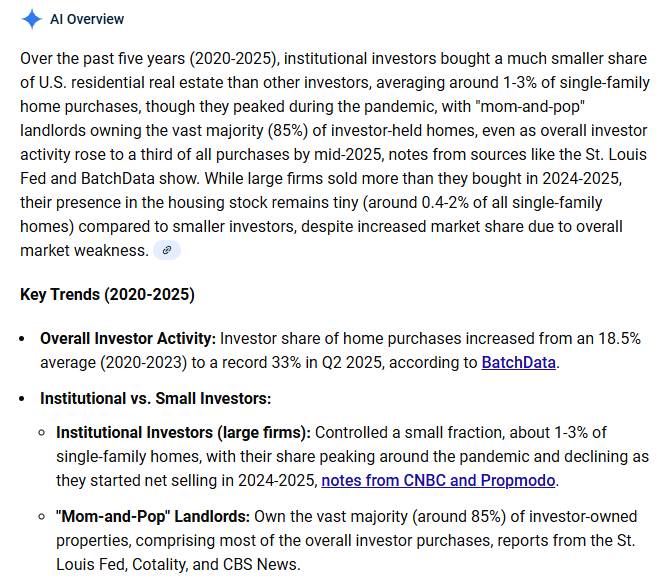
Yikes😕.......
By the logic several are using, turns out Mom-and-Pop Landlords should be the target🎯
Sooooo.... Are we sticking with that theory? Get the "evil Investors" who've been snatching up all the homes? Now that it's YOU, and not some big-rich-evil so-n-so from NY who's neck is on the chopping block? Or 🪄 now it's a bad idea and leave investors alone????
Dox them? Spray paint a red L on their home?
In some ironic news; there's a "rally" in Sacramento today in support of AB 1157 which will "strengthen" AB 1482. This Assembly bill will make Tennant protection laws permanent, cap rental increases at 2% (+CPI) removing SFH exemptions and extending just cause eviction rules.
There will be free parking for Subaru's with coexist stickers, free weed, snacks & patchouli oil. Don't forget to bring your chaulk for sidewalk art & visit the drum circle.
Yikes😕.......
By the logic several are using, turns out Mom-and-Pop Landlords should be the target🎯
Sooooo.... Are we sticking with that theory? Get the "evil Investors" who've been snatching up all the homes? Now that it's YOU, and not some big-rich-evil so-n-so from NY who's neck is on the chopping block? Or 🪄 now it's a bad idea and leave investors alone????
Dox them? Spray paint a red L on their home?
In some ironic news; there's a "rally" in Sacramento today in support of AB 1157 which will "strengthen" AB 1482. This Assembly bill will make Tennant protection laws permanent, cap rental increases at 2% (+CPI) removing SFH exemptions and extending just cause eviction rules.
There will be free parking for Subaru's with coexist stickers, free weed, snacks & patchouli oil. Don't forget to bring your chaulk for sidewalk art & visit the drum circle.
Lol 😂
Hey, we laugh but aaaahhhhhh, maybe we should knock on all the wood and throw all the salt over shoulder because there's a race for craziest made real going on.
Last night I got the news that MN Gov. ordered police to stand down and abandon policing to allow mob-rule..... again......
That's how we got a city on fire last time. But hey, I'm sure it will all work out roses this time 😕....