600 min credit score to high?

600 min credit score to high?

Emory ClaytonPro Member
Member since 2019 · 66 posts · 25 votes

As part of my minimum requirements, tenants are required to have at least a 600 credit score. I require tenants to fill out a pre-qualification before the house can be shown. As part of the pre-qualification, one of the questions that is asked is if they meet the minimum credit score of 600. I have had a lot of interest in the house, with numerous pre-qualifications come in, but almost every one states they don't at least have a 600 credit score. At that point I reject the pre-qualification because they stated they don't meet the minimum requirements. I haven't had this property for very long (under 2 years) so I don't have a lot of historical data to go off of. House is in a class C neighborhood, so its mainly being targeted by traditional blue collar workers, entry level white collar jobs (to give context). 
So l've been asking my self, is my minimum too high, do I need to re-evaluate what this should be? I have read in other places/forums that some people do not have a minimum credit score listed, however they still use it to gauge the quality of a potential tenant. I do not side with that idea. My belief is the credit score is an indication of your financial situation, and is something that cannot be overlooked. What say you? 

5Reply
414 views

Most Popular Reply

Honolulu, HI · Member since 2008 · 3k+ posts · 2k+ votes
6mo

A Credit Score is far less important than what goes into arriving at that score. You need to review and understand all of the facts in the report itself, and all other facts you uncover during your screening process. These should include court cases and traffic records, actual verification of employment/income, job history, and other relevant info based on the actual application. You need to look for missing, or contradictory bits of information such as a different address on their Pay Stub compared to their self reported address. Gaps in employment- what is the reason? Every detail. 

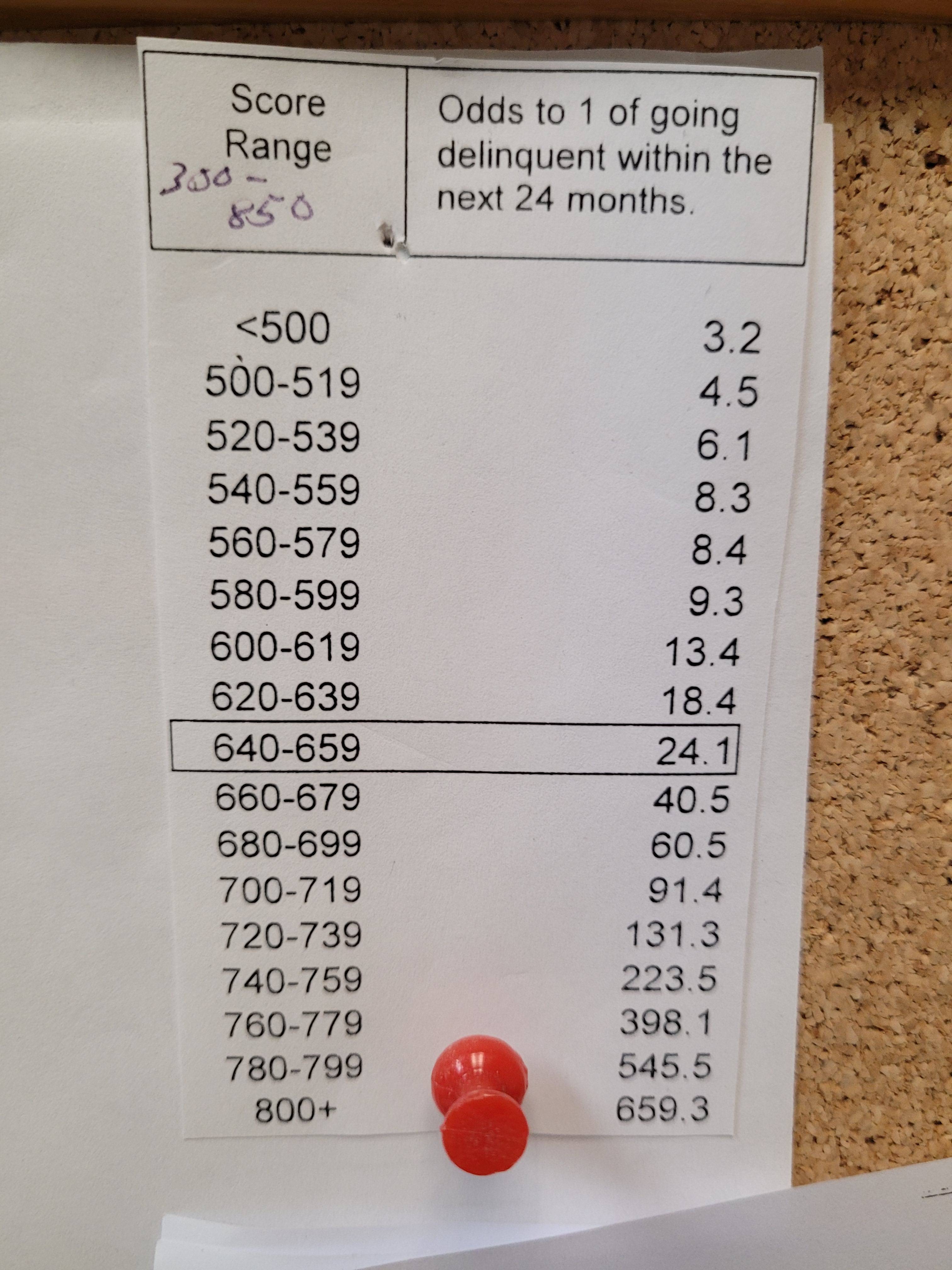
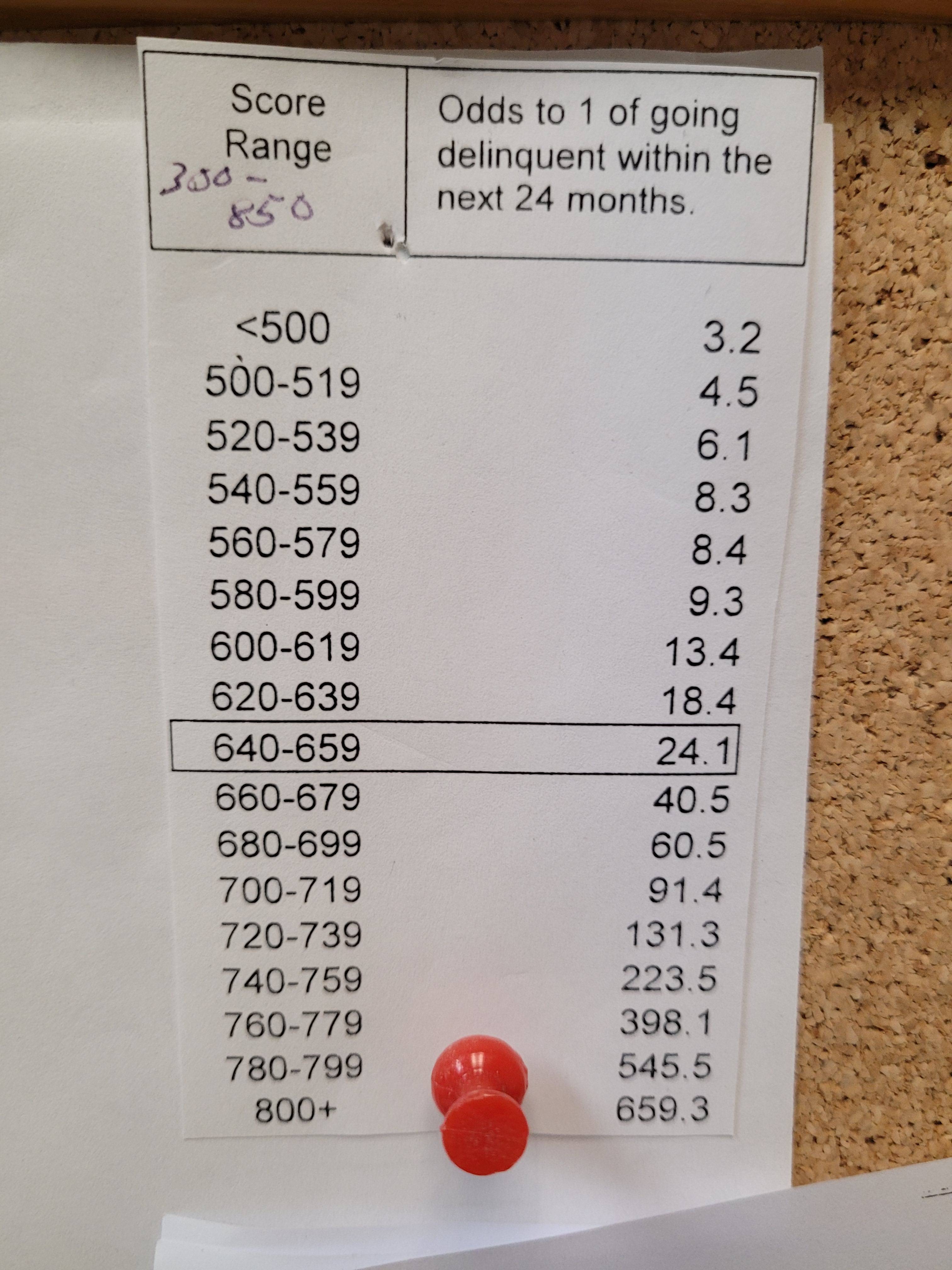
Here is a chart from Equifax for their FICO scoring system, which speaks to the odds of your Tenant going delinquent within a 24 month period:

See this reply in the discussion

33 Replies

Jump to latestLatest
  • Real Estate Broker · Atlanta · Member since 2024 · 1k+ posts · 604 votes
    6mo

    Emory, a 600 minimum is fairly common but in a Class C area it may limit your applicant pool. Some landlords lower the score requirement slightly and offset the risk with stronger income requirements, larger security deposits or solid rental history. Credit is a useful indicator but it is usually best evaluated alongside income, landlord references and overall payment history.

  • Honolulu, HI · Member since 2008 · 3k+ posts · 2k+ votes
    6mo

    A Credit Score is far less important than what goes into arriving at that score. You need to review and understand all of the facts in the report itself, and all other facts you uncover during your screening process. These should include court cases and traffic records, actual verification of employment/income, job history, and other relevant info based on the actual application. You need to look for missing, or contradictory bits of information such as a different address on their Pay Stub compared to their self reported address. Gaps in employment- what is the reason? Every detail. 

    Here is a chart from Equifax for their FICO scoring system, which speaks to the odds of your Tenant going delinquent within a 24 month period:

    • Emory ClaytonPro Member
      OP
      Member since 2019 · 66 posts · 25 votes
      6mo
      Quote from @Richard F.:

      A Credit Score is far less important than what goes into arriving at that score. You need to review and understand all of the facts in the report itself, and all other facts you uncover during your screening process. These should include court cases and traffic records, actual verification of employment/income, job history, and other relevant info based on the actual application. You need to look for missing, or contradictory bits of information such as a different address on their Pay Stub compared to their self reported address. Gaps in employment- what is the reason? Every detail. 

      Here is a chart from Equifax for their FICO scoring system, which speaks to the odds of your Tenant going delinquent within a 24 month period:


      I do all of those things. I feel like my tenant screening is more strict than what I find from most other rentals in my area. 

    • Honolulu, HI · Member since 2008 · 3k+ posts · 2k+ votes
      6mo
      Quote from @Emory Clayton:
      Quote from @Richard F.:

      A Credit Score is far less important than what goes into arriving at that score. You need to review and understand all of the facts in the report itself, and all other facts you uncover during your screening process. These should include court cases and traffic records, actual verification of employment/income, job history, and other relevant info based on the actual application. You need to look for missing, or contradictory bits of information such as a different address on their Pay Stub compared to their self reported address. Gaps in employment- what is the reason? Every detail. 

      Here is a chart from Equifax for their FICO scoring system, which speaks to the odds of your Tenant going delinquent within a 24 month period:


      I do all of those things. I feel like my tenant screening is more strict than what I find from most other rentals in my area. 


      Excellent! In that case, take a hard look at the unit itself. Post a link to your add or pics so we can offer tips. A Vacant unit is much less costly than an occupied, Non-paying unit. Interest should pick up end of the month if you don't have snow on the ground, and continue to pick up.
  • Real Estate Agent · Chicago, IL · Member since 2017 · 2k+ posts · 2k+ votes
    6mo

    People with 600 score will be absolutely awful and rarely even profitable after all their evictions/wear/turnover costs I have one building in an area like that. I normally require 680+ for my quality market rate tenant rentals that are in another area. If you are in an area with low credit scores you should do sec 8 its really the only way to have those areas not be a constant money pit. 

  • Investor · Costa Mesa, CA · Member since 2016 · 1k+ posts · 1k+ votes
    6mo

    Problem with buying in a C class area is a poor tenant pool with low credit scores. Thats why evictions, maintenance etc are higher.

  • Ben ScottPro Member
    Property Manager · Oklahoma City, OK · Member since 2019 · 577 posts · 351 votes
    6mo

    If the home is in a C class area, most of your tenant pool will be sub-600. Some of those folks make good money and pay their bills but they can't handle credit, hence the low score. You might require 2x the deposit due to low credit

  • Drew SygitBusiness Member
    Property Manager · Royal Oak, MI · Member since 2012 · 12k+ posts · 9k+ votes
    6mo
    Quote from @Emory Clayton:

    As part of my minimum requirements, tenants are required to have at least a 600 credit score. I require tenants to fill out a pre-qualification before the house can be shown. As part of the pre-qualification, one of the questions that is asked is if they meet the minimum credit score of 600. I have had a lot of interest in the house, with numerous pre-qualifications come in, but almost every one states they don't at least have a 600 credit score. At that point I reject the pre-qualification because they stated they don't meet the minimum requirements. I haven't had this property for very long (under 2 years) so I don't have a lot of historical data to go off of. House is in a class C neighborhood, so its mainly being targeted by traditional blue collar workers, entry level white collar jobs (to give context). 
    So l've been asking my self, is my minimum too high, do I need to re-evaluate what this should be? I have read in other places/forums that some people do not have a minimum credit score listed, however they still use it to gauge the quality of a potential tenant. I do not side with that idea. My belief is the credit score is an indication of your financial situation, and is something that cannot be overlooked. What say you? 


     In our market, we consider Class C properties will attract tenants with FICO scores of 560-620.

    FYI: these are NOT white-collar people of any sort! They are low blue-collar and what we politely call "no-collar" workers.

    You should be looking beyond the credit score though!

    1) How many active tradelines, excluding student loans and Chime, do they have that have 12 or 24 months of history?
    - If their credit isn't "deep" enough, the score is useless!

    2) Chime and a few other tradelines are legal scams to boost scores and should be ignored.

    3) You should require detailed 2-year residency history.
    You want to speak to other landlords to see if rent paid on time!
    NOTE: many of these applicants will claim they "live with relatives" to avoid giving an actual residency address that will divulge a less than acceptable rent payment history or moveout damages. Others, will have family & friends pose as their landlord. You need to ask questions to trip liars up.

    4) You should require detailed 2-year work history.
    How can they consistently pay rent, w/o consistent income, w/o consistent employment?
    NOTE: in addition to a paystub, require last year's W-2(s) to prove job history.

    There's more, but that's all I have time to type.

  • Dan H.Pro Member
    Investor · Poway, CA · Member since 2015 · 7k+ posts · 8k+ votes
    6mo

    We require a minimum score of 650 on our class c properties in our housing short market.  We require higher credit scores for our higher class areas.  We typically obtain a qualified tenant in our initial open house.

    As others stated, I would rather have empty unit then rent to a marginal tenant.  Let the other LLs rent to those marginal tenants.

    A tenant with poor credit score has little to nothing to lose by not paying rent.   Free rent with virtually zero consequences is too tempting.   

    So far it has worked great for us.  In decades of renting we have yet to have to evict a single tenant.  

    Good luck

    • Emory ClaytonPro Member
      OP
      Member since 2019 · 66 posts · 25 votes
      6mo
      Quote from @Dan H.:

      We require a minimum score of 650 on our class c properties in our housing short market.  We require higher credit scores for our higher class areas.  We typically obtain a qualified tenant in our initial open house.

      As others stated, I would rather have empty unit then rent to a marginal tenant.  Let the other LLs rent to those marginal tenants.

      A tenant with poor credit score has little to nothing to lose by not paying rent.   Free rent with virtually zero consequences is too tempting.   

      So far it has worked great for us.  In decades of renting we have yet to have to evict a single tenant.  

      Good luck


       "As others stated, I would rather have empty unit then rent to a marginal tenant."
      That is exactly my thinking. I have a couple levers to pull to make an adjustment, and I think at this point lowering the rent makes more sense than lowering the minimum required credit score. 

  • Member since 2026 · 1 post · 0 votes
    6mo

    I had to have 650 renting my current house. After starting a debt resolution thing, it's currently like 527 9 months later 😅 I'm making 4x the rent that I'm splitting, but on paper it's not great right now. So I'm torn on how ethical a strict minimum is (because I might be about to struggle with it) but also understand because once I get some properties, I'd definitely want to filter people out somehow.

    The drop from high 700s to 530 in a year has been rough lol. Not sure about area class and all, just in a small town.

  • Stuart UdisPro Member
    Attorney · Philadelphia · Member since 2018 · 2k+ posts · 3k+ votes
    6mo

    I’m going to state the obvious. You have a real estate problem above all else. This is the reality of owning C properties. You either concede on qualifications or are forced to be more patient. Both cost you revenue. Concede and you are more likely deal with collection issues and costlier turnovers. Remain patient and you stretch longer timeframes without collecting rent, potentially have to secure vacant property insurance, Incur utilities and other carrying costs associated with having a vacancy. 

    Remember as a landlord, you’re in the service business. Does the person living in the A or B neighborhood choose to go to a restaurant, coffee shop etc in the C neighborhood within their city? Probably not unless the product is exceptional. The same holds true for the real estate. There’s nothing you can do about the location of your real estate but you can make it the best product on the market. That can help attract better quality tenants. The obstacle there is the value of the real estate often makes it difficult to absorb the improvement costs. This is why the real estate is the issue and doesn’t get enough consideration when people buy investment real estate. 

  • Real Estate Agent · Memphis · Member since 2026 · 543 posts · 315 votes
    6mo

    A 600 minimum isn’t unreasonable, but credit score alone doesn’t always tell the full story — especially in C-class neighborhoods.

    Many solid tenants may have lower scores due to things like medical debt or old collections, while still having stable income and good rental history. On the flip side, someone can have a 620–640 and still be a chronic late payer.

    Some owners use credit more as one part of the picture, alongside things like:

    • income stability and margin above the 3x rule

    • prior landlord references and payment history

    • recent delinquencies or active collections

    If nearly everyone applying is below your threshold, it may be a signal about the local renter pool at that price point, not necessarily that your standard is wrong. The balance is protecting your risk while keeping the applicant pool large enough to find a strong fit.

  • Real Estate Agent · Cleveland OH · Member since 2015 · 213 posts · 275 votes
    6mo

    600 is just a fair credit score.   I overlook payment issues on student loan debt and medical debt but I look closely at utility, internet, cell and cable collections and deliquencies.  if they are not paying these, they are probably not worried about rent either.

  • Honolulu, HI · Member since 2008 · 3k+ posts · 2k+ votes
    6mo

    If you are getting low quality applicants, take a hard look at the unit. You will almost never attract a truly quality Tenant with tired carpet, poor wall patches, dark tones and inadequate lighting, poor security features, or difficult floor plan. 

    Here is a chart from Equifax that tells you the odds of a delinquency based on their scoring. The score is irrelevant, you need to understand the REASONS for the score, and look for Bad Habits in other areas of their life.

    • Honolulu, HI · Member since 2008 · 3k+ posts · 2k+ votes
      6mo
      Quote from @Richard F.:

      If you are getting low quality applicants, take a hard look at the unit. You will almost never attract a truly quality Tenant with tired carpet, poor wall patches, dark tones and inadequate lighting, poor security features, or difficult floor plan. 

      Here is a chart from Equifax that tells you the odds of a delinquency based on their scoring. The score is irrelevant, you need to understand the REASONS for the score, and look for Bad Habits in other areas of their life.


      What that is telling you, is that you are very likely to have a delinquency within 24 months with a score below 660.
  • Realtor · OH · Member since 2026 · 122 posts · 76 votes
    6mo
    Quote from @Emory Clayton:

    As part of my minimum requirements, tenants are required to have at least a 600 credit score. I require tenants to fill out a pre-qualification before the house can be shown. As part of the pre-qualification, one of the questions that is asked is if they meet the minimum credit score of 600. I have had a lot of interest in the house, with numerous pre-qualifications come in, but almost every one states they don't at least have a 600 credit score. At that point I reject the pre-qualification because they stated they don't meet the minimum requirements. I haven't had this property for very long (under 2 years) so I don't have a lot of historical data to go off of. House is in a class C neighborhood, so its mainly being targeted by traditional blue collar workers, entry level white collar jobs (to give context). 
    So l've been asking my self, is my minimum too high, do I need to re-evaluate what this should be? I have read in other places/forums that some people do not have a minimum credit score listed, however they still use it to gauge the quality of a potential tenant. I do not side with that idea. My belief is the credit score is an indication of your financial situation, and is something that cannot be overlooked. What say you? 


    Hey Emory, it's completely understandable that you want to set a strong baseline to protect your property, but in a Class C neighborhood, a hard 600 FICO score is going to cause unnecessary and expensive vacancies. The reality of that specific tenant pool is that many hard-working, reliable blue-collar applicants have scores in the mid-500s due to medical debt, student loans, or simply thin credit files, none of which necessarily mean they won't pay their rent. Instead of relying on a generalized three-digit number, the most effective strategy for Class C rentals is to screen heavily for behaviors that directly impact you as a landlord: a clean 5-year eviction history, verifiable income at 3x the rent, and absolutely no outstanding balances with previous property managers or utility companies.
  • Emory ClaytonPro Member
    OP
    Member since 2019 · 66 posts · 25 votes
    6mo

    A lot of people on this post have made the assumption that I only use credit score as part of the screening criteria. These are my screening criteria:

    600 Min Credit Score
    No evictions/judgements
    Verifiable income must be 3 x monthly rent
    Pets OK (2 pets maximum, restrictions & fees apply)
    Deposit same as monthly rent
    No Smokers

    Every person 21 years of age or older must fill out an application.
    No Section 8 at this time


    That being said, I feel like some of you are not using credit as a minimum requirement, and are more of using it to guide your decision making. 

    • Honolulu, HI · Member since 2008 · 3k+ posts · 2k+ votes
      6mo
      Quote from @Emory Clayton:

      A lot of people on this post have made the assumption that I only use credit score as part of the screening criteria. These are my screening criteria:

      600 Min Credit Score
      No evictions/judgements
      Verifiable income must be 3 x monthly rent
      Pets OK (2 pets maximum, restrictions & fees apply)
      Deposit same as monthly rent
      No Smokers

      Every person 21 years of age or older must fill out an application.
      No Section 8 at this time


      That being said, I feel like some of you are not using credit as a minimum requirement, and are more of using it to guide your decision making. 


       You are correct, a particular "score" is not a requirement. The Equifax reports that we pulled directly provide quite a bit of info on most people. Address and prior addresses, "also know as" names, employers, trade accounts, collection items, with details of how long accounts have been open, current balances, high limits, number of months late payments, etc.

      IMHO, your "no judgments" will eliminate some good prospects, as there are frequently very minor collection items, some of which are notes as "disputed by consumer", and some are from a years ago, so I investigate those to determine what is really relevant. I'm not going to bounce an otherwise good app for a $125, three year old item. I also have no concern with medical collection items or foreclosures, as long as they do not have numerous maxed out credit cards too! Also, a lot of the "trade" accounts are Education loans, with deferred payment schedules. You just need to review and understand each item that goes into the score.

      Additionally, if it appears they have some Bad financial "habits", look in other areas...Court Records, including Traffic and Criminal. If there are multiple traffic cases over years, this is someone that does not take rules seriously. Will they follow YOUR rules? Obviously, violent or drug related issues, and theft, are all the type of behaviors you do not want on your property, BUT, if they were years in the past, with recent "clean" years, sometimes, depending on other factors like a solid employment record and decent savings account, might be worth approving. You have to look at the bigger picture and consider the reality of any persons lifetime.

      Your last item, "No Section 8", you need to be VERY careful. Some locales have enacted laws that prohibit considering "source of income" which means any subsidized assistance. This is where it becomes tricky to have some reasonable "minimum requirements" that will likely still act as a gate to avoid S8. A large percentage of S8 applicants clearly have a number of the Bad Habits that we look for, and will be denied on that basis. But there are some that are good. It's all about the screening process. And offering a Rental unit that is actually appealing to a higher quality Tenant, even in lower end housing. Too many Tenants "settle" for a, let's just say, "less than" desirable unit, because they are desperate, or because they are used to the lower quality. No matter what pricing tier you are in, you want to attract the Best Tenants of that tier, but without overspending. 

      The importance of good documentation showing your decision process for each application cannot be stressed enough. I had a worksheet broken down into each area of the background check- Credit, Employment, Income and Banking with household totals, Court Records, Social Media, and Other. I would write in details or calculations pertaining to each area, then "Accept" or "Deny" at the bottom of the page. If Denied, I had additional line to document date that Adverse Action letter was sent, and included a copy of that letter with the application package along with the worksheet and all documents reviewed. Hold those packages in secure (locked) storage to potentially be used as evidence in the future, supporting your lawful selection of Tenants over a period of years.

  • Emory ClaytonPro Member
    OP
    Member since 2019 · 66 posts · 25 votes
    6mo

    Good detail Richard, I appreciate the feedback. 
    I'm not sure if I can remove the minimum credit score requirement at this point because I've denied many prospects based on that so far. I feel (I don't know), that could be looked at discrimination, even though my decision to remove the minimum credit score would be based on other factors like having issues finding a quality tenant. 
    Using the credit score as part of my minimum requirements almost gives me an 'easy button' because it weeds out a lot of the lesser quality tenants. Of course, this comes at the expense of having the unit sit longer. 
    I really like your idea of a worksheet that breaks everything down. The tenants I have denied so far were simply denied because they didn't meet one or more of the minimum requirements. Which again, makes it easy in screening. Now, I'm not saying that I don't go looking at every detail in the application, back ground check, etc. What I am saying is the reason I have denied applicants so far has been black and white: they didn't meet one or more of the minimum requirements. 
    I'm going to have to figure out a system that will help me in my decision process instead of relying on a minimum credit score for this process.
    I'm not sure if you're willing to share the worksheet you have, but I would be very interested to see what your process is. 

  • Honolulu, HI · Member since 2008 · 3k+ posts · 2k+ votes
    6mo

    @Emory Clayton, creating a worksheet can be as simple or as complex as you like. Mine was very simple, it was just a blank sheet of letterhead. Below the letterhead, across the top, were Applicant names, date they submitted, property address/unit. 

    Below that, headers and space for each area of their life: Credit/Banking; Employment/Gross Monthly Income; Criminal/Traffic Courts; Social Media/Other Observations. I would put all applicants info on one worksheet to calculate and aggregate income, and pull all the info together. Get in the habit of making notations for the (apparent) primary income producer, second, third, etc. for the household in the same order. You can label each header further with your individual criteria for reference, such as no new collections past 12 months, or total $ collection ratio against monthly rent; zero DUI's, X traffic violations past 12, 24 months; savings minimum balance in lieu of 3X rent gross income, minimum continuous employment period; apparent vehicle condition/care; well mannered, pushy, very distracted, obviously demanding or unreasonable, etc. Be careful with your observation notes, you cannot discriminate against protected classes, but fortunately, slobs and jerks are not such a class. Figure out what you believe is important in all of these areas, keeping in mind the reality of the Tenant pool for your unit and neighborhood. You always want to "attract" the best of the people actually interested in the neighborhood, and that is a function of the unit, and how it is presented, and general curb appeal as well as neighborhood rep.

    Here is a link to sample Adverse Action letters that simplify the process and can help you with ideas on how to narrow your guidelines. 

  • Investor · Fort Washington, MD · Member since 2014 · 1k+ posts · 1k+ votes
    6mo

    Many have explained it. I require a score in the 7s which makes it very very hard. Nearly no one meets that in months, but that is what i need.  Like many of said, what is in the credit file is more important than the score. If the person had a 580, see why. If it was due to a medical bill collection or a credit card default due to COVID, several factors can override that. They may have years or decades of paying rent on time. They may have paid off several vehicles over time with zero lates.  They also may have a stable high paying job. They could have so many things in their favor that makes them a good tenant. However, that same 580 could represent multiple failures to pay rent, evictions, dozens of late payments on everything. Most likely, they will default on you as well. Look past the score and evaluate everything, including criminal history and references. 

    • Emory ClaytonPro Member
      OP
      Member since 2019 · 66 posts · 25 votes
      5mo
      Quote from @Mark Cruse:

      Many have explained it. I require a score in the 7s which makes it very very hard. Nearly no one meets that in months, but that is what i need.  Like many of said, what is in the credit file is more important than the score. If the person had a 580, see why. If it was due to a medical bill collection or a credit card default due to COVID, several factors can override that. They may have years or decades of paying rent on time. They may have paid off several vehicles over time with zero lates.  They also may have a stable high paying job. They could have so many things in their favor that makes them a good tenant. However, that same 580 could represent multiple failures to pay rent, evictions, dozens of late payments on everything. Most likely, they will default on you as well. Look past the score and evaluate everything, including criminal history and references. 


       Mark thanks for the response. I'm curious as to why you need 7s for your credit requirement. I'm assuming this property (or properties) you speak of are in class A area's, or are properties whos rent / deposit are at such prices that only someone in the 7s should be able to afford them?

    • Investor · Fort Washington, MD · Member since 2014 · 1k+ posts · 1k+ votes
      5mo
      Quote from @Emory Clayton:
      Quote from @Mark Cruse:

      Many have explained it. I require a score in the 7s which makes it very very hard. Nearly no one meets that in months, but that is what i need.  Like many of said, what is in the credit file is more important than the score. If the person had a 580, see why. If it was due to a medical bill collection or a credit card default due to COVID, several factors can override that. They may have years or decades of paying rent on time. They may have paid off several vehicles over time with zero lates.  They also may have a stable high paying job. They could have so many things in their favor that makes them a good tenant. However, that same 580 could represent multiple failures to pay rent, evictions, dozens of late payments on everything. Most likely, they will default on you as well. Look past the score and evaluate everything, including criminal history and references. 


       Mark thanks for the response. I'm curious as to why you need 7s for your credit requirement. I'm assuming this property (or properties) you speak of are in class A area's, or are properties whos rent / deposit are at such prices that only someone in the 7s should be able to afford them?

      Just years of doing this, that is what I decided on. I feel a 7 score speak to all kinds of things like discipline, stability and a proven track record. I require the same for my C and B class. Sometimes it takes a while to get them, but it's worth it. Still, it's not just about score. That can be lowered depending on specific variables but in general, this is where i start off. Most of the PMs I have hired usually require 7, unless its class D. You cant get that there. 
  • Real Estate Broker · New York, NY · Member since 2020 · 2k+ posts · 1k+ votes
    5mo

    Hey Emory,

    That demographic tends to have lower credit scores not always because of financial irresponsibility but because of medical debt, thin credit history, or past situations that don't necessarily reflect who they are as a tenant today. A 550 or even no hard minimum with a more holistic screening approach might open up better candidates than you're currently seeing.

    The investors who tend to do well in Class C rentals usually lean more heavily on income verification and rental history than credit score alone. Someone with a 580 score, stable employment for two years, and a clean rental history is often a safer bet than someone with a 620 who just started a new job and has no rental references.

  • Honolulu, HI · Member since 2008 · 3k+ posts · 2k+ votes
    5mo

    @Mark Cruse , you are asking for trouble "lowering (the score) depending on specific variables" can get you into Fair Housing trouble. I have laid out quite a bit of detail in this thread, and that is based on personally processing roughly 3000 applications for Residential Rentals over my career. If you use the score itself as a "minimum" bar, you cannot randomly change it. You need to look at the elements that result in that score, and establish limits on each element as I have described. You pick the elements, you determine how many of each is an absolute minimum, then when you aggregate that data, you will be much more on point for the results you want, without overlooking perfectly good prospects. 

    Eviction filings against Tenants that I placed were extremely low...fewer than a half dozen over the past 10 years with around 125 units managed; Security Deposit refunds had damage deductions in less than 5% of moveouts, and fewer than a dozen of those were more than 50% of the total deposit. Turnover averaged over 4.5 years for that period. And while most were B or B-, there were about 30% C and C- units as well. 

    • Investor · Fort Washington, MD · Member since 2014 · 1k+ posts · 1k+ votes
      5mo
      Quote from @Richard F.:

      @Mark Cruse , you are asking for trouble "lowering (the score) depending on specific variables" can get you into Fair Housing trouble. I have laid out quite a bit of detail in this thread, and that is based on personally processing roughly 3000 applications for Residential Rentals over my career. If you use the score itself as a "minimum" bar, you cannot randomly change it. You need to look at the elements that result in that score, and establish limits on each element as I have described. You pick the elements, you determine how many of each is an absolute minimum, then when you aggregate that data, you will be much more on point for the results you want, without overlooking perfectly good prospects. 

      Eviction filings against Tenants that I placed were extremely low...fewer than a half dozen over the past 10 years with around 125 units managed; Security Deposit refunds had damage deductions in less than 5% of moveouts, and fewer than a dozen of those were more than 50% of the total deposit. Turnover averaged over 4.5 years for that period. And while most were B or B-, there were about 30% C and C- units as well. 


       I'm not clear on what you are saying. Get me in trouble how? I know property managers that do exactly this on every application. Maybe I was being confusing on what I said. Say I require 720, but one comes in at 700. If I look at it and there are other supporting attributes that make them a strong candidate, 700 could rank higher than a 750 in my book. If the 700 got knocked down due to a health issue or accidental collection 5 years ago, in theory they rank well above the 720 with a lower income and less stable job. If that is what you are talking about, I have no idea how you feel a person could get in trouble with fair houing. 

    • Honolulu, HI · Member since 2008 · 3k+ posts · 2k+ votes
      5mo
      Quote from @Mark Cruse:
      Quote from @Richard F.:

      @Mark Cruse , you are asking for trouble "lowering (the score) depending on specific variables" can get you into Fair Housing trouble. I have laid out quite a bit of detail in this thread, and that is based on personally processing roughly 3000 applications for Residential Rentals over my career. If you use the score itself as a "minimum" bar, you cannot randomly change it. You need to look at the elements that result in that score, and establish limits on each element as I have described. You pick the elements, you determine how many of each is an absolute minimum, then when you aggregate that data, you will be much more on point for the results you want, without overlooking perfectly good prospects. 

      Eviction filings against Tenants that I placed were extremely low...fewer than a half dozen over the past 10 years with around 125 units managed; Security Deposit refunds had damage deductions in less than 5% of moveouts, and fewer than a dozen of those were more than 50% of the total deposit. Turnover averaged over 4.5 years for that period. And while most were B or B-, there were about 30% C and C- units as well. 


       I'm not clear on what you are saying. Get me in trouble how? I know property managers that do exactly this on every application. Maybe I was being confusing on what I said. Say I require 720, but one comes in at 700. If I look at it and there are other supporting attributes that make them a strong candidate, 700 could rank higher than a 750 in my book. If the 700 got knocked down due to a health issue or accidental collection 5 years ago, in theory they rank well above the 720 with a lower income and less stable job. If that is what you are talking about, I have no idea how you feel a person could get in trouble with fair houing. 


      If using the score itself as a criteria, the criteria can't change based on other info. Tenants, and sometimes applicants, or, worst case, "testers" talk, so if one person gets accepted with a 620, while another got turned down for a 680, that is the only reference point they may have. If they perceive that the person approved is "different" from them, they may reach the wrong conclusion, regardless of facts.  Remember, with Fair Housing, it does not matter what your "intent" is, as a PM or LL, it only matters when the person feels they were turned down due to Protected Class. If you either do not save your application packages (denied or approved) documenting "fair" practices, or if they reflect a pattern that can be construed as class based, you have a problem. 

      You do not need to use the actual score as a criteria at all, if the report that it is a part of provides you the details of number and type of open, or closed by Creditor, trade accounts and the balances of the both. You might decide X number of closed with balances is one of your minimum criteria. Maybe multiple open accounts are within 10% of max available, and you limit that to 50% of such accounts as another criteria. Then you look at number and balance of "collection" accounts. You set limit them to less than $500 in total, or 3 accounts total. 

      For Rental purposes, I ignore medical bills, foreclosures,and Student Loans, as long as there are not X number of maxed out credit cards or personal lines. OTOH, with divorce cases, you need to either be able to review the decree and proof of proper payments, or you need to assume the process is incomplete, so the other party still has rights and would need to complete an application as well. When Ex's move back in, it can get complicated in a hurry. I had just such a case, with Mil Tenant, no less. The spouse showed up several months in, made nice, then got a TRO against the person I rented to. Third worst eviction results ever. 

      By the way, if you are not getting apps and full checks on every adult occupant, that can cause nearly as bad of a situation. Married folks, siblings, friends, young lovers, all can split up at any time, so you need the info on every person, and have them each sign the Agreement. Include names and ages of minors so you can add their signature if they reach the age of majority for your state. I've seen single parents move out and leave the troubled young person living there.

      Sorry, throwing a lot at you, but proper screening is the single most important task you have. Getting it wrong usually costs thousands. 
    • Emory ClaytonPro Member
      OP
      Member since 2019 · 66 posts · 25 votes
      5mo
      Quote from @Richard F.:
      Quote from @Mark Cruse:
      Quote from @Richard F.:

      @Mark Cruse , you are asking for trouble "lowering (the score) depending on specific variables" can get you into Fair Housing trouble. I have laid out quite a bit of detail in this thread, and that is based on personally processing roughly 3000 applications for Residential Rentals over my career. If you use the score itself as a "minimum" bar, you cannot randomly change it. You need to look at the elements that result in that score, and establish limits on each element as I have described. You pick the elements, you determine how many of each is an absolute minimum, then when you aggregate that data, you will be much more on point for the results you want, without overlooking perfectly good prospects. 

      Eviction filings against Tenants that I placed were extremely low...fewer than a half dozen over the past 10 years with around 125 units managed; Security Deposit refunds had damage deductions in less than 5% of moveouts, and fewer than a dozen of those were more than 50% of the total deposit. Turnover averaged over 4.5 years for that period. And while most were B or B-, there were about 30% C and C- units as well. 


       I'm not clear on what you are saying. Get me in trouble how? I know property managers that do exactly this on every application. Maybe I was being confusing on what I said. Say I require 720, but one comes in at 700. If I look at it and there are other supporting attributes that make them a strong candidate, 700 could rank higher than a 750 in my book. If the 700 got knocked down due to a health issue or accidental collection 5 years ago, in theory they rank well above the 720 with a lower income and less stable job. If that is what you are talking about, I have no idea how you feel a person could get in trouble with fair houing. 


      If using the score itself as a criteria, the criteria can't change based on other info. Tenants, and sometimes applicants, or, worst case, "testers" talk, so if one person gets accepted with a 620, while another got turned down for a 680, that is the only reference point they may have. If they perceive that the person approved is "different" from them, they may reach the wrong conclusion, regardless of facts.  Remember, with Fair Housing, it does not matter what your "intent" is, as a PM or LL, it only matters when the person feels they were turned down due to Protected Class. If you either do not save your application packages (denied or approved) documenting "fair" practices, or if they reflect a pattern that can be construed as class based, you have a problem. 

      You do not need to use the actual score as a criteria at all, if the report that it is a part of provides you the details of number and type of open, or closed by Creditor, trade accounts and the balances of the both. You might decide X number of closed with balances is one of your minimum criteria. Maybe multiple open accounts are within 10% of max available, and you limit that to 50% of such accounts as another criteria. Then you look at number and balance of "collection" accounts. You set limit them to less than $500 in total, or 3 accounts total. 

      For Rental purposes, I ignore medical bills, foreclosures,and Student Loans, as long as there are not X number of maxed out credit cards or personal lines. OTOH, with divorce cases, you need to either be able to review the decree and proof of proper payments, or you need to assume the process is incomplete, so the other party still has rights and would need to complete an application as well. When Ex's move back in, it can get complicated in a hurry. I had just such a case, with Mil Tenant, no less. The spouse showed up several months in, made nice, then got a TRO against the person I rented to. Third worst eviction results ever. 

      By the way, if you are not getting apps and full checks on every adult occupant, that can cause nearly as bad of a situation. Married folks, siblings, friends, young lovers, all can split up at any time, so you need the info on every person, and have them each sign the Agreement. Include names and ages of minors so you can add their signature if they reach the age of majority for your state. I've seen single parents move out and leave the troubled young person living there.

      Sorry, throwing a lot at you, but proper screening is the single most important task you have. Getting it wrong usually costs thousands. 

      This: 

      "You do not need to use the actual score as a criteria at all, if the report that it is a part of provides you the details of number and type of open, or closed by Creditor, trade accounts and the balances of the both. You might decide X number of closed with balances is one of your minimum criteria. Maybe multiple open accounts are within 10% of max available, and you limit that to 50% of such accounts as another criteria. Then you look at number and balance of "collection" accounts. You set limit them to less than $500 in total, or 3 accounts total."

      is more of a method I think I will move to. Admittedly I was fixated on the number, but I'm beginning to see that whats in the credit report is more important than the score.

      My only push back to this method is this; wouldn't the 'Big Three' credit bureaus be better at evaluating a persons credit worthiness that we would? Or, is the credit score given to a person from Experian/TransUnion/Equifax more about what they deem is important? Where as, us land lords/property managers, we are looking at their credit score from another perspective? To put it plainly, we are looking at a person differently than the 'Big Three' credit bureaus?
    • Investor · Fort Washington, MD · Member since 2014 · 1k+ posts · 1k+ votes
      5mo
      Quote from @Richard F.:
      Quote from @Mark Cruse:
      Quote from @Richard F.:

      @Mark Cruse , you are asking for trouble "lowering (the score) depending on specific variables" can get you into Fair Housing trouble. I have laid out quite a bit of detail in this thread, and that is based on personally processing roughly 3000 applications for Residential Rentals over my career. If you use the score itself as a "minimum" bar, you cannot randomly change it. You need to look at the elements that result in that score, and establish limits on each element as I have described. You pick the elements, you determine how many of each is an absolute minimum, then when you aggregate that data, you will be much more on point for the results you want, without overlooking perfectly good prospects. 

      Eviction filings against Tenants that I placed were extremely low...fewer than a half dozen over the past 10 years with around 125 units managed; Security Deposit refunds had damage deductions in less than 5% of moveouts, and fewer than a dozen of those were more than 50% of the total deposit. Turnover averaged over 4.5 years for that period. And while most were B or B-, there were about 30% C and C- units as well. 


       I'm not clear on what you are saying. Get me in trouble how? I know property managers that do exactly this on every application. Maybe I was being confusing on what I said. Say I require 720, but one comes in at 700. If I look at it and there are other supporting attributes that make them a strong candidate, 700 could rank higher than a 750 in my book. If the 700 got knocked down due to a health issue or accidental collection 5 years ago, in theory they rank well above the 720 with a lower income and less stable job. If that is what you are talking about, I have no idea how you feel a person could get in trouble with fair houing. 


      If using the score itself as a criteria, the criteria can't change based on other info. Tenants, and sometimes applicants, or, worst case, "testers" talk, so if one person gets accepted with a 620, while another got turned down for a 680, that is the only reference point they may have. If they perceive that the person approved is "different" from them, they may reach the wrong conclusion, regardless of facts.  Remember, with Fair Housing, it does not matter what your "intent" is, as a PM or LL, it only matters when the person feels they were turned down due to Protected Class. If you either do not save your application packages (denied or approved) documenting "fair" practices, or if they reflect a pattern that can be construed as class based, you have a problem. 

      You do not need to use the actual score as a criteria at all, if the report that it is a part of provides you the details of number and type of open, or closed by Creditor, trade accounts and the balances of the both. You might decide X number of closed with balances is one of your minimum criteria. Maybe multiple open accounts are within 10% of max available, and you limit that to 50% of such accounts as another criteria. Then you look at number and balance of "collection" accounts. You set limit them to less than $500 in total, or 3 accounts total. 

      For Rental purposes, I ignore medical bills, foreclosures,and Student Loans, as long as there are not X number of maxed out credit cards or personal lines. OTOH, with divorce cases, you need to either be able to review the decree and proof of proper payments, or you need to assume the process is incomplete, so the other party still has rights and would need to complete an application as well. When Ex's move back in, it can get complicated in a hurry. I had just such a case, with Mil Tenant, no less. The spouse showed up several months in, made nice, then got a TRO against the person I rented to. Third worst eviction results ever. 

      By the way, if you are not getting apps and full checks on every adult occupant, that can cause nearly as bad of a situation. Married folks, siblings, friends, young lovers, all can split up at any time, so you need the info on every person, and have them each sign the Agreement. Include names and ages of minors so you can add their signature if they reach the age of majority for your state. I've seen single parents move out and leave the troubled young person living there.

      Sorry, throwing a lot at you, but proper screening is the single most important task you have. Getting it wrong usually costs thousands. 
       Hey, I appreciate the tips, but I have been screening for some time. Also, most PMs I know do the same. I pick the best candidate point blank. I have no clue how you think they can figure all this out when most is in my head. If the 700 candidate is better than the 720, and someone doesn't like it, I will explain it to them. I mean this doesn't really make sense to me. How would what you are talking about even happen? I turn someone down; they are going to read my mind? How are they going to know I chose someone with a lower score? How will they even know who I chose or why? If 700 has 12 years of solid rent payments and 720's previous landlord said they were late multiple times; guess who I chose?  I don't fully get it, but I guess you just have to do what works best for you. My criteria are based on multiple factors including a minimum credit score. I have never ever heard any PM say it's illegal to accept someone with a score lower than what they require. Oh well. 

    • Honolulu, HI · Member since 2008 · 3k+ posts · 2k+ votes
      5mo
      Quote from @Emory Clayton:
      Quote from @Richard F.:
      Quote from @Mark Cruse:
      Quote from @Richard F.:

      @Mark Cruse , you are asking for trouble "lowering (the score) depending on specific variables" can get you into Fair Housing trouble. I have laid out quite a bit of detail in this thread, and that is based on personally processing roughly 3000 applications for Residential Rentals over my career. If you use the score itself as a "minimum" bar, you cannot randomly change it. You need to look at the elements that result in that score, and establish limits on each element as I have described. You pick the elements, you determine how many of each is an absolute minimum, then when you aggregate that data, you will be much more on point for the results you want, without overlooking perfectly good prospects. 

      Eviction filings against Tenants that I placed were extremely low...fewer than a half dozen over the past 10 years with around 125 units managed; Security Deposit refunds had damage deductions in less than 5% of moveouts, and fewer than a dozen of those were more than 50% of the total deposit. Turnover averaged over 4.5 years for that period. And while most were B or B-, there were about 30% C and C- units as well. 


       I'm not clear on what you are saying. Get me in trouble how? I know property managers that do exactly this on every application. Maybe I was being confusing on what I said. Say I require 720, but one comes in at 700. If I look at it and there are other supporting attributes that make them a strong candidate, 700 could rank higher than a 750 in my book. If the 700 got knocked down due to a health issue or accidental collection 5 years ago, in theory they rank well above the 720 with a lower income and less stable job. If that is what you are talking about, I have no idea how you feel a person could get in trouble with fair houing. 


      If using the score itself as a criteria, the criteria can't change based on other info. Tenants, and sometimes applicants, or, worst case, "testers" talk, so if one person gets accepted with a 620, while another got turned down for a 680, that is the only reference point they may have. If they perceive that the person approved is "different" from them, they may reach the wrong conclusion, regardless of facts.  Remember, with Fair Housing, it does not matter what your "intent" is, as a PM or LL, it only matters when the person feels they were turned down due to Protected Class. If you either do not save your application packages (denied or approved) documenting "fair" practices, or if they reflect a pattern that can be construed as class based, you have a problem. 

      You do not need to use the actual score as a criteria at all, if the report that it is a part of provides you the details of number and type of open, or closed by Creditor, trade accounts and the balances of the both. You might decide X number of closed with balances is one of your minimum criteria. Maybe multiple open accounts are within 10% of max available, and you limit that to 50% of such accounts as another criteria. Then you look at number and balance of "collection" accounts. You set limit them to less than $500 in total, or 3 accounts total. 

      For Rental purposes, I ignore medical bills, foreclosures,and Student Loans, as long as there are not X number of maxed out credit cards or personal lines. OTOH, with divorce cases, you need to either be able to review the decree and proof of proper payments, or you need to assume the process is incomplete, so the other party still has rights and would need to complete an application as well. When Ex's move back in, it can get complicated in a hurry. I had just such a case, with Mil Tenant, no less. The spouse showed up several months in, made nice, then got a TRO against the person I rented to. Third worst eviction results ever. 

      By the way, if you are not getting apps and full checks on every adult occupant, that can cause nearly as bad of a situation. Married folks, siblings, friends, young lovers, all can split up at any time, so you need the info on every person, and have them each sign the Agreement. Include names and ages of minors so you can add their signature if they reach the age of majority for your state. I've seen single parents move out and leave the troubled young person living there.

      Sorry, throwing a lot at you, but proper screening is the single most important task you have. Getting it wrong usually costs thousands. 

      This: 

      "You do not need to use the actual score as a criteria at all, if the report that it is a part of provides you the details of number and type of open, or closed by Creditor, trade accounts and the balances of the both. You might decide X number of closed with balances is one of your minimum criteria. Maybe multiple open accounts are within 10% of max available, and you limit that to 50% of such accounts as another criteria. Then you look at number and balance of "collection" accounts. You set limit them to less than $500 in total, or 3 accounts total."

      is more of a method I think I will move to. Admittedly I was fixated on the number, but I'm beginning to see that whats in the credit report is more important than the score.

      My only push back to this method is this; wouldn't the 'Big Three' credit bureaus be better at evaluating a persons credit worthiness that we would? Or, is the credit score given to a person from Experian/TransUnion/Equifax more about what they deem is important? Where as, us land lords/property managers, we are looking at their credit score from another perspective? To put it plainly, we are looking at a person differently than the 'Big Three' credit bureaus?

       Actually, the bureaus have multiple scoring models. Mortgage lenders get one, auto dealers get a different tweak, but for PM, it is more of a broad based view. The models vary in exactly the same way as I have laid out...they weight different factors in a different manner for each model. 

      At a glance, lenders, car dealers, and LL's all want someone with "good credit", and that is what the score reveals, BUT a mortgage lender has a piece of property for security; cars get repo'd quickly and easily, but LL's and PM's need to go through a long and costly eviction process with relatively little security for the amount of loss that is too easily incurred. 

      You can choose to make screening relatively simple and use a score as the bar, or you can drill down to better detail, and narrow your focus to what I call the Bad Habits that people have. Anyone can make a mistake once, maybe twice. But if they do the same basic thing 3 times, 7 times, that is just a Bad Habit. Typically, for Renters, you will see Bad Habits in multiple areas of their life including traffic, civil, and criminal courts; job hopping or multiple changes of residence over a 12 or 18 month recent period, and when that is the case, you do not want them, regardless of what their score might be.

  • Drew SygitBusiness Member
    Property Manager · Royal Oak, MI · Member since 2012 · 12k+ posts · 9k+ votes
    5mo
    Quote from @Emory Clayton:

    As part of my minimum requirements, tenants are required to have at least a 600 credit score. I require tenants to fill out a pre-qualification before the house can be shown. As part of the pre-qualification, one of the questions that is asked is if they meet the minimum credit score of 600. I have had a lot of interest in the house, with numerous pre-qualifications come in, but almost every one states they don't at least have a 600 credit score. At that point I reject the pre-qualification because they stated they don't meet the minimum requirements. I haven't had this property for very long (under 2 years) so I don't have a lot of historical data to go off of. House is in a class C neighborhood, so its mainly being targeted by traditional blue collar workers, entry level white collar jobs (to give context). 
    So l've been asking my self, is my minimum too high, do I need to re-evaluate what this should be? I have read in other places/forums that some people do not have a minimum credit score listed, however they still use it to gauge the quality of a potential tenant. I do not side with that idea. My belief is the credit score is an indication of your financial situation, and is something that cannot be overlooked. What say you? 


    For our market, Metro Detroit, we consider Class C tenants to have 560-620 FICO score.

    So, you may be a bit high - depending on YOUR market. 

    Here's bit more about how we break Classes down:

    Key metrics for each Property Class:

    Class A Properties:
    Tenant Pool: Majority of FICO scores 680+, no convictions/evictions in last 7 years.
    Tenant Default: 0-5% probability of eviction or early lease termination.
    Section 8: Class A rents are too high and won’t be approved.
    Vacancies: 5-10%, depending on market conditions.
    Cashflow vs Appreciation: Typically, 3-5 years for positive cashflow, but you get highest relative rent & value appreciation.

    Class B Properties:
    Tenant Pool: Majority of FICO scores 620-680, some blemishes, no convictions/evictions in last 5 years.
    Tenant Default
    : 5-10% probability of eviction or early lease termination.
    Vacancies
    : 10-15%, depending on market conditions.
    Cashflow vs Appreciation: Typically, 1-3 years for positive cashflow, balanced amounts of relative rent & value appreciation.
    Section 8: Class B rents are usually too high for the Section 8 program.

    Class C Properties:
    Tenant Pool: Majority of FICO scores 560-620, many blemishes, but should have no convictions/evictions in last 3 years. Verifying recent 2-years of rental history very important! Same for 2-years of job/income stability.
    Tenant Default: 10-20% probability of eviction or early lease termination.
    Section 8: Class C rents usually meet program requirements, proper screening still recommended.
    Vacancies: 10-20%, depending on market conditions and tenant screening.
    Cashflow vs Appreciation: Should cashflow immediately, at the lower end of relative rent & value appreciation.

    Class D Properties:
    Tenant Pool: Majority of FICO scores under 560, little to no good tradelines, lots of collections & chargeoffs, but should have no convictions/evictions in last 12 months. Verifying last 2-years of rental history and income/employment extremely important to find the “best of the worst”.
    Tenant Default: 20-30% probability of eviction or early lease termination.
    Section 8: Class D rents meet program requirements, often challenges to pass Section 8 inspection.
    Vacancies: 20%+, depending on market conditions and tenant screening.
    Cashflow vs Appreciation: Typically, all cashflow with little, maybe even negative, relative rent & value appreciation.

    Where did we get our FICO credit score information from?

    Check out this chart:

    FICO Score

    Pct of Population

    Default Probability

    800 or more

    13.00%

    1.00%

    750-799

    27.00%

    1.00%

    700-749

    18.00%

    4.40%

    650-699

    15.00%

    8.90%

    600-649

    12.00%

    15.80%

    550-599

    8.00%

    22.50%

    500-549

    5.00%

    28.40%

    Less than 499

    2.00%

    41.00%

    Source: Fair Isaac Company

  • Member since 2026 · 11 posts · 3 votes
    5mo

    For a Class C neighborhood 600 might be filtering out a solid chunk of otherwise qualified tenants. Some landlords in similar markets drop to 550-580 but layer in income verification at 3x rent and rental history checks to compensate. The credit score tells part of the story, the full picture matters more.

Join the conversationCreate a free account to reply, vote on answers and follow this thread.