The August Jobs Print Was Strong and Almost Nothing Else Was
Last week produced one of the widest gaps between a headline number and the data underneath it that we have seen this year, and it has direct implications for anyone modeling a refinance.
Two Very Different Labor Markets
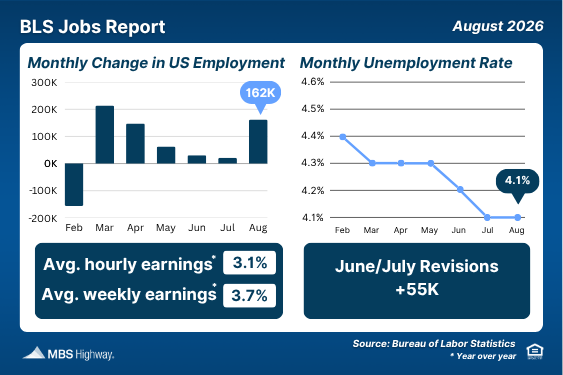
The BLS said the economy added 162,000 jobs in August, roughly three times the expected gain, with June and July revised up a combined 55,000. July in particular flipped from an initial 23,000 job decline to a 21,000 job gain. Unemployment held at 4.1%. The composition was clean: full-time employment up 735,000, part-time down 223,000, labor force participation growing rather than shrinking.
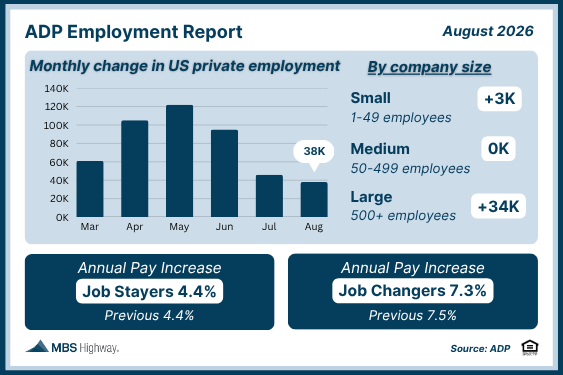
ADP, measuring the same private sector for the same month, reported 38,000 jobs. The BLS private sector figure was 127,000. That is not a rounding difference. ADP's number was its weakest since January and came in below the roughly 50,000 consensus. Revelio Labs independently landed at 36,500.
Job openings totaled 7.27 million in July against 7.3 million expected, and June got revised down 177,000 to 7.18 million. Worth noting that the openings series likely overstates real opportunity, because remote roles get posted in multiple markets and counted separately.
Initial claims sat near 206,000, which is low and says layoffs are not accelerating. Continuing claims stayed elevated at 1.78 million. That combination describes a market where you probably keep your job but struggle to find a new one, which is the classic profile of a labor market losing momentum without breaking.
Where the Hiring Is Actually Coming From
This is the part most coverage skipped. Hiring stayed concentrated in a narrow set of industries rather than spreading across the economy, with education and health services doing most of the work. That reflects long-run demographic demand from an aging population, not broad cyclical strength.
The wage data supports that read. Job changers saw pay rise 7.3% year over year while job stayers got 4.4%. A wide switcher premium usually signals competition for talent in specific pockets, not economy-wide tightness.
The Fed Dissent Nobody Is Pricing
Here is the piece that cuts hardest against consensus. The Fed held rates steady in July, and three members dissented in favor of a quarter-point hike. Not a cut. A hike, on inflation concerns.
Chair Kevin Warsh has since said that if inflation does not make meaningful progress toward the 2% target, there is still "work to do," explicitly keeping a hike live without committing to one. Governor Christopher Waller said he is willing to hold if inflation keeps improving. New York Fed President John Williams said the benchmark rate is in a good place. That is a committee whose live options are hold and hike.
If your underwriting assumes a materially lower rate on refinance in twelve to eighteen months, this is your signal to stress test the version where that does not happen. A lot of deals penciled in 2026 quietly depend on Fed policy moving a direction no voting member is currently arguing for.
The Appreciation Backdrop
Fannie Mae and Pulsenomics released their Home Price Expectations Survey, aggregating more than 150 economists, real estate experts, and market strategists. Median forecast is 2.6% home price growth over the next year and about 15% over five years.
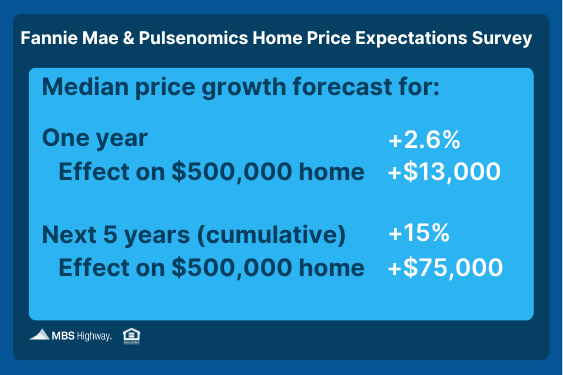
That is modest, and modest is actually the useful input here. It says you should not underwrite appreciation as a return driver, but you also should not model flat or declining values. For a leveraged buyer, 2.6% on the full asset value against a fraction of it in equity is still meaningful, but it is not a thesis on its own.
Investor Takeaway
Underwrite to today's rate. The gap between the jobs headline and everything underneath it means the Fed gets no clean signal in either direction, and the only dissent on record this cycle was for higher rates. Deals that require cheaper debt to work are a bet on policy, and policy is not pointing your way right now. What the data does support is patience on price rather than patience on rates: a cooling labor market with elevated continuing claims eventually slows household formation and buyer urgency, which shows up as seller flexibility before it shows up as index-level price declines. Watch Friday's CPI closely, because it lands five days before the September 15-16 meeting and is the single input most likely to move the committee off hold in either direction.
