Put cash flow towards principle?
Accountant · Fargo, ND · Member since 2016 · 24 posts · 17 votes
This is something that I haven't seen yet as far as an investment strategy. I've thought about taking the cash flows from the rental and putting it towards the principle on the loan in order to expedite acquisition of equity as well as mitigate perhaps thousands of dollars in interest payments over the shortened term. Is this a sound practice, or is it not talked about because there is a better strategy?
The quick answer is "no". You're an investor, not a property "babysitter". What you propose defeats the purpose of buying a rental.
1) You buy rentals for cash flow. If you're going to give the money right back, why bother?
2) Equity is a trophy on a rental. What is it good for...nothin'. You can't access it unless you sell it, or refi.
3) Here's the big one. You are not making the payments on the interest...the tenant is.
Disclosure: I dont own property, in the research/education phase.
Cash flow from properties can be used to put towards another cash flowing property. Sure, you can pay down on the property you currently own but wouldnt having 2 properties cash flowing be more ideal?
Having some debt in the properties can help prevent an attorney going after said property if, God forbid, anything were to happen.
Another property that cash flows can also help offset a potential vacancy as well.
Disclosure: I dont own property, in the research/education phase.
Cash flow from properties can be used to put towards another cash flowing property. Sure, you can pay down on the property you currently own but wouldnt having 2 properties cash flowing be more ideal?
Having some debt in the properties can help prevent an attorney going after said property if, God forbid, anything were to happen.
Another property that cash flows can also help offset a potential vacancy as well.
Fair enough on the lawyer point and the potential for mitigating the stress of having a vacancy. However, it's a double edged sword. If I take on another property it's doubling the risk, but not necessarily doubling the reward. I would have to crunch some numbers to come to an exact stance on the scenario, but if I use cash flows to save up for another down payment and keep on acquiring property in that manner, what's the use? I'm only exponentially increasing the amount of interest that I will be paying on my front-loaded loans while generating less cumulative equity. This coupled with the added risk of vacancy and tenancy and my proposed idea of putting cash flows towards principle makes for a more sound investment at first glance. After creating a nest egg for CapX, the margin over the monthly payments could be put towards the principle of the loan.
I was originally typing this on my phone but had to move to my computer to make a graph to display what I'm saying (In my data the two original examples are computed with no money down):
If I paid an additional $500 towards principle each month (after developing a suitable nest egg for CapX, of course), not only do I cut the term of the loan by 20.6 years, but I also end up paying $57,067.14 less in interest over the term.
But what if I decided to sell the property in less than 9 5/12 years (the term of the loan with the additional monthly principle)? Well, let's say after year 5 I decide to sell it. In year 5 (payment 60) the markets are doing great because it makes me happy to have larger numbers in the future, so let's say it sells at $150,000. Here is the difference in equity:
Equity from Regular PMT: 8.84% stake ($13,263.12 in proceeds from the sale)
Equity from Additional Principle: 42.41% stake ($63,615 in proceeds from the sale)
But what about the time value of money? $500 a month is $6000 a year. If I take the average market rate as a discount rate to calculate the present value of $500 monthly payments over 5 years ($30,000 total), the present value of those monthly payments adds up to $30,404.70. $404.70. So the opportunity cost of making $50,351.88 (63,615-3,263.12) in 5 years is a rounding error.
But let's say that at the beginning of year four you take all the potentially additional principle that you saved up ($17,000) and use that as a 20% down payment on another property worth $85,000. So your loan is $68,000, all else constant. In year 5 here is the breakdown of equity:
Equity in Property 1: 8.84% stake ($13,263.12 in proceeds from sale)
Equity in Property 2: 1.61% stake ($18,371.24 share)
Equity from Additional Principle: 42.41% stake ($63,615 in proceeds from the sale)
So the margin on paying an additional .5% in principle each month amounts to: $31,980.64
Holy ****
So, in this given scenario, all things considered, you would have to be insane not to contribute additional principle. In this example, not doing so will cost you $31,980.64 in 5 year's cash (can anyone discount that value for today's dollars? I'm a little weary of calculations by now...). That's a brand new Audi in cash.
I know it looks like I answered my own question here, but I am still interested in hearing any other suggestions of what to do with monthly cash flows to maximize profits. And check my math.
The quick answer is "no". You're an investor, not a property "babysitter". What you propose defeats the purpose of buying a rental.
1) You buy rentals for cash flow. If you're going to give the money right back, why bother?
2) Equity is a trophy on a rental. What is it good for...nothin'. You can't access it unless you sell it, or refi.
3) Here's the big one. You are not making the payments on the interest...the tenant is.
I get what you are proposing and you make quite the arguement. Cash flow investors will generally purchase a property where cash flow would be after: (percentage number is of tenant's payment)
Mortgage
10% repairs
10% maintenance
10% property management
5% (or market variable) for vacancy
And some left over.
These numbers are doable, but some markets are harder than others.
Yes, in 5 years I can sell for a bigger percentage. I also would have put more money into a single property where as 5 years from now, I could have multiple properties cash flowing for decent amount of money and preparing for another purchase. If my market appreciates and I decide to sell, I make some money but if it crashes, I have a pad because people will always need rents.
If I wanted the Audi, Id lease it and write it off, although a Ram 2500 Cummins is more my style :)
@Matt Finneseth, thanks for your post. There's lots RIGHT with paying down extra principal when you can. Your key words were: "in order to expedite acquisition of equity". Yep.
But, if you bought wisely in the first place, you should be USING that equity, by re-financing, as SOON as possible ie. within 6 months. ie. hardly time enough to worry about principal pay down (especially in this LOW interest rate economy).
How can you re-fi in 6 months? Because you bought with significantly extra equity from day one! How? Because you only buy bargains!
You made the comment: "If I take on another property it's doubling the risk, but not necessarily doubling the reward". Ha! That's NOT the way to look at real estate!
If you take THAT approach - why buy ANY?
I do certainly approve of your idea of squeezing the most out of every dollar of "cash flow" earned from your investments, for the long game (eg. retirement*). But in doing so, paying down the principal becomes lower in priority than: being refi-ready for your NEXT deal! All the best...
* [But if you rely on SOME of your cash flow because you're doing it full time, then yes, learn to separate "cash flow" from "living expenses"].
If you have a 5% mortgage and you can put 20% down on another cash-flow property that makes 15% COC then you are tripling your return doing that rather than paying down your mortgage. There is a reason investors want to put down the least amount as possible on a property, it's because the less you have laying dead in equity, the more you can put towards more property, but it all boils down to your debt tolerance, if paying it down helps you sleep better, then do that but if you want to make a better return and keep your equity stakes low, buy more property. If you wait until you pay property off instead of re-investing your cash flow, it will take you much, much longer to reach your monthly income goals, sure you will have less property to manage but you'll also build up more equity the more property you have and the tenant will be paying for it.
The quick answer is "no". You're an investor, not a property "babysitter". What you propose defeats the purpose of buying a rental.
1) You buy rentals for cash flow. If you're going to give the money right back, why bother?
2) Equity is a trophy on a rental. What is it good for...nothin'. You can't access it unless you sell it, or refi.
3) Here's the big one. You are not making the payments on the interest...the tenant is.
1) If my investment goals are short-term, then yes. I'm playing the long game.
2) Equity is good for long-term wealth. The opportunity cost of not reinvesting is short-sighted nonsense.
3) I am making the payments on the interest by proxy. The tenant is paying it for me, but if I don't pay down the principle in tandem that's doubling down on my losses (math provided above).
The more properties you have the less risk you actually have, as far as vacancy and inability to afford them. You're looking at it from an OO mindset. You're not paying the mortgage or the interest. The tenant is paying for the Property Taxes, Insurance, Mortage, Repairs, CapEx, Future Vacancies and Income Taxes. They're simply paying you a couple/few hundred dollars per month to live there.
So you're getting paid to allow someone to build equity for you. If you pay into the principal, you're only doing the tenant's job.
To maximize your returns with cash flows, put down on another home that will cash flow the same or better. Not only is the tenant in property/unit #1 paying for your equity, they're paying for the maintenance/cost of that equity and the down payments for more equity and cash flow from property/unit #2. Same can be said for tenant(s) in property #2, #3, ..., #N.
Let's recognize that all input here is just a drop in a large bucket of opinion, even with graphs. That's what these (albeit good) discussions tend to turn into.
I wouldn't be rushing to pay down any long-term, fixed residential mortgages that start with a 5 or less. As debt-averse as I am, there are just too many easy ways to beat a 5% return on my money. My goal as an investor is ROI. Someone else's goal of debt reduction would differ. They are more of an equity builder than an investor.
After building up an emergency account and an acquisition account to take advantage of an opportunity that may arise, I began paying down some mortgages. PITA commercial loans that require annual reporting and have short, adjustable and callable terms for sure. Older residential loans 6% or above are on the list, too. Risk-free and tax free returns of 6%+ beat the heck out of savings rates of less than 1%.
So, it depends on what you're paying off @Matt Finneseth. Accelerating 3% mortgage pay-downs just means you have different goals than a RE empire and that's fine!
@Matt Finneseth, you wrote: "The opportunity cost of not reinvesting is short-sighted nonsense". (?????)
Can you please explain what you mean by that? Thank you...
Mortgage interest is tax deductible so figures based upon interest paid is nonsense.
Take a look at a couple of scenarios:
Each of these patterns manages CASH and DEBT differently.
If you've already made up your mind, then IMO it's a apriori proof looking for a justification.
The axiom of REI is to preserve personal cash, use OPM whenever possible and acquire assets.
Let's recognize that all input here is just a drop in a large bucket of opinion, even with graphs. That's what these (albeit good) discussions tend to turn into.
You're right! And I definitely appreciate all of the feedback being provided in this thread. However, I'm not looking for conjecture or common consensus, I'm looking for quantification. There are a lot of numbers to be crunched here because I am new to REI, but I don't understand the trend of saying that the tenant is paying the mortgage and CapX. The tenant's name isn't on the loan, mine is. It is my property and I am liable for all of it's expenses, full stop. So when people say not to pay down additional principle to save myself, what was it? Fifty-some grand? In interest over the term of the loan, I'm confused. That's ~$50,000 that isn't lining my pocket.
Additionally, the mortgage is the biggest expense on the property. Once the mortgage gets paid off, I get to retain significantly more of the revenues from renting the property out, and I get to keep all of the proceeds from the sale when the time comes. Also, by building more equity in my property I will be able to leverage that equity for even more financing, as shown by my calculations above.
I understand the logic behind not putting additional money towards principle in order to reinvest it for a bigger return, but I am not seeing any numbers behind it. Like you guys, I'm all for maximizing profits here, but I require the data to help back it up.
Let's recognize that all input here is just a drop in a large bucket of opinion, even with graphs. That's what these (albeit good) discussions tend to turn into.
You're right! And I definitely appreciate all of the feedback being provided in this thread. However, I'm not looking for conjecture or common consensus, I'm looking for quantification. There are a lot of numbers to be crunched here because I am new to REI, but I don't understand the trend of saying that the tenant is paying the mortgage and CapX. The tenant's name isn't on the loan, mine is. It is my property and I am liable for all of it's expenses, full stop. So when people say not to pay down additional principle to save myself, what was it? Fifty-some grand? In interest over the term of the loan, I'm confused. That's ~$50,000 that isn't lining my pocket.
Additionally, the mortgage is the biggest expense on the property. Once the mortgage gets paid off, I get to retain significantly more of the revenues from renting the property out, and I get to keep all of the proceeds from the sale when the time comes. Also, by building more equity in my property I will be able to leverage that equity for even more financing, as shown by my calculations above.
I understand the logic behind not putting additional money towards principle in order to reinvest it for a bigger return, but I am not seeing any numbers behind it. Like you guys, I'm all for maximizing profits here, but I require the data to help back it up.
I'm not going to build a big excel to compare your data vs the other, however I am including a screen shot of the basic idea of what you would earn per month if you had 1 unit or 20 units.
You can pay down the one property which only expands you income by a small margin, after that it flat lines, or you can take the cash flow and buy more properties, and keep doing that again and again till your making hundreds of thousands per month in net rents.
Your mortgage, otherwise know as a debt service in the industry, is just that. It is a service that your paying for to extends your capital that you don't have on hand, and as the others have pointed out, the tenants are paying you so much money, that they are basically paying all cost related to the debt service and the property. The net cashflow is the real win in all of this as it's free money you can apply to anything.
Here is a quick example of how much you would earn per month vs number of units. Now, you could stop at unit 1 and spend all that time paying it down over what looked like a 10 year period in your example, or you could just let the loan term pay down as planned and compound that money so your buying more assets, over and over. When you finally get old and gray, you will have millions of dollars in equity and a very nice monthly cashflow as shown.
Number of units vs cashflow per month example: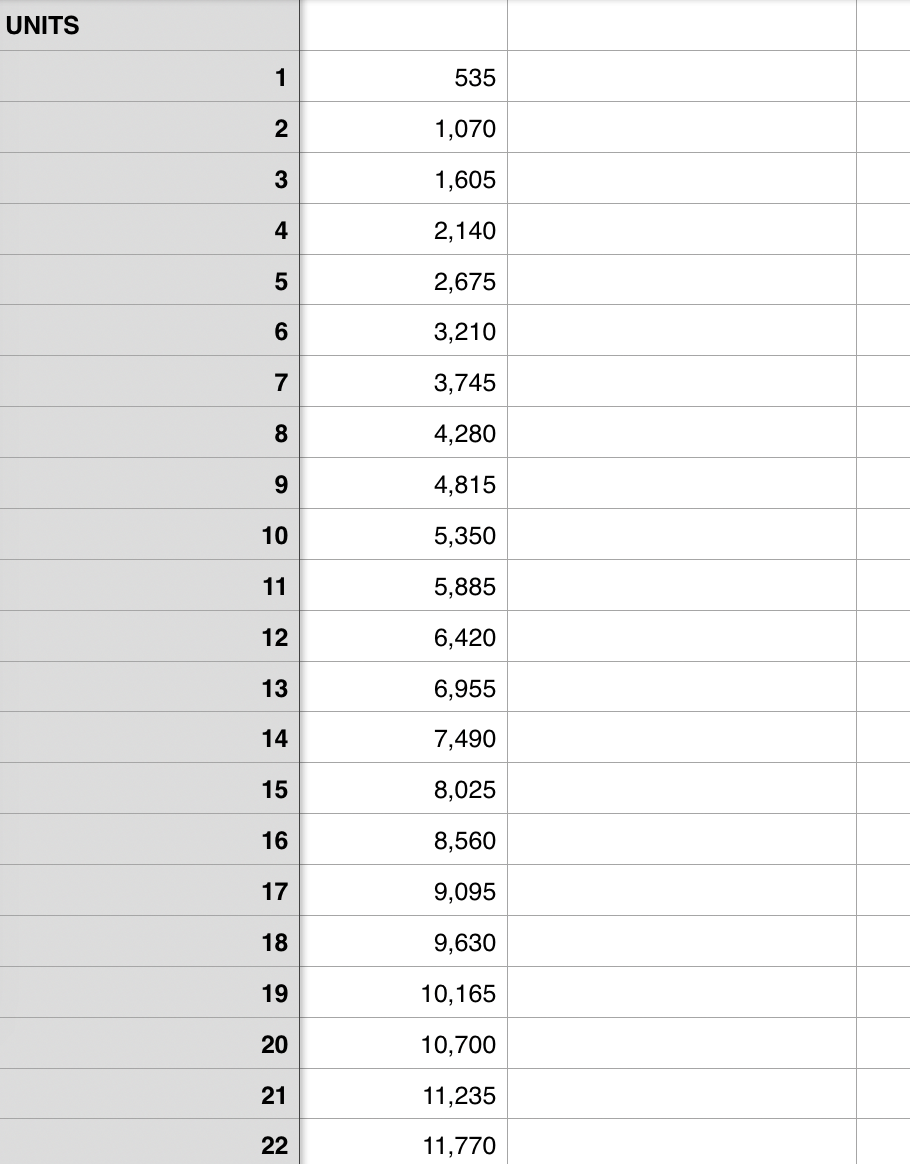
If your really good at it, you will have hundreds if not thousands of units:
If you time it just right, not only will you have the above cashflow, it will also double once the bank is paid off in full at the end of the loan term. Just think if you keep folding that money over till your age 65, and then your $539,000 monthly income, becomes $1,078,000 monthly income!
@Matt Finneseth I am often amazed at the almost moral objection that some people express when this topic comes up. The answer is not as simple as they claim. All of the following.
1) Do you have any high interest debt? Of course you should pay off the highest interest rate debts you have first.
2) Are you able to fund ALL of the great deals you find? This will depend on what part of the real estate cycle we are in. If you are missing out on great deals you should increase leverage not decrease it. Remember you want to buy the most properties at BOTTOM prices, not at the top of the market.
3) Will all of your properties cash flow with the next down turn in the rental market? If your properties cannot withstand at least a 10% reduction in rents and still cash flow they might be over leveraged. Increasing equity and then extending the terms of the loans is a major way of controlling this.
So if you have paid off your credit cards... here is what I would suggest. At the top of the market be more conservative with leverage. At the bottom of the market be more liberal.
Let's recognize that all input here is just a drop in a large bucket of opinion, even with graphs. That's what these (albeit good) discussions tend to turn into.
You're right! And I definitely appreciate all of the feedback being provided in this thread. However, I'm not looking for conjecture or common consensus, I'm looking for quantification. There are a lot of numbers to be crunched here because I am new to REI, but I don't understand the trend of saying that the tenant is paying the mortgage and CapX. The tenant's name isn't on the loan, mine is. It is my property and I am liable for all of it's expenses, full stop. So when people say not to pay down additional principle to save myself, what was it? Fifty-some grand? In interest over the term of the loan, I'm confused. That's ~$50,000 that isn't lining my pocket.
Additionally, the mortgage is the biggest expense on the property. Once the mortgage gets paid off, I get to retain significantly more of the revenues from renting the property out, and I get to keep all of the proceeds from the sale when the time comes. Also, by building more equity in my property I will be able to leverage that equity for even more financing, as shown by my calculations above.
I understand the logic behind not putting additional money towards principle in order to reinvest it for a bigger return, but I am not seeing any numbers behind it. Like you guys, I'm all for maximizing profits here, but I require the data to help back it up.
You may not know it - but I am one of the most anti-debt investors on here, so I totally get what you're saying and why.
The absolute dollar savings of $50k over 20 years or however long has to be put in context with the opportunity cost of those monies had they been invested in something else that earned more than your mortgage rate minus tax benefits.
I may have missed it, but what is the interest rate of the mortgage you are paying on in this example? Is it residential? Is it fixed?
For me, it's a simple snowball. After funding reserves and an acquisition account, the mortgages with the highest rate and/or highest hassle factor or risk are going bye-bye. My next one is a 10 unit mixed-use in 2019. Commercial PITA. With more risk than a residential. Then I have one at 7.99% going away a year or so later. I'm with you on wanting to reduce debt, believe me!
There has to be a reason other than the $50k in long-term savings. If that prevented you from buying another asset you really wanted at a great price and great terms, the real cost could be far higher. If you're only saving 3-ish% minus (the minimal, granted) tax benefits, I think the opportunity cost is too high. Too easy to beat that return in many asset classes.
Mortgage interest is tax deductible so figures based upon interest paid is nonsense.
I'm an accountant so I understand this. However, the keyword here is deductible. It is not tax free. Let's use the example above, except that the properties rent at a decent 1.5%. In year 10, Property A is still paying the mortgage and Property B has it completely paid off. Property A will be paying out $6,080.22 on the loan, $3,663.34 of which is going towards interest.
Year 10
Property A
Payments: $6,080.22 ($3,663.34 in interest)
CF (CapX excluded): $11,919.78 ($18,000-6,080.22)
Marginal Tax Rate: 33%
Deduction: $1,209.00
Tax on CF: $4,731.10
Post-Tax Income: $7,188.68
Property B
Payments: $0 (0$ interest)
CF (CapX excluded): $18,000
Marginal Tax Rate: 33%
Deduction: $0
Tax on CF: $5,940.00
Post-Tax Income: $12,060.00
Extrapolated over the remainder of the mortgage's term (20.6 years), my after-tax marginal income from this property is $100,349.19. I paid in $56,400 additionally towards principle over the 9.4 year term of the loan, so my net is $43,949.19. So, in this scenario, if I am doing a medium to long-term B&H strategy, this will net greater cash flows. Please correct me if I am wrong. If $43,949.19 is negligible to you, then you are absolutely right and considerations for interest paid is nonsense. I don't believe that to be the case, though.
Allowing equity to lie dead in a rental property is a hoarder mentality. True investors realise that the opportunity value of money far exceeds any savings generated by paying down a mortgage on a rental property. Paying down what amounts to practically free money today is nickels and dimes to a investor that can take that cash and reinvest at a 10% or better return in another property. Pay down a investment property mortgage saving 3-4% or invest in additional properties earning 10%+. Investors know the difference. The reality is that equity in a rental reduces the cash flow, it does not increase it, due to the portion of the income needing to be attributed to the dead equity.
If on the other hand you are not a investor and simply own a single rental property then it makes no difference whether you keep your money under your mattress or pay down your mortgage. You are not managing money you are hording it.
Let's recognize that all input here is just a drop in a large bucket of opinion, even with graphs. That's what these (albeit good) discussions tend to turn into.
You're right! And I definitely appreciate all of the feedback being provided in this thread. However, I'm not looking for conjecture or common consensus, I'm looking for quantification. There are a lot of numbers to be crunched here because I am new to REI, but I don't understand the trend of saying that the tenant is paying the mortgage and CapX. The tenant's name isn't on the loan, mine is. It is my property and I am liable for all of it's expenses, full stop. So when people say not to pay down additional principle to save myself, what was it? Fifty-some grand? In interest over the term of the loan, I'm confused. That's ~$50,000 that isn't lining my pocket.
Additionally, the mortgage is the biggest expense on the property. Once the mortgage gets paid off, I get to retain significantly more of the revenues from renting the property out, and I get to keep all of the proceeds from the sale when the time comes. Also, by building more equity in my property I will be able to leverage that equity for even more financing, as shown by my calculations above.
I understand the logic behind not putting additional money towards principle in order to reinvest it for a bigger return, but I am not seeing any numbers behind it. Like you guys, I'm all for maximizing profits here, but I require the data to help back it up.
You may not know it - but I am one of the most anti-debt investors on here, so I totally get what you're saying and why.
The absolute dollar savings of $50k over 20 years or however long has to be put in context with the opportunity cost of those monies had they been invested in something else that earned more than your mortgage rate minus tax benefits.
I may have missed it, but what is the interest rate of the mortgage you are paying on in this example? Is it residential? Is it fixed?
For me, it's a simple snowball. After funding reserves and an acquisition account, the mortgages with the highest rate and/or highest hassle factor or risk are going bye-bye. My next one is a 10 unit mixed-use in 2019. Commercial PITA. With more risk than a residential. Then I have one at 7.99% going away a year or so later. I'm with you on wanting to reduce debt, believe me!
There has to be a reason other than the $50k in long-term savings. If that prevented you from buying another asset you really wanted at a great price and great terms, the real cost could be far higher. If you're only saving 3-ish% minus (the minimal, granted) tax benefits, I think the opportunity cost is too high. Too easy to beat that return in many asset classes.
Thanks, I appreciate it! I'm just trying to do some comps to determine what my strategy would be for climbing the property ladder. I want to deal in apartment complexes and not SFH, so that may be the reason for all the backlash. This isn't necessarily a strategy for every single property I buy up. I'm just looking to make the most amount of cash in the least amount of time or generate enough equity in the least amount of time so I can leverage that equity to put a down payment on an apartment complex and run the numbers to strategize from there. Lot's of computations to be done haha.
@Matt Finneseth It is possible to find great deals to make the $43,949 seem small and unimportant. BUT you will not do it by buying retail and saying.... "price is not important. I will dollar cost average my way out of it."
Let's recognize that all input here is just a drop in a large bucket of opinion, even with graphs. That's what these (albeit good) discussions tend to turn into.
You're right! And I definitely appreciate all of the feedback being provided in this thread. However, I'm not looking for conjecture or common consensus, I'm looking for quantification. There are a lot of numbers to be crunched here because I am new to REI, but I don't understand the trend of saying that the tenant is paying the mortgage and CapX. The tenant's name isn't on the loan, mine is. It is my property and I am liable for all of it's expenses, full stop. So when people say not to pay down additional principle to save myself, what was it? Fifty-some grand? In interest over the term of the loan, I'm confused. That's ~$50,000 that isn't lining my pocket.
Additionally, the mortgage is the biggest expense on the property. Once the mortgage gets paid off, I get to retain significantly more of the revenues from renting the property out, and I get to keep all of the proceeds from the sale when the time comes. Also, by building more equity in my property I will be able to leverage that equity for even more financing, as shown by my calculations above.
I understand the logic behind not putting additional money towards principle in order to reinvest it for a bigger return, but I am not seeing any numbers behind it. Like you guys, I'm all for maximizing profits here, but I require the data to help back it up.
You may not know it - but I am one of the most anti-debt investors on here, so I totally get what you're saying and why.
The absolute dollar savings of $50k over 20 years or however long has to be put in context with the opportunity cost of those monies had they been invested in something else that earned more than your mortgage rate minus tax benefits.
I may have missed it, but what is the interest rate of the mortgage you are paying on in this example? Is it residential? Is it fixed?
For me, it's a simple snowball. After funding reserves and an acquisition account, the mortgages with the highest rate and/or highest hassle factor or risk are going bye-bye. My next one is a 10 unit mixed-use in 2019. Commercial PITA. With more risk than a residential. Then I have one at 7.99% going away a year or so later. I'm with you on wanting to reduce debt, believe me!
There has to be a reason other than the $50k in long-term savings. If that prevented you from buying another asset you really wanted at a great price and great terms, the real cost could be far higher. If you're only saving 3-ish% minus (the minimal, granted) tax benefits, I think the opportunity cost is too high. Too easy to beat that return in many asset classes.
Thanks, I appreciate it! I'm just trying to do some comps to determine what my strategy would be for climbing the property ladder. I want to deal in apartment complexes and not SFH, so that may be the reason for all the backlash. This isn't necessarily a strategy for every single property I buy up. I'm just looking to make the most amount of cash in the least amount of time or generate enough equity in the least amount of time so I can leverage that equity to put a down payment on an apartment complex and run the numbers to strategize from there. Lot's of computations to be done haha.
I hope you don't construe all this as backlash. It's a good but redundant discussion. The same points are made over and over by pretty much the same characters. Most all of them little residential house investors.
It would help if title said: COMMERCIAL APT BUILDING LOAN at 5%, 5-YR CALL AND RATE ADJUST. ANNUAL REPORTING REQUIREMENTS.
WOULD YOU PAY THIS OFF EARLY?
Most of the refi till you die SFR folks would back off. Cheers!
I am not a small time investor in SFHs, I hate the idea of investing in SFHs.
No I would not pay it off. Cash is far too valuable to hoard.
Didn't mean little investors, Greg. Investors in little houses.
So no factor - calls, adjustable rates, reporting requirements, interest rate - would ever cause you to pay off a debt early?
I think I know your answer, but please advise. Thanks!
Heres a simple example. assume values/rents don't rise or fall unless of a crash
scenario 1:
I have 100k
I invest all of it in a 100k SFH, and make $500 CF/month off of it after all expenses. in like 3.33 year I'll have 20k to put down on another 100k house and since this one is on a mortgage, I'll only make $150 CF/Month. This along with my fully paid rental will take like 10 years before I pay that one off. Now after almost 15 years from my initial investment, Ill have 200k equity in 2 properties with only 1k/month in CF.
damn the market popped in 15 years and my houses are only worth 50k each. shoot, now I only have 100k in value, and 1k/month CF
scenario 2 (leverage):
I have 100k
I buy 5x 100k properties and make $150 CF/Month per house. that's $750 Total/Month off the bat and overall I still have 100k of equity (5x 20k). After just 2.22 years, I'll be able to afford another 100k rental at 20% down. my CF goes up to $900 now and I still have 120k+ equity (obviously a little gets paid off over 2 years in the other 5 places). In only 1.85 years, I'll buy another at 20% down and my CF goes up to 1050 and I have around 140k+ in equity. Rinse and repeat! You'll hit your cap of 10 mortgages before 15 years and have at least 200k in equity, but ALSO CF of at least $1500/month.
crap the market pooped like in scenario 1, so your equity dropped to 100k but look you're still cashflowing 500 more per month than scenario 1.
sure there's more risk in vacancies with more properties, but honestly if you don't trust yourself to fill vacancies, you shouldn't be in this business in the first place.
Hope that helps :)
Albert Einstein once said, "The greatest invention of the 20th century is compound interest". What he said after that is more important, he said,"..those that understand it, will live off of those that don't"
In this case, the compounding effect comes from the exponential use of the cash...not, the paying down of the debt...of which is being paid by the tenant.
The tenant is giving a landlord rent money. The tenant is paying for the mortgage, the expenses, etc...including the income (cash flow) to the landlord. The cash flow is YOUR money. When you take your money, and help the tenant pay for the expenses, you are missing out on the exponential (compounding) use of your cash.
There are only 2 Rules to REI.
Golden Rule #1 of REI: Never under any circumstances spend your cash"
The problem I have and always will have with the concept of "paying off a mortgage" is that the opportunity value of cash will always be higher than any prevailing mortgage interest rates. Equity creates it's own income stream. It does not increase the income from a property because equity needs to be feed. When a investor understands the value of equity you understand that it funnels money away from the property income eventually reduces the cash flow from the rental property itself to zero and usually negative. At that point in time owning the rental is simply a PITA to have since the equity is the only thing earning a income and probably a low Income to boot since the maintenance of the property is a negative contributing factor.
Saving a few % points on a mortgage does not come close to the opportunity value of cash.
The increased income from paying down a mortgage is a misconception as you are actually decreasing income due to lost income the equity could be generating elsewhere. It is a understanding of the bigger picture of investing as opposed to looking at it as individual parts.
Investing success often has a lot to do with tricking the mind. This is what cash buyers are doing when they boast that equity increases cash flow. All it really does is appease their low risk tolerance.