Investor · Charlotte, NC · Member since 2020 · 43 posts · 9 votes
Hello all,
I will appreciate any advice on this out of state investment deal that has gone bad due to higher than anticipated property tax. This was my very first investment in real estate. I had entered real estate investing with goal of long term buy & hold.
I bought a new built SFH for $293,000 (4bedroom,2.5bath, 1800 sq ft) from a turn key company. Based on their proforma, property tax was estimated $3500. Actual property tax bill is now $10,000. I bought this property using a traditional 30 year mortgage with 25% DP and 6.125% interest rate. This investment deal was breaking even accounting for all expenses (PM, insurance, property tax etc.) prior to this high property tax bill.
Now with higher property tax, it’s negative cash flow of $1000/month.
What is the best financial move with this property? Sell it at a loss?, Do a 1031 exchange for another investment property with positive cash flow?, refinance to a lower mortgage rate?. Other options?
I will really appreciate any advice your can offer.
P.S. I missed deadline to appeal property tax with county. Based on another property in same subdivision that is similar to mine, their property tax was less by ~$800 less so appealing property tax may certainly help some but it is not going to transform this deal into a break even or positive cash flow deal.
Attorney · Philadelphia · Member since 2018 · 2k+ posts · 3k+ votes
7mo
@Pratik Patel I’m not following the numbers here. There appears to be more at odds with the original assumptions than solely the property taxes. If the property was breaking even under the initial estimate of $3,500 per year in taxes, it should not suddenly be $1,000 per month negative simply because the actual tax bill is $6,500 per year more, or roughly $540 per month. While the tax assumption miss is significant, that difference alone does not account for such a large swing. Where else were the underwriting assumptions off?
From there, you have to ask whether there is any reason to believe this property will achieve meaningful appreciation or rent increases in the near term. That question has to be balanced against the cost of exiting the investment so quickly. Once you account for transactional expenses such as brokerage commissions, transfer taxes, and other closing costs, the decision becomes more complicated. You also need to consider potential inspection-related repair addendums (these turn keys tend to have a lot of issues on re-inspection), as well as whether the property, if leased, will be marketable to the highest-paying buyer. In some cases, maximizing the sale price may require vacating the unit and turning it over before listing. This will be market and neighborhood specific. All of those factors should be weighed against the possibility that holding for a few years could produce a better outcome
Lender · Florida / Georgia · Member since 2025 · 58 posts · 28 votes
7mo
Seems like the proforma was off by 200%. My guess is the proforma used the land only tax amount. When a new construction home gets newly built. The county often hasn't reassessed it yet. So the tax bill still reflects vacant land, not a completed 4 bedroom home. They must have plugged that number into the proforma.
Once the county reassesses the finished home, the tax bill can easily triple. Especially if you are an investor and are not homesteading the property as a primary residence.
If you used a third party lender and not the builders lender they should have alerted you to this.
Refinancing may not make sense if rates do not come down enough for you to break even on the payment. If $10K is the actual tax amount. This still gets included into your monthly mortgage payment even if you refinance.
My suggestion is to do some math to figure out if you should sell vs hold it:
If you’re negative $1,000/mo, that’s $12,000/yr. What does that look like if you sold today? What would you lose if you held for 12-24 months and you are able to normalize to a degree the tax amount?
Sometimes the “loss” from selling is actually cheaper than holding a bleeding asset. Other times, the long‑term upside outweighs the short‑term pain. Look at other ways to monetize the property other than a 12 month rental ( Airbnb, Midterm Rental, Corporate Rental ).
Definitely start the process of appealing and move forward from there.
Investor · Charlotte, NC · Member since 2020 · 43 posts · 9 votes
7mo
Thank you Samuel for your input.
Holding on to this property as a long term rental will lead to negative return on my investment so that is not practical. This deal will still have negative cash flow in year 30 when I pay off mortgage. I will keep in mind your advice about using a 3rd party lender not affiliated with seller for next time.
Holding on to this property as a long term rental will lead to negative return on my investment so that is not practical. This deal will still have negative cash flow in year 30 when I pay off mortgage. I will keep in mind your advice about using a 3rd party lender not affiliated with seller for next time.
There is more than cash flow to consider when you are buying a home as a rental. There is the fact that the tenants are paying for most of the expenses as well as the house appreciating. So overtime they are paying down the mortgage and covering your expenses. I don't see how you will have negative cash flow in 30 years once the mortgage is paid off. For most people the mortgage is the biggest expense though if you are in an area where property taxes on a $300K home are $10K that may not be the case (I've never seen taxes that high on a house that price-where I am they are 1% or less).
Your property taxes were $6500 more than expected which over the course of a year is just over $500 a month-so why are you down $1000 a month? Was it negative cash flow to begin with, did it rent for significantly lower then expected?
Holding on to this property as a long term rental will lead to negative return on my investment so that is not practical. This deal will still have negative cash flow in year 30 when I pay off mortgage. I will keep in mind your advice about using a 3rd party lender not affiliated with seller for next time.
WHy don't you share more about your mortgage, property tax and insurance monthly amounts, because it is ASTOUNDING that you won't positive cashflow in year 30 when the mortgage is paid off 😡
Also, who is the turnkey provider? There is ZERO chance they didn't know about this property tax adjustment. More likely, they deliberately avoided disclosing or discussing it because they know most investors wouldn't buy with higher property taxes. Worse-case, they would ahve been on top of helping you with your property tax appeal to lessen the increase.
Holding on to this property as a long term rental will lead to negative return on my investment so that is not practical. This deal will still have negative cash flow in year 30 when I pay off mortgage. I will keep in mind your advice about using a 3rd party lender not affiliated with seller for next time.
WHy don't you share more about your mortgage, property tax and insurance monthly amounts, because it is ASTOUNDING that you won't positive cashflow in year 30 when the mortgage is paid off 😡
Also, who is the turnkey provider? There is ZERO chance they didn't know about this property tax adjustment. More likely, they deliberately avoided disclosing or discussing it because they know most investors wouldn't buy with higher property taxes. Worse-case, they would ahve been on top of helping you with your property tax appeal to lessen the increase.
Hello Drew,
Thank you for your input. Here is a detailed breakdown. I will appreciate any further advice from you and others in BP community.
Purchase price: $293,000
Closing costs including 25% DP: $80,000
30 year old Loan: ~$220,000 at 6.125% rate
Monthly mortgage payment PRIOR to higher property tax: $1863 (Principal & Interest $1335, Escrow has tax and insurance: $528)
Property tax in proforma when I bought it last year: $3500
New property tax annually: $11,000 (that’s actual amount not $10,000…sorry)
Monthly mortgage payment AFTER rise in property tax…this payment starts in March: $2970 (Principal & Interest $1335 + Escrow has tax and insurance: $1005 + Escrow shortage due to higher property tax: $630. This escrow shortage would go away after next 12 months but I am still left with new property tax amount of $11,000 annually for following year)
Cash flow AFTER rise in property tax: (rent – (mortgage $2970 + PM fee))= Negative ~$1000/month
Holding on to this property as a long term rental will lead to negative return on my investment so that is not practical. This deal will still have negative cash flow in year 30 when I pay off mortgage. I will keep in mind your advice about using a 3rd party lender not affiliated with seller for next time.
WHy don't you share more about your mortgage, property tax and insurance monthly amounts, because it is ASTOUNDING that you won't positive cashflow in year 30 when the mortgage is paid off 😡
Also, who is the turnkey provider? There is ZERO chance they didn't know about this property tax adjustment. More likely, they deliberately avoided disclosing or discussing it because they know most investors wouldn't buy with higher property taxes. Worse-case, they would ahve been on top of helping you with your property tax appeal to lessen the increase.
Hello Drew,
Thank you for your input. Here is a detailed breakdown. I will appreciate any further advice from you and others in BP community.
Purchase price: $293,000
Closing costs including 25% DP: $80,000
30 year old Loan: ~$220,000 at 6.125% rate
Monthly mortgage payment PRIOR to higher property tax: $1863 (Principal & Interest $1335, Escrow has tax and insurance: $528)
Property tax in proforma when I bought it last year: $3500
New property tax annually: $11,000 (that’s actual amount not $10,000…sorry)
Monthly mortgage payment AFTER rise in property tax…this payment starts in March: $2970 (Principal & Interest $1335 + Escrow has tax and insurance: $1005 + Escrow shortage due to higher property tax: $630. This escrow shortage would go away after next 12 months but I am still left with new property tax amount of $11,000 annually for following year)
Cash flow AFTER rise in property tax: (rent – (mortgage $2970 + PM fee))= Negative ~$1000/month
This property was always negative because you are excluding a lot of expenses and vacancy. Did your underwriting not include maintenance, cap ex, vacancy, asset protection, book keeping/accounting, etc?
The cash flow now (after the property tax increase) is far greater than $1k negative per month for the same reason.
Clearly it is more negative now but I believe this is a blessing because you now recognize this is a large cash flow negative property versus before you were under a false premise of positive cash flow. This would have had significant negative cash prior to the property tax increase.
Assuming you do not want to feed your investment to the tune of ~$1500/month sustained costs, there are a few options to keep it. Alternative rent model such as STR or rent by room may be an option but they come with more effort and more risk
Similarly there are alternative sell options such as lease to own. This has downside that it ties up your finances in this asset.
I suspect your best option is a traditional mls listing.
By the way, the turn key provider almost certainly knew of the pending property tax. They likely intentionally kept it from you because even a poor underwriting would show this to be a poor investment with a 3.75% property tax rate. It is my view they likely intentionally took advantage of you and your inexperience. They relied on you not finding out the true property tax amount and other underwriting short comings to sell a property that is a real poor investment property. If you did not buy it, it is possible they would have found someone else to take advantage of but it is also possible that they would have been stuck with this loser property. You should name the turnkey seller so they are less likely to be able to take advantage of another newbie RE investor.
Holding on to this property as a long term rental will lead to negative return on my investment so that is not practical. This deal will still have negative cash flow in year 30 when I pay off mortgage. I will keep in mind your advice about using a 3rd party lender not affiliated with seller for next time.
WHy don't you share more about your mortgage, property tax and insurance monthly amounts, because it is ASTOUNDING that you won't positive cashflow in year 30 when the mortgage is paid off 😡
Also, who is the turnkey provider? There is ZERO chance they didn't know about this property tax adjustment. More likely, they deliberately avoided disclosing or discussing it because they know most investors wouldn't buy with higher property taxes. Worse-case, they would ahve been on top of helping you with your property tax appeal to lessen the increase.
Hello Drew,
Thank you for your input. Here is a detailed breakdown. I will appreciate any further advice from you and others in BP community.
Purchase price: $293,000
Closing costs including 25% DP: $80,000
30 year old Loan: ~$220,000 at 6.125% rate
Monthly mortgage payment PRIOR to higher property tax: $1863 (Principal & Interest $1335, Escrow has tax and insurance: $528)
Property tax in proforma when I bought it last year: $3500
New property tax annually: $11,000 (that’s actual amount not $10,000…sorry)
Monthly mortgage payment AFTER rise in property tax…this payment starts in March: $2970 (Principal & Interest $1335 + Escrow has tax and insurance: $1005 + Escrow shortage due to higher property tax: $630. This escrow shortage would go away after next 12 months but I am still left with new property tax amount of $11,000 annually for following year)
Cash flow AFTER rise in property tax: (rent – (mortgage $2970 + PM fee))= Negative ~$1000/month
Taxes were $3500, now $11k => +$7,500 / 12 = $625 increase/month
Mortgage P&I $1,335 + $917 Tax + (Ins $1k/12 = $83) => TOTAL PITI $2,335
So, your actual negative cashflow is $2180 - $2335 = -$155/month
The escrow shortage is an interest free "loan" from your lender and shouldn't really be included in your analysis.
So, you're losing $155/month, but rents and value should increase over time - unless you didn't analyse the market correctly.
Negative monthly cashflow is not uncommon for the first 3-5 years of owning a Class A rental. We post about this all the time.
The positive tradeoff should be better tenants and less maintenance.
Holding on to this property as a long term rental will lead to negative return on my investment so that is not practical. This deal will still have negative cash flow in year 30 when I pay off mortgage. I will keep in mind your advice about using a 3rd party lender not affiliated with seller for next time.
WHy don't you share more about your mortgage, property tax and insurance monthly amounts, because it is ASTOUNDING that you won't positive cashflow in year 30 when the mortgage is paid off 😡
Also, who is the turnkey provider? There is ZERO chance they didn't know about this property tax adjustment. More likely, they deliberately avoided disclosing or discussing it because they know most investors wouldn't buy with higher property taxes. Worse-case, they would ahve been on top of helping you with your property tax appeal to lessen the increase.
Hello Drew,
Thank you for your input. Here is a detailed breakdown. I will appreciate any further advice from you and others in BP community.
Purchase price: $293,000
Closing costs including 25% DP: $80,000
30 year old Loan: ~$220,000 at 6.125% rate
Monthly mortgage payment PRIOR to higher property tax: $1863 (Principal & Interest $1335, Escrow has tax and insurance: $528)
Property tax in proforma when I bought it last year: $3500
New property tax annually: $11,000 (that’s actual amount not $10,000…sorry)
Monthly mortgage payment AFTER rise in property tax…this payment starts in March: $2970 (Principal & Interest $1335 + Escrow has tax and insurance: $1005 + Escrow shortage due to higher property tax: $630. This escrow shortage would go away after next 12 months but I am still left with new property tax amount of $11,000 annually for following year)
Cash flow AFTER rise in property tax: (rent – (mortgage $2970 + PM fee))= Negative ~$1000/month
Taxes were $3500, now $11k => +$7,500 / 12 = $625 increase/month
Mortgage P&I $1,335 + $917 Tax + (Ins $1k/12 = $83) => TOTAL PITI $2,335
So, your actual negative cashflow is $2180 - $2335 = -$155/month
The escrow shortage is an interest free "loan" from your lender and shouldn't really be included in your analysis.
So, you're losing $155/month, but rents and value should increase over time - unless you didn't analyse the market correctly.
Negative monthly cashflow is not uncommon for the first 3-5 years of owning a Class A rental. We post about this all the time.
The positive tradeoff should be better tenants and less maintenance.
Rent minus piti does not equate to cash flow. What about the other expenses/costs: maintenance, cap ex, vacancy, PM (even when self managing it should be allocated unless you like to work for free), book keeping/accounting, asset protection, etc.
I hope you are not making this claim to your clients.
This home would be large negative if the monthly rent ratio was 1% because the property tax alone consumes 3.5 months of rent. If that is not bad enough, price combined with financing consumes $1335/months. The interest rate combined with the price compared to the rent make this a poor investment even if the property tax was more modest.
Why do we invest in active residential RE with the associated effort and risks? Should we ever consider doing this if the projected return is below the lifetime s&p annual return of 10%? My view is NO! I typically would not even consider active residential RE investing at a projected 20%/year return, but I am a bit spoiled in my RE returns. Too much risk and effort for the return.
So what is the upside on this property? The 3.5% property tax rate will impact this property’s performance even when it appreciates and has rent growth. It makes this property a poor investment and it is best served being an owner occupied home.
Holding on to this property as a long term rental will lead to negative return on my investment so that is not practical. This deal will still have negative cash flow in year 30 when I pay off mortgage. I will keep in mind your advice about using a 3rd party lender not affiliated with seller for next time.
WHy don't you share more about your mortgage, property tax and insurance monthly amounts, because it is ASTOUNDING that you won't positive cashflow in year 30 when the mortgage is paid off 😡
Also, who is the turnkey provider? There is ZERO chance they didn't know about this property tax adjustment. More likely, they deliberately avoided disclosing or discussing it because they know most investors wouldn't buy with higher property taxes. Worse-case, they would ahve been on top of helping you with your property tax appeal to lessen the increase.
Hello Drew,
Thank you for your input. Here is a detailed breakdown. I will appreciate any further advice from you and others in BP community.
Purchase price: $293,000
Closing costs including 25% DP: $80,000
30 year old Loan: ~$220,000 at 6.125% rate
Monthly mortgage payment PRIOR to higher property tax: $1863 (Principal & Interest $1335, Escrow has tax and insurance: $528)
Property tax in proforma when I bought it last year: $3500
New property tax annually: $11,000 (that’s actual amount not $10,000…sorry)
Monthly mortgage payment AFTER rise in property tax…this payment starts in March: $2970 (Principal & Interest $1335 + Escrow has tax and insurance: $1005 + Escrow shortage due to higher property tax: $630. This escrow shortage would go away after next 12 months but I am still left with new property tax amount of $11,000 annually for following year)
Cash flow AFTER rise in property tax: (rent – (mortgage $2970 + PM fee))= Negative ~$1000/month
Taxes were $3500, now $11k => +$7,500 / 12 = $625 increase/month
Mortgage P&I $1,335 + $917 Tax + (Ins $1k/12 = $83) => TOTAL PITI $2,335
So, your actual negative cashflow is $2180 - $2335 = -$155/month
The escrow shortage is an interest free "loan" from your lender and shouldn't really be included in your analysis.
So, you're losing $155/month, but rents and value should increase over time - unless you didn't analyse the market correctly.
Negative monthly cashflow is not uncommon for the first 3-5 years of owning a Class A rental. We post about this all the time.
The positive tradeoff should be better tenants and less maintenance.
Rent minus piti does not equate to cash flow. What about the other expenses/costs: maintenance, cap ex, vacancy, PM (even when self managing it should be allocated unless you like to work for free), book keeping/accounting, asset protection, etc.
I hope you are not making this claim to your clients.
This home would be large negative if the monthly rent ratio was 1% because the property tax alone consumes 3.5 months of rent. If that is not bad enough, price combined with financing consumes $1335/months. The interest rate combined with the price compared to the rent make this a poor investment even if the property tax was more modest.
Why do we invest in active residential RE with the associated effort and risks? Should we ever consider doing this if the projected return is below the lifetime s&p annual return of 10%? My view is NO! I typically would not even consider active residential RE investing at a projected 20%/year return, but I am a bit spoiled in my RE returns. Too much risk and effort for the return.
So what is the upside on this property? The 3.5% property tax rate will impact this property’s performance even when it appreciates and has rent growth. It makes this property a poor investment and it is best served being an owner occupied home.
Good luck
I don’t know if this was already covered, but what city and state is the property in? Also, do you know why the property taxes tripled—was it due to a higher rate for non-owner-occupied properties, or did the assessed value jump after the sale?
Did you get an appraisal at purchase? I usually compare my underwriting assumptions against both the appraisal and the county assessment. A big gap there is often an early warning sign that taxes are going to reset higher the following year.
Holding on to this property as a long term rental will lead to negative return on my investment so that is not practical. This deal will still have negative cash flow in year 30 when I pay off mortgage. I will keep in mind your advice about using a 3rd party lender not affiliated with seller for next time.
WHy don't you share more about your mortgage, property tax and insurance monthly amounts, because it is ASTOUNDING that you won't positive cashflow in year 30 when the mortgage is paid off 😡
Also, who is the turnkey provider? There is ZERO chance they didn't know about this property tax adjustment. More likely, they deliberately avoided disclosing or discussing it because they know most investors wouldn't buy with higher property taxes. Worse-case, they would ahve been on top of helping you with your property tax appeal to lessen the increase.
Hello Drew,
Thank you for your input. Here is a detailed breakdown. I will appreciate any further advice from you and others in BP community.
Purchase price: $293,000
Closing costs including 25% DP: $80,000
30 year old Loan: ~$220,000 at 6.125% rate
Monthly mortgage payment PRIOR to higher property tax: $1863 (Principal & Interest $1335, Escrow has tax and insurance: $528)
Property tax in proforma when I bought it last year: $3500
New property tax annually: $11,000 (that’s actual amount not $10,000…sorry)
Monthly mortgage payment AFTER rise in property tax…this payment starts in March: $2970 (Principal & Interest $1335 + Escrow has tax and insurance: $1005 + Escrow shortage due to higher property tax: $630. This escrow shortage would go away after next 12 months but I am still left with new property tax amount of $11,000 annually for following year)
Cash flow AFTER rise in property tax: (rent – (mortgage $2970 + PM fee))= Negative ~$1000/month
Taxes were $3500, now $11k => +$7,500 / 12 = $625 increase/month
Mortgage P&I $1,335 + $917 Tax + (Ins $1k/12 = $83) => TOTAL PITI $2,335
So, your actual negative cashflow is $2180 - $2335 = -$155/month
The escrow shortage is an interest free "loan" from your lender and shouldn't really be included in your analysis.
So, you're losing $155/month, but rents and value should increase over time - unless you didn't analyse the market correctly.
Negative monthly cashflow is not uncommon for the first 3-5 years of owning a Class A rental. We post about this all the time.
The positive tradeoff should be better tenants and less maintenance.
Rent minus piti does not equate to cash flow. What about the other expenses/costs: maintenance, cap ex, vacancy, PM (even when self managing it should be allocated unless you like to work for free), book keeping/accounting, asset protection, etc.
I hope you are not making this claim to your clients.
This home would be large negative if the monthly rent ratio was 1% because the property tax alone consumes 3.5 months of rent. If that is not bad enough, price combined with financing consumes $1335/months. The interest rate combined with the price compared to the rent make this a poor investment even if the property tax was more modest.
Why do we invest in active residential RE with the associated effort and risks? Should we ever consider doing this if the projected return is below the lifetime s&p annual return of 10%? My view is NO! I typically would not even consider active residential RE investing at a projected 20%/year return, but I am a bit spoiled in my RE returns. Too much risk and effort for the return.
So what is the upside on this property? The 3.5% property tax rate will impact this property’s performance even when it appreciates and has rent growth. It makes this property a poor investment and it is best served being an owner occupied home.
Good luck
Really?
I kept this simple to show the poster that his basic analysis of the property taxes vs cashflow was flawed.
If you really want to get into the weeds, why don't you post your anaylsis, taking into account the amount the poster will lose via acquisition & sales costs, if he follows the advice to sell, versus how long it will take to recover those costs if he holds onto the property (break-even timeline). I have no idea of the outcome, but since you're smarter than I am maybe you do...
Holding on to this property as a long term rental will lead to negative return on my investment so that is not practical. This deal will still have negative cash flow in year 30 when I pay off mortgage. I will keep in mind your advice about using a 3rd party lender not affiliated with seller for next time.
WHy don't you share more about your mortgage, property tax and insurance monthly amounts, because it is ASTOUNDING that you won't positive cashflow in year 30 when the mortgage is paid off 😡
Also, who is the turnkey provider? There is ZERO chance they didn't know about this property tax adjustment. More likely, they deliberately avoided disclosing or discussing it because they know most investors wouldn't buy with higher property taxes. Worse-case, they would ahve been on top of helping you with your property tax appeal to lessen the increase.
Hello Drew,
Thank you for your input. Here is a detailed breakdown. I will appreciate any further advice from you and others in BP community.
Purchase price: $293,000
Closing costs including 25% DP: $80,000
30 year old Loan: ~$220,000 at 6.125% rate
Monthly mortgage payment PRIOR to higher property tax: $1863 (Principal & Interest $1335, Escrow has tax and insurance: $528)
Property tax in proforma when I bought it last year: $3500
New property tax annually: $11,000 (that’s actual amount not $10,000…sorry)
Monthly mortgage payment AFTER rise in property tax…this payment starts in March: $2970 (Principal & Interest $1335 + Escrow has tax and insurance: $1005 + Escrow shortage due to higher property tax: $630. This escrow shortage would go away after next 12 months but I am still left with new property tax amount of $11,000 annually for following year)
Cash flow AFTER rise in property tax: (rent – (mortgage $2970 + PM fee))= Negative ~$1000/month
Taxes were $3500, now $11k => +$7,500 / 12 = $625 increase/month
Mortgage P&I $1,335 + $917 Tax + (Ins $1k/12 = $83) => TOTAL PITI $2,335
So, your actual negative cashflow is $2180 - $2335 = -$155/month
The escrow shortage is an interest free "loan" from your lender and shouldn't really be included in your analysis.
So, you're losing $155/month, but rents and value should increase over time - unless you didn't analyse the market correctly.
Negative monthly cashflow is not uncommon for the first 3-5 years of owning a Class A rental. We post about this all the time.
The positive tradeoff should be better tenants and less maintenance.
Rent minus piti does not equate to cash flow. What about the other expenses/costs: maintenance, cap ex, vacancy, PM (even when self managing it should be allocated unless you like to work for free), book keeping/accounting, asset protection, etc.
I hope you are not making this claim to your clients.
This home would be large negative if the monthly rent ratio was 1% because the property tax alone consumes 3.5 months of rent. If that is not bad enough, price combined with financing consumes $1335/months. The interest rate combined with the price compared to the rent make this a poor investment even if the property tax was more modest.
Why do we invest in active residential RE with the associated effort and risks? Should we ever consider doing this if the projected return is below the lifetime s&p annual return of 10%? My view is NO! I typically would not even consider active residential RE investing at a projected 20%/year return, but I am a bit spoiled in my RE returns. Too much risk and effort for the return.
So what is the upside on this property? The 3.5% property tax rate will impact this property’s performance even when it appreciates and has rent growth. It makes this property a poor investment and it is best served being an owner occupied home.
Good luck
Really?
I kept this simple to show the poster that his basic analysis of the property taxes vs cashflow was flawed.
If you really want to get into the weeds, why don't you post your anaylsis, taking into account the amount the poster will lose via acquisition & sales costs, if he follows the advice to sell, versus how long it will take to recover those costs if he holds onto the property (break-even timeline). I have no idea of the outcome, but since you're smarter than I am maybe you do...
> I kept this simple to show the poster that his basic analysis of the property taxes vs cashflow was flawed.
simple in this case provided a very misleading cash flow.
> I have no idea of the outcome, but since you're smarter than I am maybe you do...
With some assumptions: - worth same as purchased - selling cost between 6% and 9%, in my underwriting I always use the conservative of any range so will be using 9% - my initial cash flow estimate will be used - 0% to 4% short term rent growth in current environment, I always use the conservative so 0% - 0% to 4% short term appreciation in current environment, I always use the conservative so 0%
$293k @ 9% =$26.37k cost to sell
Year 1 cash flow estimate negative 12*1500=18,000 Year 2 cash flow estimate negative 12*(1500-630)=$10,440 (reflects end of escrow make up payments) Total= $28,400 negative cash flow
Less than 2 years for the selling to be superior in terms of cost to sell versus to hold.
Let’s say the numbers are off by a lot and it would take 4 years. I do not care. Let’s say they are crazy off and it takes 10 year, I still do not care. I invest in RE to achieve returns far greater than I can get passively placing the money in the sp500. With a 3.5% property tax rate, does anyone who performs a fair amount of underwriting expect this property to produce far better than SP500? How about even a little better than sp500?
I see a lot of RE purchases that I suspect are unlikely to be good investments but I see few I am this sure is not a good RE investment. The 3.5% property tax rate is killing any chance. Do you see this out producing the sp500 lifetime 10% return? Do you see it far out producing the sp500 return to justify the work and risk of residential RE.
I have owned RE long enough to have first hand with a lot of risk. I have lost 4 units to hurricanes, 2 units to fire, have experienced an STR moratorium for half a year, experience multiple years of rent forebearance, experienced a crazy tenant protection that allowed the tenant to break every lease term not related to health and safety, have had some slightly bad tenants (luckily not many bad horror stories). My point is residential RE requires work and has risks. the return has to justify the work and risks.
Accountant · Chicago, IL · Member since 2018 · 2k+ posts · 1k+ votes
7mo
How soon can you appeal your taxes? I'm sure there's ways to do it and I'd recommend asking. I know that won't help get the taxes down but it will help.
Since it's a new single family home, in theory, there shouldn't be much repairs and capex for the first 5-10 years.
What does your income look like? Can you hold the property for a couple years with slightly negative cash flow? Rents should go up in theory over time so that you will have cash flow.
If you need to sell, I'd connect with your cpa to understand the tax implications. Given you recently bought it , there'd likely be minimal gain.
Accountant · Chicago, IL · Member since 2018 · 2k+ posts · 1k+ votes
7mo
Another thought: could you do rent by the room, short term rentals or medium term rentals in the area? There'd be some higher furnishing costs but it might for itself.
Attorney · Philadelphia · Member since 2018 · 2k+ posts · 3k+ votes
7mo
@Pratik Patel I’m not following the numbers here. There appears to be more at odds with the original assumptions than solely the property taxes. If the property was breaking even under the initial estimate of $3,500 per year in taxes, it should not suddenly be $1,000 per month negative simply because the actual tax bill is $6,500 per year more, or roughly $540 per month. While the tax assumption miss is significant, that difference alone does not account for such a large swing. Where else were the underwriting assumptions off?
From there, you have to ask whether there is any reason to believe this property will achieve meaningful appreciation or rent increases in the near term. That question has to be balanced against the cost of exiting the investment so quickly. Once you account for transactional expenses such as brokerage commissions, transfer taxes, and other closing costs, the decision becomes more complicated. You also need to consider potential inspection-related repair addendums (these turn keys tend to have a lot of issues on re-inspection), as well as whether the property, if leased, will be marketable to the highest-paying buyer. In some cases, maximizing the sale price may require vacating the unit and turning it over before listing. This will be market and neighborhood specific. All of those factors should be weighed against the possibility that holding for a few years could produce a better outcome
@Pratik Patel I’m not following the numbers here. There appears to be more at odds with the original assumptions than solely the property taxes. If the property was breaking even under the initial estimate of $3,500 per year in taxes, it should not suddenly be $1,000 per month negative simply because the actual tax bill is $6,500 per year more, or roughly $540 per month. While the tax assumption miss is significant, that difference alone does not account for such a large swing. Where else were the underwriting assumptions off?
From there, you have to ask whether there is any reason to believe this property will achieve meaningful appreciation or rent increases in the near term. That question has to be balanced against the cost of exiting the investment so quickly. Once you account for transactional expenses such as brokerage commissions, transfer taxes, and other closing costs, the decision becomes more complicated. You also need to consider potential inspection-related repair addendums (these turn keys tend to have a lot of issues on re-inspection), as well as whether the property, if leased, will be marketable to the highest-paying buyer. In some cases, maximizing the sale price may require vacating the unit and turning it over before listing. This will be market and neighborhood specific. All of those factors should be weighed against the possibility that holding for a few years could produce a better outcome
Thank you Stuard for your input. Here is a detailed breakdown. I will appreciate any further advice from you and others in BP community.
Purchase price: $293,000
Closing costs including 25% DP: $80,000
30 year old Loan: ~$220,000 at 6.125% rate
Monthly mortgage payment PRIOR to higher property tax: $1863 (Principal & Interest $1335, Escrow has tax and insurance: $528)
Property tax in proforma when I bought it last year: $3500
New property tax annually: $11,000 (that’s actual amount not $10,000…sorry)
Monthly mortgage payment AFTER rise in property tax…this payment starts in March: $2970 (Principal & Interest $1335 + Escrow has tax and insurance: $1005 + Escrow shortage due to higher property tax: $630. This escrow shortage would go away after next 12 months but I am still left with new property tax amount of $11,000 annually for following year)
Cash flow AFTER rise in property tax: (rent – (mortgage $2970 + PM fee))= Negative ~$1000/month
I ran new property tax of $11,000 (that’s actual amount) into BP deal analysis calculator using my loan amount ,interest rate, DP, insurance, PM fee etc. This deal has negative cash flow throughout entire duration of loan term of 30 years.
Hinton, WV · Member since 2026 · 1k+ posts · 373 votes
7mo
Ouch, that's a brutal jump from $3500 to $10k in taxes. One thing to check - some counties have different tax rates for new construction vs existing homes, and the assessment might drop after the first year when it's no longer "new." Also worth calling the county assessor directly (not just formal appeal) to understand how they valued it. Sometimes there's errors in sq footage or lot size that inflate the bill. Have you pulled the actual assessment details to see what drove the $10k number?
Ouch, that's a brutal jump from $3500 to $10k in taxes. One thing to check - some counties have different tax rates for new construction vs existing homes, and the assessment might drop after the first year when it's no longer "new." Also worth calling the county assessor directly (not just formal appeal) to understand how they valued it. Sometimes there's errors in sq footage or lot size that inflate the bill. Have you pulled the actual assessment details to see what drove the $10k number?
Thank you Bo for your input. An adjacent exactly same property by another investor was taxed about $800 less. It probably will not change investment financials much though. I will definitely inquire with tax assessor. Deadline to appeal for 2025 has passed but I’ll try for 2026.
Lender · Charleston, SC · Member since 2019 · 1k+ posts · 1k+ votes
7mo
What state is the property in - NC or SC? If it's in SC, there's likely very little you can do about the tax bill unless you can qualify for the ATI exemption. Also, if this is in SC, your lender dropped the ball; they shouldve known and warned you that taxes would be this high on your property after the reassessment to market value.
On $293k, dropping the rate really isnt going to help. Your rate is already at or below market for most investment properties at the moment, and even dropping it 1% wont move the needle much on this loan balance.
If you would be selling at a loss, there is no reason for a 1031. Those transactions are to defer payment on capital gain taxes, which only exists if there is actually a gain (based on your adjusted basis). If youre selling at a loss, there is no taxable gain to defer.
Your two basic options are 1) to sell, accept whatever loss, and redeploy the capital into another investment, or 2) continue holding the asset as-is. You will need to model out both assumptions to see which has the higher risk-adjusted IRR over your holding period.
What state is the property in - NC or SC? If it's in SC, there's likely very little you can do about the tax bill unless you can qualify for the ATI exemption. Also, if this is in SC, your lender dropped the ball; they shouldve known and warned you that taxes would be this high on your property after the reassessment to market value.
On $293k, dropping the rate really isnt going to help. Your rate is already at or below market for most investment properties at the moment, and even dropping it 1% wont move the needle much on this loan balance.
If you would be selling at a loss, there is no reason for a 1031. Those transactions are to defer payment on capital gain taxes, which only exists if there is actually a gain (based on your adjusted basis). If youre selling at a loss, there is no taxable gain to defer.
Your two basic options are 1) to sell, accept whatever loss, and redeploy the capital into another investment, or 2) continue holding the asset as-is. You will need to model out both assumptions to see which has the higher risk-adjusted IRR over your holding period.
Attorney · Philadelphia · Member since 2018 · 2k+ posts · 3k+ votes
7mo
@Pratik Patel You are not answering the key question which is why the property is now $1,000/m negative when it was breaking even before and the only change you mentioned was a $540/m increase in the property taxes. What other assumption miss is making up the additional $460/m? I am also not following how you can confidently say the property will still be negative cash flow 30 years from now. I find that very difficult to believe and if it were true you bought some lousy real estate. Furthermore, it seems you are solely viewing this through the lens of rental income cash flow. There's zero consideration placed on the equity. Equity has to be the primary consideration when considering an exit so soon after purchase.
Investor · Member since 2022 · 3k+ posts · 3k+ votes
7mo
First, out the turnkey company that used property taxes(current) and not projected. It's really misleading and deceptive. This is not their fault, it's yours, but still.
Secondly, you're down so much cause of the escrow plus new assessment. That's how the math math's. You know your options:
1) Price to sell at loss, re-invest elsewhere or take it. 2) Subsidize it at a loss, until you can breakeven which will be a while. Rent has to go up, short will fall off in a few months to a year, but you'll still be $500-ish OTM. 3) Pay it down more and get it back to ATM.
You could try to optimize it as a STR or MTR, but you also got higher fixed costs. Not sure if you expected to hear differently. But you need to do your own diligence next time.
First, out the turnkey company that used property taxes(current) and not projected. It's really misleading and deceptive. This is not their fault, it's yours, but still.
Secondly, you're down so much cause of the escrow plus new assessment. That's how the math math's. You know your options:
1) Price to sell at loss, re-invest elsewhere or take it. 2) Subsidize it at a loss, until you can breakeven which will be a while. Rent has to go up, short will fall off in a few months to a year, but you'll still be $500-ish OTM. 3) Pay it down more and get it back to ATM.
You could try to optimize it as a STR or MTR, but you also got higher fixed costs. Not sure if you expected to hear differently. But you need to do your own diligence next time.
Accountant · New York, NY · Member since 2015 · 8k+ posts · 3k+ votes
7mo
I agree that it depends on the future outlook of this property.
Will future rents / appreciation grow where it covers the property tax increase.
If not, you might be better off selling the property.
1031 exchange does not help unless you got a lot of appreciation on the home and are looking to defer the tax on gain. refinance to a lower mortgage rate would help but it depends on what interest rate you currently have and what rate you can get now.
I agree that it depends on the future outlook of this property.
Will future rents / appreciation grow where it covers the property tax increase.
If not, you might be better off selling the property.
1031 exchange does not help unless you got a lot of appreciation on the home and are looking to defer the tax on gain. refinance to a lower mortgage rate would help but it depends on what interest rate you currently have and what rate you can get now.
Property Manager · Boise, ID · Member since 2024 · 20 posts · 7 votes
7mo
If the appreciation in your area is less than 12% per year which I imagine it is I would sell it. Or if in a area where it makes sense I would rent per room with the goal is to increase rents to cover the $1000 tax increase. If you wan to sell reach out.. MY gut tells me you should sell and use the loss as a tax write-off and scrutinize future deals much closer,
Investor · Statewide, MO · Member since 2011 · 814 posts · 425 votes
7mo
if you were to sell at a loss, a 1031, at least to me, would not make sense - you could just write off the losses from it and start clean on the next deal.
Who was the company selling the home to you? Are they one of the big time advertisers here? Would be helpful so that other people aren't burned.
To be off that much on a tax estimate is ridiculous. I would bet they knew better, but lack ethics.
Real Estate Broker · Tampa, FL · Member since 2017 · 1k+ posts · 680 votes
7mo
Here’s how I’d think through this situation if someone bought a single family rental as an investment, was told taxes would be around $3K, and then got hit with a $10K tax bill instead, putting them roughly $1,000 negative every month. First thing is short-term damage control. I’d look at disputing the property taxes at the next appeal cycle because that’s often the biggest lever and people don’t realize how often assessors overshoot. Next, I’d review insurance immediately. Talk to the carrier or broker, see what the lender’s minimum requirements actually are, and consider raising deductibles temporarily to lower the premium. That alone can help monthly bleed in the short term.
On the operations side, I’d have a very honest conversation with the property management company. Transparency matters here. Explain the situation and ask if there’s a lower service tier or temporary reduced fee option. I’ve seen cases where you can agree to a stepped or exponential increase over time, lower fee now, slightly higher next year, full fee later, once the property stabilizes. Many managers will work with you if you’re upfront and realistic.
Then I’d look at income expansion. Short-term rental is one option if zoning and neighborhood allow it. Another is hybrid use, part short-term, part long-term, depending on layout. Path split or room-by-room renting is another option. Yes, it has more management complexity, but there are property managers that will at least handle rent collection while you manage placement. I’d also look at the physical asset itself. Can the lot be split? Is there room for an in-law suite, garage apartment, or even a small mobile unit where allowed? Any secondary rentable unit can dramatically change the math.
If holding no longer makes sense, I’d explore creative exits before taking a loss. Rent-to-own is a solid option to push rents higher and shift maintenance responsibility and collect an option fee. Owner financing or a creative buyer could help move the property without needing a full retail sale. The key point is this: when a deal turns negative because of bad information, the answer isn’t panic selling. It’s slowing down, reworking insurance, taxes, management, and income strategy, and only then deciding whether to hold or exit creatively.
I’ve seen plenty of deals saved this way. The math might be ugly today, but there’s almost always a lever you haven’t pulled yet. I have been doing it for 20 years and have been there too. I am here to help.
Here’s how I’d think through this situation if someone bought a single family rental as an investment, was told taxes would be around $3K, and then got hit with a $10K tax bill instead, putting them roughly $1,000 negative every month. First thing is short-term damage control. I’d look at disputing the property taxes at the next appeal cycle because that’s often the biggest lever and people don’t realize how often assessors overshoot. Next, I’d review insurance immediately. Talk to the carrier or broker, see what the lender’s minimum requirements actually are, and consider raising deductibles temporarily to lower the premium. That alone can help monthly bleed in the short term.
On the operations side, I’d have a very honest conversation with the property management company. Transparency matters here. Explain the situation and ask if there’s a lower service tier or temporary reduced fee option. I’ve seen cases where you can agree to a stepped or exponential increase over time, lower fee now, slightly higher next year, full fee later, once the property stabilizes. Many managers will work with you if you’re upfront and realistic.
Then I’d look at income expansion. Short-term rental is one option if zoning and neighborhood allow it. Another is hybrid use, part short-term, part long-term, depending on layout. Path split or room-by-room renting is another option. Yes, it has more management complexity, but there are property managers that will at least handle rent collection while you manage placement. I’d also look at the physical asset itself. Can the lot be split? Is there room for an in-law suite, garage apartment, or even a small mobile unit where allowed? Any secondary rentable unit can dramatically change the math.
If holding no longer makes sense, I’d explore creative exits before taking a loss. Rent-to-own is a solid option to push rents higher and shift maintenance responsibility and collect an option fee. Owner financing or a creative buyer could help move the property without needing a full retail sale. The key point is this: when a deal turns negative because of bad information, the answer isn’t panic selling. It’s slowing down, reworking insurance, taxes, management, and income strategy, and only then deciding whether to hold or exit creatively.
I’ve seen plenty of deals saved this way. The math might be ugly today, but there’s almost always a lever you haven’t pulled yet. I have been doing it for 20 years and have been there too. I am here to help.
That was a HUGE error on the property tax. Sorry you are going through this.
If your investment goal is long-term financial independence (by replacing your current income with rental income), you need a rental income that meets the following:
Rents must increase faster than inflation or you will not have the additional dollars you need to pay future inflated prices.
Income reliability requires having tenants in your property that remain employed even during recessions.
Your rental income needs to last for your entire life. To make this happen, invest in a city where the population is growing rapidly and consistently. When more people move to a city, it usually means new businesses are opening and creating jobs. People move to cities for work, and most jobs don't last forever (usually less than 15 years). A growing population indicates a healthy job market that will continue to attract renters.
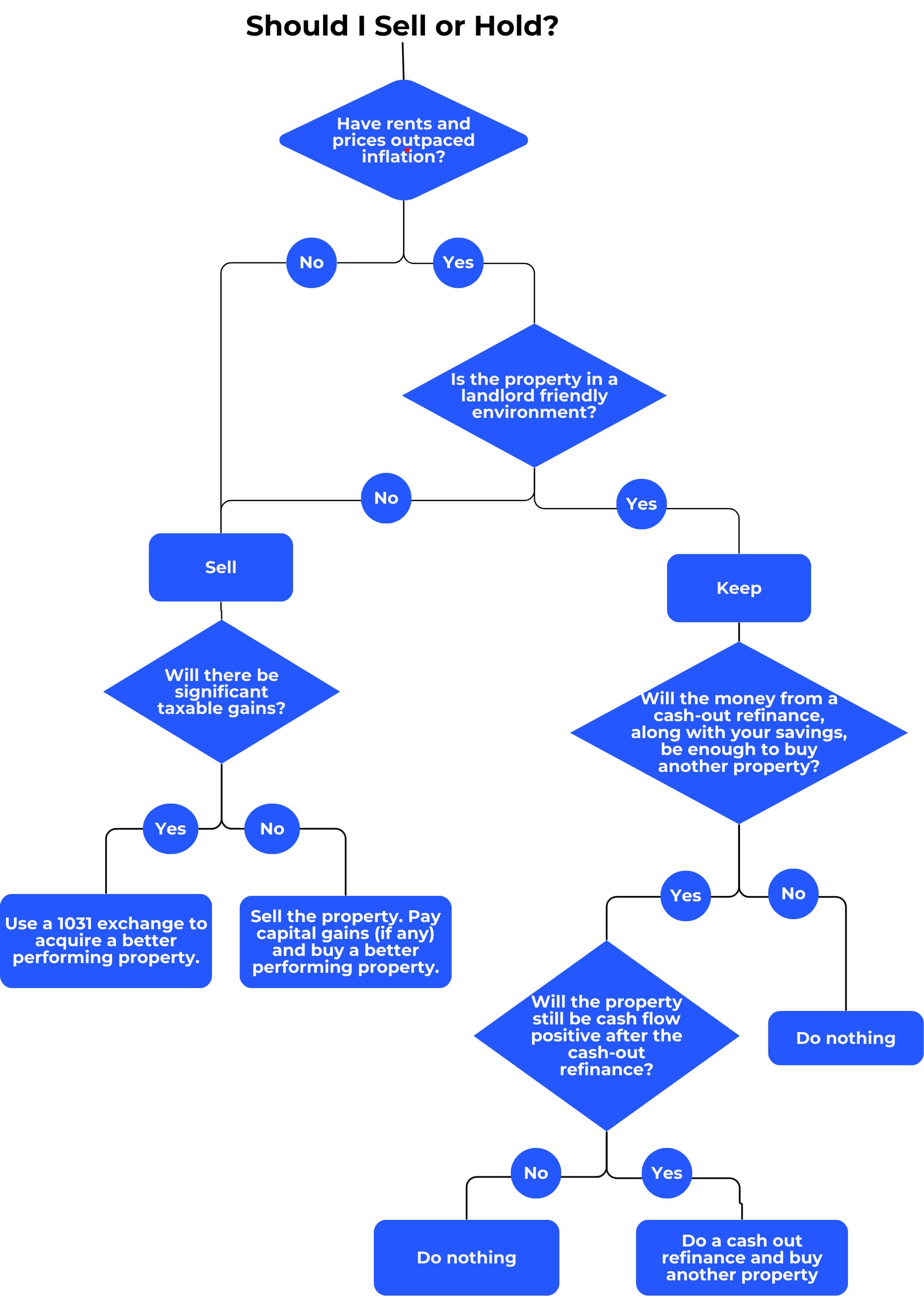
I created this diagram to simplify the decision process.
Pratik, I hope this helps. If you decide on a 1031 exchange, feel free to reach out—we've completed over ninety 1031 exchanges with people in similar situations. I also wrote a paper on safe(r) 1031 transactions you may find useful.
That was a HUGE error on the property tax. Sorry you are going through this.
If your investment goal is long-term financial independence (by replacing your current income with rental income), you need a rental income that meets the following:
Rents must increase faster than inflation or you will not have the additional dollars you need to pay future inflated prices.
Income reliability requires having tenants in your property that remain employed even during recessions.
Your rental income needs to last for your entire life. To make this happen, invest in a city where the population is growing rapidly and consistently. When more people move to a city, it usually means new businesses are opening and creating jobs. People move to cities for work, and most jobs don't last forever (usually less than 15 years). A growing population indicates a healthy job market that will continue to attract renters.
I created this diagram to simplify the decision process.
Pratik, I hope this helps. If you decide on a 1031 exchange, feel free to reach out—we've completed over ninety 1031 exchanges with people in similar situations. I also wrote a paper on safe(r) 1031 transactions you may find useful.
Real Estate Investor · Clarksville, TN · Member since 2017 · 5 posts · 2 votes
7mo
I had a similar experience on our first investment purchase in 2017. We purchased a sfh from a turn key rental provider in Indianapolis and later found the property tax estimates were based on if you owner-occupied the property. They doubled when it was a rental. Why would they estimate their tax based on owner occupying when the intent of the company is to sell rental investments? That was an interesting first lesson for us.
Elyse L Rasmussen, The McCormick Group RE517 Reviews
I had a similar experience on our first investment purchase in 2017. We purchased a sfh from a turn key rental provider in Indianapolis and later found the property tax estimates were based on if you owner-occupied the property. They doubled when it was a rental. Why would they estimate their tax based on owner occupying when the intent of the company is to sell rental investments? That was an interesting first lesson for us.
Huntsville, AL · Member since 2018 · 577 posts · 864 votes
7mo
@Pratik Patel - one of the benefits of BP is folks learning from each other.
Pointing out that a proforma had the wrong amount of property taxes on it helps folks to perform their own due diligence and potentially avoid the same mistake. I am sure people in the BP community will benefit from this insight.
However, I note that you have opted not to disclose the name of the company that sold the property to you despite multiple posters asking you this question. Just curious if there is a reason why you have opted not to disclose this. Totally your choice, obviously.
By the way, I would sell this property immediately based on the numbers you showed, cut my losses, and look at the lost money as the cost of learning REI.
Real Estate Investor · Clarksville, TN · Member since 2017 · 5 posts · 2 votes
7mo
Our entry point was 99,500. It was a 3.85% interest rate, bringing in 1,050 in rent when we first bought it. It was a 2008 build and had very little repairs (we just replaced the roof in 2025) and some room to save steadily for capex. We were plenty in the green. Everything is tighter now with new purchases though because of higher purchase prices and interest rates. Have to BeReal tight on numbers. But to answer your question, we still own that property. It has more than doubled in value, has a long term tenant and rent is 1400 now.
Elyse L Rasmussen, The McCormick Group RE517 Reviews
Real Estate Investor · Clarksville, TN · Member since 2017 · 5 posts · 2 votes
7mo
Our entry point was 99,500. It was a 3.85% interest rate, bringing in 1,050 in rent when we first bought it. It was a 2008 build and had very little repairs (we just replaced the roof in 2025) and some room to save steadily for capex. We were plenty in the green. Everything is tighter now with new purchases though because of higher purchase prices and interest rates. Have to BeReal tight on numbers. But to answer your question, we still own that property. It has more than doubled in value, has a long term tenant and rent is 1400 now.
Elyse L Rasmussen, The McCormick Group RE517 Reviews
Alot of good advice already, will chime in with a couple thoughts. First, sorry the lender made such a significant error. I have bought several new construction and the lender was always good about checking current tax rates and giving me the loan estimate with the full tax amount expected. I am pretty surprised the underwriters didn't catch that, although with a conventional loan they are qualifying you based on your income and other financial assets vs a DSCR that takes into consideration the rental amount. Based on the analysis in the thread, it sounds like you would be more like $500-$600 negative cashflow once everything stabilizes. Selling the asset you will probably incur 15-20K in closing costs. If you wanted to keep the house until you can capture some appreciation, you could lower your payments and overall interest by doing a mortgage recast. Alot of lenders will allow this for no/low fee. Basically what you do is put down an additional lump sum of principal and they re-amortize the loan. Obviously, there is an opportunity cost of using those additional funds to purchase other properties, but maybe along with the other advice to context taxes, request lower pm fee, and lower insurance it would make it worth the investment. Below is a calculator you could model that scenario with.
Alot of good advice already, will chime in with a couple thoughts. First, sorry the lender made such a significant error. I have bought several new construction and the lender was always good about checking current tax rates and giving me the loan estimate with the full tax amount expected. I am pretty surprised the underwriters didn't catch that, although with a conventional loan they are qualifying you based on your income and other financial assets vs a DSCR that takes into consideration the rental amount. Based on the analysis in the thread, it sounds like you would be more like $500-$600 negative cashflow once everything stabilizes. Selling the asset you will probably incur 15-20K in closing costs. If you wanted to keep the house until you can capture some appreciation, you could lower your payments and overall interest by doing a mortgage recast. Alot of lenders will allow this for no/low fee. Basically what you do is put down an additional lump sum of principal and they re-amortize the loan. Obviously, there is an opportunity cost of using those additional funds to purchase other properties, but maybe along with the other advice to context taxes, request lower pm fee, and lower insurance it would make it worth the investment. Below is a calculator you could model that scenario with.
This was the problem even before the tax issue. No secret I'm not a fan of new build or supposed turn key rental deals but regardless I would 100% have expected them to alert me to such a significant increase in taxes likely which should have been included in the prospectus.
This was a bad investment before even factoring the new property tax amount. By the typical 1% rule, this deal is at .74%. If you have 1 single month of vacancy, you don't earn enough money on an annual basis to cover it. There's probably more expenses that aren't mentioned here, like a landscape guy, irrigation system maintenance, annual HVAC checks, an increase in your insurance premium, and probably lots of other potential costs. If you have a tenant for a couple years, you may need light (or more) rehab costs to get it rent-ready, so that's likely to be more than another months' rent lost. There's an article currently posted about the 1% rule is "outdated". No it's not. Math is math, and math never gets outdated. If you don't want to follow a simple mathematical equation to quickly determine potential profitability of a deal, this is the kind of situation you end up with. If a $293,000 home doesn't rent for more that $2180 per month, it's a bad market to buy a rental. Math is math, and it doesn't lie.