New to Real Estate · Los Angeles · Member since 2026 · 18 posts · 7 votes
Hi everyone,
Sorry if I go on too long here. I live and work in Los Angeles. I have a rental in the North Long Beach area which I brought in 2011 and I had my mom living there until a few months ago. The cash flow was so good that I thought real estate was easy. You buy a property then rent it and make money, easy. LOL
So, I brought another property in Georgia. I thought I was so smart. My plan was make money on the rent and I would turn my trips to see my grandchild (I am only 41 years old, I had kids young) into a tax deduction. However, this property costing me every month and I really haven't seen the tax benefits. I also had a bad first tenant there.
I was ready to quit and cut my loss. However, I want to learn what I can before I give up. I hope to understand if I can recover, whether Georgia real estate is a good choice, and is Los Angeles even an options.
Hi and welcome. Appreciate you sharing your experience and yup unfortunately negative RE experiences can slap hard. I went from decades of rehabs and LTR to STRs and it has been humbling for sure. If you post the area in GA perhaps someone will weigh in. Unless the neighborhood is bad since you have family there it might make sense to improve the process and keep the property.
@Peter Garcia One difficult out-of-state rental does not necessarily mean Georgia is a bad market—or that the property cannot recover. Your Long Beach property benefited from a different purchase price and operating history, so comparing the two may set unrealistic expectations.
I would review the Georgia property on its own: current rent versus market rent, management, vacancy, repairs, financing, insurance, taxes, and any near-term capital needs. Then compare a realistic 12-month hold plan with the net proceeds from selling. A better manager, tenant screening, or modest rent adjustment may help, but do not keep it solely because you hope the tax benefits will offset weak operations.
Also, trips to visit family do not become deductible simply because you own a nearby rental. Only the properly documented business portion of qualifying travel may be deductible, and rental losses can be limited depending on your income and participation. Before quitting, have a local property manager assess the property and ask a tax professional to review the actual tax treatment. Los Angeles can still work, but higher prices and local regulations mean the deal must be evaluated very carefully.
Yes, I don't why I even thought all rentals be the same. To be fair to myself, I treated real estate investing more as a hobby that makes money before and I thought riskless compare to other investment. I understand so much more now and I working with a property manager. I will keep you advise in mind. I am not giving up yet.
@Peter Garcia Sounds like you’ve been through a lot with your investment properties. Before giving up, it might be worth exploring your lending options to see if there’s a way to improve your cash flow. Feel free to reach out. I’d be happy to help you explore what might work best for your situation!
I appreciate the advise. I have a job so I don't rely on the cash flow and I am not losing very much. Maybe I can make up the losses with appreciation. Though, I know I should not rely on appreciation to make a good deal. Appreciation should just be a bonus, right.
Welcome, and you're not the first one to learn this way. Plenty of us did.
On the trips, I'd be careful. If the main reason for the trip is seeing your grandchild, the travel generally isn't deductible just because you stop by the rental. It has to be mainly for the property, and you'd want a record of what you did there each day. Mixing the two is one of the things that gets questioned.
For the Georgia place, I'd start by pulling twelve months of every dollar in and out, including the mortgage, taxes, insurance, management, and repairs. Once you see exactly where the money is going, it's a lot easier to decide whether to raise the rent, cut a cost, or sell. A lot of times the problem is one or two line items, not the whole deal.
Yes, it is a expensive lesson but I did not use any of my travel to Georgia as a tax deduction. I saw the Youtuber say they count everything they do as a tax deduct which made me think I could deduct more than I could.
I've had a property recently which has had stroke of issue after issue. A storm passed through and tore up some of my roof resulting in over 3k in damages. Then I had pests, then a broken washing machine. Sometimes, when it rains it pours. With your property in Georgia, you will have to ask yourself if you are just getting unlucky or you underestimated the cost it would take to maintain the property. If the property isn't sustainable don't be afraid to get rid of it. Every investor on their journey will make mistakes.
Georgia itself though has plenty of good markets to invest in. I would suggest looking at Macon, Augusta, suburbs outside of Atlanta, and Savannah as all possible options.
You cheered me up though I feel bad for you and that situation. My property is in Lithonia which is a suburb of Atlanta. Though, it is a 30 minute drive from Atlanta. I thought that was close enough to Atlanta but my LA brain may be warping my views.
My tenant only costed me a month of rent and 1K water bill. I can't call myself unlucky because I mixed business and family which I knew was a bad idea at the time.
Sorry if I go on too long here. I live and work in Los Angeles. I have a rental in the North Long Beach area which I brought in 2011 and I had my mom living there until a few months ago. The cash flow was so good that I thought real estate was easy. You buy a property then rent it and make money, easy. LOL
So, I brought another property in Georgia. I thought I was so smart. My plan was make money on the rent and I would turn my trips to see my grandchild (I am only 41 years old, I had kids young) into a tax deduction. However, this property costing me every month and I really haven't seen the tax benefits. I also had a bad first tenant there.
I was ready to quit and cut my loss. However, I want to learn what I can before I give up. I hope to understand if I can recover, whether Georgia real estate is a good choice, and is Los Angeles even an options.
Thank you all in advance
Welcome to the community, Peter! What you're experiencing with that second deal is super common, as local SoCal appreciation lulls us into thinking long-distance landlord-ing is effortless until a bad tenant or unexpected vacancy drains monthly cash flow. Before throwing in the towel on out-of-state investing, consider auditing your management and underwriting metrics; a lot of investors who get burned in lower-yield pockets end up shifting focus toward established Midwest markets, where sub-$200k purchase prices and strong rent-to-price ratios give you way more cash flow buffer to handle property management fees and capital expenditures without dipping into your own pocket. Keep your head up, tighten your property management oversight on the Georgia door, and feel free to reach out.
Your encouragement is appreciated. I'll you in mind when I have question. Right now, I have hard time with questions because I don't know exactly which questions to ask.
Sorry if I go on too long here. I live and work in Los Angeles. I have a rental in the North Long Beach area which I brought in 2011 and I had my mom living there until a few months ago. The cash flow was so good that I thought real estate was easy. You buy a property then rent it and make money, easy. LOL
So, I brought another property in Georgia. I thought I was so smart. My plan was make money on the rent and I would turn my trips to see my grandchild (I am only 41 years old, I had kids young) into a tax deduction. However, this property costing me every month and I really haven't seen the tax benefits. I also had a bad first tenant there.
I was ready to quit and cut my loss. However, I want to learn what I can before I give up. I hope to understand if I can recover, whether Georgia real estate is a good choice, and is Los Angeles even an options.
Thank you all in advance
Tax benefits - your CPA should be able to help you depreciate a lot of the updates / repairs you've had to make with the tenants in place. If you don't have a CPA who specializes in Real Estate, then I'd recommend finding one who can help you do that. The benefits are there, just need to find the right CPA to help you do it. Depending on how you use the property, how many hours you put into it, you can qualify for a REP status and do a cost segregation on the property to accelerate your depreciation and really apply the tax benefits. Otherwise you'll be taking standard deduction over 27 years.
As for the property and out of state investing, bad tenants are all part of the deal. I started off as an OOS investor back in 2021 while living in San Francisco and have had my fair share of tenants who've had to be evicted, trashed properties and so forth. Trick is to have the right systems / teams in place and do thourough tenant screening but even then there is no guarantee of perfect tenants. Once you find the right tenants, you'll see the benefits a lot more. Trick is to keep them in place as long as humanly possible.
Sorry if I go on too long here. I live and work in Los Angeles. I have a rental in the North Long Beach area which I brought in 2011 and I had my mom living there until a few months ago. The cash flow was so good that I thought real estate was easy. You buy a property then rent it and make money, easy. LOL
So, I brought another property in Georgia. I thought I was so smart. My plan was make money on the rent and I would turn my trips to see my grandchild (I am only 41 years old, I had kids young) into a tax deduction. However, this property costing me every month and I really haven't seen the tax benefits. I also had a bad first tenant there.
I was ready to quit and cut my loss. However, I want to learn what I can before I give up. I hope to understand if I can recover, whether Georgia real estate is a good choice, and is Los Angeles even an options.
Thank you all in advance
@Peter Garcia Hey Peter, sorry to hear about your experience, but you're certainly not the only one. Investing out of state is tricky, and I've seen many investors move their equity back to California (or their home state) because a pro forma doesn't account for the challenges that come with distance. Recognizing that is completely okay and can help you get into a better position, and it sounds like you've done well overall even with this hiccup.
Investing in California, or even Long Beach, again might feel daunting, but it's very doable if you choose to. The market here has also shifted back in favor of buyers, so your timing may be better than you think. I specialize in Long Beach and LA, so I'm happy to answer any questions you have. Keep your head up!
Specialist · I give advice - [email protected] - I focus on states where investing is profitable, reasonably safe & secure · Member since 2026 · 171 posts · 62 votes
Sorry if I go on too long here. I live and work in Los Angeles. I have a rental in the North Long Beach area which I brought in 2011 and I had my mom living there until a few months ago. The cash flow was so good that I thought real estate was easy. You buy a property then rent it and make money, easy. LOL
So, I brought another property in Georgia. I thought I was so smart. My plan was make money on the rent and I would turn my trips to see my grandchild (I am only 41 years old, I had kids young) into a tax deduction. However, this property costing me every month and I really haven't seen the tax benefits. I also had a bad first tenant there.
I was ready to quit and cut my loss. However, I want to learn what I can before I give up. I hope to understand if I can recover, whether Georgia real estate is a good choice, and is Los Angeles even an options.
Thank you all in advance
We follow the adage "invest where you can make money, live where you want". If LA is too expensive or too micromanaging to make money, try closer by, like Phoenix or Las Vegas. At least you have the ability to be there when you need to be and is more likely than when investing 2,000 miles away.
Distance plays a huge role in most investors success and ultimate satisfaction. Investing is a lifestyle, make it a happy life.
Welcome, Peter, and congrats on holding the Long Beach place since 2011. That equity gives you real options.
Here is something the replies haven't covered: decide on Georgia with numbers instead of frustration. Take actual rent minus mortgage, taxes and insurance, then set aside roughly 15% for repairs and vacancy. Next, estimate what you would net after selling costs. If that equity could earn more somewhere else than the property is losing each month, selling is reallocating, not quitting. Also, trips to see your grandchild generally won't carry a rental deduction without a real business purpose, so run that past a CPA before counting on it.
On whether LA works: rents there rarely cover the payment, which is why many California investors look at Midwest markets. In my experience, I'm still finding single families in Columbus in the $120K-$180K range that cash flow after expenses, though it takes patience and not every deal pencils.
Feel free to connect, I'd enjoy comparing notes as you figure out your next move.
Peter, I think that realization is actually an important part of the process. A lot of investors learn the difference between “this property makes money” and “I thought this property would make money” the hard way. Since you now have a property manager, I’d give the Georgia property a clean 12 month review rather than judging it based on the difficult tenant period alone. Look at the actual rent, management, repairs, taxes, insurance, financing, vacancy, and depreciation together.
I’d also review your tax return separately from the property's cash flow. You can have a rental showing a tax loss because of depreciation while still having positive cash flow, or have a real cash loss where the tax deduction doesn't provide an immediate benefit because of the passive activity rules.
And I think you’re right to separate the family travel from the investment activity. The fact that you own a rental in Georgia doesn't make a personal trip deductible. If a trip has a legitimate business purpose, the facts and documentation matter, so I'd have your CPA review the specific circumstances rather than relying on what you see online.
The good news is that you don't necessarily need to decide today whether Georgia was a mistake. First figure out what the property is actually producing, what the tax return is actually giving you, and whether the property can perform under professional management.
That should give you a much better basis for deciding whether to hold, improve, or eventually sell.
Feel free to DM me I’d be happy to send over a few resources that might be helpful.
I appreciate that you took the time to consider my situation. Yes, I giving myself a year to understanding this business and the Georgia property before I sell.
Sorry I'm still learn so I may not have gotten the terms right. But I did not use a property management company because I was renting to family (I thought I would not need one but I was wrong). Now I'm work with this company: https://www.listtosellatl.com/property-management
I believe house was A (It was a new construction) but I would call the neighborhood a C (the schools are ok but the crime is bad).
Price was 299,990
Initial investment was 3,000
Rent was 2,300 (may have cut the to 2,100)
Mortgage is 1,823
HOA is 185
Insurance is 142
All other bill are paid by tenant I think
I also think I have some time before I need add in repairs and cap ex because it is a new construction.
However, cash flow is still between -150 and -250
I don't rely on this cash flow because I have a W-2 job. I hope this helps.
Georgia can still be a phenomenal long-term market, but remote management, local vacancy dynamics, and unexpected capital expenditures often eat up cash flow fast if the deal structure or property management isn't locked down. Before cutting your losses, it’s worth reviewing your current debt structure, rental rates, and expenses to see if a simple repositioning or refinancing can turn the cash flow around. Glad you're sticking around to learn, feel free to drop questions anytime!
I believe if you are failing cut your losses quickly but I also think that you shouldn't give up without trying your best to success. So, I doing that now.
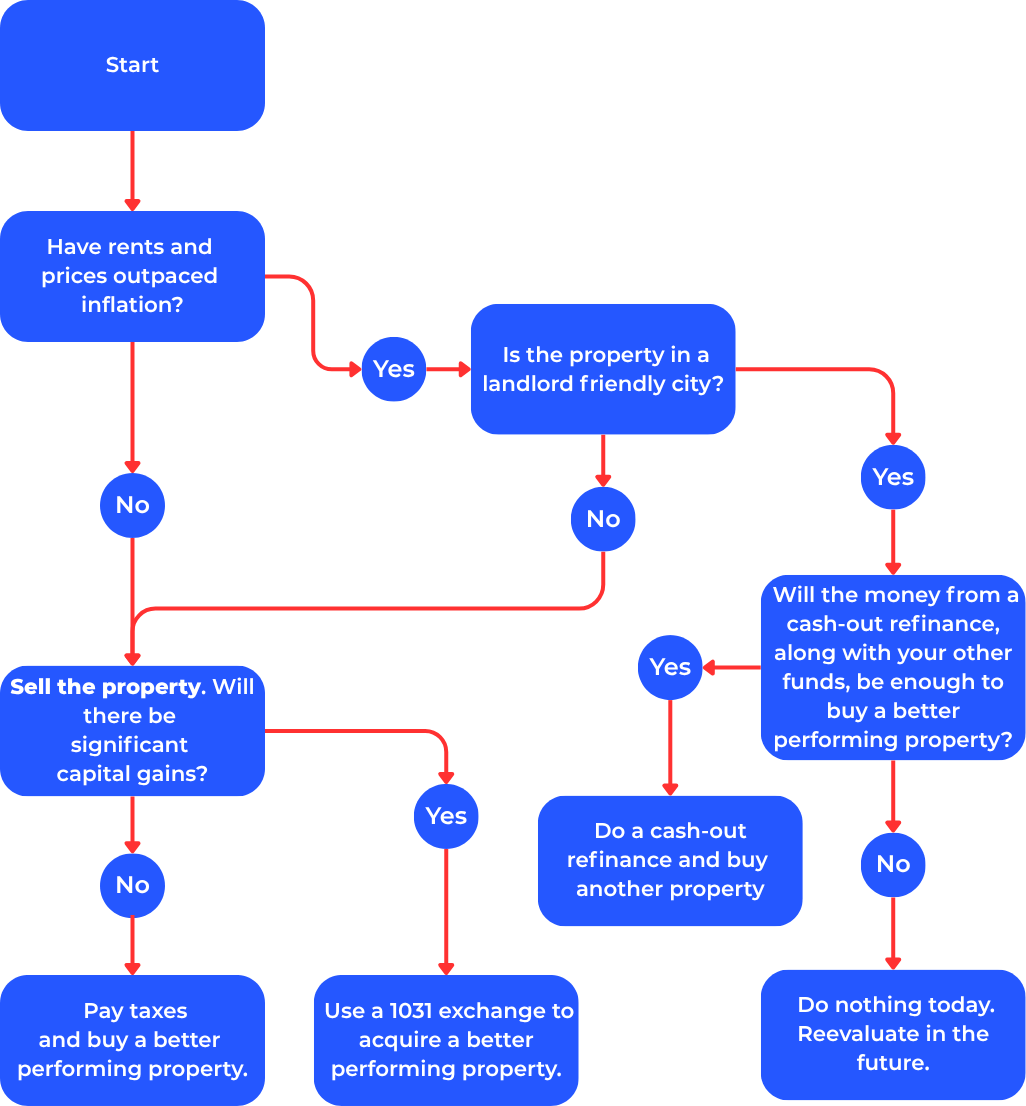
I am frequently asked by new clients what they should do with underperforming properties. My answer is that it depends on property performance and equity.
There are 4 options:
Cash-out refinance
Sell and pay the taxes
Hold the property and reevaluate in the future
1031 exchange
I created the following diagram to simplify the decision about the best option for you.
As to where to invest?
If you want monthly retirement income that lasts 20 to 40 years and grows faster than inflation, where you invest matters more than what you buy. The city, not the property, sets the limits on long-term rent growth.
Think of the city as a harbor and its rents as boats. When population and housing demand grow, the tide comes in and lifts every boat. When population declines, rents may fall or fail to keep pace with inflation. No matter how good a property is, it can perform only within the limits of the city where it is located.
Evaluate any city you are considering against the following requirements.
Population Growth: Start with cities having a metro population over 1 million and consistent and significant growth. Wikipedia
No Rent Control: Rent control may prevent you from increasing the rent fast enough to keep pace with inflation. It may limit your property manager's ability to select the best tenant. It may make evictions of non-performing tenants difficult or impossible. Never invest in any location with rent control. Google “[city] rent control”. (LA’s rent control.)
Local Investment Team availability: While general knowledge from seminars and books is helpful, local expertise is crucial for specific purchases. Only an experienced local investment team can provide the resources and knowledge you'll need.
When you filter out all the cities that do not meet all the above requirements, you will have a shortlist of cities for further evaluation.
I used the metrics you gave for cities and I found Surprise, AZ as good city that is at least within driving distance. What do you think? I am unsure about out of state investment now. I need a bit of time.
Sorry if I go on too long here. I live and work in Los Angeles. I have a rental in the North Long Beach area which I brought in 2011 and I had my mom living there until a few months ago. The cash flow was so good that I thought real estate was easy. You buy a property then rent it and make money, easy. LOL
So, I brought another property in Georgia. I thought I was so smart. My plan was make money on the rent and I would turn my trips to see my grandchild (I am only 41 years old, I had kids young) into a tax deduction. However, this property costing me every month and I really haven't seen the tax benefits. I also had a bad first tenant there.
I was ready to quit and cut my loss. However, I want to learn what I can before I give up. I hope to understand if I can recover, whether Georgia real estate is a good choice, and is Los Angeles even an options.
Thank you all in advance
@Peter Garcia, I actually think it's good that you've decided to learn from the Georgia property before making a final decision about selling it. I also noticed you mentioned that you've started working with a property manager. Since you're managing the property from California, that could be a helpful step, especially after what happened with your first tenant.
I work with landlords and real estate investors as an attorney in Maryland, and I've seen situations where a tenant issue became much harder to deal with because the lease, payment records, or communication wasn't properly documented. With an out of state rental, I'd want to make sure the property manager has a clear process for handling late payments, maintenance requests, tenant communication, and keeping the owner updated. Even with a newer property, those things can make a big difference when something unexpected happens.
I appreciate you being open about your experience, @Peter Garcia. A lot of investors learn these lessons as they go, and it's good that you're taking the time to understand what went wrong instead of rushing into another decision. Landlord-tenant matters are a big part of my legal work, so your experience caught my attention. Happy to stay connected!
I believe if you are failing cut your losses quickly but I also think that you shouldn't give up without trying your best to success. So, I doing that now.