All of these are options but its really difficult to analyze someones situation with very limited data. If the current property is performing well and you can get equity out of it, that is what I would do. You could do a 1031 as well which could let you tap into more of that equity, but it also depends if its $200k of equity or $20M of equity in the property.
A lot of unknowns to really give any type of response that could be used constructively.
All of these are options but its really difficult to analyze someones situation with very limited data. If the current property is performing well and you can get equity out of it, that is what I would do. You could do a 1031 as well which could let you tap into more of that equity, but it also depends if its $200k of equity or $20M of equity in the property.
A lot of unknowns to really give any type of response that could be used constructively.
Need some more information, what are actual numbers? lease term? Asset type?
Depreciation is a constant. So it’s the same in year 39 (because it’s a commercial property not residential.) as it was in year 1. It’s great your parents were able to hang on to a property so long. But unless you’re almost to year 40 this isn’t a reason to sell/exchange
If they do an exchange they will only be able to depreciate 1/40th of the building difference. So. Unless they plan to buy something worth twice as much, that makes at least twice as much, the exchange won’t really help. Even that would only result in half as much depreciation on twice as much income. To get as much depreciation shelter as they currently have. They would literally have to spend twice as much and yet only make the same income, and that’s not a good plan.
You could do a cash out refi for money if that’s tight, but it will reduce your income obviously. You probably have a very low ROE but if they have a “known quantity” in their current property. Honestly it’s pry time to hold until death and all the taxes go away. If they bought at 30 years old and are 70+ are they really interested in upsetting a working income stream? Unless they “need” more money to live on I think you’re letting a small amount of tax savings cloud your judgment.
Imagine they bought the property 40 years ago for $400k so today it’s worth $1.6-$3.2m) (3.5-7% annual growth.) Assuming the property was 80% of the value. They’ve been depreciation 2.5% of 80% of $400k. Around $8k per year. So they save $2-3k a year in taxes? That’s a reason to have 5-10% in selling in buying costs? ($100-$200k) That would involve flushing all the depreciation savings they took over 40 years down the drain in one day.
If they sold for $1.5M after selling costs and bought a $2M NNN property. That would provide maybe $400k of fresh property to depreciate? (They don't get to depreciate the 1.5M again.). So they could claim 1/40th of $400k or $10k/yr and save $3k a year in taxes? If they only pay 2% in selling costs including commissions and transfer taxes it would take 10 years to break even.
If they can generate a greater return than the borrowing costs then the $500k cash out isn’t a horrible idea.
Ps. 2 NNN concerns from someone who has researched but never bought/owned. 1) The returns from national tenants is generally pretty low. 2) They often trade hands based on cap rates like a bond. This means as the lease starts to expire the property value can decline, A LOT. This might be a $500k property trading at $2M because dollar store or Starbucks is paying the rent. But even the biggest names close stores. I watched a video showing big name NNN's trading tens to hundreds of thousands lower than recent purchase price. This is especially dangerous with franchises where the franchisee can go out of business much easier than a corporate store. Good luck.
If they sold for $1.5M after selling costs and bought a $2M NNN property. That would provide maybe $400k of fresh property to depreciate? (They don't get to depreciate the 1.5M again.). So they could claim 1/40th of $400k or $10k/yr and save $3k a year in taxes? If they only pay 2% in selling costs including commissions and transfer taxes it would take 10 years to break even.
If they can generate a greater return than the borrowing costs then the $500k cash out isn’t a horrible idea.
Ps. 2 NNN concerns from someone who has researched but never bought/owned. 1) The returns from national tenants is generally pretty low. 2) They often trade hands based on cap rates like a bond. This means as the lease starts to expire the property value can decline, A LOT. This might be a $500k property trading at $2M because dollar store or Starbucks is paying the rent. But even the biggest names close stores. I watched a video showing big name NNN's trading tens to hundreds of thousands lower than recent purchase price. This is especially dangerous with franchises where the franchisee can go out of business much easier than a corporate store. Good luck.
Hello @Bob Dole,
My recommendation is to decide the best move based on achieving their financial goal. If the goal is long-term financial independence, this requires a rental income that meets the following requirements:
Only when both conditions are met will you have an income that will enable financial independence. We've completed over ninety 1031 exchanges so far. In most cases, rents were not increasing faster than inflation, the government was controlling the property rather than the landlord, or the city was in decline. To help new clients decide on the best course of action, I put together the following decision diagram.
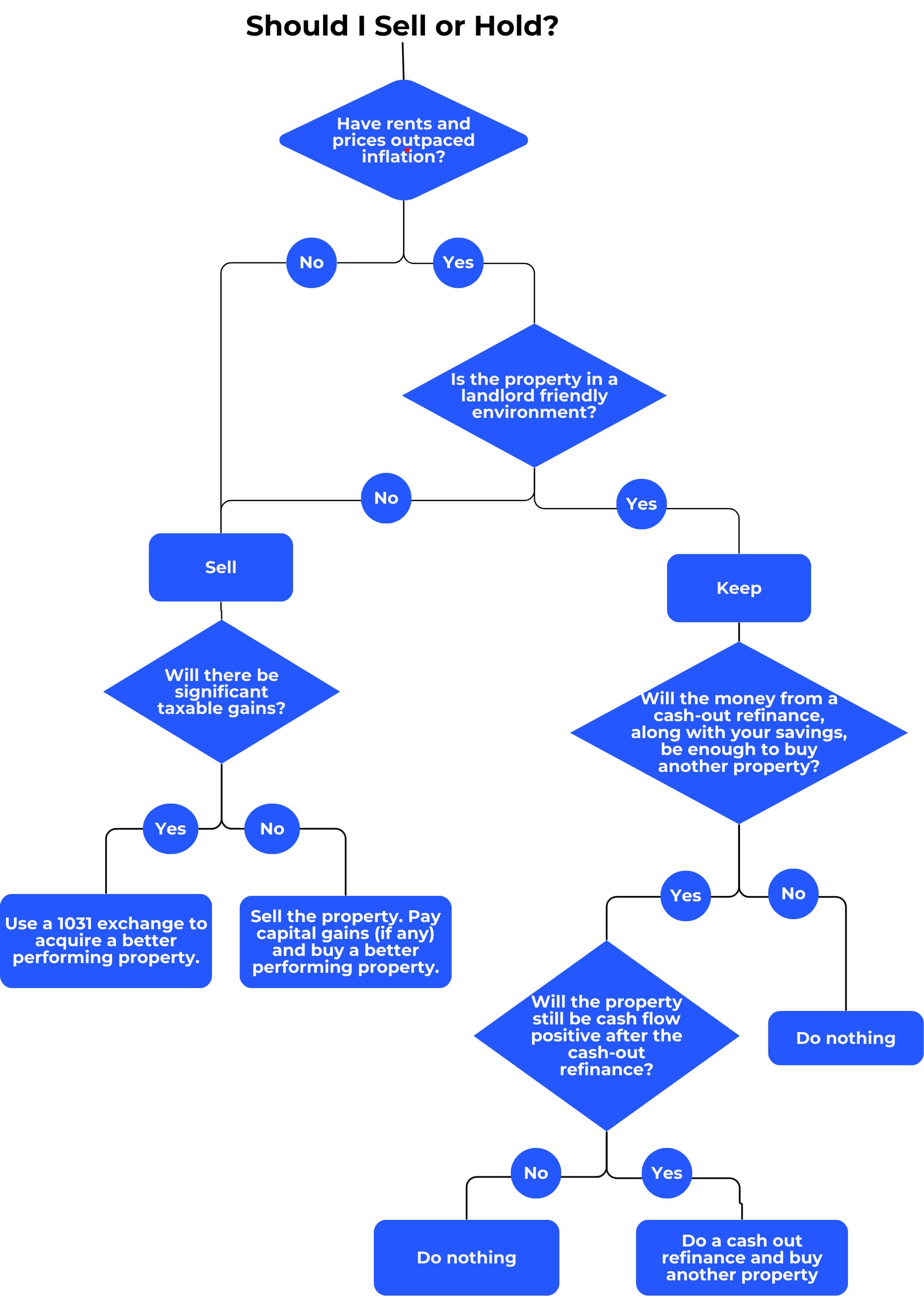
Instead of basing your decision on taxes, base it on achieving your financial goal.
Why am I not seeing a word about what mom and dad want to do and what they are comfortable with doing?
You didn't add $1.5M worth of capitalization when you bought the hypothetical $2M NNN property. You added the MAYBE $80k left you couldn't depreciate from the first property and the $500k in cash/loans you use to complete the sale. But, maybe you only bought $1.6M worth of property (out of that $2m) that could be depreciated if the rest is land.
Your CPA will have to tell you which possibility below is the answer. (Or something else.) Because I don’t have a clue.
1) You bought a $2M property with $1.6M that can be depreciated. And that’s your remaining property basis ($80k) plus $100k of the $500k you added so you can depreciate $180k. Over 40 years, or $4,500/yr saving $1,500/yr in taxes?
2) You get lucky and you can depreciate all of the new $500k you added and the $80k you had remaining. So you get to depreciate $580k over 40 years $14,500/yr saving you $5k/yr in taxes?
You don’t get to depreciate the $1.5M value, (the buyer will), only your original purchase price. (Of the building, not total.) And you say that’s been depreciated to zero. Neither one gets me to pay $70-$100k+ to sell the old property with 14-70 year payback period.
How much is the cash flow per month? It doesn't seem incredibly high if you take even a 30% expense ratio, you have $5k in cash flow before taxes which is about a 3% ROE.
you mentioned rents being $7,250. What are market rents?
I would also consider what the tax gain is because you'd need to buy a much bigger property to have any depreciation. I'd focus on increasing ROE and see if you can bump that up to at least 5-6%.
Leverage th asset for a line of credit. If/when you use the line of credit to purchase another piece of real estate, be sure it'll cash flow once you convert to a long-term loan.
@Bill B. Thanks for the insight. I did some more reading. I thought the depreciation was reset upon exchanging into a new building. But it's only the delta between the selling price and the new building price.
Unless the delta is large, the depreciation isn't going to be much. In my head I was thinking to 1031 into a slightly more expensive property so cashflow would be high, not a lot of debt, and take advantage of the depreciation. But this won't work unless we 1031 into something more expensive (say $1m+ delta).
I think this option is off the table. Remaining options are, do nothing or take equity out and reinvest it.
Thanks for the knowledge! Learn something new everything, in this case, what I learned was very valuable!