Skip to content
×
PRO Members Get
Full Access
Get off the sidelines and take action in real estate investing with BiggerPockets Pro. Our comprehensive suite of tools and resources minimize mistakes, support informed decisions, and propel you to success.
Advanced networking features
Market and Deal Finder tools
Property analysis calculators
Landlord Command Center
ANNUAL Save 16%
$32.50 /mo
$390 billed annualy
MONTHLY
$39 /mo
billed monthly
7 day free trial. Cancel anytime.
Level up your investing with Pro
Explore exclusive tools and resources to start, grow, or optimize your portfolio.
~$5,000+ potential annual savings on vetted partner products
10+ deal analysis calculators with ready-to-share reports
Lawyer-reviewed leases for every state ($99/package value)
Pro badge for priority visibility in the Forums

Let's keep in touch

Subscribe to our newsletter for timely insights and actionable tips on your real estate journey.

By signing up, you indicate that you agree to the BiggerPockets Terms & Conditions
Followed Discussions Followed Categories Followed People Followed Locations
Short-Term & Vacation Rental Discussions
All Forum Categories
Followed Discussions
Followed Categories
Followed People
Followed Locations
Market News & Data
General Info
Real Estate Strategies
Landlording & Rental Properties
Real Estate Professionals
Financial, Tax, & Legal
Real Estate Classifieds
Reviews & Feedback

Updated about 2 months ago on . Most recent reply

User Stats

19
Posts
12
Votes
Christian Johnston
12
Votes |
19
Posts

Pricing, SEO/Algorithm, and the Game You Are Actually Playing on Airbnb- Make more $$

Posted
I've been doing revenue management for 4+ years, currently across about 100+ and I've developed a framework for how I think about pricing on Airbnb that I wanted to share because I think a lot of hosts are leaving money on the table without realizing it.

For context on where this comes from: when we take over pricing for a listing, our average revenue increase over the first 90 days is around 31%. Some listings more, some less, depends on where they started and what market they're in. I'm not saying that to flex. I'm saying it because the framework below is what I believe drives those results, and I think it's useful even if you're self-managing one property.

This is a thought framework, not gospel. It's how I think Airbnb's algorithm evaluates your listing and why pricing is the biggest lever most hosts aren't using strategically. I could be wrong about pieces of it. I'd actually love to hear from anyone who sees it differently or has tested other approaches. 

If you take nothing else from this article, take this:

Pricing is not just "what you charge." Pricing is how you communicate value to a marketplace algorithm that is deciding whether you deserve attention.

And Airbnb is absolutely deciding that. Every day.

I'm going to explain how I think Airbnb works, why pricing is the lever that moves the most weight, and how to use it to climb out of the "invisible listing" trap and into the top tier where the platform starts working for you, not against you.

This is my worldview, based on a lot of observation, a lot of testing, and a lot of conversations with owners, operators, and the masterminds I participate in, with that...take it with a grain of salt. 

If this was useful, drop a reply and let me know. If there's a specific piece you want me to go deeper on, like how I actually run comps, how I think about minimum stays, how I handle seasonal markets, whatever, tell me and I'll write it up. If enough people find this stuff valuable I'm happy to keep going with more focused breakdowns on specific pricing problems. And if you think I'm wrong about any of it, I want to hear that too.

1) Airbnb is not your partner. Airbnb is a marketplace optimizing for its own outcome.

Let's start with the uncomfortable truth.

Airbnb's job is not "to help hosts." Airbnb's job is to maximize Airbnb's revenue while maintaining the guest's trust so the whole marketplace does not collapse.

When Airbnb decides what shows up on page one, it's not random. It's not "fair." It's not "who deserves it."

It's a ranking problem.

Airbnb looks at the first page like a real estate developer looks at land. Each slot has value. Showing your listing instead of someone else's listing has a cost. I call it opportunity cost because that's what it is.

So the platform is constantly asking:

  • If we give this listing visibility, does it make us money?
  • Does it protect trust with guests?

That's it. That's the game.

2) Page one is "land." Every listing there is an investment decision.

Here's the analogy I use over and over:

Imagine Airbnb's search results are a shopping mall. Page one is the storefronts right by the entrance. If Airbnb puts a dead store in that spot, the mall makes less money.

Airbnb does not want dead stores.

So Airbnb treats page one like prime land with monetization potential. Every listing shown there needs to justify why it deserves that land.

This is why I keep repeating the phrase opportunity cost.

If Airbnb shows your listing in a high-visibility position and you do not convert, Airbnb lost money because it wasted a high-value slot on something that did not produce a booking.

3) The algorithm is constrained by "trust," but driven by "money"

I break Airbnb's priorities into two categories:

A) Long-term trust (reviews, legitimacy, safety)

Airbnb has doubled down on being a trusted platform. Customer support, legitimacy, safety, all of it.

In practice, your reviews are the easiest public proxy for trust.

If your reviews are strong, the trust side is mostly "handled."

B) Short-term money (bookings and fees)

Once trust is not your problem, what remains is money.

Airbnb wants to show listings that will likely book because Airbnb makes money when you make money.

So how does Airbnb guess who will book?

It uses performance signals.

And that's where pricing becomes a weapon.

4) The core signals I BELIEVE Airbnb weights most

I'm not claiming I know Airbnb's exact formula. Nobody outside Airbnb does.

What I'm telling you is the mental model that actually predicts what happens in the real world.

Signal 1: The 60-day lookback

Airbnb has shifted their KPIs to emphasize recent performance. In my view, the 60-day lookback matters a lot.

In other words: what have you done for Airbnb lately?

If your last 60 days look strong versus your market, Airbnb is more confident you will monetize page-one exposure.

Signal 2: Conversion rate (views that become bookings)

A lot of people miss this.

In my experience, conversion rate is a massive lever. It is literally Airbnb watching what happens when they send you traffic.

If Airbnb tests you (gives you impressions) and you convert better than alternatives, you look valuable.

If Airbnb tests you and you do not convert, you look like a bad investment.

Signal 3: Market-relative occupancy (how you perform versus competitors)

Airbnb does not care about your feelings. Airbnb cares about your performance versus the other options the guest could book.

Occupancy versus market is a major clue Airbnb can use to estimate whether you're priced correctly and whether guests actually want you.

Signal 4: How your next 30-60 days are shaping up (booking velocity and key date capture)

Airbnb is also looking forward. Past performance matters, but future occupancy matters too.

A listing that is trending toward being booked in the near future is a listing Airbnb can monetize.

A listing with an empty near-term calendar is a listing Airbnb can't.

5) The feedback loop that makes or breaks your listing

This is the part most hosts do not understand.

Once you fall out of the top tier, you can get stuck in a negative loop:

Less page-one exposure → Less traffic → Less bookings → Worse KPIs versus competitors → Airbnb devalues you and tests you less often → Repeat.

That is the loop.

And it gets worse because a lot of markets behave like an 80/20 distribution: most bookings go to a small top slice of listings. If you are not in that slice, it can feel like you are invisible.

So the job is not "set a price."

The job is break into the positive feedback loop:

You convert → You book → Airbnb sends more traffic → You book more → Airbnb trusts you more.

6) A common mistake: filling other channels and starving your primary booking channel (whether its airbnb,vrbo, etc)

Let's talk about something that silently destroys listings.

If you fill up on other platforms and Airbnb cannot book your calendar, you reinforce the idea that Airbnb cannot monetize you.

You might think you're being smart by diversifying.

But if Airbnb is your primary demand engine, starving Airbnb can push you deeper into the negative loop because Airbnb sees less revenue potential from you.

I'm not saying "turn off other channels."

I'm saying balance them methodically so you do not sacrifice your primary booking channel while chasing short-term cash.

That balance is part of ramping correctly.

BTW, I have run AB tests on (2) units that are part of a duplex in San Diego, exact mirror units. I can elaborate on the controls I used but what I did find, which makes sense, is that airbnb DOES treat a blocked calendar differently from an empty calendar  (blocked calendar = more favorable). Tests like this should be taken with a grain of salt for obvious reasons (length, sample size, etc).

7) Pricing is not a number. Pricing is a signal.

Here's the sentence I want burned into your brain:

Pricing is how you signal value to both a human and an algorithm.

If you price too high too early, you do not just lose a booking.

You lose visibility.

Because an unbooked listing is not making Airbnb money, and the platform does not reward that.

So pricing is not "maximize nightly rate."

Pricing is "maximize the probability of booking at the highest possible rate without losing the algorithm's confidence."

That's a mouthful, but it's real.

8) Pricing power: the concept that changes how you think about rate

This is where I need you to stop thinking like a host and start thinking like a marketplace operator.

I want to introduce a concept I call pricing power. It's the single most important idea in this article because it determines what you're allowed to do with price at any given moment.

Pricing power is earned, not assumed. You have it when your listing is outperforming market occupancy. You do not have it when you are matching or trailing the market.

Here's why this matters so much.

Think about two listings. Same market. Same nightly rate. Let's call them Listing A and Listing B.

Listing A is priced at $500/night. Over the next 30 days, it's sitting at 70% occupancy. The market is at 50%.

Listing B is also priced at $500/night. Over the next 30 days, it's sitting at 40% occupancy. The market is still at 50%.

Now here's the question: what happens if both listings raise their prices by $75 a night?

Most hosts think the answer is the same for both. It is not. Not even close.

Listing A has pricing power. At $500, guests are choosing it at a rate that beats the market by 20 points. That tells you something important: at the current price, this listing is undervalued. Demand is proving that. Guests are looking at the photos, the reviews, the price, and the location and saying "yes" at a higher rate than the market average.

So when Listing A raises price, Airbnb's signal is: this listing was converting above market, it moved price up, let's test it. And because Listing A had room — because demand was already outpacing supply at that rate — there's a real chance it holds conversion. Maybe occupancy drops from 70% to 63%. That's fine. You're still beating market. You've captured more revenue per night and you've kept the algorithm's confidence.

Listing B does not have pricing power. At $500, it's already below market occupancy. Guests are looking at Listing B and saying "no" more often than the average listing in the market. That means the current price is probably too high for what the listing delivers relative to alternatives.

So when Listing B raises price, Airbnb's signal is: this listing was already underperforming at $500, now it's at $575, and — predictably — bookings drop further. Airbnb tested you with impressions and you converted even worse. So Airbnb de-promotes you. Less visibility, fewer eyeballs, weaker KPIs. The negative loop kicks in.

Same action. Completely different outcomes. The difference is pricing power.

If you are at or below market occupancy, you do not have pricing power. You are not in a position to raise rates. You are in a position to earn the right to raise rates. Those are two very different places.

If you are meaningfully above market occupancy, you have pricing power. And the question becomes: how do you use it without blowing it?

9) The Amazon analogy: why you can't just spike the price

This is where I need to reframe how you think about Airbnb entirely.

Airbnb is not a hotel booking site. Airbnb is a search-and-rank marketplace. It functions more like Amazon than it does like Marriott.com.

Think about it this way.

You go to Amazon and type "spatula." What do you expect? You expect Amazon to show you a well-reviewed, fairly priced spatula that matches what you're looking for. You trust that ranking. You trust that the first few results are a reasonable deal.

That trust is what makes Amazon's marketplace work. And Amazon protects it aggressively.

Now imagine a seller has a spatula listed at $12. It's selling well. Good reviews, strong conversion, consistent sales velocity. Amazon notices. Amazon starts showing it near the top because it's a reliable product that makes Amazon money when people click on it.

Now that seller wakes up one morning and changes the price to $24.

What happens?

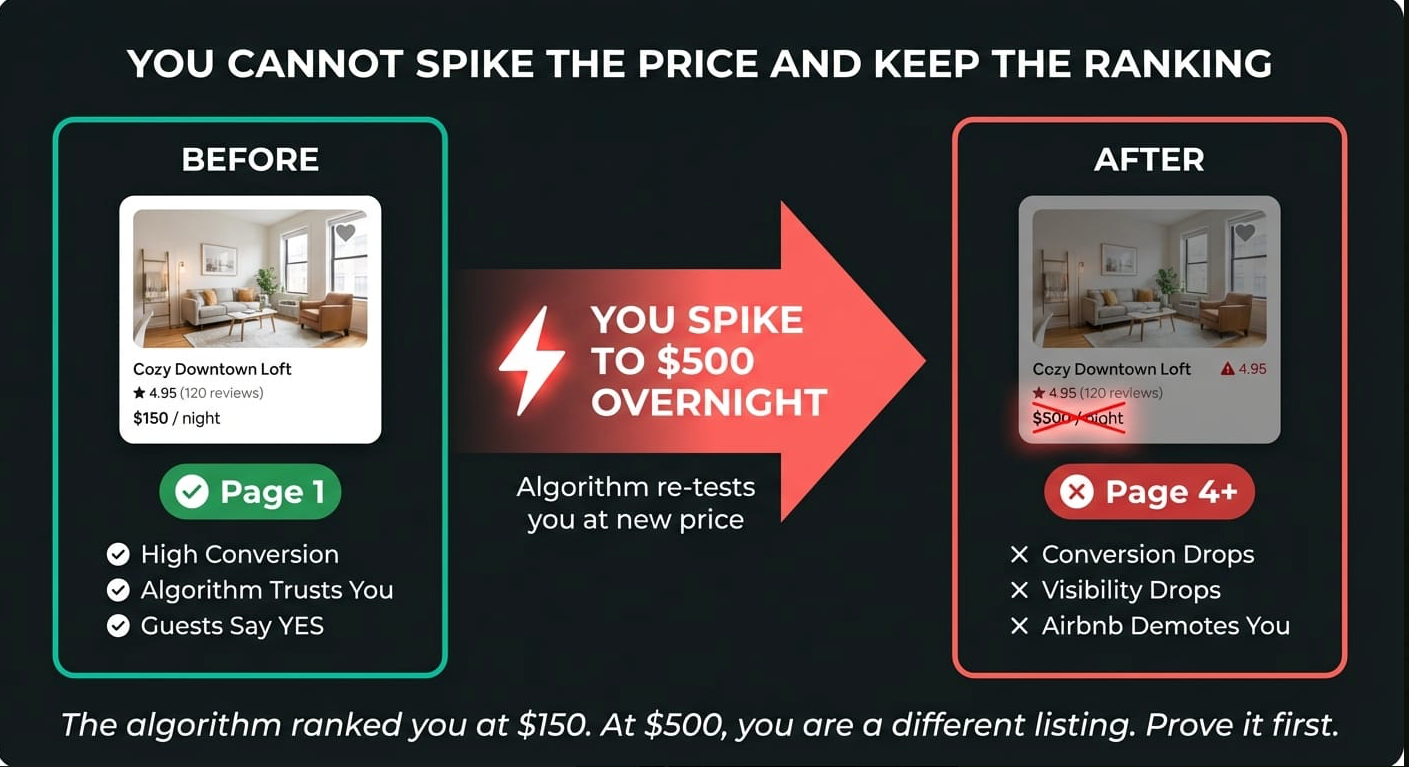
Amazon does not just shrug and show a $24 spatula at the top of the results. Amazon is smart enough to know that a sudden price doubling on a product that was ranking based on $12 performance is a different proposition. The conversion rate will likely tank. Shoppers will look at $24 and pick something else. Click-through drops. Sales drop. Amazon re-ranks the product lower because it's no longer doing what it was doing when Amazon decided to feature it.

Airbnb works the same way.

When Airbnb shows your listing on page one, it's making a promise to the guest. The implicit promise is: "We think this listing is a good match for you at a fair price." That's what guests expect from a search-derived platform. When you type your destination and dates, you expect Airbnb to surface listings that represent genuine value relative to what you're looking for.

So when you spike your price dramatically, you're not just changing a number. You're breaking the signal that earned you the visibility in the first place. Airbnb tested you at $400 and you converted. Guests saw you at $400 and said "yes." Now you're at $550 and the algorithm is going to test you again — but this time, you're a different value proposition. If guests stop saying "yes," Airbnb stops giving you the spotlight.

This is why I keep saying: you have to convince Airbnb to show you at the price you're trying to capture. You cannot demand it. You cannot jump to it. You earn it incrementally by proving conversion at each step.
10) The ramp: how it actually works, mechanically

When I talk about ramping, I'm not speaking abstractly. This is a deliberate, step-by-step process of retraining Airbnb's model of what your listing is worth.

Here's the mechanics.

Step 1: Establish pricing power.

Before you touch your rate, you need to be outperforming market occupancy. MPI above 1.0. Ideally around 1.15–1.2 or higher depending on your market and your goals.

If you're at or below market, your job is not to raise price. Your job is to win bookings at your current rate until your occupancy proves you're undervalued. That might mean dropping price. It definitely means protecting conversion.

Step 2: Make a measured move.

Once you have pricing power — meaning guests are choosing you at a rate that beats the market — you raise price incrementally. Not 20%. Not "let's see what happens." A controlled increase. Maybe 5–8% on specific date ranges where you're seeing the strongest demand.

Here's what's happening behind the curtain when you do this:

Airbnb sees the price change. Airbnb re-tests you. It gives you impressions at the new rate and watches. Do guests still click? Do they still book? If yes, Airbnb updates its internal model of your listing. Your listing is now "worth" more in Airbnb's eyes. Your ranking holds or improves because you're still converting.

If no — if conversion drops — Airbnb adjusts the other direction. You lose position.

So the ramp is a conversation with the algorithm. You're saying "I think I'm worth more." And Airbnb is saying "prove it." And then you do, or you don't. And you adjust accordingly.

Step 3: Hold, measure, repeat.

After each increase, you hold. You let the data come in. You watch your occupancy relative to market. You watch conversion. You watch your forward 30 days.

If your occupancy stays above market after the increase, you still have pricing power. You can test another increase.

If your occupancy drops to market or below, you've found the ceiling for now. Hold there. Let the performance stabilize. Rebuild if needed.

This is not a one-week project. This is a continuous cycle. You're perpetually asking: do I have pricing power right now? And if the answer is yes, you use it carefully. If the answer is no, you protect what you have.

Step 4: Use far-out dates to manufacture disproportionate conversion.

This is where pricing becomes a strategic weapon.

If only a few guests are shopping far-out dates — say, 90+ days from now — and your listing is priced attractively for those dates, you can win a conversion with very few page views. That makes your conversion rate look exceptional because the denominator is small.

Then once you secure the booking, you jump the prices up for the remaining far-out inventory because you already captured the conversion signal Airbnb cares about.

That's a very different approach than "let the pricing software run." It's using timing and demand windows to shape the signals Airbnb sees about you.

11) Demand vs saturation: why most dynamic pricing is incomplete

Most pricing tools react to demand.

What they often do not properly account for is saturation.

You can have a demand spike but still have a ton of remaining inventory in the market. If the market is not saturating those dates, raising your prices because demand nudged up can be an efficiency mistake.

So when I price, I'm thinking:

  • Are people booking these dates (velocity)?
  • How much inventory is left (saturation)?
  • If I raise price, will it cost me conversion and therefore cost me visibility?

That third question is everything.

Note for real world implementation. 

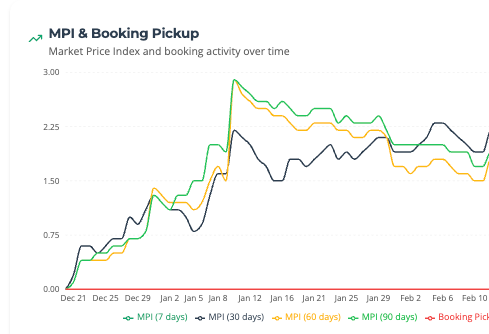
MPI = Fancy way to say what is my occupancy over a time period (like the next 30 days) compared to the markets occupancy over the next 30 days. 

For the houses i do revenue management for, I typically graph out MPI over time. The goal: exceed 1.8 MPI  to establish pricing power,  increase prices until I stabilize at 1.3-1.8 (depending on risk tolerance and other factors like market competitiveness/saturation). 
12) What I do when a listing is underperforming

If a listing is not performing, I assume one of two problems exists:

Trust problem: reviews, experience delivery, operational issues.

Value problem: the guest is not convinced at that price.

If trust is fine, pricing becomes the fastest lever to fix value perception and conversion.

Because again, Airbnb is watching conversion.

The goal is not "cheap."

The goal is a deal relative to what else exists.

Your listing is never competing with "your mortgage."

Your listing is competing with the three listings above you in search that have similar photos, similar amenities, and similar reviews.

13) What not to do (and what I recommend instead)

Do not panic-raise prices when you are only matching the market.

If you are sitting at market occupancy and you raise 20%, Airbnb may test you for a short window and then de-promote you when the bookings do not show up. You are spending pricing power you don't have.

Do not starve Airbnb of inventory if Airbnb is your primary engine.

Filling other platforms can backfire if it trains Airbnb that it cannot monetize you.

Do not try to "game" the algorithm with fake activity.

Yes, some hosts try to manufacture signals. I've heard people talk about it.

My recommendation is simple: do not build your business on tactics that can violate platform rules or burn your account.

Instead, manufacture real signals:

  • Real bookings
  • Real conversions
  • Real guest satisfaction

If you do that, the machine eventually has to respect you.

Do not treat a price increase like it's free.

Every time you raise price, you are spending credibility with the algorithm. If you raise and conversion holds, you earned it. If you raise and conversion drops, you paid a cost. Think of each price increase like an investment — it has downside risk if you haven't earned the right to make it.

14) My weekly pricing workflow (the practical version)

Here's how I'd run pricing if I was managing one listing and wanted to build momentum.

A) Protect the two pillars.

Maintain review quality and guest experience so trust stays handled.

Maintain conversion by staying competitive in your comp set.

B) Track what Airbnb actually cares about.

Last 60 days: booking performance.

Conversion rate: are views becoming bookings?

Market-relative occupancy (MPI logic): are you outperforming your market or just matching it? This tells you whether you have pricing power or not.

Next 30 days: is your near-term calendar trending strong?

C) Make changes like an operator, not like a gambler.

If you're only matching market occupancy, you do not have pricing power. Do not spike prices broadly. Your job is to earn it.

If you're beating the market, you have pricing power. Test measured increases. Watch the response. Protect conversion at every step.

Use far-out dates to capture conversion efficiently, then re-price once booked.

D) Remember what you're actually optimizing.

You are not optimizing nightly rate.

You are optimizing the flywheel: conversion → bookings → visibility → more bookings → the right to charge more.

Closing: you have to convince the platform

Most people think Airbnb "SEO" is photos, titles, and amenities.

Those matter, but if you want the lever that moves the algorithm, it's pricing tied to performance.

Airbnb is deciding where you belong based on whether you are likely to make Airbnb money while protecting trust.

Here's the thing nobody tells you: you cannot just pick the price you want and expect the platform to comply. You have to earn it. You have to prove it. You have to convince Airbnb — through real conversion, real bookings, and real performance relative to your market — that your listing deserves to be shown at that rate.

Just like a seller on Amazon can't double the price of a spatula overnight and expect to hold their ranking, you can't spike your Airbnb rate and expect to hold your visibility.

The hosts who win this game are not the ones who set the highest rate. They're the ones who understand that the rate is a conversation with the algorithm — and they know how to lead that conversation, one step at a time.

So when I price a listing, I'm not just setting a rate.

I'm shaping:

  • conversion,
  • occupancy,
  • revenue,
  • pricing power,
  • and the platform's belief about my listing's value.

And if you do that well, you stop begging for bookings.

You start earning visibility

-CJ

Most Popular Reply

User Stats

13,376
Posts
16,628
Votes
John Underwood
#1 All Forums Contributor
  • Investor
  • Greer, SC
16,628
Votes |
13,376
Posts
John Underwood
#1 All Forums Contributor
  • Investor
  • Greer, SC
Replied
Quote from @Christian Johnston:
I've been doing revenue management for 4+ years, currently across about 100+ and I've developed a framework for how I think about pricing on Airbnb that I wanted to share because I think a lot of hosts are leaving money on the table without realizing it.

For context on where this comes from: when we take over pricing for a listing, our average revenue increase over the first 90 days is around 31%. Some listings more, some less, depends on where they started and what market they're in. I'm not saying that to flex. I'm saying it because the framework below is what I believe drives those results, and I think it's useful even if you're self-managing one property.

This is a thought framework, not gospel. It's how I think Airbnb's algorithm evaluates your listing and why pricing is the biggest lever most hosts aren't using strategically. I could be wrong about pieces of it. I'd actually love to hear from anyone who sees it differently or has tested other approaches. 

If you take nothing else from this article, take this:

Pricing is not just "what you charge." Pricing is how you communicate value to a marketplace algorithm that is deciding whether you deserve attention.

And Airbnb is absolutely deciding that. Every day.

I'm going to explain how I think Airbnb works, why pricing is the lever that moves the most weight, and how to use it to climb out of the "invisible listing" trap and into the top tier where the platform starts working for you, not against you.

This is my worldview, based on a lot of observation, a lot of testing, and a lot of conversations with owners, operators, and the masterminds I participate in, with that...take it with a grain of salt. 

If this was useful, drop a reply and let me know. If there's a specific piece you want me to go deeper on, like how I actually run comps, how I think about minimum stays, how I handle seasonal markets, whatever, tell me and I'll write it up. If enough people find this stuff valuable I'm happy to keep going with more focused breakdowns on specific pricing problems. And if you think I'm wrong about any of it, I want to hear that too.

1) Airbnb is not your partner. Airbnb is a marketplace optimizing for its own outcome.

Let's start with the uncomfortable truth.

Airbnb's job is not "to help hosts." Airbnb's job is to maximize Airbnb's revenue while maintaining the guest's trust so the whole marketplace does not collapse.

When Airbnb decides what shows up on page one, it's not random. It's not "fair." It's not "who deserves it."

It's a ranking problem.

Airbnb looks at the first page like a real estate developer looks at land. Each slot has value. Showing your listing instead of someone else's listing has a cost. I call it opportunity cost because that's what it is.

So the platform is constantly asking:

  • If we give this listing visibility, does it make us money?
  • Does it protect trust with guests?

That's it. That's the game.

2) Page one is "land." Every listing there is an investment decision.

Here's the analogy I use over and over:

Imagine Airbnb's search results are a shopping mall. Page one is the storefronts right by the entrance. If Airbnb puts a dead store in that spot, the mall makes less money.

Airbnb does not want dead stores.

So Airbnb treats page one like prime land with monetization potential. Every listing shown there needs to justify why it deserves that land.

This is why I keep repeating the phrase opportunity cost.

If Airbnb shows your listing in a high-visibility position and you do not convert, Airbnb lost money because it wasted a high-value slot on something that did not produce a booking.

3) The algorithm is constrained by "trust," but driven by "money"

I break Airbnb's priorities into two categories:

A) Long-term trust (reviews, legitimacy, safety)

Airbnb has doubled down on being a trusted platform. Customer support, legitimacy, safety, all of it.

In practice, your reviews are the easiest public proxy for trust.

If your reviews are strong, the trust side is mostly "handled."

B) Short-term money (bookings and fees)

Once trust is not your problem, what remains is money.

Airbnb wants to show listings that will likely book because Airbnb makes money when you make money.

So how does Airbnb guess who will book?

It uses performance signals.

And that's where pricing becomes a weapon.

4) The core signals I BELIEVE Airbnb weights most

I'm not claiming I know Airbnb's exact formula. Nobody outside Airbnb does.

What I'm telling you is the mental model that actually predicts what happens in the real world.

Signal 1: The 60-day lookback

Airbnb has shifted their KPIs to emphasize recent performance. In my view, the 60-day lookback matters a lot.

In other words: what have you done for Airbnb lately?

If your last 60 days look strong versus your market, Airbnb is more confident you will monetize page-one exposure.

Signal 2: Conversion rate (views that become bookings)

A lot of people miss this.

In my experience, conversion rate is a massive lever. It is literally Airbnb watching what happens when they send you traffic.

If Airbnb tests you (gives you impressions) and you convert better than alternatives, you look valuable.

If Airbnb tests you and you do not convert, you look like a bad investment.

Signal 3: Market-relative occupancy (how you perform versus competitors)

Airbnb does not care about your feelings. Airbnb cares about your performance versus the other options the guest could book.

Occupancy versus market is a major clue Airbnb can use to estimate whether you're priced correctly and whether guests actually want you.

Signal 4: How your next 30-60 days are shaping up (booking velocity and key date capture)

Airbnb is also looking forward. Past performance matters, but future occupancy matters too.

A listing that is trending toward being booked in the near future is a listing Airbnb can monetize.

A listing with an empty near-term calendar is a listing Airbnb can't.

5) The feedback loop that makes or breaks your listing

This is the part most hosts do not understand.

Once you fall out of the top tier, you can get stuck in a negative loop:

Less page-one exposure → Less traffic → Less bookings → Worse KPIs versus competitors → Airbnb devalues you and tests you less often → Repeat.

That is the loop.

And it gets worse because a lot of markets behave like an 80/20 distribution: most bookings go to a small top slice of listings. If you are not in that slice, it can feel like you are invisible.

So the job is not "set a price."

The job is break into the positive feedback loop:

You convert → You book → Airbnb sends more traffic → You book more → Airbnb trusts you more.

6) A common mistake: filling other channels and starving your primary booking channel (whether its airbnb,vrbo, etc)

Let's talk about something that silently destroys listings.

If you fill up on other platforms and Airbnb cannot book your calendar, you reinforce the idea that Airbnb cannot monetize you.

You might think you're being smart by diversifying.

But if Airbnb is your primary demand engine, starving Airbnb can push you deeper into the negative loop because Airbnb sees less revenue potential from you.

I'm not saying "turn off other channels."

I'm saying balance them methodically so you do not sacrifice your primary booking channel while chasing short-term cash.

That balance is part of ramping correctly.

BTW, I have run AB tests on (2) units that are part of a duplex in San Diego, exact mirror units. I can elaborate on the controls I used but what I did find, which makes sense, is that airbnb DOES treat a blocked calendar differently from an empty calendar  (blocked calendar = more favorable). Tests like this should be taken with a grain of salt for obvious reasons (length, sample size, etc).

7) Pricing is not a number. Pricing is a signal.

Here's the sentence I want burned into your brain:

Pricing is how you signal value to both a human and an algorithm.

If you price too high too early, you do not just lose a booking.

You lose visibility.

Because an unbooked listing is not making Airbnb money, and the platform does not reward that.

So pricing is not "maximize nightly rate."

Pricing is "maximize the probability of booking at the highest possible rate without losing the algorithm's confidence."

That's a mouthful, but it's real.

8) Pricing power: the concept that changes how you think about rate

This is where I need you to stop thinking like a host and start thinking like a marketplace operator.

I want to introduce a concept I call pricing power. It's the single most important idea in this article because it determines what you're allowed to do with price at any given moment.

Pricing power is earned, not assumed. You have it when your listing is outperforming market occupancy. You do not have it when you are matching or trailing the market.

Here's why this matters so much.

Think about two listings. Same market. Same nightly rate. Let's call them Listing A and Listing B.

Listing A is priced at $500/night. Over the next 30 days, it's sitting at 70% occupancy. The market is at 50%.

Listing B is also priced at $500/night. Over the next 30 days, it's sitting at 40% occupancy. The market is still at 50%.

Now here's the question: what happens if both listings raise their prices by $75 a night?

Most hosts think the answer is the same for both. It is not. Not even close.

Listing A has pricing power. At $500, guests are choosing it at a rate that beats the market by 20 points. That tells you something important: at the current price, this listing is undervalued. Demand is proving that. Guests are looking at the photos, the reviews, the price, and the location and saying "yes" at a higher rate than the market average.

So when Listing A raises price, Airbnb's signal is: this listing was converting above market, it moved price up, let's test it. And because Listing A had room — because demand was already outpacing supply at that rate — there's a real chance it holds conversion. Maybe occupancy drops from 70% to 63%. That's fine. You're still beating market. You've captured more revenue per night and you've kept the algorithm's confidence.

Listing B does not have pricing power. At $500, it's already below market occupancy. Guests are looking at Listing B and saying "no" more often than the average listing in the market. That means the current price is probably too high for what the listing delivers relative to alternatives.

So when Listing B raises price, Airbnb's signal is: this listing was already underperforming at $500, now it's at $575, and — predictably — bookings drop further. Airbnb tested you with impressions and you converted even worse. So Airbnb de-promotes you. Less visibility, fewer eyeballs, weaker KPIs. The negative loop kicks in.

Same action. Completely different outcomes. The difference is pricing power.

If you are at or below market occupancy, you do not have pricing power. You are not in a position to raise rates. You are in a position to earn the right to raise rates. Those are two very different places.

If you are meaningfully above market occupancy, you have pricing power. And the question becomes: how do you use it without blowing it?

9) The Amazon analogy: why you can't just spike the price

This is where I need to reframe how you think about Airbnb entirely.

Airbnb is not a hotel booking site. Airbnb is a search-and-rank marketplace. It functions more like Amazon than it does like Marriott.com.

Think about it this way.

You go to Amazon and type "spatula." What do you expect? You expect Amazon to show you a well-reviewed, fairly priced spatula that matches what you're looking for. You trust that ranking. You trust that the first few results are a reasonable deal.

That trust is what makes Amazon's marketplace work. And Amazon protects it aggressively.

Now imagine a seller has a spatula listed at $12. It's selling well. Good reviews, strong conversion, consistent sales velocity. Amazon notices. Amazon starts showing it near the top because it's a reliable product that makes Amazon money when people click on it.

Now that seller wakes up one morning and changes the price to $24.

What happens?

Amazon does not just shrug and show a $24 spatula at the top of the results. Amazon is smart enough to know that a sudden price doubling on a product that was ranking based on $12 performance is a different proposition. The conversion rate will likely tank. Shoppers will look at $24 and pick something else. Click-through drops. Sales drop. Amazon re-ranks the product lower because it's no longer doing what it was doing when Amazon decided to feature it.

Airbnb works the same way.

When Airbnb shows your listing on page one, it's making a promise to the guest. The implicit promise is: "We think this listing is a good match for you at a fair price." That's what guests expect from a search-derived platform. When you type your destination and dates, you expect Airbnb to surface listings that represent genuine value relative to what you're looking for.

So when you spike your price dramatically, you're not just changing a number. You're breaking the signal that earned you the visibility in the first place. Airbnb tested you at $400 and you converted. Guests saw you at $400 and said "yes." Now you're at $550 and the algorithm is going to test you again — but this time, you're a different value proposition. If guests stop saying "yes," Airbnb stops giving you the spotlight.

This is why I keep saying: you have to convince Airbnb to show you at the price you're trying to capture. You cannot demand it. You cannot jump to it. You earn it incrementally by proving conversion at each step.

10) The ramp: how it actually works, mechanically

When I talk about ramping, I'm not speaking abstractly. This is a deliberate, step-by-step process of retraining Airbnb's model of what your listing is worth.

Here's the mechanics.

Step 1: Establish pricing power.

Before you touch your rate, you need to be outperforming market occupancy. MPI above 1.0. Ideally around 1.15–1.2 or higher depending on your market and your goals.

If you're at or below market, your job is not to raise price. Your job is to win bookings at your current rate until your occupancy proves you're undervalued. That might mean dropping price. It definitely means protecting conversion.

Step 2: Make a measured move.

Once you have pricing power — meaning guests are choosing you at a rate that beats the market — you raise price incrementally. Not 20%. Not "let's see what happens." A controlled increase. Maybe 5–8% on specific date ranges where you're seeing the strongest demand.

Here's what's happening behind the curtain when you do this:

Airbnb sees the price change. Airbnb re-tests you. It gives you impressions at the new rate and watches. Do guests still click? Do they still book? If yes, Airbnb updates its internal model of your listing. Your listing is now "worth" more in Airbnb's eyes. Your ranking holds or improves because you're still converting.

If no — if conversion drops — Airbnb adjusts the other direction. You lose position.

So the ramp is a conversation with the algorithm. You're saying "I think I'm worth more." And Airbnb is saying "prove it." And then you do, or you don't. And you adjust accordingly.

Step 3: Hold, measure, repeat.

After each increase, you hold. You let the data come in. You watch your occupancy relative to market. You watch conversion. You watch your forward 30 days.

If your occupancy stays above market after the increase, you still have pricing power. You can test another increase.

If your occupancy drops to market or below, you've found the ceiling for now. Hold there. Let the performance stabilize. Rebuild if needed.

This is not a one-week project. This is a continuous cycle. You're perpetually asking: do I have pricing power right now? And if the answer is yes, you use it carefully. If the answer is no, you protect what you have.

Step 4: Use far-out dates to manufacture disproportionate conversion.

This is where pricing becomes a strategic weapon.

If only a few guests are shopping far-out dates — say, 90+ days from now — and your listing is priced attractively for those dates, you can win a conversion with very few page views. That makes your conversion rate look exceptional because the denominator is small.

Then once you secure the booking, you jump the prices up for the remaining far-out inventory because you already captured the conversion signal Airbnb cares about.

That's a very different approach than "let the pricing software run." It's using timing and demand windows to shape the signals Airbnb sees about you.

11) Demand vs saturation: why most dynamic pricing is incomplete

Most pricing tools react to demand.

What they often do not properly account for is saturation.

You can have a demand spike but still have a ton of remaining inventory in the market. If the market is not saturating those dates, raising your prices because demand nudged up can be an efficiency mistake.

So when I price, I'm thinking:

  • Are people booking these dates (velocity)?
  • How much inventory is left (saturation)?
  • If I raise price, will it cost me conversion and therefore cost me visibility?

That third question is everything.

Note for real world implementation. 

MPI = Fancy way to say what is my occupancy over a time period (like the next 30 days) compared to the markets occupancy over the next 30 days. 

For the houses i do revenue management for, I typically graph out MPI over time. The goal: exceed 1.8 MPI  to establish pricing power,  increase prices until I stabilize at 1.3-1.8 (depending on risk tolerance and other factors like market competitiveness/saturation). 

12) What I do when a listing is underperforming

If a listing is not performing, I assume one of two problems exists:

Trust problem: reviews, experience delivery, operational issues.

Value problem: the guest is not convinced at that price.

If trust is fine, pricing becomes the fastest lever to fix value perception and conversion.

Because again, Airbnb is watching conversion.

The goal is not "cheap."

The goal is a deal relative to what else exists.

Your listing is never competing with "your mortgage."

Your listing is competing with the three listings above you in search that have similar photos, similar amenities, and similar reviews.

13) What not to do (and what I recommend instead)

Do not panic-raise prices when you are only matching the market.

If you are sitting at market occupancy and you raise 20%, Airbnb may test you for a short window and then de-promote you when the bookings do not show up. You are spending pricing power you don't have.

Do not starve Airbnb of inventory if Airbnb is your primary engine.

Filling other platforms can backfire if it trains Airbnb that it cannot monetize you.

Do not try to "game" the algorithm with fake activity.

Yes, some hosts try to manufacture signals. I've heard people talk about it.

My recommendation is simple: do not build your business on tactics that can violate platform rules or burn your account.

Instead, manufacture real signals:

  • Real bookings
  • Real conversions
  • Real guest satisfaction

If you do that, the machine eventually has to respect you.

Do not treat a price increase like it's free.

Every time you raise price, you are spending credibility with the algorithm. If you raise and conversion holds, you earned it. If you raise and conversion drops, you paid a cost. Think of each price increase like an investment — it has downside risk if you haven't earned the right to make it.

14) My weekly pricing workflow (the practical version)

Here's how I'd run pricing if I was managing one listing and wanted to build momentum.

A) Protect the two pillars.

Maintain review quality and guest experience so trust stays handled.

Maintain conversion by staying competitive in your comp set.

B) Track what Airbnb actually cares about.

Last 60 days: booking performance.

Conversion rate: are views becoming bookings?

Market-relative occupancy (MPI logic): are you outperforming your market or just matching it? This tells you whether you have pricing power or not.

Next 30 days: is your near-term calendar trending strong?

C) Make changes like an operator, not like a gambler.

If you're only matching market occupancy, you do not have pricing power. Do not spike prices broadly. Your job is to earn it.

If you're beating the market, you have pricing power. Test measured increases. Watch the response. Protect conversion at every step.

Use far-out dates to capture conversion efficiently, then re-price once booked.

D) Remember what you're actually optimizing.

You are not optimizing nightly rate.

You are optimizing the flywheel: conversion → bookings → visibility → more bookings → the right to charge more.

Closing: you have to convince the platform

Most people think Airbnb "SEO" is photos, titles, and amenities.

Those matter, but if you want the lever that moves the algorithm, it's pricing tied to performance.

Airbnb is deciding where you belong based on whether you are likely to make Airbnb money while protecting trust.

Here's the thing nobody tells you: you cannot just pick the price you want and expect the platform to comply. You have to earn it. You have to prove it. You have to convince Airbnb — through real conversion, real bookings, and real performance relative to your market — that your listing deserves to be shown at that rate.

Just like a seller on Amazon can't double the price of a spatula overnight and expect to hold their ranking, you can't spike your Airbnb rate and expect to hold your visibility.

The hosts who win this game are not the ones who set the highest rate. They're the ones who understand that the rate is a conversation with the algorithm — and they know how to lead that conversation, one step at a time.

So when I price a listing, I'm not just setting a rate.

I'm shaping:

  • conversion,
  • occupancy,
  • revenue,
  • pricing power,
  • and the platform's belief about my listing's value.

And if you do that well, you stop begging for bookings.

You start earning visibility

-CJ


 Very long article so I had to skim it.

I do way better on Vrbo. Maybe this is self fulfilling  because the Vrbo crowd tends to plan and book early leaving few dates available for Airbnb.

  • John Underwood
  • Loading replies...