Fortunes made, fortunes lost, all on the same properties!

Fortunes made, fortunes lost, all on the same properties!

Collin HaysBusiness Member
Property Manager · Gatlinburg, TN · Member since 2020 · 3k+ posts · 4k+ votes

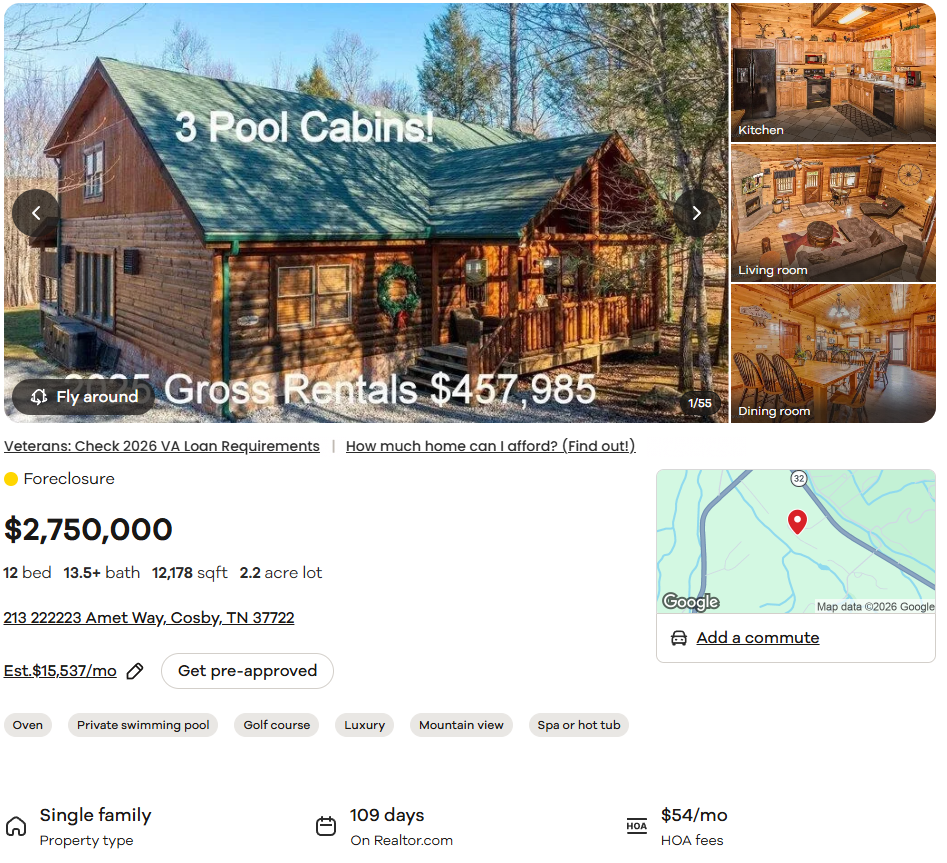
When I began investing in the Smokies in 2005, this cabin development was being constructed a few miles away.  All of the units had pools. The units were priced at $899K and $999K, depending on which size of cabin you wanted.  Similar to the last few years, they got snatched up by eager buyers.  Then the financial crisis hit, and rents were way down. Several of these were bought out of bankruptcy or short sales for as little as $250,000.  Those buyers proceeded to make hay, the cabins rented well, and eventually the owners made tremendous profits by reselling them to eager buyers for $1 million + in the 2021-22 timeframe.  

But history tends to repeat itself.  We now have a glut of pool cabins in the Smokies with not enough guests.  The eager buyer of these cabins paid too much and is overleveraged.  The cabins are in foreclosure...again.  The next buyer will probably do very well.
4Reply
318 views

Most Popular Reply

John UnderwoodPro Member
Investor · Greer, SC · Member since 2014 · 13k+ posts · 17k+ votes
6mo

It is interesting to see the cycles.

People that can hold on for the long term almost always fare well.

See this reply in the discussion

14 Replies

Jump to latestLatest
  • John UnderwoodPro Member
    Investor · Greer, SC · Member since 2014 · 13k+ posts · 17k+ votes
    6mo

    It is interesting to see the cycles.

    People that can hold on for the long term almost always fare well.

  • Mike GrudzienPro Member
    Lender · Eugene, OR · Member since 2019 · 2k+ posts · 1k+ votes
    6mo

    I just love Collin's updates!  Keep it up.

  • Member since 2023 · 39 posts · 13 votes
    6mo

    The only difference between now and 2009-2014 was that there were no buyers in 2009-2014 at any price. The cabins were all in disrepair after years of neglect. PM contracts were 40/60 splits that trended more towards 60/40 of guest total in favor of the PM due to fees.

    At the 2012 rents, the numbers barely made sense with a 40/60 split as an investment. People at that time bought to have a 2nd vacation home. No one expected to make a return on these cabins. Self Managing wasn't realistic.

    In 2013/2014 the rental multiple was 2-4x. This should be valued at 1.0M - 1.2M for all 3 cabins to be anything close to the post-GFC era. Nowadays, there are plenty of buyers between the 5-7x revenue multiple.

    Also at that time the banks were selling off entire developments that they had repossessed from the builder that couldn't sell. As in 30+ cabins at a time. Thats not really happening either. 

    • Real Estate Agent · Gatlinburg, TN · Member since 2015 · 68 posts · 70 votes
      6mo
      Quote from @Sunil Ghosal:

      The only difference between now and 2009-2014 was that there were no buyers in 2009-2014 at any price. The cabins were all in disrepair after years of neglect. PM contracts were 40/60 splits that trended more towards 60/40 of guest total in favor of the PM due to fees.

      At the 2012 rents, the numbers barely made sense with a 40/60 split as an investment. People at that time bought to have a 2nd vacation home. No one expected to make a return on these cabins. Self Managing wasn't realistic.

      In 2013/2014 the rental multiple was 2-4x. This should be valued at 1.0M - 1.2M for all 3 cabins to be anything close to the post-GFC era. Nowadays, there are plenty of buyers between the 5-7x revenue multiple.

      Also at that time the banks were selling off entire developments that they had repossessed from the builder that couldn't sell. As in 30+ cabins at a time. Thats not really happening either. 

      There wasn't a time when you could purchase at a GRM of 2 in the Smokies. There may have been a cabin or two, but definitely not widespread. During the foreclosure crisis a GRM of 6 was commonplace, 5 times gross was considered a good deal, 4 times gross was an excellent deal and rarely found, and anything below 4 times gross was very rare with practically nothing dropping below 3.5x gross. We bought one during that era I consider one of the better deals that did $89k that we purchased for $211,033 (2.37 GRM). That was an anomaly for the time. Some of the 6 bedroom pool cabins in Black Bear Ridge that sold for $250k to $325k as foreclosures had similar GRM below 3. I know Anjan can attest to these figures of GRM! 😜


      Keep in mind the gross reported during that time period was strictly rental rate revenue not including cleaning fees. As professional management companies predominantly operated in the area and self managing via VRBO was fairly rare. So that has to be taken into consideration when comparing the two time eras as well.
       

  • Collin HaysBusiness Member
    OP
    Property Manager · Gatlinburg, TN · Member since 2020 · 3k+ posts · 4k+ votes
    6mo

    There are more similarities that you might think.  

    Yes, management fees were higher - we were at 33% - but we were having to pay for our own marketing because the OTA platforms weren't yet a thing.  That was a massive expense.  If you add the 15-16% OTA fees today to the typical management fee, you are at or above the totals back then.

    Many properties today are haggard. Used up and unkept. Investors are broke and don't want to spend a dime.

    I don't recall a time when you could buy a cabin for 2-4X annual rents, and I've been in the Smokies for quite a long time.  Other than the bubble years of 21-22, 10X has been the going rate. And I don't see any homes priced at 5-7X rents, either. If they were, I'd be writing some checks.  

  • Chris SeveneyBusiness Member
    Moderator
    Investor · VA · Member since 2015 · 21k+ posts · 19k+ votes
    6mo

    Going to be a lot of opportunities coming for people and the comment below that those who can hold long term are going to do very well is very true 

    7e investments53 Reviews
  • Julius VincentBusiness Member
    Tax Strategist | CPA, MBA + Wharton FP&A | CFO-Level Planning · Houston, TX · Member since 2025 · 157 posts · 172 votes
    6mo

    You're the man, @Collin Hays! Always enjoy your posts.

    Horizon Wealth & Tax Advisors510 Reviews
  • Don KonipolBusiness Member
    Investor · The Woodlands TX / Avon, CT · Member since 2009 · 6k+ posts · 10k+ votes
    6mo
    Quote from @Collin Hays:

    When I began investing in the Smokies in 2005, this cabin development was being constructed a few miles away.  All of the units had pools. The units were priced at $899K and $999K, depending on which size of cabin you wanted.  Similar to the last few years, they got snatched up by eager buyers.  Then the financial crisis hit, and rents were way down. Several of these were bought out of bankruptcy or short sales for as little as $250,000.  Those buyers proceeded to make hay, the cabins rented well, and eventually the owners made tremendous profits by reselling them to eager buyers for $1 million + in the 2021-22 timeframe.  

    But history tends to repeat itself.  We now have a glut of pool cabins in the Smokies with not enough guests.  The eager buyer of these cabins paid too much and is overleveraged.  The cabins are in foreclosure...again.  The next buyer will probably do very well.

    The MOST dangerous investor is the one that hasn’t experienced a down cycle.
    Private Mortgage Financing Partners, LLC
    • Jay HinrichsBusiness Member
      Real Estate Consultant · Summerlin, NV · Member since 2014 · 45k+ posts · 66k+ votes
      6mo
      Quote from @Don Konipol:
      Quote from @Collin Hays:

      When I began investing in the Smokies in 2005, this cabin development was being constructed a few miles away.  All of the units had pools. The units were priced at $899K and $999K, depending on which size of cabin you wanted.  Similar to the last few years, they got snatched up by eager buyers.  Then the financial crisis hit, and rents were way down. Several of these were bought out of bankruptcy or short sales for as little as $250,000.  Those buyers proceeded to make hay, the cabins rented well, and eventually the owners made tremendous profits by reselling them to eager buyers for $1 million + in the 2021-22 timeframe.  

      But history tends to repeat itself.  We now have a glut of pool cabins in the Smokies with not enough guests.  The eager buyer of these cabins paid too much and is overleveraged.  The cabins are in foreclosure...again.  The next buyer will probably do very well.

      The MOST dangerous investor is the one that hasn’t experienced a down cycle.

      I love Collins posts they are so informative.. Its always tough to see folks go through there first bad RE cycle.  old dogs like myself been through a number of them. Carter years  resolution trust  N. CA earthquake that was local but had the bay area in a deep decline most folks are or were not aware of.. mini melt down of the dot com bubble then the mother of them all in 08 to 2011 or so  then the biden years etc etc.. Now we are seeing it in SWF cape coral lehigh area were flocks of investors thought it was a good Idea to build new builds in an area that has massive amount of build able lots and builders taking on 50 projects in a year with no hope of ever being able to perform. I dont know the smokies at all but these cycles are not new and its just the nature of the game.. supply demand  fomo  new shiny toy etc.
    • Don KonipolBusiness Member
      Investor · The Woodlands TX / Avon, CT · Member since 2009 · 6k+ posts · 10k+ votes
      6mo
      Quote from @Jay Hinrichs:
      Quote from @Don Konipol:
      Quote from @Collin Hays:

      When I began investing in the Smokies in 2005, this cabin development was being constructed a few miles away.  All of the units had pools. The units were priced at $899K and $999K, depending on which size of cabin you wanted.  Similar to the last few years, they got snatched up by eager buyers.  Then the financial crisis hit, and rents were way down. Several of these were bought out of bankruptcy or short sales for as little as $250,000.  Those buyers proceeded to make hay, the cabins rented well, and eventually the owners made tremendous profits by reselling them to eager buyers for $1 million + in the 2021-22 timeframe.  

      But history tends to repeat itself.  We now have a glut of pool cabins in the Smokies with not enough guests.  The eager buyer of these cabins paid too much and is overleveraged.  The cabins are in foreclosure...again.  The next buyer will probably do very well.

      The MOST dangerous investor is the one that hasn’t experienced a down cycle.

      I love Collins posts they are so informative.. Its always tough to see folks go through there first bad RE cycle.  old dogs like myself been through a number of them. Carter years  resolution trust  N. CA earthquake that was local but had the bay area in a deep decline most folks are or were not aware of.. mini melt down of the dot com bubble then the mother of them all in 08 to 2011 or so  then the biden years etc etc.. Now we are seeing it in SWF cape coral lehigh area were flocks of investors thought it was a good Idea to build new builds in an area that has massive amount of build able lots and builders taking on 50 projects in a year with no hope of ever being able to perform. I dont know the smokies at all but these cycles are not new and its just the nature of the game.. supply demand  fomo  new shiny toy etc.

       “I love Collins posts they are so informative.”

      Private Mortgage Financing Partners, LLC
    • Collin HaysBusiness Member
      OP
      Property Manager · Gatlinburg, TN · Member since 2020 · 3k+ posts · 4k+ votes
      6mo
      Quote from @Don Konipol:
      Quote from @Jay Hinrichs:
      Quote from @Don Konipol:
      Quote from @Collin Hays:

      When I began investing in the Smokies in 2005, this cabin development was being constructed a few miles away.  All of the units had pools. The units were priced at $899K and $999K, depending on which size of cabin you wanted.  Similar to the last few years, they got snatched up by eager buyers.  Then the financial crisis hit, and rents were way down. Several of these were bought out of bankruptcy or short sales for as little as $250,000.  Those buyers proceeded to make hay, the cabins rented well, and eventually the owners made tremendous profits by reselling them to eager buyers for $1 million + in the 2021-22 timeframe.  

      But history tends to repeat itself.  We now have a glut of pool cabins in the Smokies with not enough guests.  The eager buyer of these cabins paid too much and is overleveraged.  The cabins are in foreclosure...again.  The next buyer will probably do very well.

      The MOST dangerous investor is the one that hasn’t experienced a down cycle.

      I love Collins posts they are so informative.. Its always tough to see folks go through there first bad RE cycle.  old dogs like myself been through a number of them. Carter years  resolution trust  N. CA earthquake that was local but had the bay area in a deep decline most folks are or were not aware of.. mini melt down of the dot com bubble then the mother of them all in 08 to 2011 or so  then the biden years etc etc.. Now we are seeing it in SWF cape coral lehigh area were flocks of investors thought it was a good Idea to build new builds in an area that has massive amount of build able lots and builders taking on 50 projects in a year with no hope of ever being able to perform. I dont know the smokies at all but these cycles are not new and its just the nature of the game.. supply demand  fomo  new shiny toy etc.

       “I love Collins posts they are so informative.”


       you must be bored.  

  • Andrew SteffensBusiness Member
    Tampa, FL · Member since 2022 · 4k+ posts · 3k+ votes
    6mo

    At what price are those $1M houses profitable in today's rental market?

  • Investor · Get yourself trained before doing something inadvisable. · Member since 2024 · 3k+ posts · 1k+ votes
    6mo
    Quote from @Collin Hays:

    When I began investing in the Smokies in 2005, this cabin development was being constructed a few miles away.  All of the units had pools. The units were priced at $899K and $999K, depending on which size of cabin you wanted.  Similar to the last few years, they got snatched up by eager buyers.  Then the financial crisis hit, and rents were way down. Several of these were bought out of bankruptcy or short sales for as little as $250,000.  Those buyers proceeded to make hay, the cabins rented well, and eventually the owners made tremendous profits by reselling them to eager buyers for $1 million + in the 2021-22 timeframe.  

    But history tends to repeat itself.  We now have a glut of pool cabins in the Smokies with not enough guests.  The eager buyer of these cabins paid too much and is overleveraged.  The cabins are in foreclosure...again.  The next buyer will probably do very well.

    . 

    "But history tends to repeat itself." Again, and again and again. Sometimes I feel we as a nation are in a time warp of stupidity. We keep making the same mistakes over and over. 

    But, It's actually a new group of "consumer class" Americans each time, trying to get more out (borrowing) than they're putting in. The "producer class" can't produce enough fast enough to keep up with demand. 

    That is, in 2008 no one thought the banks would shortly stop lending. That surprised a lot of people. In 2001 (I know, way before your time:-) When the airplanes hit the buildings, no one expected banks to stop lending. When the Dot Com bubble burst in late 1990's no one expected the banks to stop lending.

    Thank God, we'll never have a Recession or Black Swan event ever again!

    (Just kidding)

    Major Recessions Since 1900

    • 1902–1904: Lasted ~1 year 11 months; peak unemployment 16.2%.
    • 1907–1908: Lasted ~1 year 1 month; peak unemployment 29.2%.
    • 1910–1912: Lasted 2 years; peak unemployment 14.7%.
    • 1913–1914: Lasted ~1 year 11 months; peak unemployment 25.9%.
    • 1918–1919: Lasted ~7 months; peak unemployment 24.5%.
    • 1920–1921: Lasted ~1 year 6 months; peak unemployment 38.1%.
    • 1923–1924: Lasted ~1 year 2 months; peak unemployment 25.4%.
    • 1926–1927: Lasted ~1 year 1 month; peak unemployment 12.2%.
    • 1929–1933 (Great Depression): Lasted ~4 years 7 months; peak unemployment 24.9% (26.7% by some measures).
    • 1937–1938: Lasted ~1 year 1 month; peak unemployment 26.4%.
    • 1945–1946: Lasted ~8 months; peak unemployment 5.2%.
    • 1948–1949: Lasted ~11 months; peak unemployment 7.9%.
    • 1953–1954: Lasted ~10 months; peak unemployment 6.1%.
    • 1957–1958: Lasted ~8 months; peak unemployment 7.5%.
    • 1960–1961: Lasted ~10 months; peak unemployment 7.1%.
    • 1969–1970: Lasted ~11 months; peak unemployment 6.1%.
    • 1973–1975: Lasted ~1 year 4 months; peak unemployment 9.0%.
    • 1980: Lasted ~6 months; peak unemployment 7.8%.
    • 1981–1982: Lasted ~1 year 4 months; peak unemployment 10.8%.
    • 1990–1991: Lasted ~8 months; peak unemployment 7.8%.
    • 2001: Lasted ~8 months; peak unemployment 6.3%.
    • 2007–2009 (Great Recession): Lasted ~1 year 6 months; peak unemployment 10.0–10.1%.
    • 2020 (Great Lockdown): Lasted ~2 months; peak unemployment 30.2%.

    Lending gets really hard to get sometimes.

    Psychologists and econ guys tell us it's all in our heads. When enough people think things are slowing down and getting bad, that sentiment picks up steam and everybody starts believing it, and then it happens. Not so much that it HAD to happen, but enough people believed it would happen.

    As the old (elder) Bush used to say "Not going to believe it, it wouldn't be prudent."

    (Yes, I know the Fed's definition of a recession and I'm using the popular understanding, not the official Fed definition)

    • Collin HaysBusiness Member
      OP
      Property Manager · Gatlinburg, TN · Member since 2020 · 3k+ posts · 4k+ votes
      6mo
      Quote from @Ken M.:
      Quote from @Collin Hays:

      When I began investing in the Smokies in 2005, this cabin development was being constructed a few miles away.  All of the units had pools. The units were priced at $899K and $999K, depending on which size of cabin you wanted.  Similar to the last few years, they got snatched up by eager buyers.  Then the financial crisis hit, and rents were way down. Several of these were bought out of bankruptcy or short sales for as little as $250,000.  Those buyers proceeded to make hay, the cabins rented well, and eventually the owners made tremendous profits by reselling them to eager buyers for $1 million + in the 2021-22 timeframe.  

      But history tends to repeat itself.  We now have a glut of pool cabins in the Smokies with not enough guests.  The eager buyer of these cabins paid too much and is overleveraged.  The cabins are in foreclosure...again.  The next buyer will probably do very well.

      . 

      "But history tends to repeat itself." Again, and again and again. Sometimes I feel we as a nation are in a time warp of stupidity. We keep making the same mistakes over and over. 

      But, It's actually a new group of "consumer class" Americans each time, trying to get more out (borrowing) than they're putting in. The "producer class" can't produce enough fast enough to keep up with demand. 

      That is, in 2008 no one thought the banks would shortly stop lending. That surprised a lot of people. In 2001 (I know, way before your time:-) When the airplanes hit the buildings, no one expected banks to stop lending. When the Dot Com bubble burst in late 1990's no one expected the banks to stop lending.

      Thank God, we'll never have a Recession or Black Swan event ever again!

      (Just kidding)

      Major Recessions Since 1900

      • 1902–1904: Lasted ~1 year 11 months; peak unemployment 16.2%.
      • 1907–1908: Lasted ~1 year 1 month; peak unemployment 29.2%.
      • 1910–1912: Lasted 2 years; peak unemployment 14.7%.
      • 1913–1914: Lasted ~1 year 11 months; peak unemployment 25.9%.
      • 1918–1919: Lasted ~7 months; peak unemployment 24.5%.
      • 1920–1921: Lasted ~1 year 6 months; peak unemployment 38.1%.
      • 1923–1924: Lasted ~1 year 2 months; peak unemployment 25.4%.
      • 1926–1927: Lasted ~1 year 1 month; peak unemployment 12.2%.
      • 1929–1933 (Great Depression): Lasted ~4 years 7 months; peak unemployment 24.9% (26.7% by some measures).
      • 1937–1938: Lasted ~1 year 1 month; peak unemployment 26.4%.
      • 1945–1946: Lasted ~8 months; peak unemployment 5.2%.
      • 1948–1949: Lasted ~11 months; peak unemployment 7.9%.
      • 1953–1954: Lasted ~10 months; peak unemployment 6.1%.
      • 1957–1958: Lasted ~8 months; peak unemployment 7.5%.
      • 1960–1961: Lasted ~10 months; peak unemployment 7.1%.
      • 1969–1970: Lasted ~11 months; peak unemployment 6.1%.
      • 1973–1975: Lasted ~1 year 4 months; peak unemployment 9.0%.
      • 1980: Lasted ~6 months; peak unemployment 7.8%.
      • 1981–1982: Lasted ~1 year 4 months; peak unemployment 10.8%.
      • 1990–1991: Lasted ~8 months; peak unemployment 7.8%.
      • 2001: Lasted ~8 months; peak unemployment 6.3%.
      • 2007–2009 (Great Recession): Lasted ~1 year 6 months; peak unemployment 10.0–10.1%.
      • 2020 (Great Lockdown): Lasted ~2 months; peak unemployment 30.2%.

      Lending gets really hard to get sometimes.

      Psychologists and econ guys tell us it's all in our heads. When enough people think things are slowing down and getting bad, that sentiment picks up steam and everybody starts believing it, and then it happens. Not so much that it HAD to happen, but enough people believed it would happen.

      As the old (elder) Bush used to say "Not going to believe it, it wouldn't be prudent."

      (Yes, I know the Fed's definition of a recession and I'm using the popular understanding, not the official Fed definition)


       Good info as always Ken!  I'm waiting for Climate Change Lockdowns...

Join the conversationCreate a free account to reply, vote on answers and follow this thread.