





Austin Market Report – February 2026
The February 2026 statistics for the Austin five-county metro show a market that is gradually gaining momentum while prices continue adjusting modestly downward. Buyer activity increased year over year, with more pending contracts and closed sales compared with February 2025. At the same time, inventory continues to expand and pricing metrics remain slightly lower than last year.
Taken together, these trends point toward a market that is gradually moving toward more balanced conditions as the spring season approaches.
Key Highlights
• Total sales increased to 2,102 units, a +7.5% increase year over year.
• Pending / under-contract units increased +10.2%, indicating stronger near-term demand.
• New listings rose +5.1% while active listings increased +8.6%, continuing the expansion of inventory.
• Average and median sold prices declined 4.4% and 4.7% respectively year over year.
• Average days on market increased to 111, while months of inventory rose to 5.3 months, indicating more balanced market conditions.

Average and Median Sold Price Trends
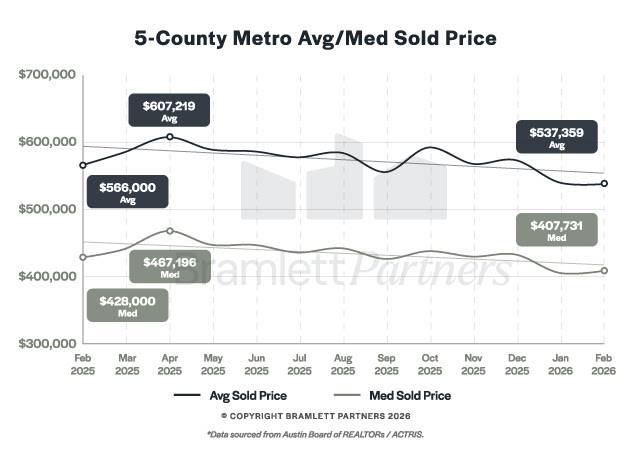
Pricing across the Austin metro continues to adjust gradually. The average sold price declined to $537,359, while the median sold price declined to $407,731 compared with the same time last year. This represents decreases of 4.4% and 4.7% respectively.
These price movements are consistent with the gradual normalization that has been occurring since the rapid appreciation during the pandemic years. Month-to-month pricing has remained relatively steady, suggesting the market is continuing to recalibrate as inventory expands and buyers regain negotiating leverage.
Pending Sales Increase Suggests Improving Demand
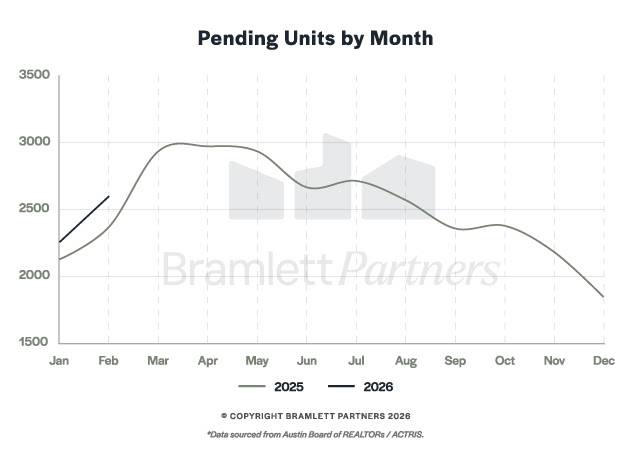
Pending or under-contract units increased 10.2% year over year, reaching 2,602 units in February. Pending contracts are one of the most useful forward indicators because they typically convert to closed sales within the following one to two months.
Austin’s housing market historically follows a clear seasonal pattern in which buyer activity begins increasing in late winter before peaking in late spring or early summer. The February data suggests buyers are beginning to re-enter the market after the slower winter months.
New Listings Continue Expanding Inventory
New listings increased to 4,086 units in February, a 5.1% increase year over year. Active listings rose to 14,676 homes, representing an 8.6% increase.
One of the defining characteristics of Austin’s current housing market is the continued expansion of inventory. During the pandemic boom years, inventory fell to historically low levels, which created intense competition and rapid price appreciation.
Today’s market looks very different. Buyers have more options and more negotiating leverage, while sellers need to price more carefully to attract demand. Months of inventory now sits at 5.3 months, approaching the level economists typically associate with balanced housing markets.

Total Volume Shows Market Stabilizing
Despite lower prices, the total dollar volume of homes sold increased slightly in February to approximately $1.13B, a +2.7% increase year over year. This increase occurred because the number of homes sold rose enough to offset modest price declines.
However, year-to-date volume remains down about 2.2% compared with the same period last year, reflecting the slower start to the year that has become common in the current interest rate environment.
Overall, the combination of increasing transaction activity and gradual price adjustments suggests the market is stabilizing rather than moving sharply in either direction.

Broader Economic Indicators
Consumer sentiment improved modestly in recent readings from the University of Michigan survey, rising into the mid-50 range. While still below historical averages, the increase suggests consumers are gradually becoming more comfortable with current economic conditions.

Mortgage rates have also moved slightly lower in recent months. After reaching approximately 6.36% in December, rates have recently moved closer to 6.1%. Even relatively small changes in mortgage rates can affect affordability and influence buyer activity.
Mortgage rates will remain one of the most important variables affecting housing demand throughout 2026.

If You’re a Buyer
Inventory has increased meaningfully compared with the past several years, while prices remain modestly lower year over year. This combination gives buyers more options and generally reduces the level of competition compared with the conditions seen in 2021 and 2022.
Interest rates remain a key factor affecting affordability. Some buyers choose to transact in periods of higher rates because competition is often lower, with the option to refinance if financing conditions improve later.
If You’re a Seller
The Austin housing market remains active, but it is significantly more price-sensitive than it was during the peak pandemic years. Buyers now have more choices and tend to compare properties more carefully before making offers.
Homes that are priced appropriately and presented well continue to sell, while listings that begin above market expectations often spend longer on the market. With average days on market now at 111 days, pricing strategy and preparation are increasingly important.
Buyer activity has increased compared with the winter months, and Austin’s housing market historically sees its highest levels of activity during the spring season.
Real estate is highly local and situation-specific. If you’d like to talk through your plans or timing, or how current market trends may affect your situation in the greater Austin metro, I’m always happy to be a resource.