- Real Estate Agent
- Nashville, TN
- 180
- Votes |
- 369
- Posts
The $6.6 Billion Bet on Nashville
This week, we’re talkin’ a hot jobs report - that everyone hated, what if AI is actually adding jobs to the economy, and concrete trucks are multiplying like rabbits in Nashville.
Let’s get into it.
----
Today’s Interest Rate: 6.66%
(☝️ .10% from this time last week, 30-yr fixed)
----
The Weekly 3 in News:
- The hiring ‘recession’ may be ending. U.S. employers added 172,000 jobs in May, well above the ~88,000 expected, and March and April were revised up by a combined 93,000. Thats after multiple downward revisions. Plus, unemployment held at 4.3%. (BLS; CNBC, Jun 5)
- The largest job openings beat on record, jumping ~731,000 in April, when the market expected no change,the biggest surprise in the history of the series. A question I now have: is AI (finally) creating more roles than it’s replacing? (KL)
- Productivity is doing the heavy lifting. Over the past year, labor productivity rose 2.8% while unit labor costs rose just 0.5%. Signature healthy, supply-driven growth, not an inflationary boom. (BLS Productivity and Costs, Q1 2026 revised)
- Bonus! Nashville’s East Bank moved from paper to dirt. Oracle filed permits to demolish roughly 515,000 square feet across its ~80-acre assemblage, and the broader Eastpoint development broke ground in late May. The $4.5B campus is officially a construction site! My 12-yr old self will be staring at it this week. (Axios Nashville, Apr 13; Fox 17)
- The Country Music Festival takes over downtown. Four days, ten-plus stages, nightly shows at the new and old stadium footprint, and a lineup that ran from Luke Bryan and Tim McGraw to Shaboozey. The festival draws north of 95,000 people a day and is, quietly, one of the best live demonstrations of why this city’s tourism numbers keep breaking records. (CMA Fest)
- Nashville Sounds at First Horizon Park. Triple-A baseball in the middle of Germantown, walkable from the same neighborhoods we’ll talk about below. Cheap seats, cold beer, skyline views.
The Jobs Report Came in Hot
Let’s start with the number that set the tone last week.
The U.S. economy added 172,000 jobs in May, nearly double the ~88,000 economists expected, and the prior two months were revised up by a combined 93,000 (BLS). Average hourly earnings rose 0.3% on the month and 3.4%over the year (BLS). Unemployment sat at 4.3%.
Economists, who are normally pretty boring, were elated:
- Heather Long at Navy Federal: “The hiring recession is over. American firms are hiring again. This is a strong jobs report from every angle.”
- Gus Faucher at PNC: “This is a labor market that is stronger than it was last year and is looking pretty darn solid. There’s no indication that the labor market needs support.”
- Ellen Zentner at Morgan Stanley, with the line that matters most for our mortgages: “More solid jobs data leaves the Fed where it’s been for a while, watching and waiting, focused on the inflation side of its mandate.” (CNBC, Jun 5)
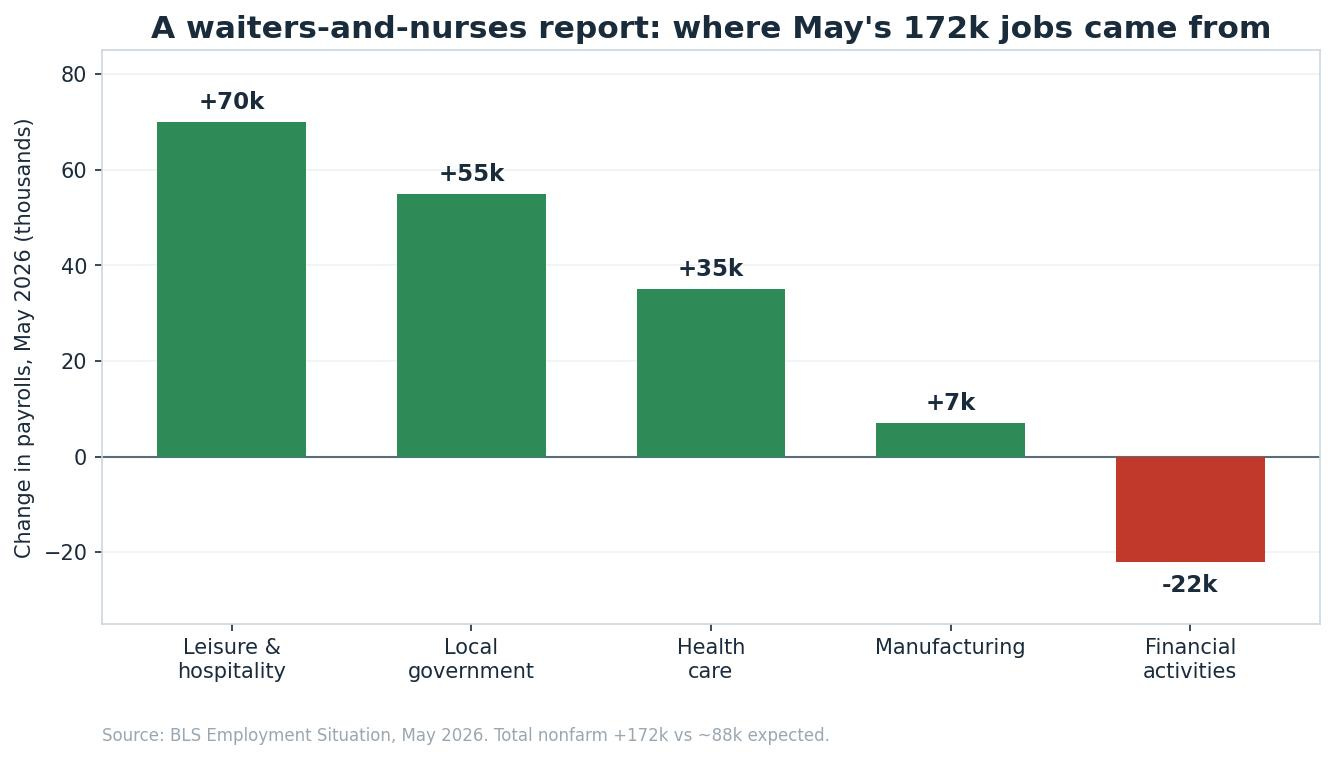
Where the jobs came from. Here’s the part most coverage skipped: the gains were led by leisure and hospitality (about +70,000, mostly restaurants and bars), local government (+55,000), and health care (+35,000). Manufacturing added a thin +7,000, and financial activities actually lost about 22,000 (BLS; NPR, Jun 5).
This was a waiters-and-nurses month, not a software-engineer month (keep reading).
This a strong, broad labor market is exactly the backdrop that supports renters staying strong and young folks saving for their first home.
A steelman thought: the honest counterargument is that this report is softer underneath the headline. The job growth was concentrated in lower-wage, cyclical sectors, restaurants, bars, and government, rather than high-paying private industry, and finance shed jobs outright. A separate read of the data even argued the labor market is “freezing” beneath the surface, with hiring narrow and churn low (Verified Investing). If most of the hiring is in sectors that get cut first in a downturn, then the strength is may be more fragile.
Counterpoint: But then I think, even a hospitality-led labor market is a labor market that pays rent, and can sock away money in the savings account. Plus the upward revisions to prior months argue the trend is firming. That was new and consequential.
Plus, what if……
But What if AI Is also Adding Jobs?
Now for the real contrarian view.
The fear for 2+ years has been that AI would hollow out employment.
But while this feels correct, and sounds good….is this actually true?
The jobs data is pointing the other way, at least so far. In April, job openings surged by roughly 731,000, the largest upside surprise in the history of the JOLTS series, when forecasters expected no change at all (The Kobeissi Letter). That is not what tech displacement looks like.
LinkedIn’s data shows AI has already been associated with about 1.3 million NEW roles, like AI engineers and data annotators (World Economic Forum). U.S. job postings requiring AI skills have grown sharply year over year (Index.dev), and PwC’s analysis finds AI-skill roles command a wage premium and are growing while postings overall have softened (PwC AI Jobs Barometer).
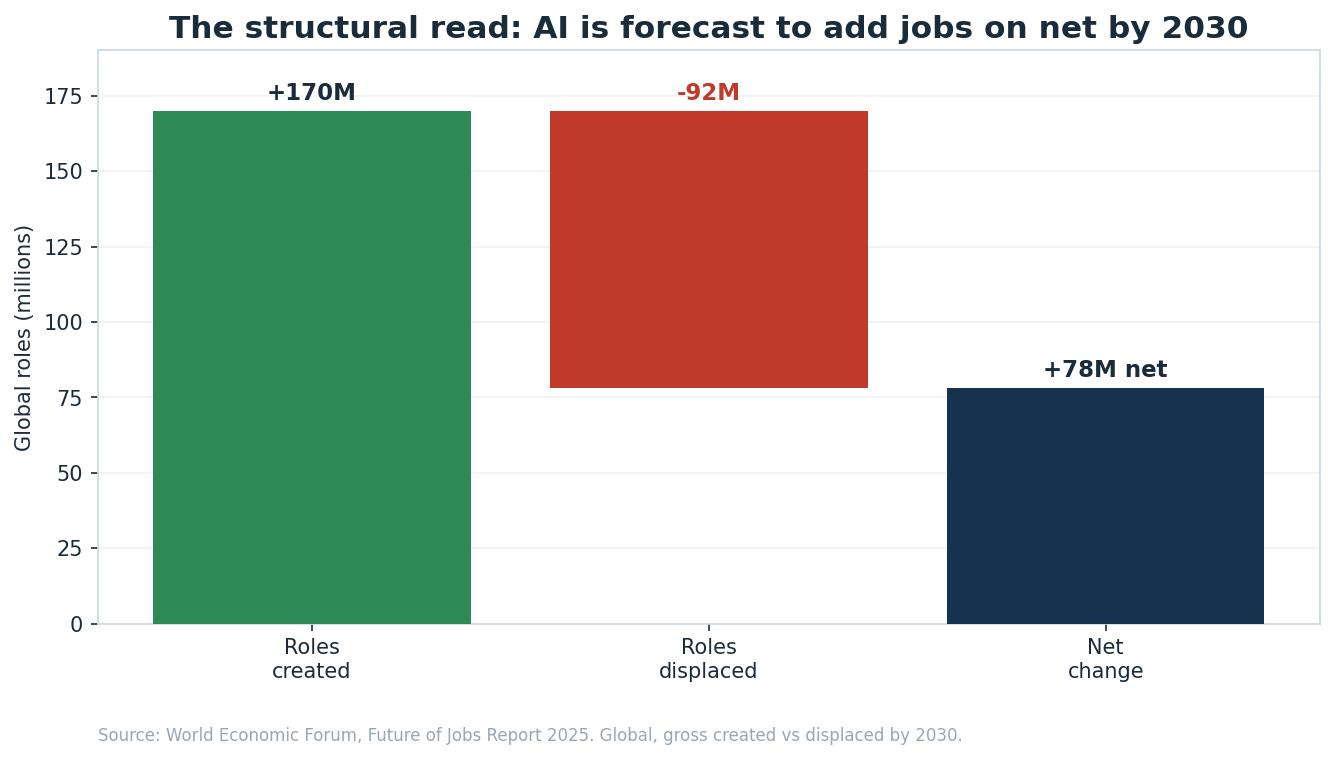
The World Economic Forum’s framing captures it: it projects roughly 170 million new roles created and 92 million displaced by 2030, a potential net gain of about 78 million jobs (World Economic Forum).
Displacement is real and it will hurt specific people in specific roles.
But on net, the forecast is for more work, not less.
The Deflation EngineThe stock market sold off on the strong jobs number last week because it assumed strength means inflation.
History suggests that’s not automatic.
Over the past year, productivity rose about 2.8% while unit labor costs rose just 0.5% (BLS). When output per hour grows faster than what labor costs, employers can pay people more and charge customers less.
Deflationary + productivity improvement = AI Jobs.
If you believe this, then a strong labor market is not a reason to fear the Fed.
I’ll say this again, the Fed is NOT going to raise rates (absent a new Black Swan event).
In fact, it is a reason to expect lower rate policy down the road.
Further, this Fed Chair wants to get the Fed out of the news and stop their constant market intervention, which will significantly help to stop the reoccurring inflationary whiplash.
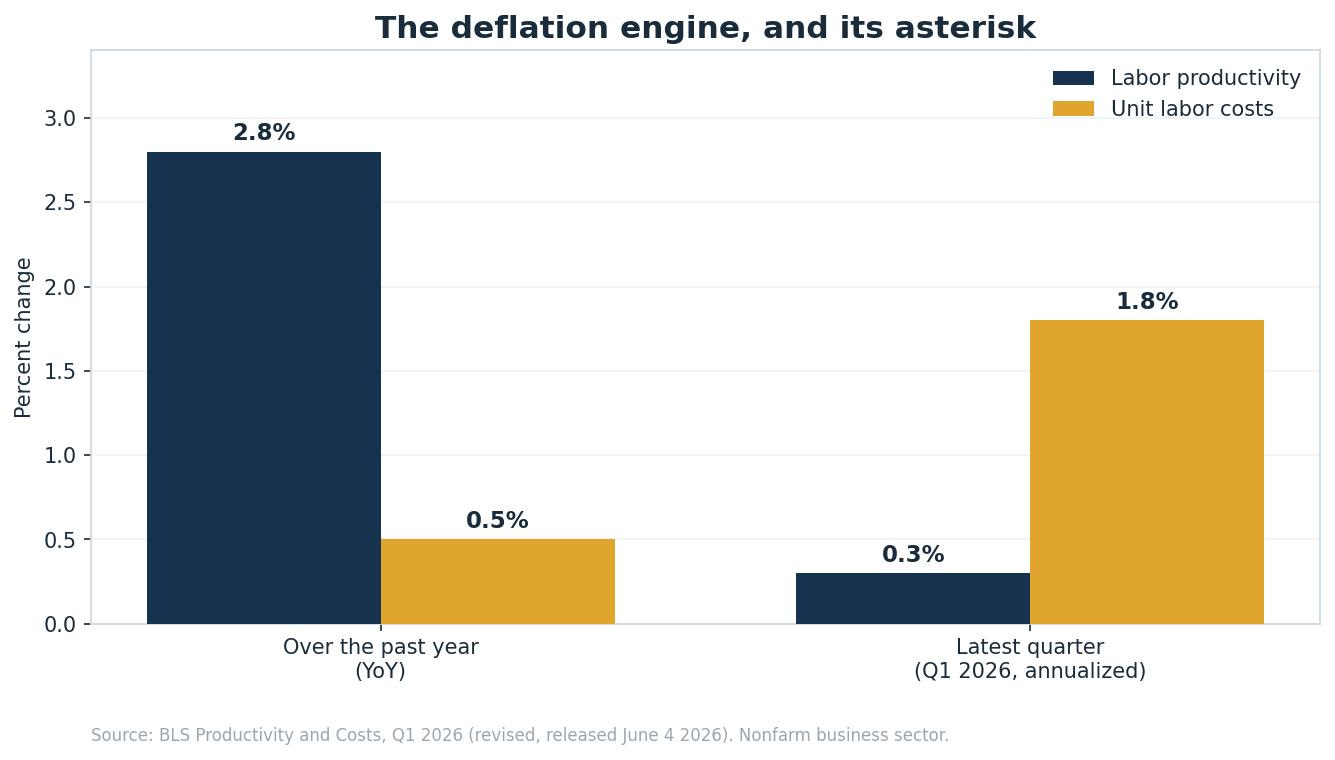
The steelman: What if I’m wrong?
Productivity in Q1 2026 alone grew only 0.3% and unit labor costs actually rose 1.8% on an annualized basis (BLS). One soft quarter doesn’t a trend make, but it does mean my deflation call is just starting to happen, it’s not actually happened yet. Energy prices will be a headwind until we get that damn Gulf straight open. A sustained energy price shock can lift inflation regardless of what AI does to productivity.
Sidebar: Saudi Arabia is fast moving to move operations out of the Gulf and on the other side of the country (the Red Sea) where they don’t have to deal with Iran. This is a multi year endeavor, but once complete, the Straight will be largely irrelevant for global energy production.
But I digress…
The next two quarters of productivity and oil will tell us whether it holds. If oil keeps climbing, I’m wrong on the timing.
I do think the market sold off last week for the wrong reason, marking my second week in a row call that the bond market is offsides. And I put my money where my mouth is, moved most of my free cash to 30-yr bonds.
Which brings me home to Nashville, because there’s one city where you can watch all of this, labor strength, corporate investment, and the productivity boom’s winners…
…turn into concrete!
----
Nashville Is Building: What $6.6 Billion of Concrete Tells You.
The cranes are up!
But, first, the local labor picture summary. The Nashville metro had about 1.21 million jobs as of late 2025, up roughly 12,400, or 1.0%, year over year (BLS Nashville Area Summary).
And, the big number, our metro recently ranked #2 among the 100 largest U.S. metros for job growth and per-capita income, behind only Raleigh (Capital Analytics).
That is the demand engine, and why there is so much building here.
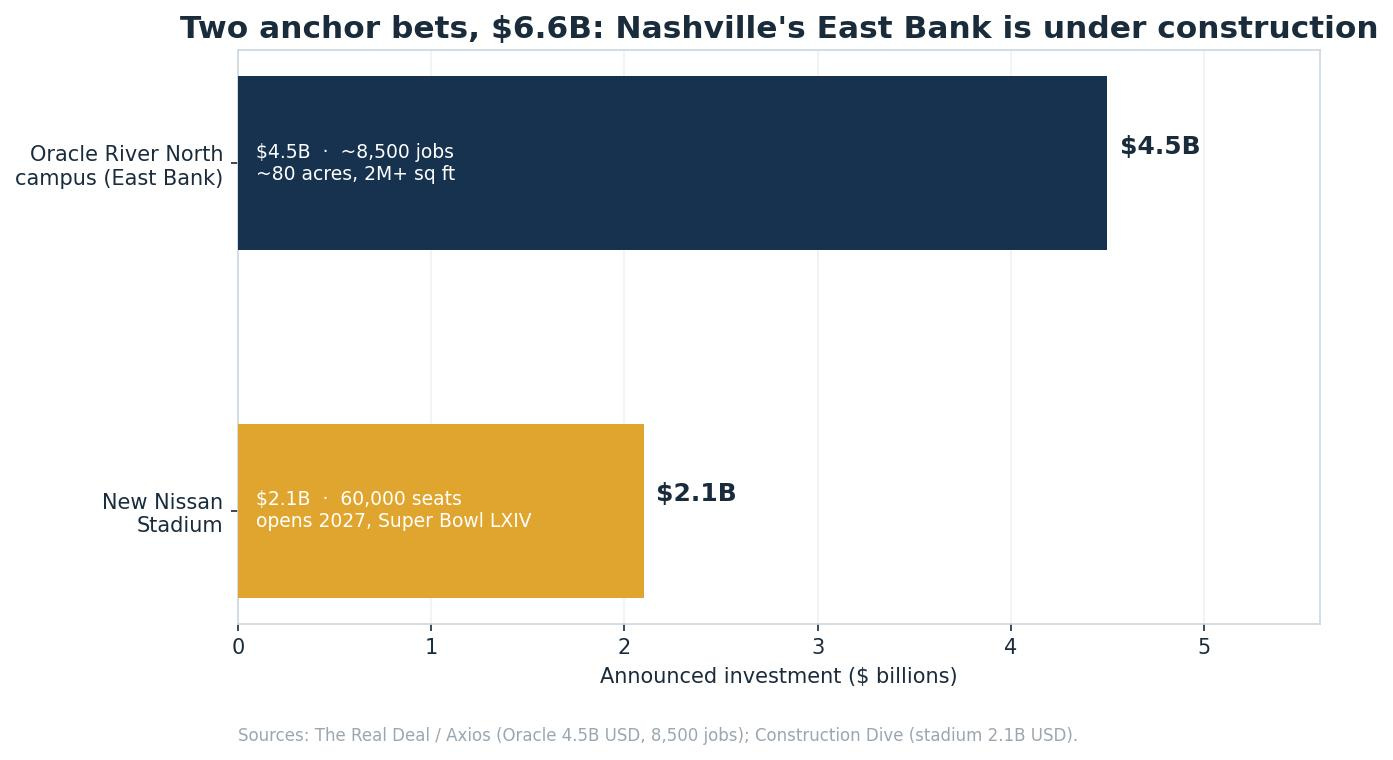
What is being built? Three Biggies:- --The stadium. The new Nissan Stadium, a $2.1 billion, 60,000-seat enclosed venue, was about 75% complete as of late March and remains on track to open in 2027 (NewsChannel 5; Construction Dive). It already locked in Super Bowl LXIV in 2030, the first Super Bowl in Nashville (WSMV, May 19). Roughly $1.26 billion of the cost is public money, the largest stadium subsidy in U.S. history, which is its own debate, but for an investor the relevant fact is simpler: this is the anchor the entire East Bank development.
- --Oracle’s campus. Just a stone’s throw away, Oracle now controls nearly 80 acres on the East Bank for a campus that has grown into a projected $4.5 billion investment, with more than 8,000 jobs committed, over 2 million square feet of office, a Nobu hotel, and public riverfront park space (Axios Nashville; Grant Hammond; The Real Deal). Oracle just started demolition of 515,000 sq/ft of old industrial buildings, and a new river cresting pedestrian bridge to Germantown is in design (Arch Paper, May 2026). The stadium and the Oracle campus, total about $6.6 billion of announced investment. That doesn’t count the public infrastructure, the parks, or the residential breaking ground around them. Total investment could be double that.
- --Nashville Corporate is Booming. Starbucks is moving a satellite headquarters to Nashville, along with 2,000 tech workers at $125,000 average salary. Amazon has a large presence. Meta’s data center in Gallatin keeps expanding. And In-N-Out Burger is building a 100,000-square-foot Eastern Territory office in Franklin(just south of Nashville) — a $125.5 million project housing roughly 200 corporate employees, opening late this year. Plus Nashville is likely getting a 46-story St. Regis (which would be the city’s tallest hotel) and a Ritz-Carlton in The Gulch neighborhood, both accommodating the higher end luxury consumer.
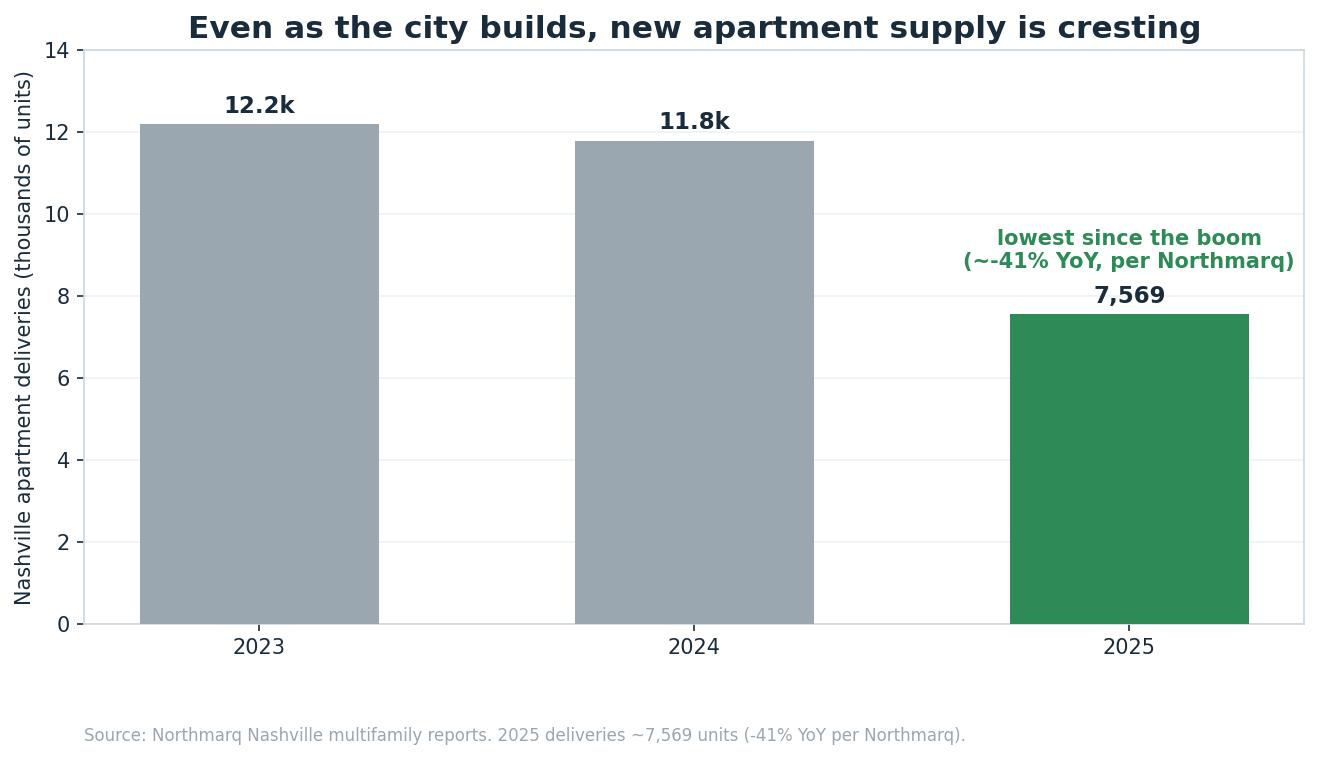
An important note: all this building is happening as we continue the 2020-2021 zero interest rate apartment boom and bust. New apartment supply peak mid last year and will continue downward.
More folks seeking jobs with fewer housing units coming online = future rent growth.
 The People Keep Coming.
Tourism also has not slowed, down, quite the opposite.
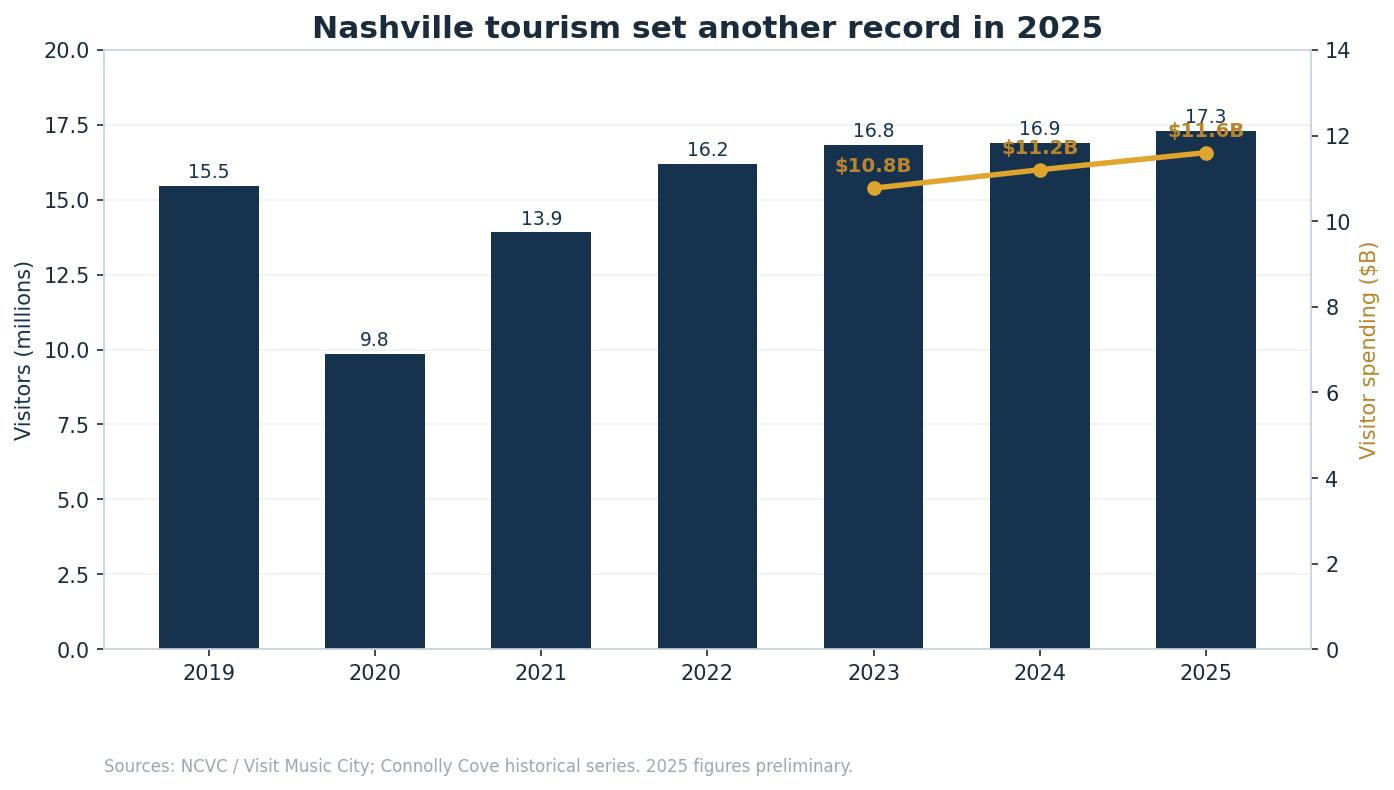
Nashville drew a record ~17.3 million visitors in 2025, who spent about $11.6 billion, up roughly 3.7% year over year and a new high (Whiskey Riff, Mar 2026; Visit Music City research). For comparison, the prior record was $11.2 billion in 2024 (Visit Music City). For context, the city drew 15.5 million visitors in 2019 and bottomed at 9.9 million in the pandemic year of 2020 (Connolly Cove). The trend is up and to the right.
This is on a population of fewer than 700,000.
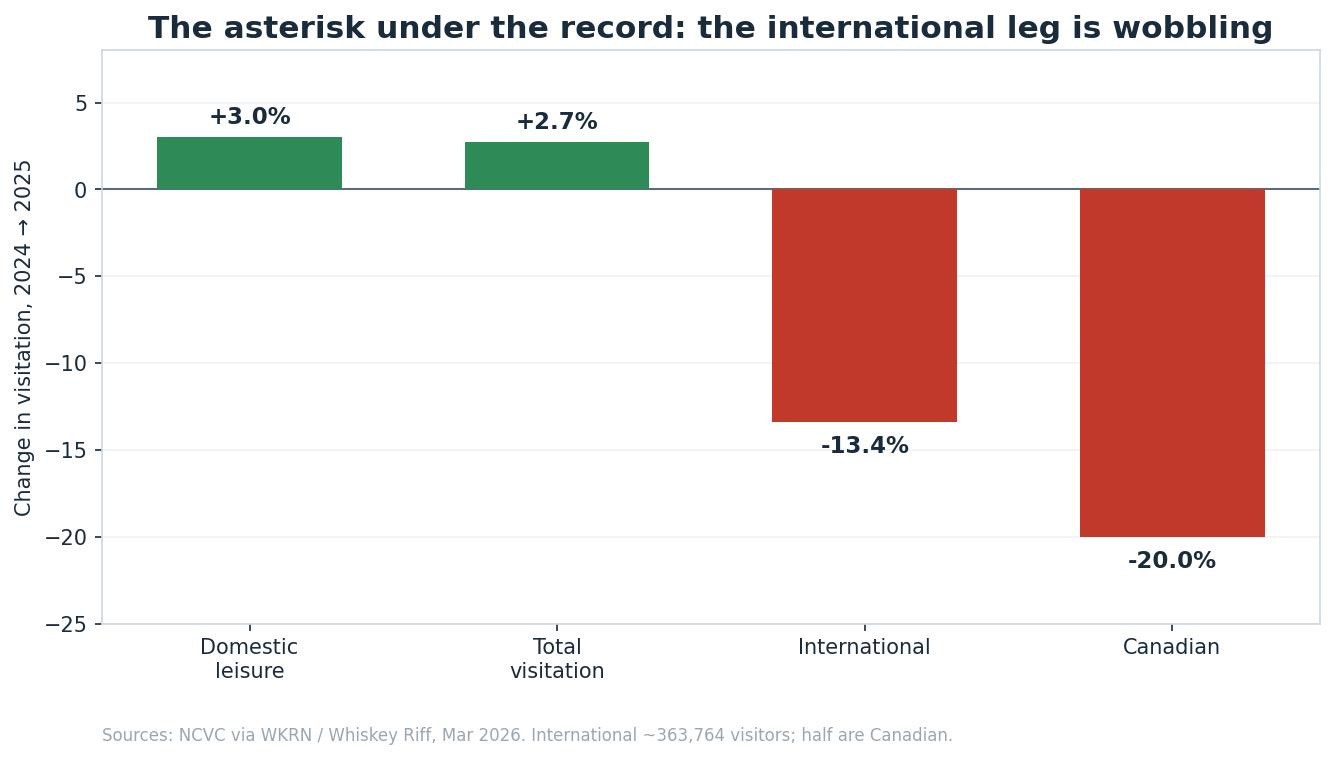
These numbers were blockbusting, despite a headwind from slower international travel. International visitation fell about 13.4% in 2025 to roughly 363,764 visitors, and since about half of Nashville’s international visitors are Canadian, the ~20% drop in Canadian arrivals likely affected the numbers significantly (WKRN; Whiskey Riff). But domestic travel, up about 3%, more than filled the gap.
What the hell Canada?
Bunch of silly geese.
Of course, I still keep a handy right next to my keyboard. Sometimes old school is the best school.
Ok, back to business.
----
My Skeptical Take
Every week, it seems like the financial news arrives dressed like a firefighter, ready for some emergency.
Calm down people.
The jobs report did not describe an economy running too hot, but one where the economic pie is enlarging and becoming more productive. Over the past year, the output of an hour of work grew faster than the cost of that hour.
This is the unglamorous engine of real progress: not a boom to be feared, but the slow compounding that happens when an economy learns to do a little more with a little less.
If AI is actually adding work rather than erasing it, and lifting productivity rather than hollowing it out, then the bond market is merely having a childish tantrum.
Instead we could be in for faster growth.
Cooler prices.
And a gentler path for interest rates.
Sometimes good news is just good news. Stop overthinking it.
The temperament for a moment like this will favor the calm investor.
It belongs to the person who can hold a long horizon while everyone around them always sees a firefighter.
Now, I would be misleading you if I called the picture spotless, which would be an asthma to this newsletter.
Recent hiring was in fact concentrated in the cyclical corners of the economy. Productivity was not totally booming in the most recent quarter. Oil is still elevated on the world’s anxieties. Nashville is booming, but a few corporate cancelations could change that picture.
A serious person holds both optimism and the skepticism in their mind at once, and lets the numbers, not the mood of the week, settle the argument.
In the end real estate is a business that rewards patience over cleverness and temperament over conviction. Charlie Munger said it more plainly than I can:
The work, then, is not to predict but to underwrite your investment honestly, and to have the composure to wait and strike on a great deal in a city that is slowly building itself into its own future.
Make your decisions wisely.
Until next time. Stay Curious. Stay Skeptical.
Herzliche Grüße,
-The Skeptical Investor
- Andreas Mueller