Do you think the Austin market is still worth investing in right now?

Most Popular Reply

Dave MeyerPro Member
Head of Real Estate Investing at BiggerPockets · Seattle, WA · Member since 2015 · 356 posts · 830 votes
2y

I flew to Austin a little while back to consider investing and decided against it. Too expensive, too much multifamily supply as @Scott Trench mentioned. Long term fundamentals are great, but personally I'd wait for a few years and see how this multifamily glut plays out before doing anything. Felt the same way about San Antonio FWIW. 

See this reply in the discussion

24 Replies

Jump to latestLatest
  • Lender · Chicago, IL · Member since 2021 · 424 posts · 145 votes
    2y
    Quote from @Rene Hosman:

    The average vacancy rate in Austin is hovering around 15%.


     Let the lowered rates do their thing and maybe ask again in 6-9 months.

  • Rene HosmanPro Member
    OP
    Rental Property Investor · Denver, CO · Member since 2024 · 583 posts · 656 votes
    2y
    Quote from @Jason Taken:
    Quote from @Rene Hosman:

    The average vacancy rate in Austin is hovering around 15%.


     Let the lowered rates do their thing and maybe ask again in 6-9 months.


     D you think the lower rates will have an impact on the rental vacancy rates?

    BiggerPockets
  • Ryan KellyBusiness Member
    Real Estate Broker · Austin, TX · Member since 2018 · 1k+ posts · 1k+ votes
    2y

    @Rene Hosman the answer to your question will have a lot more to do with your goals and if the market aligns with them. I’ve had clients consistently investing pre-pandemic, during the pandemic, and post-pandemic. It all depends on what they are hoping to achieve. The current market is challenging, but that’s short term. The long term trends with jobs and population growth are still very strong.

    Ryan Kelly Group - Keller Williams5112 Reviews
  • Joe S.Pro Member
    Investor · San Antonio · Member since 2020 · 3k+ posts · 3k+ votes
    2y

    Well, a realtor and a lender already insinuate that investing there is great so it must be. 🤣

  • Scott TrenchPro Member
    Rental Property Investor · Denver, CO · Member since 2014 · 2k+ posts · 6k+ votes
    2y

    Austin is increasing multifamily unit supply by 10% year over year, with more on the way next year. 

    This does not account for the also large supply of new construction single family inventory hitting the market in 2024 and 2025. 

    I don’t care how great the city is, how many companies are moving to it or surrounding areas in Texas, or how much people love it there. 

    Rents and prices are going down. 

    30 years? Yes, prices will be higher. 

    But, this market is getting wrecked, and will continue to get wrecked, as far as the owners of rental property investments are concerned. Hopefully the pain abates in 2025 as the onslaught of new supply slowly abates. 

  • Mark F.Pro Member
    Rental Property Investor · Northern NJ · Member since 2019 · 673 posts · 678 votes
    2y
    Quote from @Scott Trench:

    Austin is increasing multifamily unit supply by 10% year over year, with more on the way next year. 

    This does not account for the also large supply of new construction single family inventory hitting the market in 2024 and 2025. 

    I don’t care how great the city is, how many companies are moving to it or surrounding areas in Texas, or how much people love it there. 

    Rents and prices are going down. 

    30 years? Yes, prices will be higher. 

    But, this market is getting wrecked, and will continue to get wrecked, as far as the owners of rental property investments are concerned. Hopefully the pain abates in 2025 as the onslaught of new supply slowly abates. 

     I'm sure it's a great time to invest there, in fact I'll get 22% on my money if I go with this syndication! I almost want to join this webinar just to see if anyone will mention all the new supply coming online I've been hearing about. Because according to them, Austin has a supply shortage.

    https://www.eventbrite.com/e/how-you-can-achieve-up-to-22-re...

    https://disclosurequest.com/form/lcp-austin-dev-fund-25-llc/0002022266-24-000001

  • Dave MeyerPro Member
    Head of Real Estate Investing at BiggerPockets · Seattle, WA · Member since 2015 · 356 posts · 830 votes
    2y

    I flew to Austin a little while back to consider investing and decided against it. Too expensive, too much multifamily supply as @Scott Trench mentioned. Long term fundamentals are great, but personally I'd wait for a few years and see how this multifamily glut plays out before doing anything. Felt the same way about San Antonio FWIW. 

  • Real Estate Broker · Austin, TX · Member since 2012 · 1k+ posts · 1k+ votes
    2y

    Opinions with out data is ...... opinions. Is the average vacancy rate of 15% for Houses? Apartments? Industrial? Office (its higher than 15%  and is roughly 23%https://www.commercialedge.com/blog/national-office-report/)? Retail (retail is very good btw)? and so on. Also some submarkets are doing very well in several of the categories above. There is a reason why Blackstone is now one of the largest commercial owners in the metro. They aren't dummies. Being a contrarian has usually played out well historically or you could look in the rear view mirror in a year or two and sang Coulda, woulda shoulda : ). 

  • Cincinnati, OH · Member since 2020 · 4k+ posts · 3k+ votes
    2y

    @Aaron Gordy, I do totally agree with you, that submarkets make a huge difference.  As does asset class.  Would I invest in an in-fill strip center on a major retail corridor with signalized access and strong incomes?  Very likely I would.

    Would I buy a suburban 80s built multifamily surrounded by cranes putting up thousands of new multifamily units?  Probably not.

    But to your comment about investing like a contrarian: I am confused by which way you are meaning that.  Many on this thread seem to think Austin is overheated, so being contrarian is investing more in Austin.  But you note that Blackstone is a major investor in Austin, so the contrarian point is to NOT invest in Austin.

    I have no skin in the game either way.  Back to your point, I don't think Austin is about as neutral as can be.  There are a lot of positives to it.  There are certainly risks to it.  But I don't rank it higher or lower than any other market in the US.  It all comes down to the actual opportunity presented, and understanding those risks while balancing the possible reward.

  • Scott TrenchPro Member
    Rental Property Investor · Denver, CO · Member since 2014 · 2k+ posts · 6k+ votes
    2y

    Let’s talk about data. 


    There is a complicated set of assumptions that go into calculating demand. That includes income growth, net migration, jobs growth, qualitative assumptions about desirability of an area, etc. 

    I am sure that many of these look great for Austin. I am sure that people are moving there, I am sure that people are getting good jobs, I am sure that Austin is a wonderful place to live, and the very high expectations for the city’s bright future are all realized without obstacle. 

    However, I prefer to start my analysis with supply. Supply data and forecasting, unlike demand data and forecasting, is easy. There are no qualitative assumptions. There are no mysteries. There are no complicated models to build out. All new supply is permitted, and easily traceable. Developers usually have expensive bridge debt on their construction projects, and a heavy incentive to deliver their inventory as rapidly as possible. While it is possible that some construction gets abandoned, the reality is that most projected supply will be completed, and will immediately get absorbed by the market. 

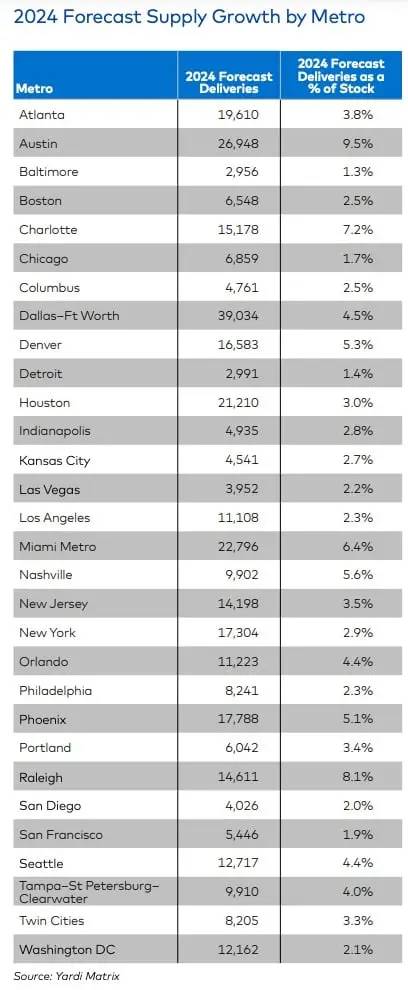
    Here is the supply forecast for 2024 for the largest metros in the country: 
    I don't need someone's demand forecasts. 

    I can tell, right here, right now, that Austin is the worst major metro to invest in rental housing stock in 2024. Rents are going down. Or if they go up, they will lag behind virtually every single other large metro in this country.

    Again, I don’t care how great someone thinks Austin is, or how much relatively worse someone thinks a city like Chicago is. 

    Austin is going to perform worse, both for multifamily asset values and rent growth, than Chicago, in 2024, and likely into 2025 as well. 

    Sometimes, it’s that easy. 

    When there is 5.5 times as much relative inventory getting introduced to Austin compared to Chicago, the “growth” of Austin relative to Chicago really doesn’t matter much. ALL of the demand side analysis will be overwhelmed by the cruel reality (for landlords) of the supply onslaught facing that city.

    On the bright side, affordability for renters will definitely be going up! 

     I know I will not make friends with investors, syndicators, realtors, and lenders in Austin by sharing this brutal reality with them. But, it’s far worse to leave people confused about what’s going to happen. I have tried to be as vocal about this as possible for the last two years including in Q1 2024, and Q1 2023. 

    Now, when supply stops coming in at this incredible rate, Austin investors will see a return to rent and price growth. In 15-30 years, this will all be noise, and properties values and rents will have increased.

    In the meantime, buckle up. It will not be fun.

    All this said, I know nothing of the other types of real estate in the sector. It is very possible, for example, in Austin, that valuations of office, retail, industrial, self-storage, or something else responds favorably to the changes happening in the city and could be a great buy. 

    But housing? I’m a bear. 

    Let’s come back in a year and see how it goes though. Could always be wrong! 

  • Gino BarbaroPro Member
    Rental Property Investor · St Augustine, FL · Member since 2014 · 2k+ posts · 1k+ votes
    2y

    @Rene Hosman

    A lot of noise on this thread. If you're a long term investor with a certain buy criteria, and have faith in the market, then you invest. I was just in Nashville, and by all metrics, is over priced, over supplied. The city is booming, and long term will be okay. It's not for me, but I can understand why some investors love it.

    Investors have been over paying for deals for years in Austin, especially the older vintages. The market cycle caught up with them. It' a function of price now, and if you can find a deal that is priced accordingly, then you buy it, especially if you like the fundamentals long term

  • Jordan MoorheadBusiness Member
    Real Estate Agent · Austin, TX · Member since 2015 · 5k+ posts · 3k+ votes
    2y

    I will continue to invest in the area but only in deals that make sense right now, have good debt terms and are in areas of the metro that are growing quickly. 

  • Jonathan KlemmBusiness Member
    Moderator
    Contractor · Chicago, IL · Member since 2016 · 4k+ posts · 2k+ votes
    2y

    I love the Supply data perspective @Scott Trench.  I was just in Austin a couple of months after moving away 12 years ago, and it's scary different.  

    I am a Chicago investor through and through, so it's great to see the "% of stock" at 1.5% here.

  • Real Estate Broker · Austin, TX · Member since 2012 · 1k+ posts · 1k+ votes
    2y

    The folks that are on the ground know. @Jordan Moorhead

    I had written out out a response that was documented with statistical evidence across the asset classes that are good ones... but on 2nd thought. No. More for me and my company. Stay away. : )

  • Accountant · Austin, TX · Member since 2024 · 54 posts · 35 votes
    2y

    Austin is the capital of Texas, a corridor of the Golden Triangle (Dallas-Houston-San Antonio), home to a huge university, a large population, and still a lot of job opportunities.

    Overall, the market is warm, not as HOT as the weather right now.

  • Real Estate Broker · Coppell, TX · Member since 2011 · 5k+ posts · 4k+ votes
    2y
    Quote from @Rene Hosman:

    The average vacancy rate in Austin is hovering around 15%.

    Austin is a great place to live....however right now seems to be a bit of a stalemate. Prices still high, although have come down some. Rents still low compared to prices. Unless you have some kind of compelling reason to buy there, probably there are places with better returns. That is if you are thinking single family or multi-family. If you are in the local market and have a great understanding of the change in the ADU laws and density, there could be some opportunity there. What I've heard though in most places with these changes, is that there is a lot of excitement, but very few permits. So the excitement might not match the ROI. Maybe opportunity in various areas of commercial? Office still seems to have some struggles, hotels I think will struggle for some more time, not sure about other avenues.

  • Real Estate Agent · Austin, TX · Member since 2018 · 63 posts · 48 votes
    2y

    I'd probably stay away from big multifamily deals in the short term.  I still see opportunities that are attractive to me in single family rentals, flips, and short term rentals.

  • Scott TrenchPro Member
    Rental Property Investor · Denver, CO · Member since 2014 · 2k+ posts · 6k+ votes
    1y

    It's been about a year. Here's how this played out in Austin: 

    I think now is potentially go time in Austin, here in summer/fall/winter 2025. The data is not showing home prices getting crushed, but I'd be ready to bet pretty big that in income property (2-4 units or larger multifamily) are in fact seeing huge drops. I bet you will find properties that have been sitting for a year or more, with multiple price cuts, in many sections of the city that fit the income property description. 

    I think that if I lived an invested in Austin, I'd be chomping at the bit. The competition and onslaught of new supply is likely just about to finish, and I could see rent growth jumping pretty meaningfully from it's current, depressed state, over the next two years.

  • Ryan KellyBusiness Member
    Real Estate Broker · Austin, TX · Member since 2018 · 1k+ posts · 1k+ votes
    1y

    Most of the damage has been done in Austin, so I expect normalization within 6-12 months. Cash flow is still very challenging, like any fast growing metro, but appreciation will likely start trending positive again starting next year as we go over the peak of inventory. We're seeing some good equity deals and sellers desperate enough to offer them. I don't know if we'll see these same dynamics in years ahead. Well, except For condos, they have a long way to go!

    Ryan Kelly Group - Keller Williams5112 Reviews
  • Real Estate Broker · Austin, TX · Member since 2012 · 1k+ posts · 1k+ votes
    1y

    I agree with @Ryan Kelly. The downtown condos are taking a beating but one can't cash flow on them unless one puts more than average down payments. There are many good things happening in the metro. Things are looking up, no doubt

  • Min ZhangBusiness Member
    Real Estate Agent · Member since 2022 · 1k+ posts · 1k+ votes
    1y

    Hi Rene! It depends on your goals, but here’s my honest take—Austin's still a solid long-term play, especially if you're banking on appreciation. The tech and job growth there are real. That said, the numbers are definitely tighter now than a few years ago. If you're looking for strong cash flow out the gate, it might not be the best market today unless you're putting down a large amount or finding a creative angle.

    Personally, I’ve been more drawn to certain Midwest markets just because the cash-on-cash is easier to hit, and the entry points are lower. But every market has its angle—are you leaning more toward appreciation or cash flow for your next investment?

  • Scott TrenchPro Member
    Rental Property Investor · Denver, CO · Member since 2014 · 2k+ posts · 6k+ votes
    1w

    It's been about another year. Looks like this overall view continues to hold, but I was at least a year early on thinking the rent growth would return!

    Sometimes the analysis about the trend overall for a few years is easy. But, the timing specifically is very hard.

  • Jordan MoorheadBusiness Member
    Real Estate Agent · Austin, TX · Member since 2015 · 5k+ posts · 3k+ votes
    6d

    @Scott Trench we've seen building slow down a lot as far as new permits are going. Personally I think next year later in the year rents will start going back up. We're seeing some great deals on property here now.

  • Alyssa MarquezBusiness Member
    Real Estate Agent · San Antonio TX / Fort Lauderdale, FL · Member since 2023 · 129 posts · 31 votes
    5d

    I think Austin is still a good place to make an investment but I probably would get very deal specific right now. I wouldn't buy as an appreciating asset that rents will snap back. I want the property to work at current rents, taxes, insurance, vacancy, and with good cash flow. If I could buy at a good basis with lots of options to exit, I might buy. The potential is there.

Join the conversationCreate a free account to reply, vote on answers and follow this thread.