Quote from @James Wise:
BiggerPockets is the biggest real estate Networking site out there. As such, everyone who's anyone who is involved in Real Estate is here to discuss Real Estate and do some business.
The unfortunate, but obvious, negative side effect of this is that unscrupulous individuals are unavoidably going to find there way here.
Below is a list of some of the ones I can remember being active on the site. Feel free to add more as you remember them, or as new ones pop up or become exposed.
___
Marco Santarelli
Longtime poster here on the site. Accused of running a $62 Million Dollar Ponzi Scheme.
Norada Capital Management suspending payments
___
Clayton Morris
Former Podcast Guest. Accused of running a massive Ponzi Scheme with Bert Whalen in Indianapolis. Lost a $7.8 Million Dollar Lawsuit to HoltonWiseTV.
Clayton Morris / Morris Invest House of Cards starting to fall
___
Robert Ellis / Kyle Stroker
This guy Robert Ellis positioned himself as a property developer in Columbus, Ohio over the last couple of years. Oddly enough, we aren't sure if that's his real identity. As he's also known online as Kyle Stroker, an amateur porn actor.
We're Raising $3M — What's the BEST Way to Do It Without a Steakhouse Dinner?
___
Matt Motil
Longtime poster here on the site. Sentenced to almost 6 years in jail for running a Ponzi Scheme in Cleveland, Ohio that target many out of state investors.
WARNING: Matt Motil of Cleveland, OH
___
Wendell de Guzman
Longtime poster here on the site. Former podcast guest. Accused of stealing money from many out of state investors for a scam he was running in the Chicago market.
Be careful who you invest with
___
Bob Prisco / Bob Stevens
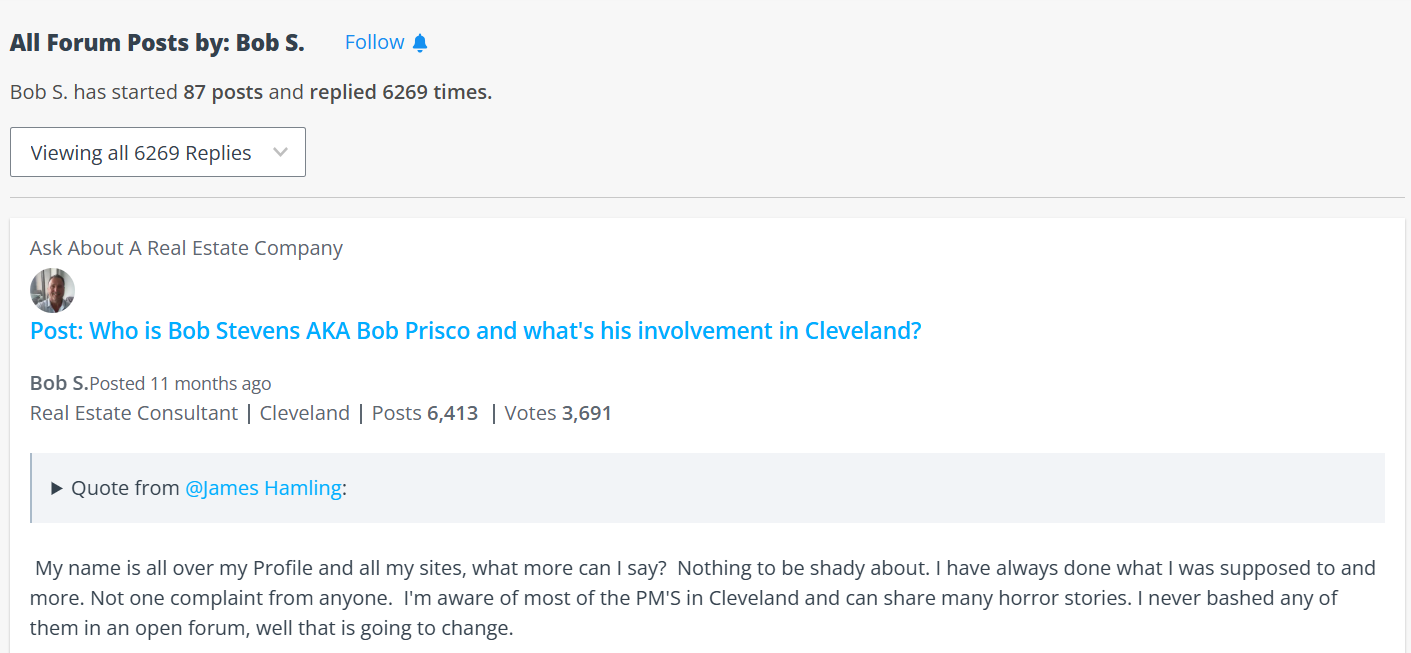
Longtime spammer here on the site. Found out to be using a fake identity here on Bigger Pockets. Famous for letting out of state investors know that they don't need to learn or educate themselves on the Cleveland market. All they need is a "team" which he conveniently provides.
Who is Bob Stevens AKA Bob Prisco and what's his involvement in Cleveland?
We've got a new one to add to the list, Barry Minkow. I think Barry Minkow might be the most prolific criminal we've ever had join BiggerPockets.
Barry just recently signed up for BIggerPockets to engage in discussion about one of his articles in the thread below
Did Brandon Turner really lose $14M of investor money while pocketing $4.4M???
As for Barry's criminal history, it spans multiple decades and multiple stints in prison. Below is an excerpt from his Wikipedia page.
___
___
___
Conviction and prison
Minkow and ten other ZZZZ Best insiders were indicted by a federal grand jury in January 1988 on fifty-four counts of racketeering, securities fraud, money laundering, embezzlement, mail fraud, tax evasion and bank fraud. The indictment accused Minkow of milking banks and investors of millions of dollars while systematically draining his company of assets. It also accused Minkow of setting up dummy companies, writing phony invoices and conducting tours of purported restoration sites. Prosecutors estimated that as much as ninety percent of the company's revenue was fraudulent.[6] On June 16, prosecutors won a superseding indictment charging Minkow with credit card fraud and two additional counts of mail fraud.[22]
While Minkow admitted to manipulating the company's stock, he claimed that he was forced to turn the company into a Ponzi scheme under pressure from the organized-crime figures who secretly controlled his company,[23] a story he later admitted was false.[4] On December 14, he was found guilty on all charges.[18] On March 27, 1989, he was sentenced to twenty-five years in prison. He was also placed on five years' probation and ordered to pay $26 million in restitution. In sentencing him, U.S. District Court Judge Dickran Tevrizian described Minkow as a man without a conscience, rejecting his plea for a lighter sentence as "a joke" and "a slap on the wrist" for someone who had manipulated the financial system. The SEC subsequently banned him from ever serving as an officer or director of a public company again. He served under seven and a half years, most of them at Federal Correctional Institution, Englewood.
While imprisoned, Minkow claimed to have become a born-again Christian.[24] During his prison stay, he became involved in Christian ministry, completing coursework through Liberty University's School of Lifelong Learning.[4]
Release
After his early release from prison in 1995, Minkow went to work as a pastor at the Church at Rocky Peak in Chatsworth, California, and became director of the church's Bible Institute.[17] That same year he wrote a first-hand account of the ZZZZ Best scam, Clean Sweep. Minkow's book claims all of his share of the book's proceeds would go toward repaying his victims.[4] His other substantial debt is a $7 million loan from Union Bank.[25]
In 1997, Minkow became pastor of Community Bible Church in San Diego. Soon after his arrival, a church member asked him to look into a money management firm in nearby Orange County. Suspecting something was amiss, Minkow alerted federal authorities, who discovered the firm was a $300 million pyramid scheme. This was the beginning of the Fraud Discovery Institute (FDI), Minkow's for-profit investigative firm. His original targets were penny stock companies, which are often havens for fraud. However, he soon attracted the attention of media outlets including The Wall Street Journal, Bloomberg News, Fox News, and CBS's 60 Minutes. Several Wall Street investors sent money to Minkow in order to persuade him to pursue bigger targets.[26] Minkow claimed to have uncovered $1 billion worth of fraud through the FDI.[27]
Shorting stock
Minkow's motives were brought into question by multiple news stories, which concluded that Minkow was shorting stock before he released a report on a public company. According to The San Diego Union-Tribune, Minkow had engaged in this practice as early as 2006. His critics denounced this practice as unethical, if not illegal. At least one critic accused him of engaging in short and distort, a form of securities fraud which is a reversal of a pump and dump scheme.[28]
For instance, Minkow accused Herbalife of a "laundry list" of issues and had "correctly revealed that Herbalife's president had inflated his résumé."[29][17] Herbalife paid Minkow $300,000,[29] after which he issued a press release withdrawing all accusations and contentions against the company,[30] and removed all the accusations from his website. Additionally, Minkow made $50,000 from shorting Herbalife stock.[31] He continued to profit from his short sales position due to sharp decreases in the reported company's stock price immediately after releasing a new report.[17]
On 20 February 2007, Minkow distributed a 500-page report to officials at the SEC, the Federal Bureau of Investigation (FBI), and the Internal Revenue Service (IRS), accusing USANA of operating an illegal pyramid scheme.[32][33] On the day Minkow's report was released, USANA's shares had traded at $61.19 but by August the share price had tumbled to less than $35.[32][34] Minkow later acknowledged that he was shorting USANA's shares, hoping to profit from a drop in the stock price.[35]
USANA filed lawsuits against Minkow, accusing him of stock manipulation and defamation. However, USANA dropped the defamation suit and a judge later threw out four of the five claims brought against Minkow, ruling that the claims violated California's anti-SLAPP law for suing Minkow for fair criticism.[36] The judge also cited two examples where USANA failed to refute Minkow's claims that their products were overpriced and of no better quality than other lower-priced brands.[37] The remaining charge of stock manipulation was settled in July 2008 when USANA and Minkow reached an undisclosed settlement, which included the removal of all USANA-related materials from the FDI website, a related Chinese website, and from YouTube. Minkow also agreed to never trade in USANA's stock again.[38] Separately from the settlement, USANA paid $142,510 in attorney fees to Minkow and the FDI under an order from federal Magistrate Samuel Alba. Court documents show that USANA never pursued others whom they suspected of being part of the alleged stock manipulation nor did they ask for an injunction, their only avenue of release in this case.[37]
Minkow almost always held a position in securities on which he reported.[39] However, he has since stated that while his lawyers advised him this practice was legal, it was probably unethical.[28] Several companies have since sued Minkow for making false accusations against them, with most of the suits being settled out of court.[26]
Lennar
In 2009, Minkow issued a report accusing major homebuilder Lennar of massive fraud, claiming that irregularities in the company's off-balance-sheet debt accounting were evidence of a massive Ponzi scheme. Minkow accused Lennar of not disclosing enough information about this to its shareholders, and also claimed a Lennar executive had taken out a fraudulent personal loan.[40] In an accompanying YouTube video, he denounced Lennar as "a financial crime in progress" and "a corporate bully". Lennar's stock plummeted in the wake of Minkow's reports, tumbling from $11.57 a share to $6.55 in two weeks.[28] Minkow issued the report after being contacted by Nicholas Marsch, a San Diego developer who had filed two lawsuits against Lennar for fraud. Indeed, the language of the FDI report echoed that used in Marsch's filings. One of Marsch's suits was summarily thrown out; the other ended with Marsch having to pay Lennar $12 million in counterclaims.[17]
Lennar responded by adding Minkow as a defendant in a lawsuit against Marsch. Minkow was initially unconcerned, since he had prevailed before in similar cases on free speech grounds.[28] According to court records, Minkow had shorted Lennar stock, buying $20,000 worth of options in a bet that the stock would fall.[40] Even more seriously, he also bought Lennar stock after his FDI report, believing the stock would rebound after its dramatic plunge.[41] Minkow initially denied doing this, only to be forced to recant when confronted with trading records. Minkow forged documents alleging misconduct on Lennar's part and lied about having to go to the emergency room on the night before he was first scheduled to testify. He also went forward with the report even after a private investigator he had hired for the case could not substantiate Marsch's claims. In an unrelated development, it was also revealed that Minkow operated the FDI out of the offices of his church and even used church money to fund the organization—something which could have jeopardized his church's tax-exempt status.[17]
On December 27, 2010, Florida Circuit Court Judge Gill Freeman issued a default judgment against Minkow in response to a motion by Lennar. Freeman found that Minkow had repeatedly lied under oath, destroyed or withheld evidence, concealed witnesses, deliberately tried to "cover up his misconduct", and had even lied to his own lawyers about his behavior. Freeman determined that Minkow had perpetrated "a fraud on the court" that was so egregious that letting the case go any further would be a disservice to justice. In her view, "no remedy short of default" was appropriate for Minkow's lies. She ordered Minkow to reimburse Lennar for the legal expenses it incurred while ferreting out his lies. According to legal experts, terminating sanctions such as default judgments are extremely rare, since they are reserved for particularly egregious misconduct and have the effect of revoking a litigant's right to defend himself. Earlier, Freeman had been so angered by Minkow's behavior that she called him a liar in open court, a rarity for a judge. Lennar estimated that its attorneys and investigators spent hundreds of millions of dollars exposing Minkow's lies.[42][43]
Insider trading guilty plea
On March 16, 2011, Minkow announced through his attorney that he was pleading guilty to one count of insider trading. According to his lawyer, Minkow had bought his Lennar options using "nonpublic information". The plea, which was separate from the civil suit, came a month after Minkow learned he was the subject of a criminal investigation. On the same day, Minkow resigned as senior pastor of Community Bible Church, saying in a letter to his congregants that since he was no longer "above reproach", he felt that he was "no longer qualified to be a pastor." Six weeks earlier, $50,000 in cash and checks had been stolen from the church during a burglary. Though unsolved, it was noted as suspicious due to Minkow's admitted history of staging burglaries to collect insurance money.[40][44][45][46]
The nature of the "nonpublic information" became clear a week later, when federal prosecutors in Miami filed a criminal information charging Minkow with one count of conspiracy to commit securities fraud. Prosecutors charged that Minkow and Marsch (listed as an unindicted co-conspirator in the complaint) conspired to extort money from Lennar by driving down its stock. The complaint also revealed that Minkow had sent his allegations to the SEC, the FBI, and the IRS, and that the three agencies found his claims credible enough to open a formal criminal investigation into Lennar's practices. Minkow then used confidential knowledge of that investigation to short Lennar stock, even though he knew he was barred from doing so.[47][48][49] Minkow opted to plead guilty to the conspiracy charge rather than face charges of securities fraud and market manipulation, which could have sent him to prison for life.[50]
On March 30, 2011, Minkow pleaded guilty before Judge Patricia A. Seitz. His attorney, Alvin Entin, admitted that his client had acted recklessly, but had been "deluded and taken advantage of" by Marsch. He faced a maximum of five years in prison, as much as $350,000 in fines and penalties and $500 million in restitution. However, he agreed to cooperate with the government in its probe of Marsch.[51][52][53]
The Los Angeles Times obtained a copy of the plea agreement, in which Minkow admitted to issuing his FDI report on Lennar at Marsch's behest. According to the agreement, Marsch offered to have Minkow retract his report if Lennar paid him in cash and stock. It also said that Minkow's report triggered a bear raid which temporarily reduced the market capitalization of Lennar by $583 million. Minkow faced a minimum of thirty years in prison had the case gone to trial.[54] On June 16, Freeman ordered Minkow to pay Lennar $584 million in damages—roughly the amount the company lost as a result of the bear raid orchestrated by Minkow and Marsch. Her ruling stated that Minkow and Marsch had entered into a conspiracy to wreck Lennar's stock in November 2008.[53] With interest, the bill could easily approach a billion dollars—far more than Minkow stole in the ZZZZ Best scam.[55]
On July 6, it emerged that officials with Community Bible Church had accused Minkow of running the FDI with church funds, applying for credit cards in the names of church members and leading his flock into bad investments. Church officials had made the claims as part of a confidential pre-sentencing report. When Entin got word of the letter, he asked for and was granted two weeks to review the allegations and respond to them. This pushed Minkow's sentencing back to July 21.[56][57] This was the second time Minkow's sentencing had been postponed; it was originally slated for June 16 but was postponed to July 6.
In a pre-sentencing evaluation performed on May 10, 2011, Minkow was diagnosed by a Michael Brannon as having a personality disorder with antisocial and narcissistic features, attention deficit hyperactivity disorder, anxiety disorder, opioid dependence, anabolic steroid abuse, and migraine headaches.[58]
On July 21, Seitz sentenced Minkow to five years in prison. In imposing the sentence, she stated that Minkow had "no moral compass that says 'Stop.'" Seitz also ordered him to pay Lennar $583.5 million in restitution—an amount that had been imposed a month earlier in the civil case.[27][56][59] She also recommended that Minkow serve his sentence at Federal Prison Camp, Montgomery in Montgomery, Alabama. However, on September 20, he was ordered to begin his sentence at Federal Medical Center, Lexington in Lexington, Kentucky.[60]
Church fraud guilty plea
On June 14, 2011; KGTV in San Diego interviewed several members of Minkow's former church, who said Minkow swindled them. One woman said Minkow asked her for $300,000, purportedly to help finance a movie about his redemption story.[61]
On January 22, 2014, Minkow pleaded guilty to one count each of conspiracy to commit bank fraud, wire fraud, mail fraud and to defraud the federal government. He admitted to embezzling over $3 million in donations to Community Bible Church from 2001 to 2011. He opened unauthorized bank accounts purportedly on the church's behalf, forged signatures on church checks, diverted money from legitimate church accounts for his personal use, and charged unauthorized personal expenses on church credit cards. He also concealed $890,000 of income and $250,000 in taxes from the IRS.[62][63] Among his victims were a widower who gave $75,000 to fund a supposed hospital in Sudan to honor his wife after she died of cancer, and a woman who gave Minkow $300,000 that would have otherwise gone to help raise her teenage granddaughter.[64]
On April 28, 2014, Judge Michael Anello sentenced Minkow to five years in prison, the maximum possible sentence under his plea bargain. It is to be served after Minkow completes his sentence for securities fraud. While Minkow's attorneys asked for a sentence of forty-one months, Anello felt obligated to impose the maximum for what he called a "despicable, inexcusable crime."[65] On June 2, Minkow reached an agreement with federal prosecutors that called for him to pay $3.4 million in restitution.[66] This will potentially be a ruinous amount for Minkow, on top of the restitution he still owes Lennar, Union Bank and the ZZZZ Best victims. Earlier, he said that the $26 million restitution for the ZZZZ Best scam alone was large enough that he would be writing restitution checks to the victims for the rest of his life.[17] As a result of his latest sentence, Minkow was released on June 6, 2019.