Hi all. I'm a new investor, and since my local market is quite expensive, I'm going to be investing out of state. One thing I was curious about is how out of state investors manage rehab from afar. Obviously you want to find a contractor you trust, but beyond that is there someone you would have stopping by the property regularly to make sure the work is progressing, address any issues that come up, etc? Who would that be - a property manager? Agent? I understand I will presumably need to pay someone to take on this role, I'm just not sure who the right person is to ask (and how much I should expect this to cost).
Investor · VA · Member since 2015 · 21k+ posts · 19k+ votes
22h
My recommendation is to travel to the location I'm going to invest in and meet with people personally. It's much easier to gauge the quality of someone and their work by meeting them in person or seeing some of their projects, compared to just talking to somebody over the phone or via email.
Investor · PA - NY - NJ · Member since 2019 · 489 posts · 175 votes
1d
@Elliot W. The boots on the ground during a rehab is usually either a project manager you pay per job, or an investor-savvy agent willing to do walkthroughs, not a normal PM who only handles tenants. Pay on milestones with photo and video updates, not big upfront draws. Who you hire matters more than the title on their card. Do you already have a deal under contract, or are you still building the team?
Thank you, Matthew. Still building the team, and realized as I considered making an offer on a property that this was an important question that I didn’t have an answer to yet. 
mostly there is no such person. no agent or property manager is going to step up and be your quarterback.
instead of investing "out of state" can you invest within a couple hours of where you are? there is just no substitute for being hands-on and in person.
Investor · Collierville, TN 38017 · Member since 2017 · 706 posts · 516 votes
1d
I run rehabs in Memphis at 236 doors, and I don't personally quarterback any of them. The system does. My property manager walks the properties, lets contractors in for bids, and sends me photos. I use the same crews job after job — they know my scope, my pricing, and that I pay fast. I buy sub-$100K all-in, never put earnest money down, and the rehab budget is locked before I close. The key is sequence: hire the property manager first, use their contractor referrals, then test the crew with one small job. If they can't finish a $15K cosmetic rehab on schedule, don't hand them a $40K one. Scale the trust before you scale the dollars.
Real Estate Agent · Chicago, IL · Member since 2017 · 2k+ posts · 2k+ votes
1d
You need either your own past used trusted contacts or for your realtor to give you their trusted contacts. A property manager's interests are opposite to yours, they want it to take longer and to charge as much as they can to maximize their fees. I have a group of contractors I refer out to clients over and over again so they will not screw anyone over as it would be a very costly loss of business to them being me giving them future referrals are tied to their success. You also need someone local to pay to check on the work as it goes, videos are nice but really need a 3rd party. I also do this for my out of state clients and have even hired my realtor teammate to do this for me when I travel and need someone check on my own rehab, its really essential even if you have used them there might be a spot that needs redoing etc. I once had a client use their own contractor and a job I could do for $25 to 30k got hustled for more and more up to a total of $70k and this was a contractor they supposedly met off BP. Many of these workers will straight up hustle out of state owners for as much as they can.
Thank you, Henry. Since I am out of state and a new investor I don’t have my own trusted contacts yet, but the framework of getting referrals who have an incentive to be trustworthy based on their existing relationships (eg with my agent) is a helpful way to think about it. And I definitely want someone to go check on the work like you said. Trust but verify. 
Investor · VA · Member since 2015 · 21k+ posts · 19k+ votes
22h
My recommendation is to travel to the location I'm going to invest in and meet with people personally. It's much easier to gauge the quality of someone and their work by meeting them in person or seeing some of their projects, compared to just talking to somebody over the phone or via email.
Real Estate Agent · Columbus, OH · Member since 2019 · 3k+ posts · 2k+ votes
21h
Welcome, Elliot, and planning the oversight before you buy puts you ahead of most first-timers. The replies above cover building the team, so here's how I'd structure the milestone checks.
Tie every contractor draw to a milestone you can verify: demo done, rough-in plumbing, electrical and HVAC done before drywall, drywall, finishes, final. The pre-drywall stop matters most, because it's the last time anyone can see inside the walls. At each milestone, have an independent person, like a local inspector or a project manager paid by the visit, walk it on a live video call and send dated photos before you release money.
Also put in writing that any change in scope needs a signed change order with a price, and check permit status yourself on the city's website. Those two habits catch most surprises from a distance.
I enjoy networking with investors working through this, so feel free to connect and I'll see where I can help.
1 - Will the General Contractor you hire complete ever single Item?
2 - If your GC needs specialty work subbed out[Counter Tops, Chimney Maintenance, Garage Door Repair or other Specialty Items)
Can your GC run Point on those Items Yes/No.
3 - Can you Meet the GC in person at the Start, Middle and Finish of the Project?
4 - Use A local Hard Money Lender that will walk the property before releasing Funds
5 - Reporting
What is will the reporting look like.
Day-to-Day may be too frequent,
Weekly
Start the Week
End of Week
How are you tracking the work and progress?
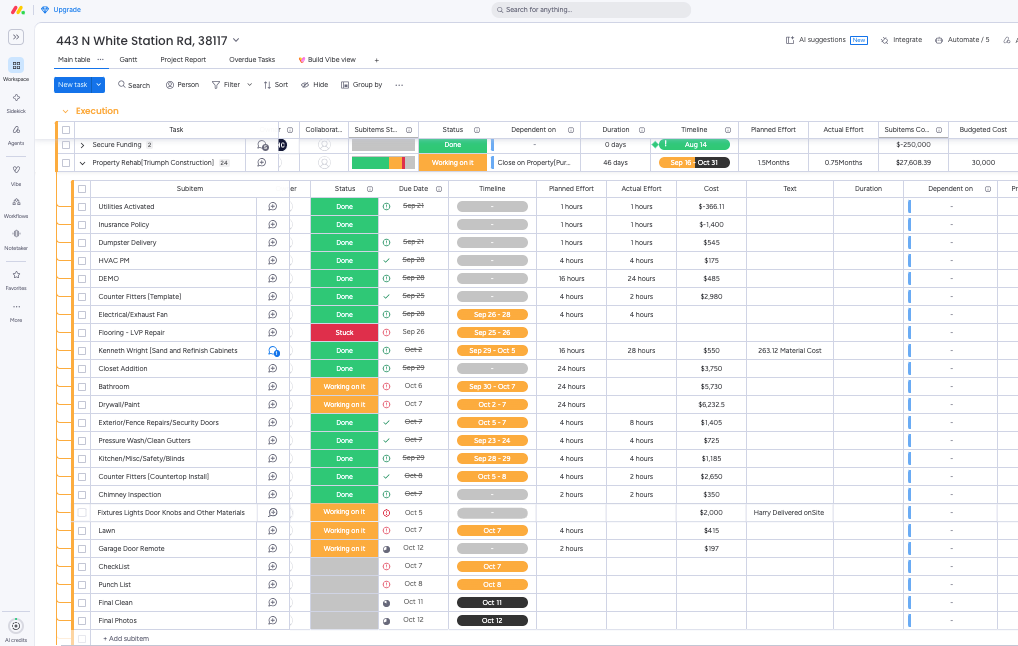
During my first project, I have used Monday.com to keep track the project. Track the budget, milestones and timelines. The GC has provides the Master SOW and I track it when changes are made. Because of a situation were we needed some specialty work completed. Keeping things inline helped keep the project on track for the most part. So Far it has really helped me stay on top of the project, while communicating with the GC a couple days per week.
Real Estate Investor · Memphis, TN · Member since 2016 · 417 posts · 139 votes
20h
Where are located and where is your project you are planning to manage? I would suggest, if possible connect with a Local REIA or Investor Community. They may have some resources that could ease the stress a little.
Accountant · Seattle, WA · Member since 2025 · 391 posts · 153 votes
15h
@Elliot W. Managing a rehab from out of state is definitely possible, but it helps to treat local oversight as a separate role from the contractor doing the work. A property manager or investor-friendly agent may help with occasional check-ins, but for a larger renovation, a local project manager, owner’s representative, or experienced construction inspector is often a better fit.
The key is building a system that does not rely on trust alone: a detailed scope of work, milestone-based payments, permits where required, weekly photo or video updates, lien waivers, and independent walkthroughs before major draws are released. For significant work, periodic inspections by someone who understands construction can catch problems that photos may miss.
Cost will vary by market and project size—some people charge per visit, while others charge a flat fee or a percentage of the rehab budget. Rather than choosing based only on price, look for someone independent of the contractor, experienced with similar projects, properly insured where applicable, and willing to provide clear written reports. For a first out-of-state rehab, paying for stronger oversight can be money well spent and a good way to learn the market without being completely dependent on one person.
Homeowner · Fort Collins, CO · Member since 2026 · 2 posts · 1 vote
11h
Hi Elliot, welcome — I'm in Fort Collins, CO, and I'm in the same boat as a beginner learning all of this for the first time, so take my thoughts accordingly. One thing I've picked up as a homeowner is that getting the scope of work in writing before anything starts has saved me more than once. Itemized bids make it a lot harder for a project to quietly balloon, and that seems even more important when you can't swing by the property yourself.
The milestone-based payment idea folks mentioned here really resonates with me. Paying for completed, verified work instead of large upfront draws seems like the single biggest protection for an out-of-state investor. I'd also ask for dated progress photos on a fixed schedule so there's a paper trail. Good luck with Cleveland/Pittsburgh — planning the oversight first like this seems like exactly the right instinct.
CPA, CFP®, PFS · FL · Member since 2017 · 5k+ posts · 3k+ votes
5h
Elliot, for an out-of-state rehab, I’d definitely have someone local checking on the property regularly rather than relying entirely on the contractor to police their own work.
Depending on the size of the project, that could be a property manager, owner's rep, GC, or another trusted local person. The important part is having someone who can physically verify progress, catch issues early, document the work, and keep the contractor accountable.
I’d also build the cost of that oversight into the deal from the beginning. Saving a little on project oversight isn't worth much if a problem sits unnoticed for three weeks.
One other thing I'd recommend from day one is keeping very clean records of the rehab. Track the invoices and scope of work by project, because repairs and capital improvements can have very different tax treatment, and you'll want a clear record for basis and depreciation once the property is placed in service.
For an out-of-state investment, I'd think about the local operating team and the tax/bookkeeping system together. Both become much harder to fix after the rehab is finished.
Feel free to DM me, I’d be happy to send over a few resources that might be helpful.
Real Estate Broker · Rochester, NY · Member since 2010 · 1k+ posts · 699 votes
2h
@Elliot W. We handle this regularly in Rochester. Our businesses cover real estate sales, property management and general contracting, so we see the project from acquisition through renovation and leasing.
When we act as GC, that’s a separate, more hands-on service above and beyond our normal property-management scope. I think that distinction matters when you’re hiring someone locally.
A property manager or agent might be able to help, but I wouldn’t automatically assume renovation supervision is included—or that they have the construction experience to do it well.
For anything beyond a simple renovation, I’d want clear responsibility for the scope, schedule, subcontractors, change orders, progress verification and final completion. The owner should know who is accountable, what reporting to expect and how payments tie to verified milestones.
That’s the white-glove part: someone locally owning the process instead of leaving you to coordinate everything from several states away.
What market are you considering, and what’s the approximate renovation budget? The level of oversight you need changes quite a bit with the project’s complexity.
Property Manager · Southfield Mi · Member since 2018 · 184 posts · 172 votes
16m
There are 3 major keys to successfully investing while out of state:
You must connect with local professionals who have your best interest at heart.
Many realtors, Property Managers, contractors, brokers, lenders see you as a fast dollar or meal ticket. They will happily sell you a dream and drag you along until you either run out of money or figure out what is going on. There will be many smiling faces, polite conversations, professional exchanges intended to lull you into a relationship. The people you want to deal with won't just have great conversation and "systems".. The pros you want to deal with are actually engaged in your target area on a day-to-day basis. They can break down a city off the top of their head neighborhood by neighborhood. They know values, crime rates, tenant pools, rehab costs, municipal codes. You want someone who will point you to a great deal and away from bad ones. Good team members are always figuring out ways to help you win not just looking out for their own bottom line.
You have to clear any preconceived ideas you have about out of state communities. You must not super impose what you are used to, or what your native city or community is like on other cities.
Too often a local professional has to arm wrestle with an out of state client who absolutely believes that we live in a homogenous country where everything is basically the same. It's absolutely not. Preferences, theft, tenants, municipal codes and requirements, weather are extremely local. Understanding this will help you avoid mistakes that you wouldn't make otherwise.
Avoid the urge to fall in love with a property
This ties into the first point about having local navigators. Quite often Out of State investors will come to an unfamiliar place, look at a property the sparks start flying. Ideas rush to the forefront of your mind and the vision crystalizes-yep, not the best thing to do when you don't fully understand the area. Once this happens it takes a ton of energy to get you off the property and if you stubbornly move forward anyway after receiving advice not to the blame will often shift to your team when in fact it was just not the best deal. If you ever decide to look into Detroit Michigan we would be happy to help you out.