
Your money isn’t necessarily worth the same in the future as it is today.
The time value of money states that the money you have today is worth more than the money you’ll have at a future date. The two main reasons why are your potential earning capacity and inflation. It’s why people make investments instead of letting their money sit in their checking accounts. It’s why Mad Men’s Peggy Olson didn’t balk when she was offered $19,000 per year in 1970 (the equivalent of about $149,500 today).
As a real estate investor, understanding the time value of money is critical because it’ll help you make informed financial decisions that will impact the profitability of your investments. To help you make these decisions, let’s explore the time value of money, including how it works, how future values, present values, and compounding periods fit into the equation, and include some real-life investing examples to show you how to make your money work for you over time.
What is the Time Value of Money?
The time value of money is a financial concept that refers to the idea that the value of money today (present value) is worth more than the same amount in the future (future value). The amount of money you have today can accrue interest, thus increasing in value over time, while the amount you receive in the future doesn’t have time to do the same.
The time value of money is often calculated using the principles of present and future value, which also considers factors like inflation, interest rates, and the length of time involved.
Why is Knowing the Time Value of Money Important?
Understanding the time value of money is crucial for real estate investors since real estate transactions involve significant amounts of money over extended periods. This concept can guide you in deciding when to invest, what rates of return to expect, and how much you should buy or sell a property for.
The time value of money can help real estate investors make smart financing choices, like what type of mortgage is most advantageous based on their circumstances or when to refinance their loan. It’s also a helpful tool for evaluating an investment’s potential profitability when estimating the net present value (NPV) of its expected cash flows.
These are just a few examples of how the time value of money can be useful to real estate investors. Understanding this concept is essential to making informed financial decisions and evaluating investment opportunities.
How to Understand the Time Value of Money
Imagine it’s early 2018 again. Let’s say you have $10,000 lying around, but instead of investing it, you lock it up in your safe in case of an emergency. This money’s present value (still assuming it’s 2018) is $10,000. Five years later, in our actual present, you open up your safe, and your $10,000 is still there.
The good news is that you haven’t lost anything. Your $10,000 is still $10,000. The bad news is that $10,000 isn’t worth what it was five years ago.
Why? Because inflation reduces the purchasing power of money over time, the same amount of money is worth less in the future than it is today. For example, $10,000 in 2018 has the equivalent purchasing power of about $12,014.33 in 2023.
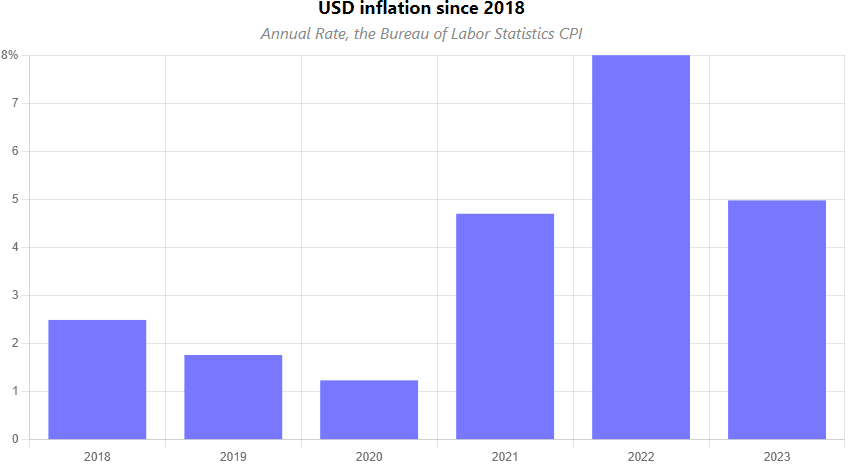
Between 2018 and 2023, the dollar realized an average inflation rate of about 3.74% each year, resulting in a cumulative price increase of 20.14%. If you took your money out of the safe and put it in an investment account that accrued 3.74% each year, you’d have $2,014.33 more today than if you left it in the safe.
Because you left your $10,000 in the safe, your purchasing power is less than it was. Since you didn’t keep up with inflation, your $10,000 is worth around $8,323.39 now. It’s still technically the same $10,000, but prices have slowly increased since then, so your money won’t stretch as far as it did five years ago.
Real estate investing using the time value of money
Suppose you took the $10,000 from your safe and invested it in a REIT or multi-family property. Each year, your investment made 10%, and, for simplicity’s sake, you didn’t collect dividends or make any additional deposits. After five years of collecting 10% interest, you now have $16,105.10. Not only is that $6,105.10—you’ve also outpaced inflation by $4,090.77!
A Foolproof Formula For the Time Value of Money
No single formula estimates the time value of money. Which formula you use depends on your specific situation and the variables involved. If you’re looking to calculate the future value of money, your basic formula will deviate from if you’re trying to solve for the value of a future sum in present-day dollars.
First, let’s define some of the most commonly used variables when determining which formula will give you the answer you’re looking for. Don’t worry—we’ll show you some of these formulas and real-world examples shortly.
- Future value: This tells you the value of an investment or cash flow at a future time. This calculation is determined by compounding the current value at a given rate.
- Present value: This tells you the value of a future payment or cash flow in today’s dollars. It’s calculated by discounting the future value at a given rate.
- Interest rate: This is the percentage of return earned or paid on an investment. You use this to calculate the future value of an investment or loan.
- Discount rate: This is the rate used to discount future cash flows to their present value, taking factors like risk, inflation, and opportunity cost into account.
- Number of Periods: This is the number of times the interest rate is applied to your principal.
In this post, our primary focus is on money’s present and future value. Still, other terms (especially interest rates) will inevitably arise when calculating your money’s time value. Understanding and knowing when to use these variables allows you to analyze and compare different potential investments, evaluate their potential for risks and returns, and make clearer decisions regarding when you should save, borrow, and invest.
What is Future Value: A Basic Primer
The future value determines the amount of money an investment will generate over time by considering variables like future cash flows and interest rates. Going back to the earlier example, if you were weighing whether you should put your $10,000 into a multi-family property averaging 10% year-over-year returns, you have an idea of your expected rate of return.
Of course, no one can fully predict the future. There will still be risks and several internal and external forces that’ll ultimately impact your returns. You can calculate for some of those, but this post covers the basics.
How to Calculate Future Value
There are multiple ways to calculate future value. Here are a few of the basic formulas:
Calculating for simple annual interest
Let’s say you’re investing in that multi-family property with a constant growth rate of 10%. The $10,000 you’re putting into it is money you won’t touch throughout your five-year investment. You’re also not expecting to receive dividends, your interest rate is simple, not compounding, and you’re not investing any more money during the five-year investment period.
Here’s the formula for simple interest:
FV = I x [1 + (R x T)]
- FV = Future Value
- I = Investment amount
- R = Interest rate
- T = Number of years
FV = $10,000 x [1 + (0.10 x 5)]
FV = $10,000 x (1 + 0.5)
FV = $10,000 x 1.5
FV = $15,000
Calculating for compounded annual interest
Simple interest assumes that you’re only earning money on your initial investment. That’s not usually how investments work. Compounded interest earns interest on both your initial investment and on the interest earned on that investment over time.
For example, after the first year of your investment above, you’ll have $11,000 ($10,000 x [1 + (0.10 x 1)]. While simple interest repeats this process by using only your $10,000 principle, with compounded interest, you’re starting your second year with $11,000.
Here’s the formula for compound interest:
FV = I x (1 + R)T
- FV = Future Value
- I = Investment amount
- R = Interest rate
- T = Number of years
Here’s what that looks like in action:
| Number of Years | Principle and Formula | Ending Principle |
| 1 | FV = $10,000 x (1 + 0.10)1 | $11,000 |
| 2 | FV = $10,000 x (1 + 0.10)2 | $12,100 |
| 3 | FV = $10,000 x (1 + 0.10)3 | $13,310 |
| 4 | FV = $10,000 x (1 + 0.10)4 | $14,641 |
| 5 | FV = $10,000 x (1 + 0.10)5 | $16,105.50 |
After five years, you’ve made $6,105.50. That’s $1,105.50 more than if you accrued simple interest.
If your investment gets compounded multiple times each year, you will use this formula:
FV = PV x [(1 + i/n)]n x t
- FV = Future Value
- PV = Present Value
- i = Interest rate
- n = Number of compounding periods per year
- t = Number of years
Let’s assume that your interest compounds monthly:
FV = $10,000 x (1 + 0.10/12)12 x 5
FV = $16,453.09
Future value formulas can also help you determine the future value of an annuity:
FV = [(1 + r)n – 1] / r
And continuously compounded interest:
FV = PVert
- FV = Future Value
- PV = Present Value
- r = Interest rate
- n = Number of compounding periods per year
- t = Number of years
- e = Euler’s number (approximately 2.71828)
What is Present Value: The Basics
Present value refers to the current value of a future sum of money or cash flow discounted by a specific interest rate. In other words, it’s a calculation that estimates the amount of money you need to invest today to achieve a specific target return in the future.
In real estate, the present value is the price an investor should pay today to make a string of future cash flows to achieve their target return. If you want to invest in a REIT and turn $10,000 into more than $16,000 in five years, your REIT needs to make 10% year-over-year in compounding interest.
How You Can Calculate Present Value
When you’re calculating the present value of a future sum, your equation will look like this:
PV = FV / (1 + i)n
- PV = Present Value
- FV = Future Value
- i = Interest rate
- n = Number of periods or years
Let’s use the above example but assume you don’t know the present value. You know that you want at least $16,000 in five years and that the REIT accrues 10% interest yearly.
PV = $16,000 / (1 + .10)5
PV = $16,000 / (1.10)5
PV = $16,000 / 1.61051
PV = $9,934.74
To have at least $16,000 in five years, you must invest $9,934.74 in the REIT today.
The Pros and Cons of Calculating for Future Value and Present Value
Here are a few of the advantages and disadvantages to consider when calculating these values:
Advantages
- Calculations can be helpful in many ways. Determining these values relies heavily on assumptions, including inflation, interest rates, and economic conditions. While they’re not perfect, they can help you plan for many things, like how long it’ll take you to save for a down payment, how much interest you’ll accrue over a certain number of years, and more.
- Comparing investment options is easier. Suppose you had to choose between one of two investment options. The first requires investing $5,000 for three years for an 8% year-over-year return. The second also has you invest $5,000 for three years, but if your returns mimic the last three years, they will be 5% for the first year, 9% for the second, and 10% for the third. Calculating future value will help you determine which investment is better. If you know you want to have $10,000 in three years, which are your returns, you can calculate the present value of money you’ll need to invest today.
Disadvantages
- Calculations are just estimations. Future and present values are based on assumptions, especially when using only basic calculations. Interest rates can vary substantially over time, and a million things not in your control can impact your actual return.
- Constant growth isn’t constant forever. Just because a REIT has consistently shown 10% year-over-year growth doesn’t mean that it’ll continue to do so. The year after you invest, it may only make a 2% return or even lose money. Assuming that something will grow consistently is unrealistic because growth is seldom linear or constant. For a perfect example, revisit the USD inflation chart in this post, which demonstrates how economic conditions can impact inflation rates and currency value.
The Time Value of Money (with Real-Life Examples)
Now that you know how future value and present value apply to the time value of money, let’s use some real-world examples:
Which investment is better?
Jamie is considering two different investment options, each requiring him to invest a one-time sum of $10,000. Option one requires him to invest a one-time sum of $10,000 for three years for an 8% year-over-year return with yearly compound interest. Option two also requires him to invest a one-time sum of $10,000. If his expected returns mimic the previous three years, he will earn 4% for the first year, 9% for the second, and 11% for the third. Which is the better investment?
To determine these investments’ future values, Jamie needs to use the formula for compounded annual interest: FV = I x (1 + R)T
Option one is straightforward:
FV = $10,000 x (1 + 0.08)3
FV = $10,000 x (1.08)3
FV = $10,000 x 1.259712
FV = $12,597.12
Option two is a little trickier because the rate is different each year. However, because you have to solve for each year, T = 1, you can instead use the formula for simple interest: FV = I x [1 + (R x T)], or even FV = I x (1 + R)
Year 1:
FV = I x (1 + R)
FV = $10,000 x (1 + 0.04)
FV = $10,000 x 1.04
FV = $10,400
Year 2:
FV = $10,400 x (1 + 0.09)
FV = $10,400 x 1.09
FV = $11,336
Year 3:
FV = $11,336 x (1 + 0.11)
FV = $11,336 x 1.11
FV = $12,582.96
Option one is the better investment, with a difference of $14.16 compared to option two.
Turning an inheritance into a down payment
Maria inherits $20,000 from her late aunt, which she puts in an investment account managed by her financial advisor. Her goal is to have enough money for a down payment for a bed and breakfast. If she needs $30,000 for her down payment and wants it in the next five years, what is the minimum interest rate she needs?
Maria will need to use the compound annual interest formula, but this time she has to solve for r. The math gets a bit tricky, but it looks like this:
r = (FV/PV)(1/T) – 1
r = (30,000/20,000)(1/5) – 1
r = 0.08447, or 8.45%
If Maria’s unsure whether she correctly solved for r, she can double-check her work using the formula as she learned it:
FV = PV x (1+r)T
$30,000 = $20,000 x (1 + 0.0845)5
$30,000 = $20,000 x (1.0845)5
$30,000 = $20,000 x 1.50
$30,000 = $30,000
Present value of a complex
Lee is part of an investment group that pools its money to buy and rent out apartment complexes. His group is ready to invest in another one in a hot market and estimates they’ll earn 15% year-over-year returns for the next five years. If Lee wants the future value of his investment to be $2 million, how much does he need to invest today?
The figure this out, Lee needs to use the present value formula:
PV = FV / (1 + i)n
PV = $2,000,000 / (1 + 0.15)5
PV = $2,000,000 / (1.15)5
PV = $2,000,000 / 2.01135
PV = $994,357.02
Lee only needs to invest $994,357.02 to double his money within five years!
Time Value of Money FAQs
Do you still have questions about the time value of money? Here are the answers to some of the most common questions:
How does inflation impact the time value of money?
It makes the value of a dollar decrease over time. That’s why if you kept $10,000 in your safe from 2018-2023, that $10,000 only has a purchasing power of about $8,323.39.
How is the time value of money used in finance?
Investors calculate for present value all the time. It serves as the foundation for numerous financial applications, including:
- Financial modeling
- Stock pricing
- Bond pricing
- Banking
- Insurance
In real estate, you can use it when analyzing a variety of investment opportunities.
Why is it important to know about the time value of money?
The time value of money tells you how much your money is worth now compared to how much it used to be worth, which can be an eye-opening experience that makes you think about money in a whole new way. $1,000 today won’t be as valuable as $1,000 in 2024, less valuable in 2025, etc.
How does the time value of money factor into decision-making?
When real estate investors are trying to decide if an investment is right for them or if they’re trying to determine which investment will yield the best returns, future value, and present value formulas can help them figure it out.
What is the difference between present value and future value?
Present value refers to the current value of a future sum of money if you invested it today. Meanwhile, future value refers to the value of a sum of money at a later time, assuming a certain rate of interest.