Originally posted by @Mac F.:
@George Gammon, I read your profile. You are certainly someone with a lot of experience and a solid depth of knowledge.
You stated that you "feel a moral obligation" to show the light on Dave Ramsey, who has "destroyed more American minds than anyone else." If you could please do that in this thread, I'd appreciate it. I'm sure the 12 other people you tagged in your comment about DR would appreciate it too.
DR, to my knowledge, has never recommended fixed income investments. In the context of DR, a comparison of real estate investing to fixed income is an unfair straw man argument. DR mentions this often enough that I'm pretty certain most DR listeners know his position too.
DR recommends putting 15% of gross income into retirement in 'good growth stock mutual funds.' A fair argument would be to compare someone who followed DR's preferred method to your example. But even that would probably not be fair-- because nobody on this thread has advocated that. Maybe compare someone who uses that $200k to pay off their student debt, then saves a down payment and then invests in real estate?
Second, you keep bringing up that people here don't understand inflation. Could you please explain what you mean by that? I would think that a strong basic understanding of housing inflation is one of the things that attracts people to real estate investing, at least that's the impression I've gotten from reading the forums. It certainly seems to be a regular point of emphasis on the various BP podcasts.
Finally, why do you feel that net level of positive cash flow of $1500 a month on a 500k portfolio of properties with 40% down is reasonable, especially for novice investors? Please go into detail on this. One of the great things about BP is that there are so many experienced real estate investors, like yourself, here. That seems like a fantastic return, especially for novice investors, and I just don't have the confidence yet that that's reasonable. Maybe I'm confused, but I've listened to enough BP podcasts where I've been cautioned not to expect to make a strong return on my first real estate investment. As a novice real estate investor, I'd appreciate it. Oh, and feel free to be as technical and detailed as you want on this-- I need practice at calculating real estate investment returns.
Thanks.
Thank you for your post and questions. I'll respond by first outlining why Dave Ramsey's ideas are dangerous. Like a politician, he either knows the truth and is lying or he's an idiot.
Let's start by using DR "Financial Peace University" baby steps.
Step 1 - $1000 emergency fund. I can't argue with this.
Step 2 - Pay off all debt, using debt snowball. This is where he starts to go off the rails. Consumer debt is bad, granted, but all debt is not created equal. A 30 year fixed rate mortgage on a cash flow positive rental property is the opposite of consumer debt. There's no better way (risk adjusted) to build wealth in today's economic environment. Paying off fixed rate debt, that's paid by a 3rd party, is a terrible idea. And he's not talking about consumer debt exclusively, here's a pictograph from his website referring to real estate investing. See step #1

Also note: 5% of net worth. Another insane suggestion I could discuss for hours.
Step 3 - 6 months expenses in savings. Agreed.
Step 4 - Invest 15% of Household Income into Roth IRAs and Pre-Tax Retirement. Once again completely insane. I'll go into why this is incredibly high risk below when I discuss mutual funds. But if you want tax free way to build wealth real estate (starter homes in midwest purchased under the cost of construction) does that and is 100x less risky.
Step 5 - College fund. I disagree with the entire cultures obsession with sending kids to college (this isn't DR specific.) Do a simple cost/benefit analysis, 90% of degrees are a waste. If you want to be educated you have the internet, everything I know about macro, as an example, I learned from internet, audio books, and Youtube.
Also, I was a self made millionaire at the age of 34. Literally used nothing I learned in school past grade 3. Another example, a good friend is a small car dealer, his oldest son loves cars and just turned 18. My friend gave him the option of college or start out in family biz. Kid chose biz, is now making 70k a year and has a skill (flipping cars) he can use for the rest of his life to make 100k plus a year... no student debt and a much healthier liver.
The problem is the statistics on college are extremely misunderstood. They point to the fact college grads make more money, but they don't adjust for the skills required to graduate from college, such as self discipline, motivation and intellect.
My point is, it isn't necessarily the degree but the skillset and personality the kid had prior to college...college just gets all the credit, wrongfully so. The exceptions are skilled trades, doctor, lawyer, engineer etc. but there my argument would be most kids go into those fields for the money and you could make much more money flipping cars or 1000 other things by learning the trade instead of going to college and signing up for 200k in debt you can't unload in bankruptcy.
Step 6 - Pay off home early. I completely disagree. Why? Because, in most cases, it's financially crazy to own a home.
Most people live in a home, that if it were a rental, would have an atrocious R/V ratio. So own rental starter homes in the midwest, under cost of construction, with 30 year fixed rate debt, that have good R/V ratios.
It's much better to rent a 1 million dollar house to live in and take the 1 million dollars and buy good rental props. Even if you don't pay cash it's most often cheaper to rent a nice house than to buy it when you consider the costs of owning. So rent where you live and buy things to rent to others.
Or house hack. Buy a triplex, live in one unit, and have your renters pay the mortgage (again, make sure it's 30 year fixed rate). This and BRRRR are by far the smartest suggestions on BP.
FYI, I'm 46 now, I've never owned where I lived.
Step 7 - Build wealth and give. This is where he want's you to "invest in mutual funds," and to be fair real estate (all cash and 5% of your investments). So let's assume the other 90-95% goes into mutual funds. Just go to his website and it's obvious he's drank the mutual fund koolaid. Again, not sure whether he knows how bad his advice is and is lying or is completely ignorant. My guess is it's the former because of the mental gymnastics required for articles like this from his blog.

And if you read the blog post it becomes obvious why I tend to believe he's blatantly lying to his audience and his whole schtick is a rouse. see below

Notice he brushes off the lost decade by saying you have to look at the bigger picture and you can't cherry pick time frames. But that's exactly what he does to make his claim about the 12% average returns. The whole basis for for the blog post and a big part of what he sells to his audience.
But it goes from a subtle white lie to blatant fraud when you look at how he's selling a "12%" return.
Meaning, most of his listeners are unsophisticated, they don't know a 12% drop one year and a 12% gain the next doesn't put you back at zero. They think that their money will just compound at a 12% clip annually. Let's look at reality.
If we took what DR says at face value, the market goes up on average of 12% a year going back to 1923, we should be able to type the value of the 1923 S&P into a compound interest calculator, input 12%, and we should have roughly 3000 (where the S&P is today). I only have data from 1928 on, but I think you'll still get my point. The S&P was 17 in 1928. Let's see what happens...

If what DR says is true, the way he sells it to his audience, if S&P would have to be at 512,000 right now!!! It's at 3000!!!
And I'm not even adjusting for inflation. Adjusted for inflation (meaning 12% annual increases in purchasing power) the S&P would be at over 7,500,000!!! YES, 7.5 MILLION.
You maybe saying to yourself, "what George is saying can't be true" DR would never get away with that much of a lie. Here's why DR can get away with his claims. They're true in literal terms but they're wildly false in the way he presents it to his audience and how his audience perceives what he's saying.
DR presents this 12% claim as though, over the long haul, your money will grow by 12% a year. FALSE! Why? Because when a number is reduced by 10% and then increased by 10% you're not left with the same number...it's lower.
As an example. Take $1000 and decrease it by 50%, you now have $500. Increase that $500 the next year by 60% and you now have a total of $800. A $200 (20%) loss but a 5% average return (-50 + 60 = 10/2 = 5%).
This becomes very clear when we look at graph of annual S&P returns.
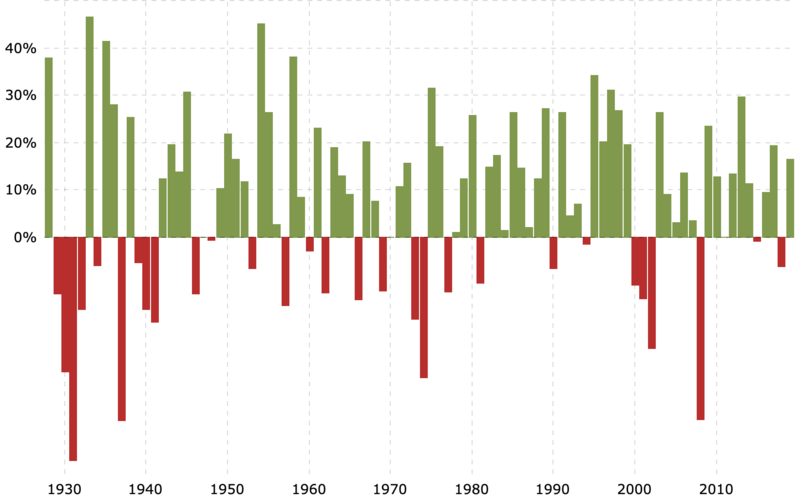
Or better yet, look at an inflation adjusted chart. Please notice how much you'd make if you invested in 1928 and left your money in for 52 years, until 1980.
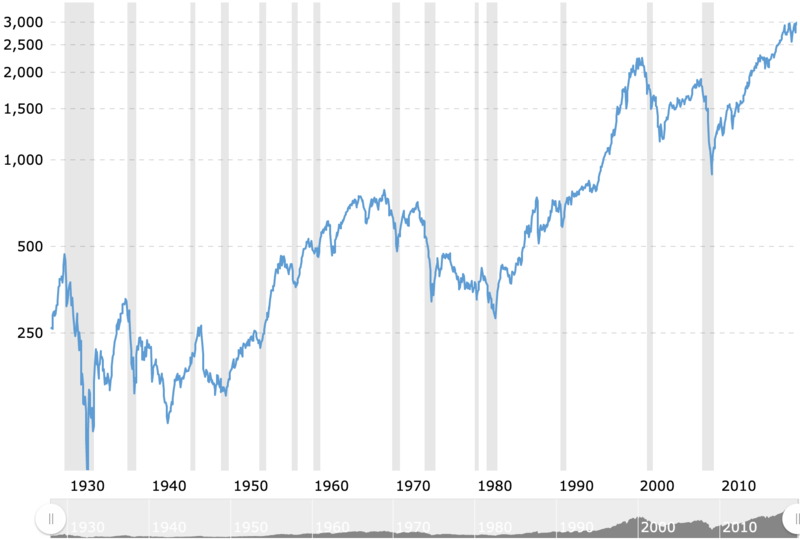
You would've made zero (adjusted for inflation). Dave Ramsey what happened to 12% per year??
What infuriates me the most is he targets people in the south and people who go to church, in other words people with traditional values who are more susceptible to his "be prudent, save money, no debt, invest in mutual fund" snake oil.
To be clear, 10% of what he says is spot on, have a rainy day fund and don't take on consumer debt, but the other 90% is so bad it's completely inexcusable.
If you're one of the millions of Americans, not just DR fans, who have drank the koolaid of the financial services industry and invested into the "safety" of mutual funds, I apologize, I don't relish being the bearer of bad news. But as I said in my first post on this thread, I feel a moral obligation to set the record straight.
Please note: I didn't even hit the tip of the iceberg of why mutual funds are quite possibly the worst investments on a risk/reward basis. I understand I exclusively focused on S&P and mutual funds typically contain bonds. I did this because interest rates have been driven down so low by the Fed, mutual funds no have to overweight equities because they can't get a return from bonds. This problem will be exacerbated if/when US bonds go into a negative yield like Europe and Japan.
I realize this is complex stuff. It's why DR can dupe so many, including maybe himself. I'd like to point out I learned none of the above in college. ;)
If you have any questions don't hesitate to reach out, all my contact info is on my profile.
Good luck,


