Investor · United States · Member since 2020 · 17 posts · 9 votes
My husband and I live in San Luis Obispo. The market here is extremely high so my husband and I have been educating ourselves on out-of-state apartment complexes. We do not have experience with oos investing yet but are looking to get started. Can anyone suggest where to start? I'm trying to narrow down target location and then start vetting properties and agents. Is that the best angle?
1) identify your desired market (steady population growth, job growth, rent growth, decrease in crime, household income and value) www.city-data.com can provide a lot of useful metrics.
2) identify your submarket using same approach as above. Additionally start reach out to agents in investors currently operating in that area and ask questions. Vet the area to determine it's where you want to be
3) Determine your investing criteria. This will be crucial to enable to your qualify or disqualify properties quickly until you find the right deal.
4) Have your financing squared away prior to talking to agents. The last thing you would want is for your potential team member to feel like they're working for free. Have your ducks lined up in a row so you can pull the trigger when a property is presented to you and fits your criteria.
5) start building your team with local agents, property managers, contractors, title companies, insurance agents etc.
The more specific and prepared you are on what you want, the easier it will be to build the appropriate team to make it happen.
I'm in a similar boat. (Also living in CA). What i'm doing right now is talking to my lender, giving her a heads up about my next move, shes willing to work with me. I'd suggest you do that OR you can start analyzing properties from various locations to see where works best. example Alabama/Kentucky/Ohio/Texas/Missouri, the list really goes on bc most places are not as expensive as CA. Get comfortable with running the numbers. Are you looking to buy and hold or flip?. Work the numbers and what you want.
Next or while you're running the numbers call realtors, interview them. Ask them as many questions you can think of and them some. Make sure they're investor friendly and have properties or flipped properties. most likely they'll connect you with a lender they've worked with or you can hit google and search that area.
I realized after I typed the above, you answered your own question lol. you're on the right track @Megan Winterberg dont forget about the property management side of it if you're buying and holding.
1) identify your desired market (steady population growth, job growth, rent growth, decrease in crime, household income and value) www.city-data.com can provide a lot of useful metrics.
2) identify your submarket using same approach as above. Additionally start reach out to agents in investors currently operating in that area and ask questions. Vet the area to determine it's where you want to be
3) Determine your investing criteria. This will be crucial to enable to your qualify or disqualify properties quickly until you find the right deal.
4) Have your financing squared away prior to talking to agents. The last thing you would want is for your potential team member to feel like they're working for free. Have your ducks lined up in a row so you can pull the trigger when a property is presented to you and fits your criteria.
5) start building your team with local agents, property managers, contractors, title companies, insurance agents etc.
The more specific and prepared you are on what you want, the easier it will be to build the appropriate team to make it happen.
I would just add to what Dallon is saying and fly there and meet these people in person. They will take you that much more serious if you do. These brokers get calls from people out of state all day. If you down them and meet it'll set you apart.
Lastly you may want to partner with someone who has done this before.
I would just add to what Dallon is saying and fly there and meet these people in person. They will take you that much more serious if you do. These brokers get calls from people out of state all day. If you down them and meet it'll set you apart.
Lastly you may want to partner with someone who has done this before.
Absolutely, get face-to-face. Also be aware that the best way to get familiar with an area is to go there and get your feet on the ground.
@Megan Winterberg I have over 100 OOS investors from the East & West coast who choose one of the many Midwest markets. Most of them are successful at it.
From what I have seen, the make or break for inexperienced investors is finding a good Property Manager/operator. When your starting out you don't know what you don't know and that experienced operator will mitigate that risk.
@Julio Garcia I talked to our lender but she doesn't do out of California so I think what's next is for me to iron out my target location and then really focus on building my team i.e. agent, lender, and pm. I've been analyzing quite a few properties. I have a business background and have thoroughly enjoyed crunching the numbers - definitely a fan of excel.
Dallon, Jonathan, Taylor, Jason thank you so so much for the input! Our finances are lined up, however, we are not pre-approved yet but am looking to get that ironed out once I narrow down the location and find my all-star agent and property management.
We've talked about flying out to our target location once we vet a few agents and property managers so we can meet them in person as well as tour potential properties. However, after doing some research David Greene rarely goes to see his properties and has even bought OOS without touring the specific properties. Now I know he has way more experience than us and that makes me extremely nervous but it's an interesting angle. With COVID I'd love to avoid getting on a plane but it may not be avoidable.
@Megan Winterberg Hi Megan! You can also look into local banks in that specific market to use as lender and let them know you’re looking for an agent as well if they know any investor friendly realtors for that area. Small local banks are more familiar with local agents and contractors too!
I know that in Buffalo,NY they usually sell the worst properties that nobody else wants to buy to out of town investors. Especially cash buyers get screwed, sometimes when they come to look at their new house they find out that it’s only a vacant lot or the house is scheduled to get demolished by the city.
@Account Closed is correct in what I meant. The more specific you are on what you want, the more focused it makes you on identifying the properties that fit your criteria. Out of state lenders/agents/pm will gain more confidence in you. Are you looking for development, value add or capital preservation? Light value add or heavy lift? Single family or Multifamily? Age of building? How many units? Price per door? Cap rate?
Performing all your due diligence and speaking with a lender to really know what you and your team can qualify for may help in determining these points. No point in looking at 50+ unit properties when you can only afford 5-10.
For Example:
"Hi Mr. Agent. My name is Troy and I am an out of state investor focused on acquiring small multifamily in your market because of reasons one, two and three. Combined our team has over 15yrs experience of owning and managing 1-4 unit rental properties. We are looking to scale up and based on our experience shared with a local lender, we know we can confidently purchase up to a 20 unit value add property built in the 80's or newer with current rents $150-200 under market. Our ideal purchase price would be around $60k-80k per door. This would enable us to carry out our business plan effectively and obtain the target ROI we have set for ourselves."
If you present yourself in a similar way then there is no question as to what it is you're looking for and makes it easier for agents to take you seriously and not waste their time or yours sending you properties that don't fit your criteria.
I have one other item: Remember initial cash flow is not the same as actual cash flow. Actual cash flow is the cash flow over the hold period and sometimes has little correlation to the initial cash flow. A Midwest market that has zero population growth over the last decade is likely to experience virtual no inflation adjusted increase in cash flow and may experience a reduction in inflation adjusted cash flow. This contrasts with the fastest growing cities (Raleigh, Austin, Phoenix, Nashville, Dallas/Ft Worth, San Antonio, etc. - long list of fast growing cities) which may have less initial cash flow, but are likely to experience better cash flow over the holding period.
Note: cap rates are a reflection of expected risk and expected return. Markets with higher cap rates are typically expected to have either more risk and/or lower return than markets with lower cap rates. Unless you have a lot of experience, I would avoid the highest cap rate areas.
@Megan Winterberg I went through a similar analysis last year trying to decide on which market to buy in. Here are some questions that helped me
1. How much money do you have to put down? Loans for MF have changed a bit lately, but they’re still pretty attractive. I see most maxing out at 80-85% LTC when there are renovations planned.
2. This in turn will decide how big of an apartment building you can afford. Every market is different. The same deposit will be able to get 100 units in one market and 20 in another. For me, I wanted to MAX the amount of units, without falling into too low valued areas. Keeping $50k/unit as a min helped set in stone how many units I could afford per market.
3. Coinciding with step 2 is deciding on the market. There’s already been great responses here and in other posts. I would say picking the market depends on
- landlord friendly areas
- area where you have the best team with boots on the ground
- maximizes you’re unit/$
- deals in class C and B buildings
- strong JOB market for the future
- strong median salary vs market rents
These questions or points helped narrow down the search for me. I was only looking for apartments that had deferred maintenance and high expenses and were family owned. I found the most upside potential here. Hope this helps.
Make sure to properly vet the agent you use. Its really easy to get misled when dont know an area or straight up scammed on turnkey properties where lose 10k+ right on the buy being its so overpriced. In regards to properties look for B class or higher. The cap/ex on c class or lower (rents under $1200) can be a killer when out of state managing and not being able to shop prices on big jobs as easily makes them costlier then a local. I always tell my clients to be conservative with numbers/expectations. Condos are also a good option and tend to be very low risk/easy first out of state deals.
I have purchased several out of state properties that I have never personally seen. Of extreme importance is that I always had a through property inspection done so I knew what I was getting and what needed to be done. So although I never saw them in person I got some in-depth photos.
@Megan Winterberg @Tanya Villanueva, many have given you a lot of good points thus far, so really I just want to piggy back on a couple that I think are huge and where I have seen others fail.
1. Knowing what area you want to go into is huge, but you can not make this solely on the numbers as it is not that easy. This also depends on the inventory and where you feel comfortable building a team. You may love an area but may not feel good about those you talked to. Knowing what type of properties you want to buy is huge. I get calls often, “I just want to buy good deals”. It’s not that easy. Know what you want! Are you ok with challenging C class properties? What cap rate do you want to buy at and what do you want to perform at? Are you looking to find properties you can refi out of or does that not matter? Are you flipping?
2. Know where your money will come from and be ready to pull the trigger. I’ll come back to this
3. Find an agent and there are very few that really understand investments and will guide you in the right direction without worrying about there commission. I have a partner who got hammered by bad advice from an agent in Columbus / Dayton before we had met. This same agent pushed properties to me that made no sense. The positive, I met one of my partners through this agent. However, those two reasons caused me to get my realtor license so me and my network never had to worry about that again.
****The key factors - your agent should be an investor and should be extremely dialed into the market and have a network. They should be able to point you to lenders, they should have contractors ready to roll that they have vetted, they should know the good PM from the bad (or better case scenario, they actually have a PM company already). And you do not want an agent that solely makes their money on commission (this is not hard and fast and there are some really good agents out there like this), but this is best case decisions. Reason is, you never want their commission to stand in the way of a deal. If your agent is hooked up in the area, they will bring you off market stuff that nobody else has access to, but #2 is important when they do. You have to be ready to pull trigger on stuff. I’m very flexible with my commission because I know my clients out of state are going to have me as property management, so why would I kill a deal over quick commission instead of having a longer relationship? Lastly, with the agent, if your lucky to find one that has the above criteria you need to make sure your goals and their goals are different. You ask why?????? Because if your both going after the same type of properties, they will only give you the bread crumbs.....
Example; one of my clients loves value add quads. While I have some, I’m focused on larger multi-family. So any quad I find I’m happy to send his way, but If I found an amazing deal in a 48 unit complex, I’m going to close the deal for myself first! Your agent should always tell you the truth.
Another client loves A-B class properties. Perfect, I only buy in C class.
Another client loves trailers parks, awesome While I grew up in one, I don’t want to own one!
4. Hopefully, you have now built your team, but if not, find your property management team
5. Fly out and spend a few days with everyone and get to know the area, so you know what your agent is talking about as he references neighborhoods
6. Go get to work and buy some S*%&!!!!
Sorry for long response, but best of luck to you!!!!! Reach out if I can ever be of assistance.
Have you considered the Phoenix market? This past May the U.S. Census Bureau announced 15 cities that had the largest growth in raw numbers since the last census, in 2010. Phoenix came in at #1.
The current inventory here is quite low, 0.6 months of supply. The demand heavily favors landlords and appreciation.
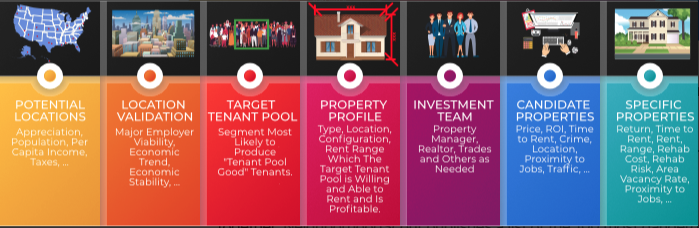
Hi @Megan Winterberg , below is a visual summary of a lot things folks in this post have said earlier. I stumbled upon this in another post and found it useful.
HIGH LEVEL VIEW:
Potential locations: appreciation, population, per capita income, taxes
Location validation: major employer viability, economic trend, economic stability
Target tenant pool: segment most likely to produce "good tenant pool" tenants
Property profile: type, location, configuration, rent range which the target tenant pool is willing and able to rent and is profitable.
Investment team: property manager, realtor, trades and others as needed
Candidate properties: price, ROI, time to rent, crime, location, proximity to jobs, traffic
Specific properties: return, time to rent, rent range, rehab cost, rehab risk, area vacancy rate, proximity to jobs
Thank you very much for the advice. I have some rough numbers of how much we can leverage but still trying to narrow down what commercial loan terms are really like i.e. interest rate, years, etc. I'm also trying to focus on market. Once I have my dollars and target market I plan to focus on that team so I can get this momentum started.