Syndication Fees Syndicate Fees- Are these normal????

Syndication Fees Syndicate Fees- Are these normal????

Member since 2021 · 95 posts · 30 votes
  • Acquisition fee 2.95% of purchase price of asset
  • Disposition fee 1% of sale price of asset
  • Asset management fee: 1% of equity raised
  • Fund admin fee: .25% of equity raise

Their waterfall is 70/30 split until 13% IRR then 50/50

0Reply
225 views

Most Popular Reply

Member since 2020 · 984 posts · 1k+ votes
4y

I think 1% for the acquisition fee since when I am explaining to investors I want to be able to speak with conviction when I tell investors my goal even if the deal goes bust is to pay the investors, first.

Supposing, you do a $5 million property at 3% = $150,00. That is a ton of money for just putting the deal together and 1% or $50,000 is still more than enough money.

A syndicators first goal is to make their investors feel safe and you pay them, first. Personally, I would not pay you 3% because syndicating and putting deals together is not all that complicated. You can either do it or maybe you should not.

See this reply in the discussion

25 Replies

Jump to latestLatest
  • Apartment Syndicator · Charleston, SC · Member since 2017 · 519 posts · 631 votes
    4y

    @DongHui Patel The fees that you listed are normal for most syndication deals.  Are you investing through a fund or in an individual offering?  The fund admin fee isn't as typical for individual offerings, but it's very common for funds.  Many operators are doing 70/30 splits currently and the waterfall seems reasonable too.

  • Member since 2021 · 95 posts · 30 votes
    4y
    Originally posted by @Charles Seaman:

    @DongHui Patel The fees that you listed are normal for most syndication deals.  Are you investing through a fund or in an individual offering?  The fund admin fee isn't as typical for individual offerings, but it's very common for funds.  Many operators are doing 70/30 splits currently and the waterfall seems reasonable too.

     WHat about a catch up provision in the waterfall? Is that normal? 

    Also is it normal to be senior to return of capital to a /b investors?

  • Investor · North Richland Hills, TX · Member since 2013 · 1k+ posts · 1k+ votes
    4y

    Fees are too greedy. I am ok with acquisition fee and asset management fee as %% of the collected rents. 

    However,  in this case they charge asset management as %% of equity. That's not right!

    Catch up provision on top of it is way too greedy.

  • Apartment Syndicator · Charleston, SC · Member since 2017 · 519 posts · 631 votes
    4y

    @DongHui Patel Every deal is structured a bit differently.  Catch up provisions aren't included in every offering, but they're certainly not out of the ordinary.  And what exactly is senior to the return of capital?  The catch up provision?

    @Nick B. Funds typically charge an asset management as a percentage based on the amount of equity.  Accordingly, many more experienced operators are starting to do the same.  In many cases, it's similar to what any other professional money manager does.

  • Member since 2020 · 984 posts · 1k+ votes
    4y

    I think 1% for the acquisition fee since when I am explaining to investors I want to be able to speak with conviction when I tell investors my goal even if the deal goes bust is to pay the investors, first.

    Supposing, you do a $5 million property at 3% = $150,00. That is a ton of money for just putting the deal together and 1% or $50,000 is still more than enough money.

    A syndicators first goal is to make their investors feel safe and you pay them, first. Personally, I would not pay you 3% because syndicating and putting deals together is not all that complicated. You can either do it or maybe you should not.

  • Investor · North Richland Hills, TX · Member since 2013 · 1k+ posts · 1k+ votes
    4y

    @Charles Seaman, they can charge what they want but I find this fee to be unfair. 

  • Rental Property Investor · San Antonio, TX · Member since 2016 · 48 posts · 16 votes
    4y

    @DongHui Patel The fees you listed look reasonable for a syndication. Should note that the returns quoted are inclusive of the fees the syndicator charges for putting the deal together and managing it during the hold period.

    The fund fee is also reasonable and normally covers costs associated with establishing and managing the fund.

  • Member since 2021 · 95 posts · 30 votes
    4y
    Originally posted by @Nick B.:

    @Charles Seaman, they can charge what they want but I find this fee to be unfair. 

    I agree these fees are unfair and greedy. 

  • TX · Member since 2018 · 154 posts · 92 votes
    4y

    @DongHui Patel one thing to think about is the syndicator has to outlay money up front as well - inspections, attorneys, loan fees, travel fees to the property. They aren’t asking for reimbursement there - it’s contained in the acquisition fee. One other thing is your syndicator needs money personally for food, rent, etc so he/she can run the property efficiently. Not sure if it’s “fair”, but something to consider.

  • Rental Property Investor · RVA · Member since 2016 · 5k+ posts · 4k+ votes
    4y

    On their own, each of those fees is a relatively reasonable figure. However, taken together, they add up to what I would consider excessive.

  • Investor · Cary, NC · Member since 2012 · 218 posts · 196 votes
    4y

    A 3% fee for acquisition is quite high unless it's a very small $ acquisition.  So, I'd shop around for other operators and deals to at least get a point of comparison.

  • Member since 2020 · 984 posts · 1k+ votes
    4y

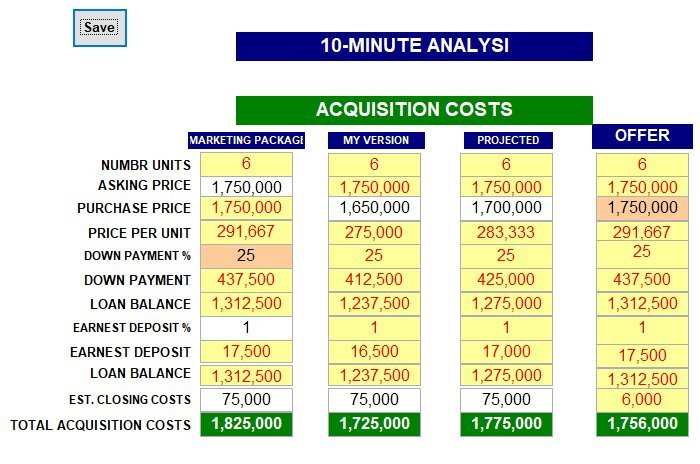
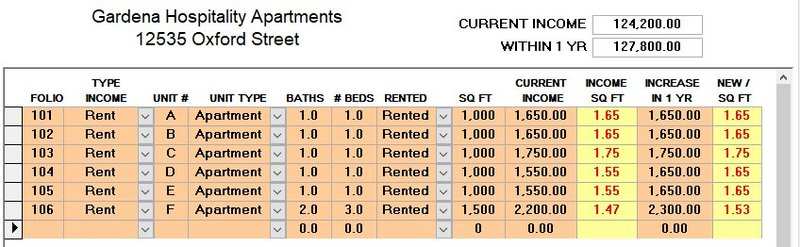
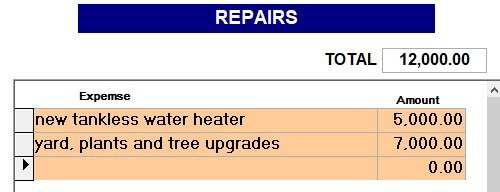
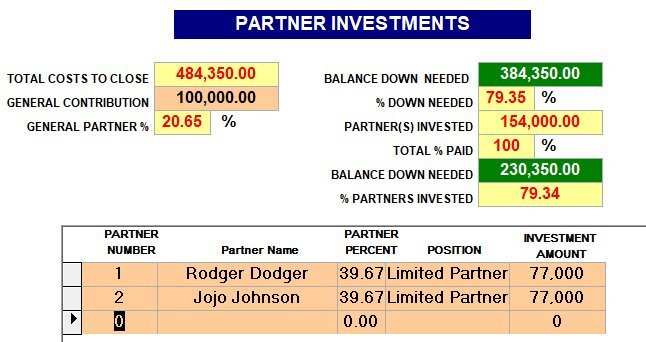
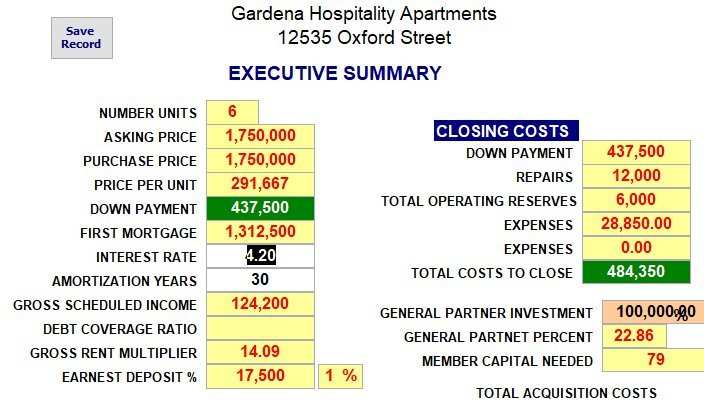
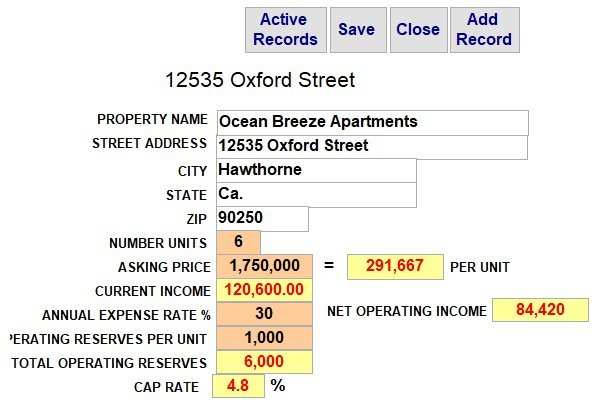
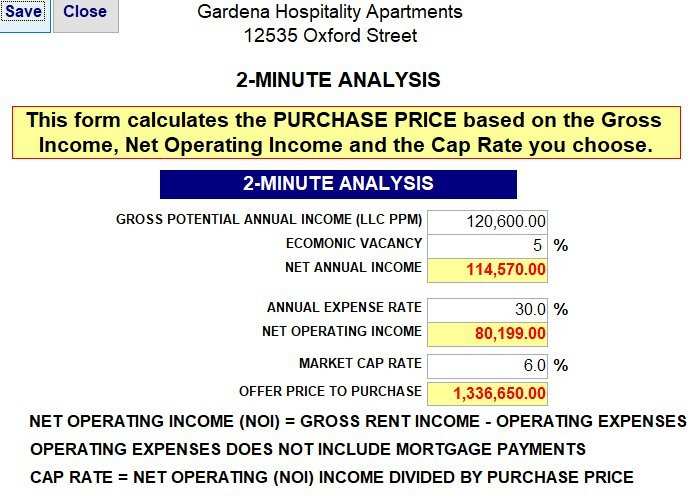
    I've been developing a software program for analyzing all types of real estate deals and have been working heavily on the syndicating section. If anyone would like a free copy, or to help develop I can always use some help. Last week, I purchased a software online and it ended up being a spread sheet that is too difficult to use. Attached, are some screenshots for what I am working on.
  • Member since 2020 · 984 posts · 1k+ votes
    4y

    The way I set the software up is so to analyze a property you only need to enter information in the tan colored fields. When you get a prospectus for a property you need to do the side-by-side column to check the broker's numbers, enter your own default numbers and compare. Then, for the 3rd column, you project what your pffer and the last column is for what you actually pay. The property in the example is for the property my son purchased in March 2021 after he sold his 5 Las Vegas homes.

    I also sold all my homes in Las Vegas and am super happy I don't have to deal with the out-of-my-area contractors, tenant problems, management company problems and many other things. Now, since properties are so expensive in California I am going back to syndicating. I was syndicating back in 1980 and stopped because I was too business with my construction business.

  • Real Estate Syndicator · Milwaukee, WI · Member since 2018 · 1k+ posts · 907 votes
    4y

    I'd say the fees are slightly higher than the industry average. I usually see at least 15% IRR on the hurdle but I'd assume the operator is very experienced if they are commanding these fees..which usually makes up for it.

  • Rental Property Investor · St. Paul, MN · Member since 2016 · 3k+ posts · 3k+ votes
    4y

    I'd say the accumulation of all of those fees is what makes it excessive. Also, typically the AM fee is 1-3% of the collected revenue. If this is a fund, then it's often a percentage of the money raised, but 1% is high. I am also not a fan of a disposition fee - especially as much as 1%

  • Paul MoorePro Member
    Commercial Real Estate Fund Manager · Lynchburg, VA · Member since 2015 · 1k+ posts · 1k+ votes
    4y

    @DongHui Patel. Great question.  I’m not going to directly address the question because the answer depends on the track record, team, and projected profitability of the syndicator in part. (For example, if they could predictably produce 30% annual returns with low risk, many would be happy to invest.) 


    But I am going to potentially ruin someone’s day if you haven’t thought of this…


    Let's just look at the acquisition fee and the liquidation fee and let's round those 4% total. That doesn't seem horrible until you look at what it really cost you as the equity investor: assuming a constant loan to value ratio of 70%, the cost to you is about 13% of your equity. That is 4% / (1 minus LTV (0.7)) = 13%+. And the syndicator will get that whether they perform well or horribly, assuming they don't lose it back to the bank of course.

    So I ask everyone… Does this seem like a high fee to you now?  Would you pay 13% to your stock broker to enter and exit a trade?  

  • Specialist · Austin, TX · Member since 2017 · 137 posts · 109 votes
    4y

    @Paul Moore notes an item overlooked by some.  "Let's just look at the acquisition fee and the liquidation fee and let's round those 4% total. That doesn't seem horrible until you look at what it really cost you as the equity investor: assuming a constant loan to value ratio of 70%, the cost to you is about 13% of your equity. That is 4% / (1 minus LTV (0.7)) = 13%+. And the syndicator will get that whether they perform well or horribly, assuming they don't lose it back to the bank of course.

    So I ask everyone… Does this seem like a high fee to you now? Would you pay 13% to your stock broker to enter and exit a trade?"

    +1 on that. 

    Some deals can be setup with potentially disparate comprehensive risk to LP vs GP. The facts are somewhere in the PPM, OA, SA docs written by a legal team whose job is to first protect the GP interest. Read them closely. Sadly some only read them when the tide goes out and boats are already grounded.

  • Member since 2021 · 95 posts · 30 votes
    4y
    Originally posted by @Ariel K.:

    @DongHui Patel one thing to think about is the syndicator has to outlay money up front as well - inspections, attorneys, loan fees, travel fees to the property. They aren’t asking for reimbursement there - it’s contained in the acquisition fee. One other thing is your syndicator needs money personally for food, rent, etc so he/she can run the property efficiently. Not sure if it’s “fair”, but something to consider.

    I think youre not seeing the magnitude of this. a $60M acquisition at 3% fees would be = $1.8M. $1.8M!!!!

    What kind of upfront fees are being fronted that equate to $1.8M. That is rhetorical You can itemize the actual fees and they would be under $200k. So again, there is $1.6M upside here for no reason. This is money in their pocket, at the BEGINNING OF THE DEAL, and they keep it WHETHER THEY PERFORM OR NOT! 

  • TX · Member since 2018 · 154 posts · 92 votes
    4y

    @DongHui Patel I am not a syndicator, so take this with a grain of salt…if you are doing a $60 million acquisition, inspections alone could be $200k. You have to hire someone to raise money, attorneys for PPMs, loan costs - good luck doing that for $200k

  • Investor · Newport Beach, CA · Member since 2019 · 190 posts · 176 votes
    4y

    We're in a high fee environment right now and even taking that into consideration, these fees are high.  Maybe I'm misreading, but no initial hurdle?  Just 70/30 out of the gate... after a 2.95% acq fee?

    It's also important to know the expected hold period, especially as it relates to the acq fee.  A 3% acq fee is a whole lot material on a 3 year hold than it is on a 10 year hold.

  • Rental Property Investor · Austin, TX · Member since 2021 · 9 posts · 2 votes
    4y

    Summary:  some of these fees seems high but others are close to standard.

    Typically we have a 1% acquisition fee for deals >$30M and 1.5% - 2% for those < $30M. Asset management fee is 1% of the gross monthly receipts for the GP team to manage the 3rd party property management company (typically 3% - 4% fee of gross receipts for these bigger deals). We don't charge the disposition fee or a equity fee raise. We start at 70/30 split and keep that through the whole investment without a change upon hittting a specific IRR or total return.

  • Rental Property Investor · Phoenix/Lima, Arizona/OH · Member since 2012 · 4k+ posts · 4k+ votes
    4y
    Originally posted by @Nick B.:

    @Charles Seaman, they can charge what they want but I find this fee to be unfair. 

    In the beginning of my career, I used to think the same way, and on the first couple of syndications, I pegged asset management fees to revenue. However, then reality happened and caused me to rethink this approach. 

    This asset management fee pays for what? For asset management, which means it basically pays for operations overhead, salaries, software, etc. 

    Well, when things are running well, no one cares. But, when things turn sideways, you realize in a hurry that you wish you had more budget to hire more people, better people, more software, etc. When the revenue comes down, the last thing you want to be is hamstrung on the money you can throw at the issue. This is very similar to having reserves.

    Granted, WhiteHaven may well be one of the more expensive sponsors out there. But, what we do is hard and very dynamic, and I wouldn't do it without being able to make plenty of money for myself and have plenty more for operations. I pay my office staff well, and I pay my construction guys more than most, which is why things run like they should and investors make money, which is the whole point.

  • Developer · Houston, TX · Member since 2017 · 161 posts · 134 votes
    4y
    Originally posted by @DongHui Patel:
    • Acquisition fee 2.95% of purchase price of asset
    • Disposition fee 1% of sale price of asset
    • Asset management fee: 1% of equity raised
    • Fund admin fee: .25% of equity raise

    Their waterfall is 70/30 split until 13% IRR then 50/50

    This deal is a PASS! This entire deal screams of money grab. What size deal is this? 

  • Developer · Houston, TX · Member since 2017 · 161 posts · 134 votes
    4y
    Originally posted by @DongHui Patel:
    Originally posted by @Ariel K.:

    @DongHui Patel one thing to think about is the syndicator has to outlay money up front as well - inspections, attorneys, loan fees, travel fees to the property. They aren’t asking for reimbursement there - it’s contained in the acquisition fee. One other thing is your syndicator needs money personally for food, rent, etc so he/she can run the property efficiently. Not sure if it’s “fair”, but something to consider.

    I think youre not seeing the magnitude of this. a $60M acquisition at 3% fees would be = $1.8M. $1.8M!!!!

    What kind of upfront fees are being fronted that equate to $1.8M. That is rhetorical You can itemize the actual fees and they would be under $200k. So again, there is $1.6M upside here for no reason. This is money in their pocket, at the BEGINNING OF THE DEAL, and they keep it WHETHER THEY PERFORM OR NOT! 

    Is this deal called the waterleaf? I reviewed it recently on our Analysis breakdown. Should be airing soon. Sponsor doesn't actually disclose the fees in their Investor pkg but make you dig it up in the PPM. not very transparent. 

    High fees are a tell tale sign for inexperienced operators since experienced operators would know the deal could not support that level of combined fees. Their underwriting and assumptions are too aggressive and thus they believe they have a unicorn when its really a donkey. 

     Be careful 

  • Member since 2021 · 95 posts · 30 votes
    4y
    Originally posted by @Joseph Bramante:
    Originally posted by @DongHui Patel:
    Originally posted by @Ariel K.:

    @DongHui Patel one thing to think about is the syndicator has to outlay money up front as well - inspections, attorneys, loan fees, travel fees to the property. They aren’t asking for reimbursement there - it’s contained in the acquisition fee. One other thing is your syndicator needs money personally for food, rent, etc so he/she can run the property efficiently. Not sure if it’s “fair”, but something to consider.

    I think youre not seeing the magnitude of this. a $60M acquisition at 3% fees would be = $1.8M. $1.8M!!!!

    What kind of upfront fees are being fronted that equate to $1.8M. That is rhetorical You can itemize the actual fees and they would be under $200k. So again, there is $1.6M upside here for no reason. This is money in their pocket, at the BEGINNING OF THE DEAL, and they keep it WHETHER THEY PERFORM OR NOT! 

    Is this deal called the waterleaf? I reviewed it recently on our Analysis breakdown. Should be airing soon. Sponsor doesn't actually disclose the fees in their Investor pkg but make you dig it up in the PPM. not very transparent. 

    High fees are a tell tale sign for inexperienced operators since experienced operators would know the deal could not support that level of combined fees. Their underwriting and assumptions are too aggressive and thus they believe they have a unicorn when its really a donkey. 

     Be careful 

     Not Waterleaf but If you would like to DM me I can chat thru it with you

Join the conversationCreate a free account to reply, vote on answers and follow this thread.