I am interested in hearing thoughts from the BP Community for the best approach to taking the next steps in my REI pursuit. To set the stage, I am currently active duty military with a family. I currently own two properties, one I live in and one is a rental. I am looking to use the equity in my rental to purchase another investment property and continue to scale my portfolio.
The rental was bought in the summer of 2020 and has been rented for over 4 years by the same tenants. I currently make about $750 a month in cash flow after expenses (I am using a local property manager). I just resigned the lease this past spring and it is set for two years. The mortgage is a VA Loan with a rate below 3%. According to the many real estate platforms the value of the property is anywhere from $365k-$374k in value, giving me about $160k in equity if 100% LTV. Due to the rate and my love of the location, this property is a long-term hold for me as I could see my family using it in retirement.
My initial thoughts are either a HELOC of Home Equity Loan. I prefer the HELOC simply because it gives me more flexibility in my search before I have to begin paying back the note. I do understand that I am siding with a variable rate versus fixed rate when choosing the HELOC over the loan. Where my roadblock comes is that I have read on this forum a number of times that using a HELOC for a down payment can quickly over lever a person and that is something I don't want to do.
I have thought about DSCR loans, house hacking, BRRR (I love the idea but not so sure the wife would love it with the construction, especially if it is a house hack as well), and a few other methods of acquiring my next property.
Getting past the method of utilization of the equity in the rental is the first hurdle I would like to figure out how to solve with everyone’s help. Once that is done, I would love to continue the conversation for the remaining steps.
I appreciate any feedback you can offer. Thank you!
@Chris Berezansky you'll be hard pressed to find a lender/bank/credit union willing to HELOC lend more than 65% of the total loan amount on a rental.
If value = $375k x 65% = $243,750 MAX TOTAL LOANS.
You state you have $160k equity, so if we base that off the $375k estimated value => $215k current loan balance.
$243,750 - $215k => $28,750 MAX HELOC amount
A total refinance would typically allow you to access 70-75% of the property value. So, another $37k roughly.
Where investors get into trouble in your case is what happens when both rentals are vacant for 2-3 months and need $5k+ repairs each to be RentReady?
Lack of reserves can lead to financial ruin.
MIchael,
I appreciate the candid feedback. What would you see as an alternative to accessing the equity besides a HELOC? I shy away from a refi simply because of how low my rate is and knowing I may never see that low of a rate in my lifetime.
Overall, it sounds like building up cash from rental income may be the only option.
I am interested in hearing thoughts from the BP Community for the best approach to taking the next steps in my REI pursuit. To set the stage, I am currently active duty military with a family. I currently own two properties, one I live in and one is a rental. I am looking to use the equity in my rental to purchase another investment property and continue to scale my portfolio.
The rental was bought in the summer of 2020 and has been rented for over 4 years by the same tenants. I currently make about $750 a month in cash flow after expenses (I am using a local property manager). I just resigned the lease this past spring and it is set for two years. The mortgage is a VA Loan with a rate below 3%. According to the many real estate platforms the value of the property is anywhere from $365k-$374k in value, giving me about $160k in equity if 100% LTV. Due to the rate and my love of the location, this property is a long-term hold for me as I could see my family using it in retirement.
My initial thoughts are either a HELOC of Home Equity Loan. I prefer the HELOC simply because it gives me more flexibility in my search before I have to begin paying back the note. I do understand that I am siding with a variable rate versus fixed rate when choosing the HELOC over the loan. Where my roadblock comes is that I have read on this forum a number of times that using a HELOC for a down payment can quickly over lever a person and that is something I don't want to do.
I have thought about DSCR loans, house hacking, BRRR (I love the idea but not so sure the wife would love it with the construction, especially if it is a house hack as well), and a few other methods of acquiring my next property.
Getting past the method of utilization of the equity in the rental is the first hurdle I would like to figure out how to solve with everyone’s help. Once that is done, I would love to continue the conversation for the remaining steps.
I appreciate any feedback you can offer. Thank you!
You’ve set yourself up well—low-rate VA loan, solid long-term hold, and steady cash flow from a reliable tenant. That’s a great base to grow from. A HELOC can give you flexibility, but you’re right to be cautious about over-leverage, especially in a variable-rate environment. One thing I recommend is stress-testing the numbers: if rates bump up a couple points or if it takes longer to find the next property, would cash flow still hold? DSCR loans are solid for scaling once you’re comfortable with your equity play, and house hacking can be powerful (though timing and family dynamics matter). The main thing is aligning your financing choice with your risk tolerance and long-term plan—especially since you see the current property as a retirement option.
You asked a simple question, but there’s no simple answer. Here are a few things I’d consider:
If you refinance your rental, your rate will likely jump to around 6.5% or higher. That would probably wipe out your cash flow, and for me, it would be tough to give up such a low interest rate.
If you go the HELOC route, you're right that it's a floating rate loan. Some lenders do offer fixed terms for five to seven years, which could buy you enough time to refinance if and when rates come down.
House hacking is probably the lowest risk option, though it may take time for you to build up down payment if you can't use another 0% down VA loan. This would be a trade off between time and money.
The bigger question is whether continuing to hold the property or buying more properties in the same area makes sense. That depends on your long-term goals. If financial independence is the objective, then the income from your rentals has to meet certain requirements:
Rents and prices need to rise faster than inflation.
Operating costs must stay low. The two biggest costs investors face are property taxes and insurance. For example, I own two homes of similar value, one in Las Vegas and one in Austin. In Las Vegas, I pay about $2,200 a year in property taxes. In Austin, the taxes are over $10,000 a year, and the rent per square foot in Vegas is actually higher than in Austin.
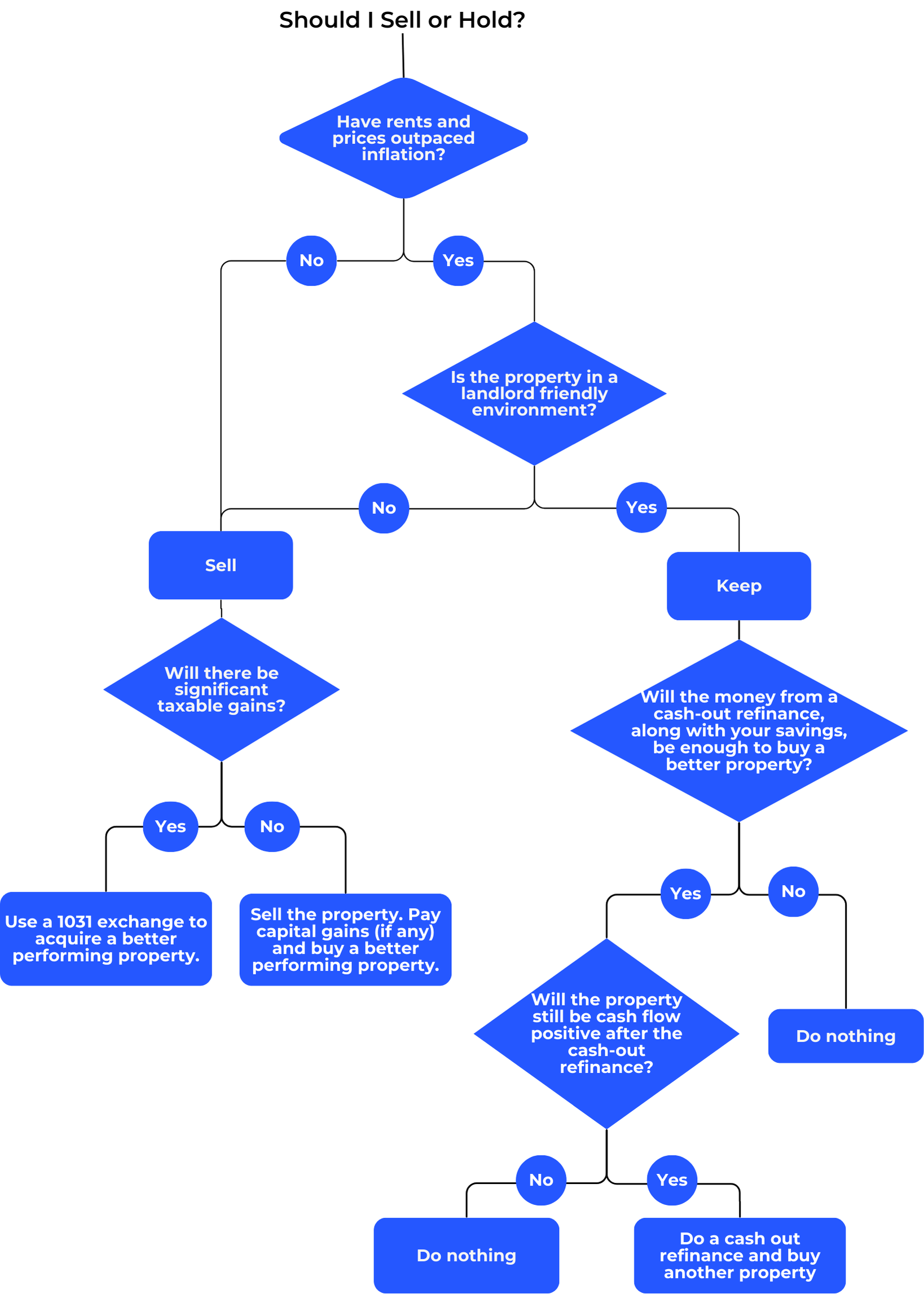
I created this decision tree to help investors think through whether to refinance, hold, or sell:
In my view, there’s more to consider than just interest rates. To live on rental income in the future, you need rents that consistently grow faster than inflation. If they don’t, then no matter how many properties you own, it won’t add up to sustainable financial independence.
You asked a simple question, but there’s no simple answer. Here are a few things I’d consider:
If you refinance your rental, your rate will likely jump to around 6.5% or higher. That would probably wipe out your cash flow, and for me, it would be tough to give up such a low interest rate.
If you go the HELOC route, you're right that it's a floating rate loan. Some lenders do offer fixed terms for five to seven years, which could buy you enough time to refinance if and when rates come down.
House hacking is probably the lowest risk option, though it may take time for you to build up down payment if you can't use another 0% down VA loan. This would be a trade off between time and money.
The bigger question is whether continuing to hold the property or buying more properties in the same area makes sense. That depends on your long-term goals. If financial independence is the objective, then the income from your rentals has to meet certain requirements:
Rents and prices need to rise faster than inflation.
Operating costs must stay low. The two biggest costs investors face are property taxes and insurance. For example, I own two homes of similar value, one in Las Vegas and one in Austin. In Las Vegas, I pay about $2,200 a year in property taxes. In Austin, the taxes are over $10,000 a year, and the rent per square foot in Vegas is actually higher than in Austin.
I created this decision tree to help investors think through whether to refinance, hold, or sell:
In my view, there’s more to consider than just interest rates. To live on rental income in the future, you need rents that consistently grow faster than inflation. If they don’t, then no matter how many properties you own, it won’t add up to sustainable financial independence.
Eric,
Thank you for your feedback. Your flow chart is also super useful.
I have a follow-up a couple questions regarding your point about operating costs, rents, prices, and inflation.
1. Regarding your first block in the flow chart, what data points do you use or find helpful to determine the inflation comparison? Is there a specific threshold for rate-of-change in that relationship that will cause you to change your keep vs. hold stance?
2. I have heard recently on the BP podcast that buying new builds has become more logical from a number's stance recently. From your general perspective, how might this approach play out with house hacking?
3. What were some of your decision points that you encountered when investing out of state? I see this as my most likely move, but finding a starting point (realtor, property type, contractor, location of property, etc.) without wasting the time of someone is something I don't want to do. Having a 70% plan from general research before contacting folks locally is where I would ideally like to be.
You asked a simple question, but there’s no simple answer. Here are a few things I’d consider:
If you refinance your rental, your rate will likely jump to around 6.5% or higher. That would probably wipe out your cash flow, and for me, it would be tough to give up such a low interest rate.
If you go the HELOC route, you're right that it's a floating rate loan. Some lenders do offer fixed terms for five to seven years, which could buy you enough time to refinance if and when rates come down.
House hacking is probably the lowest risk option, though it may take time for you to build up down payment if you can't use another 0% down VA loan. This would be a trade off between time and money.
The bigger question is whether continuing to hold the property or buying more properties in the same area makes sense. That depends on your long-term goals. If financial independence is the objective, then the income from your rentals has to meet certain requirements:
Rents and prices need to rise faster than inflation.
Operating costs must stay low. The two biggest costs investors face are property taxes and insurance. For example, I own two homes of similar value, one in Las Vegas and one in Austin. In Las Vegas, I pay about $2,200 a year in property taxes. In Austin, the taxes are over $10,000 a year, and the rent per square foot in Vegas is actually higher than in Austin.
I created this decision tree to help investors think through whether to refinance, hold, or sell:
In my view, there’s more to consider than just interest rates. To live on rental income in the future, you need rents that consistently grow faster than inflation. If they don’t, then no matter how many properties you own, it won’t add up to sustainable financial independence.
Eric,
Thank you for your feedback. Your flow chart is also super useful.
I have a follow-up a couple questions regarding your point about operating costs, rents, prices, and inflation.
1. Regarding your first block in the flow chart, what data points do you use or find helpful to determine the inflation comparison? Is there a specific threshold for rate-of-change in that relationship that will cause you to change your keep vs. hold stance?
2. I have heard recently on the BP podcast that buying new builds has become more logical from a number's stance recently. From your general perspective, how might this approach play out with house hacking?
3. What were some of your decision points that you encountered when investing out of state? I see this as my most likely move, but finding a starting point (realtor, property type, contractor, location of property, etc.) without wasting the time of someone is something I don't want to do. Having a 70% plan from general research before contacting folks locally is where I would ideally like to be.
Thanks again for your feedback.
-Chris
Hello Chris,
Great questions.
1. Inflation and buying power
Over the past five years, the average annual inflation rate in the U.S. has been around 5% (2021–2024). (Source)
If rent growth hasn’t outpaced inflation, your real buying power has declined even though rent increased.
For example, suppose your rent is $1,000 per month, inflation averages 5% per year, and rent growth averages 3% per year. After five years, your rent would rise to about $1,159, but that $1,159 would only buy what $908 buys today.
Formula:$1,000 × (1 + 3%)^5 ÷ (1 + 5%)^5 ≈ $908
So even though your rent went up, your buying power went down.
2. New construction
The main advantage of new construction is lower maintenance costs in the early years. Beyond that, I don’t see much of a benefit.
Rather than choosing a property based on others’ opinions or hope, start by identifying a tenant segment with a strong record of long-term, on-time payers. Once you know who they are, find out what and where they’re renting today, then buy similar properties. This approach nearly eliminates property selection risk.
3. Out-of-state investing
What were some of the decision points you considered when investing out of state?
To achieve long-term financial independence, rent growth must exceed inflation, and the income must be sustainable over your lifetime. The odds of living in a city that meets all those conditions are slim, so look for markets that do.
Here are the key requirements for an investment city:
Metro population over 1 million: Larger metros are less dependent on a single employer or industry. Wikipedia
Strong, sustained population growth: Demand drives prices and rents, and demand follows population growth. Wikipedia
No rent control: Rent control limits your ability to raise rents with inflation and can restrict your property manager’s tenant selection. Avoid any market with rent control.
Low operating costs: What matters is what you keep, not what you gross. The biggest variables are property taxes and insurance.
Low natural disaster risk: Disasters can destroy not only properties but entire local economies. Insurance may cover rebuilding, but communities can take years to recover. High homeowners insurance rates are often a warning sign.
Chris, with the right local investment team, it makes no difference whether you buy next door or across the country. Of the 170+ clients we’ve worked with, fewer than ten were local. The rest live in other states or countries. Remote investing works—if you work with an experienced, trustworthy local team.
Investor · VA · Member since 2015 · 21k+ posts · 19k+ votes
1y
@Matt F. no lender is going to give a second position loan up to 100% equity that is the problem realistically they're only going to be able to take 25 to 30,000 of that equity which most likely is not gonna get them very far
I am interested in hearing thoughts from the BP Community for the best approach to taking the next steps in my REI pursuit. To set the stage, I am currently active duty military with a family. I currently own two properties, one I live in and one is a rental. I am looking to use the equity in my rental to purchase another investment property and continue to scale my portfolio.
The rental was bought in the summer of 2020 and has been rented for over 4 years by the same tenants. I currently make about $750 a month in cash flow after expenses (I am using a local property manager). I just resigned the lease this past spring and it is set for two years. The mortgage is a VA Loan with a rate below 3%. According to the many real estate platforms the value of the property is anywhere from $365k-$374k in value, giving me about $160k in equity if 100% LTV. Due to the rate and my love of the location, this property is a long-term hold for me as I could see my family using it in retirement.
My initial thoughts are either a HELOC of Home Equity Loan. I prefer the HELOC simply because it gives me more flexibility in my search before I have to begin paying back the note. I do understand that I am siding with a variable rate versus fixed rate when choosing the HELOC over the loan. Where my roadblock comes is that I have read on this forum a number of times that using a HELOC for a down payment can quickly over lever a person and that is something I don't want to do.
I have thought about DSCR loans, house hacking, BRRR (I love the idea but not so sure the wife would love it with the construction, especially if it is a house hack as well), and a few other methods of acquiring my next property.
Getting past the method of utilization of the equity in the rental is the first hurdle I would like to figure out how to solve with everyone’s help. Once that is done, I would love to continue the conversation for the remaining steps.
I appreciate any feedback you can offer. Thank you!
Hey Chris, first off thank you for your service and it sounds like you've set yourself up with a really strong foundation between your low interest VA loan and solid cash flow. Tapping into that equity through a HELOC can be a smart move, especially since it gives you flexibility to shop around before taking on any actual debt, and a lot of investors use it to fund down payments or even full purchases without touching their primary financing. The key is making sure the numbers on your next deal are strong enough to comfortably cover the HELOC payments and still cash flow so you're not overleveraging. I moved from Portland to Columbus, Ohio in 2020 and built a 10+ rental portfolio, and I've seen a lot of investors successfully use equity lines to scale here because the market is still affordable and you can find solid properties in the $120–180k range that hit the 1% rule and cash flow from day one. Plus, the macro picture here is strong with big job growth and companies like Intel, Amazon, Google, Honda, Microsoft, and more expanding here. HELOCs can be a great tool if you stay disciplined with how you deploy the capital and make sure the next property pays for itself and the debt you're taking on. Happy to connect and answer any questions you have!
Nashville · Member since 2019 · 10 posts · 3 votes
8mo
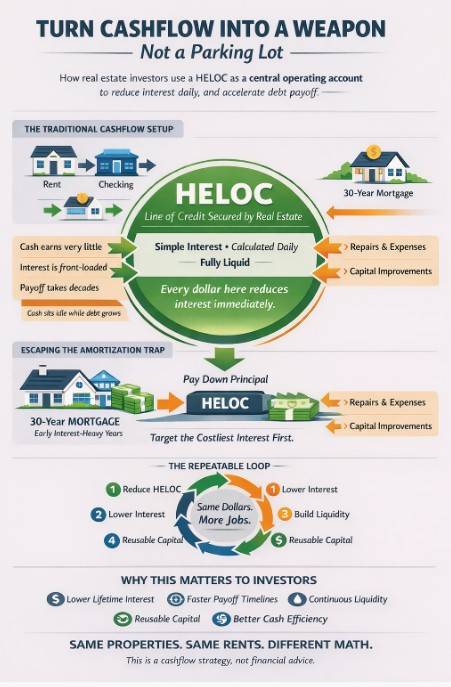
Chris, You're making good cash flow on the property so dipping into it by getting a HELOC to acquire capital takes asking more questions. Are you happy with the appreciation of the property and are you making good progress on principal reduction of your current first mortgage. All three items, cashflow, appreciation, PR = IRR. As a lender, I can go to 80% on an investor HELOC if you're looking to scale. Happy to jump on a call! I coach investors on proper use of a HELOC. Attached is an illustration.