19 yr old: What is wrong with my ROI calculations 55-100% ROI/yr?

19 yr old: What is wrong with my ROI calculations 55-100% ROI/yr?

Wholesaler · Calgary, Alberta · Member since 2020 · 44 posts · 1 vote

First off for some reference before you get into the Example: As you know there are at least 5 different possible "sources" of income when buying any kind of Apartment, multi family or single family real estate deal. 

3 of them are recurring and passive profit each year #1 Cash flow, #2 Principal paydown ,#3 Appreciation. 

The other 2 are not recurring and not passive #4 Bought Below Market Value , #5 Other Value Adds (Not Renovations).

Now this example is just laying out what based on my knowledge, how much each one of these "sources" of income have the possibility to return.

I.e #1 Cash flow, it is a very known fact that you can get 7%-10% ROI I.e 7-10 CAPs. Therefore I know I am 100% right with how much ROI Cash Flow can bring in (7-10%/yr ROI).

Now, what are the known ROI's for the other 4 "sources" of income? This is what I am trying to find out for certain.

What do you think about the possible ROIs I suggest in my example, because to my knowledge they are all very possible, and some if not all are even somewhat conservative.


Ex: Purchase Price: 75-100 unit @$4m PP, $1m down

ACCURATE CONSERVATIVE RETURN NUMBERS FOR APARTMENTS (Can apply to Single and Multi Family as well):

Income #1)Cash flow:@7%-10% ROI =$5.8k-$8.3k/month =$70k-$100k/year

Income #2)Principal Pay Down: @33% minimum of $3m-$4m mortgage ($15k/month mortgage) =$60k/year

Income #3)Appreciation: @2% of $4m PP =$80k, @3% =$120k, @4% =$160k

Income #4)Bought Below Market Value: @5% of $4m PP =$200k, @7.5% =$300k, @10% =$400k

Income #5)Other Value Adds (Not Renovations): @2% of $4m PP =$80k, @3.5% =$140k, @4.5% =$180k, 7% =$280k

Total Yearly Reoccurring ROI On $1m:

1)Cash flow =7%-10% ROI

2)Principal Pay Down = 6% ROI

3)Appreciation =8%-16% ROI

Total =21%-32% Yearly Recurring ROI ($210-$310k On The $1m Down)

Total One Time Only ROI:

4)Bought Below market Value =20%-40% ROI (@5%-10% Below)

Total =45%-72% ROI ($450k-$720k On the $1m Down)

5)Other Value Adds =10%-28% ROI (@2.5%-7% Value Add)

Over All Total ROI =55%-100% ROI ($550k-$1m On the $1m Down)


#1 is 100% possible 

#2 is also 100% possible

#3 is also 100% possible when talking long term and not being stupid/bad

and so are #4 and #5 honestly as far as my knowledge goes, just seems way to good to be true ofc.

As well as basically no taxes paid on all of it... (Property tax write offs alone =$70k/year, and cash flow is the only taxed income when doing everything properly so the $6.7k-$8.3k/month Taxable Cash flow = basically 0 taxes paid with just ONE right off/tax savings method)
0Reply
24 views

9 Replies

Jump to latestLatest
  • Investor · Huntsville, AL · Member since 2020 · 30 posts · 21 votes
    6y

    I think you're confusing Cash Flow with NOI.

  • Investor · Huntsville, AL · Member since 2020 · 30 posts · 21 votes
    6y

    You're also neglecting repairs, managment, capex, vacancy, insurance, property taxes, etc. 

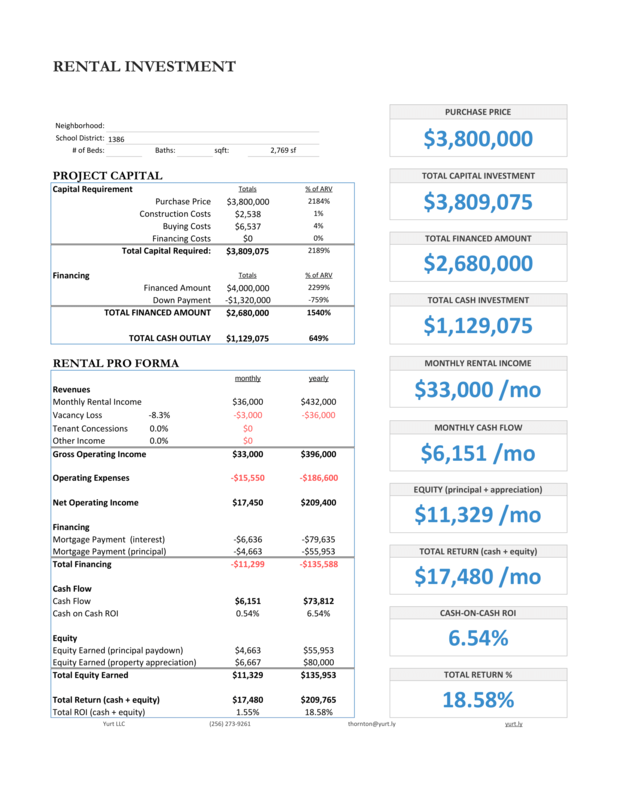
    I generated a sample report based off the lowest numbers you offered in your example. You're calculating "cash flow" in a weird way. Come up with the $ figure you expect to get in rent then subtract all expenses. Calculating cash flow by a % is weird.

  • Wholesaler · Calgary, Alberta · Member since 2020 · 44 posts · 1 vote
    6y

    @Thornton D.

    I just did it that way/converted it so it would fit into my example in a basic way... Anything can be shown in any kind of conversion and it is still correct/a equivalent.  

  • Wholesaler · Calgary, Alberta · Member since 2020 · 44 posts · 1 vote
    6y

    @Thornton D.

    Also no I am not neglecting any of that, that falls under your cash flow. 

    Your Cash Flow is expenses minus rental income and expenses with a true net cash flow covers everything. Cash flow IS NOI...

  • Wholesaler · Calgary, Alberta · Member since 2020 · 44 posts · 1 vote
    6y

    @Thornton D.

    And regardless, it could be 3-5% ROI and it would not change anything basically, the returns I am showing add up to be insane amounts, clearly.

  • Member since 2019 · 1 post · 0 votes
    6y

    @Thornton Drury I really like that P&L you shared, would you be able to share a blank (or dummy data) editable version so that I could see how you've calculated some of the fields?

  • Investor · Huntsville, AL · Member since 2020 · 30 posts · 21 votes
    6y

    @Colston Bowler Its the one from https://www.houseflippingsprea.. 

    Its got SOOOOO much more than just that report you see there. Worth EVERY PENNY.

  • Member since 2020 · 217 posts · 167 votes
    6y

    Devon,

    Unless you're one heck of an unusual and experienced investor that wants to mess with apartments I could argue to stick with a single family home. Now, I'm not an expert on the investing in Canada, but have enough Canadian friend to know it's similar to the US.

    And if you had a million dollars you'd be MUCH better off with houses, for a number of reasons.

    However, if you're just putting this deal together, selling the purchase contract and can take a small percentage like 2 or 3% and never do another thing, great. And very commendable if you can do that... certainly possible.

    Keep us posted.

  • Investor · Toronto, Ontario · Member since 2016 · 50 posts · 15 votes
    5y

    I did a video on getting down to your NOI

    after that (to get to cashflow) you need to subtract your debt service and capex reserves (I subscribe to capex being 'below the line'...a good explanation here: 

    CCIM courses on commercial real estate, and in our software, is to put the reserves below the NOI – in other words, not to treat reserves as having any effect on the Net Operating Income.

    This makes sense, I believe, for a number of reasons. First, NOI by definition is equal to revenue minus operating expenses, and it would be a stretch to classify reserves as an operating expense. Operating expenses are costs incurred in the day-to-day operation of a property, costs such as property taxes, insurance, and maintenance. Reserves don't fit that description, and in fact would not be treated as a deductible expense on your taxes.

    Perhaps even more telling is the fact that we expect the money spent on an expense to leave our possession and be delivered to a third party who is providing some product or service. Funds placed in reserve are not money spent, but rather funds taken out of one pocket and put into another. It is still our money, unspent.

Join the conversationCreate a free account to reply, vote on answers and follow this thread.