Owner-Occupied Duplex Analysis

Owner-Occupied Duplex Analysis

Los Angeles, CA · Member since 2020 · 2 posts · 0 votes

Hey everyone, this is my first post on here, and I was looking at creating a template to analyze owner-occupied duplex properties in Los Angeles. The reason for the analysis is to compare purchasing a SFR vs an owner-occupied duplex, both with conventional financing 80% and 85% leverage, respectively.

I'm having a couple of difficulties in this analysis and wanted to see how most members here tackle some of these questions: I have seen some posters on here note that you should underwrite the duplex as an investment property with both units rented, however, I am having a bit of trouble wrapping this around my head, because I am in fact comparing an SFR to an owner-occupied duplex and not other investment properties, how have some of you approached this and underwriting to an NOI? Any adjustments or tips here?

Also, I did want to factor in non-cash items to get my true ROI figure and had a couple of questions below:

Depreciation - the only use for depreciation here is improvement costs at 27.5 years per year depreciated, then taking 50% of that? The rest of the depreciation as a W2 employee is of no use correct?

Interest expense - when modeling this in, I would take 50% of my interest expense and subtract out of NOI and the remaining interest expense I would be able to model in as a deduction at my marginal tax rate?

Lastly, I know some of these questions are more tax based in nature than real estate and understand it is nuanced. Being in CA, are there any tips or links you might be able to share on some further insight to these questions?

Many thanks for all the help and looking forward to being an active member of this community.

      0Reply
      106 views

      Most Popular Reply

      Basit SiddiqiBusiness Member
      Accountant · New York, NY · Member since 2015 · 8k+ posts · 4k+ votes
      5y

      House hacking makes your tax situation more complex.
      You purchased a property that is treated as both an investment property and a personal residence. As such, payments that you make need to be prorated between business deductions and personal deductions.

      Payments that you make normally fall into one of 3 buckets
      100% of the payment can be factored in somewhere on the return
      Partial payment can be factored somewhere on the return
      0% of the payment can be factored in somewhere on the return

      House-hacking also has considerable tax implications in the event that you want to sell this property.

      You can potentially defer a portion or all of the gain on the investment property with 1031 exclusion.
      You can potentially exclude a portion or all of the gain on the personal residence with section 121 exclusion

      See this reply in the discussion

      8 Replies

      Jump to latestLatest
      • Realtor · Los Angeles, CA · Member since 2018 · 952 posts · 1k+ votes
        5y
        Originally posted by @Armen Haroutunian:

        Hey everyone, this is my first post on here, and I was looking at creating a template to analyze owner-occupied duplex properties in Los Angeles. The reason for the analysis is to compare purchasing a SFR vs an owner-occupied duplex, both with conventional financing 80% and 85% leverage, respectively.

        I'm having a couple of difficulties in this analysis and wanted to see how most members here tackle some of these questions: I have seen some posters on here note that you should underwrite the duplex as an investment property with both units rented, however, I am having a bit of trouble wrapping this around my head, because I am in fact comparing an SFR to an owner-occupied duplex and not other investment properties, how have some of you approached this and underwriting to an NOI? Any adjustments or tips here?

        Also, I did want to factor in non-cash items to get my true ROI figure and had a couple of questions below:

        Depreciation - the only use for depreciation here is improvement costs at 27.5 years per year depreciated, then taking 50% of that? The rest of the depreciation as a W2 employee is of no use correct?

        Interest expense - when modeling this in, I would take 50% of my interest expense and subtract out of NOI and the remaining interest expense I would be able to model in as a deduction at my marginal tax rate?

        Lastly, I know some of these questions are more tax based in nature than real estate and understand it is nuanced. Being in CA, are there any tips or links you might be able to share on some further insight to these questions?

        Many thanks for all the help and looking forward to being an active member of this community.
            Armen,

            I'm a house hacker and realtor who works with house hackers, so your question is right up my alley!

            I built a spreadsheet that analyzes house hack as just that (not as straight investments). Question: in your comparison, is your SFR owner-occupied, or is it a rental?

            Let me answer your questions as best I can:

            As regards depreciation, it doesn't really matter that you're a W2 employee because the depreciation will be taken against your rental income, and then any extra depreciation deductions will be carried forward. If you do straight-line depreciation over 27.5 years, you probably won't be carrying deductions forward.

            In an owner-occupied duplex, you're allowed to depreciate the part of the building that is used as a rental. The calculation is based on square footage, not units. So if you live in a 1000-sq-ft unit and rent a 1200-sq-ft unit, you'd be allowed to depreciate 54.5% of the building.

            Also keep in mind that land value in LA is huge. Building value usually isn't more than 50% of a property's purchase price. At my last primary residence SFR, the land made up 70% of the property's value!

            Regarding interest expense, you are correct, though it's probably better to apportion interest expense by square footage, not just 50/50 between two units. For further questions, you should hire a real-estate-centric CA CPA; I have a great one to recommend!

            All the best,

            Jon

          1. Basit SiddiqiBusiness Member
            Accountant · New York, NY · Member since 2015 · 8k+ posts · 4k+ votes
            5y

            House hacking makes your tax situation more complex.
            You purchased a property that is treated as both an investment property and a personal residence. As such, payments that you make need to be prorated between business deductions and personal deductions.

            Payments that you make normally fall into one of 3 buckets
            100% of the payment can be factored in somewhere on the return
            Partial payment can be factored somewhere on the return
            0% of the payment can be factored in somewhere on the return

            House-hacking also has considerable tax implications in the event that you want to sell this property.

            You can potentially defer a portion or all of the gain on the investment property with 1031 exclusion.
            You can potentially exclude a portion or all of the gain on the personal residence with section 121 exclusion

          2. Los Angeles, CA · Member since 2020 · 2 posts · 0 votes
            5y
            Originally posted by @Jon Schwartz:
            Originally posted by @Armen Haroutunian:

            Hey everyone, this is my first post on here, and I was looking at creating a template to analyze owner-occupied duplex properties in Los Angeles. The reason for the analysis is to compare purchasing a SFR vs an owner-occupied duplex, both with conventional financing 80% and 85% leverage, respectively.

            I'm having a couple of difficulties in this analysis and wanted to see how most members here tackle some of these questions: I have seen some posters on here note that you should underwrite the duplex as an investment property with both units rented, however, I am having a bit of trouble wrapping this around my head, because I am in fact comparing an SFR to an owner-occupied duplex and not other investment properties, how have some of you approached this and underwriting to an NOI? Any adjustments or tips here?

            Also, I did want to factor in non-cash items to get my true ROI figure and had a couple of questions below:

            Depreciation - the only use for depreciation here is improvement costs at 27.5 years per year depreciated, then taking 50% of that? The rest of the depreciation as a W2 employee is of no use correct?

            Interest expense - when modeling this in, I would take 50% of my interest expense and subtract out of NOI and the remaining interest expense I would be able to model in as a deduction at my marginal tax rate?

            Lastly, I know some of these questions are more tax based in nature than real estate and understand it is nuanced. Being in CA, are there any tips or links you might be able to share on some further insight to these questions?

            Many thanks for all the help and looking forward to being an active member of this community.
                Armen,

                I'm a house hacker and realtor who works with house hackers, so your question is right up my alley!

                I built a spreadsheet that analyzes house hack as just that (not as straight investments). Question: in your comparison, is your SFR owner-occupied, or is it a rental?

                Let me answer your questions as best I can:

                As regards depreciation, it doesn't really matter that you're a W2 employee because the depreciation will be taken against your rental income, and then any extra depreciation deductions will be carried forward. If you do straight-line depreciation over 27.5 years, you probably won't be carrying deductions forward.

                In an owner-occupied duplex, you're allowed to depreciate the part of the building that is used as a rental. The calculation is based on square footage, not units. So if you live in a 1000-sq-ft unit and rent a 1200-sq-ft unit, you'd be allowed to depreciate 54.5% of the building.

                Also keep in mind that land value in LA is huge. Building value usually isn't more than 50% of a property's purchase price. At my last primary residence SFR, the land made up 70% of the property's value!

                Regarding interest expense, you are correct, though it's probably better to apportion interest expense by square footage, not just 50/50 between two units. For further questions, you should hire a real-estate-centric CA CPA; I have a great one to recommend!

                All the best,

                Jon

                Hi Jon, thanks for the thorough response and answer to the questions. I am treating the SFR as owner-occupied and not as a rental.

              1. Realtor · Los Angeles, CA · Member since 2018 · 952 posts · 1k+ votes
                5y
                Originally posted by @Armen Haroutunian:
                Originally posted by @Jon Schwartz:
                Originally posted by @Armen Haroutunian:

                Hey everyone, this is my first post on here, and I was looking at creating a template to analyze owner-occupied duplex properties in Los Angeles. The reason for the analysis is to compare purchasing a SFR vs an owner-occupied duplex, both with conventional financing 80% and 85% leverage, respectively.

                I'm having a couple of difficulties in this analysis and wanted to see how most members here tackle some of these questions: I have seen some posters on here note that you should underwrite the duplex as an investment property with both units rented, however, I am having a bit of trouble wrapping this around my head, because I am in fact comparing an SFR to an owner-occupied duplex and not other investment properties, how have some of you approached this and underwriting to an NOI? Any adjustments or tips here?

                Also, I did want to factor in non-cash items to get my true ROI figure and had a couple of questions below:

                Depreciation - the only use for depreciation here is improvement costs at 27.5 years per year depreciated, then taking 50% of that? The rest of the depreciation as a W2 employee is of no use correct?

                Interest expense - when modeling this in, I would take 50% of my interest expense and subtract out of NOI and the remaining interest expense I would be able to model in as a deduction at my marginal tax rate?

                Lastly, I know some of these questions are more tax based in nature than real estate and understand it is nuanced. Being in CA, are there any tips or links you might be able to share on some further insight to these questions?

                Many thanks for all the help and looking forward to being an active member of this community.

                    Armen,

                    I'm a house hacker and realtor who works with house hackers, so your question is right up my alley!

                    I built a spreadsheet that analyzes house hack as just that (not as straight investments). Question: in your comparison, is your SFR owner-occupied, or is it a rental?

                    Let me answer your questions as best I can:

                    As regards depreciation, it doesn't really matter that you're a W2 employee because the depreciation will be taken against your rental income, and then any extra depreciation deductions will be carried forward. If you do straight-line depreciation over 27.5 years, you probably won't be carrying deductions forward.

                    In an owner-occupied duplex, you're allowed to depreciate the part of the building that is used as a rental. The calculation is based on square footage, not units. So if you live in a 1000-sq-ft unit and rent a 1200-sq-ft unit, you'd be allowed to depreciate 54.5% of the building.

                    Also keep in mind that land value in LA is huge. Building value usually isn't more than 50% of a property's purchase price. At my last primary residence SFR, the land made up 70% of the property's value!

                    Regarding interest expense, you are correct, though it's probably better to apportion interest expense by square footage, not just 50/50 between two units. For further questions, you should hire a real-estate-centric CA CPA; I have a great one to recommend!

                    All the best,

                    Jon

                    Hi Jon, thanks for the thorough response and answer to the questions. I am treating the SFR as owner-occupied and not as a rental.

                    Armen,

                    Oh! Then you really shouldn't be looking at the duplex at a straight investment.

                    I house hacked a duplex in Hancock Park last year. My wife, daughter, and I live upstairs, and we found a fantastic couple to rent downstairs.

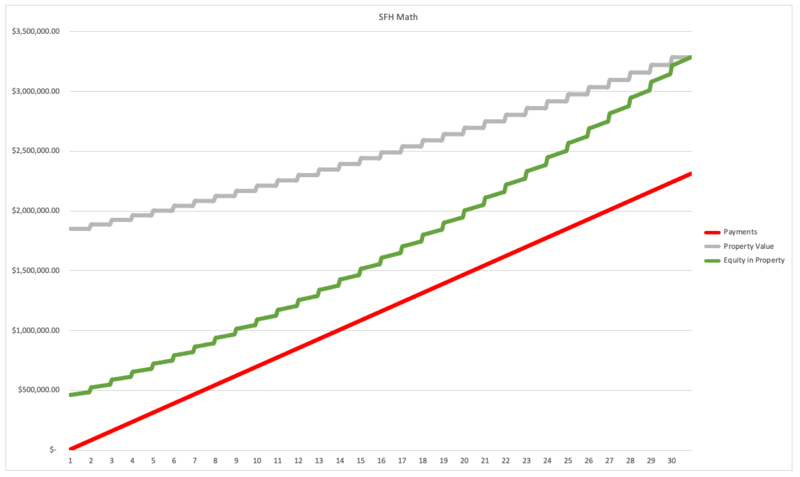
                    My wife was not into this idea at first, and I had to make several charts in Excel to demonstrate to her how advantageous buying an owner-occupied duplex is.

                    What convinced her were the following images. If we bought a house, the longterm cumulative effect looks like this:

                     The grey line is property value, the green line is your equity in the property, and the red line is cumulative payments. This chart assumes 2% annual appreciation.

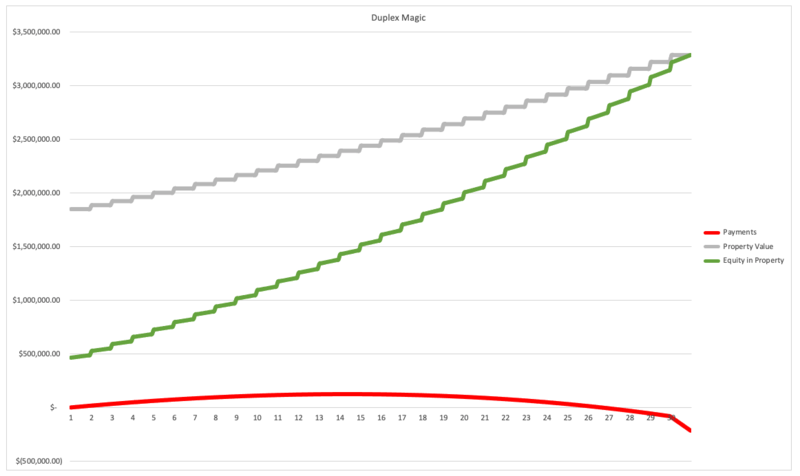
                    Now look at the same values for an owner-occupied duplex:

                    I showed this to my wife, and she said, "Ohhh... now I get it."

                    (The duplex chart assumes 2% annual appreciation and 2% annual rent increases, both super conservative.)

                    This a 20,000-foot analysis, of course. I made a spreadsheet with a much more thorough analysis, which I'll PM you now.

                    All the best,

                    Jon

                  1. New to Real Estate · San Diego · Member since 2018 · 6 posts · 0 votes
                    4y

                    Jon, 

                    Long-time lurker, first-time poster here. Looking at buying my first duplex and live in upstairs in the So-Cal area. With rental rates as they are, my pass has me realizing properties that I initially wasn't sure were viable, very much are. As you already know, there is a lot to consider to really evaluate costs. Been trying to piece it together over the last few days and stumbled around this post. I would love to see the sheet you've used to help guide my own due diligence. If not, I understand - if you have any advice for making sure I'm taking everything into account it would be equally appreciated.

                  2. Los Angeles, CA · Member since 2017 · 1 post · 0 votes
                    4y

                    Hi Joel,

                    I'm a long-time lurker like you and found Jon's House Hack Calculator maybe six months back via this thread and have found it very helpful. Just go to his site, enter your email and a copy of the sheet will be shared with you via Google Drive: http://househack.la/calculator...

                    I ended up taking the calculations from the summary tab and used those to create my own spreadsheet to compare multiple properties at once, since the House Hack Calculator is built for one property at a time.

                    Jon, in case you still check this thread - thank you for making the calculator available! It's a great resource for analyzing deals in an expensive market like LA.

                    Cheers,

                    Patrick

                  3. New to Real Estate · San Diego · Member since 2018 · 6 posts · 0 votes
                    4y

                    Thank you so much Patrick for the quick reply and Jon for creating a tool to save the rest of us a few days in excel!

                  4. Member since 2020 · 12 posts · 4 votes
                    4y

                    Just wanted to thank this thread in general.  Looking at 2 and 3 family buildings in Brooklyn NY, where I would live in one of the units.  Ideally 3 family, so I can eventually takeover another floor, and still have some rental income coming in to offset the note.  Very helpful.  

                  Join the conversationCreate a free account to reply, vote on answers and follow this thread.