When your rental(s) are paid off what to do next?

When your rental(s) are paid off what to do next?

Investor · Member since 2017 · 21 posts · 9 votes

I few more years and a few of my rentals will be paid off.  I was going to use the income as my pension plan, but as I do more research, I was wondering what others do.  Should I....

1.  Do a 1031 exchange and scale higher?

2.  Use the income as a pension, but liability increases if a renter wants to sue.  Should I increase insurance and add an umbrella?

3.  cash out and refi for more properties?  If so, what minimum percentage do you maintain to keep lawyers away.  Ex 1m dollar property and refi just 100k because interest rate may be high like 6.5% etc

4.  any other suggestions

Currently, I haven't paid off the rentals because interest rates are low and money are in equities making 7% or more.  If living off the income should not be an option because of renters possibly suing, I still make money through other investments, SS, dividends etc.

Thanks for looking

2Reply
807 views

Most Popular Reply

Chris SeveneyBusiness Member
Moderator
Investor · VA · Member since 2015 · 21k+ posts · 19k+ votes
1y
Quote from @Mel Rosario:

I few more years and a few of my rentals will be paid off.  I was going to use the income as my pension plan, but as I do more research, I was wondering what others do.  Should I....

1.  Do a 1031 exchange and scale higher?

2.  Use the income as a pension, but liability increases if a renter wants to sue.  Should I increase insurance and add an umbrella?

3.  cash out and refi for more properties?  If so, what minimum percentage do you maintain to keep lawyers away.  Ex 1m dollar property and refi just 100k because interest rate may be high like 6.5% etc

4.  any other suggestions

Currently, I haven't paid off the rentals because interest rates are low and money are in equities making 7% or more.  If living off the income should not be an option because of renters possibly suing, I still make money through other investments, SS, dividends etc.

Thanks for looking


 no right or wrong answer. For #2 I am never concerned about a tenant suing, I have insurance for this and use a property manager. I also do not do anything stupid. 

For the other scenarios, of course the answer is "it depends" but not sure what you mean by keeping lawyers away. I worked for multi-billion dollar real estate investors and they never ran there business based on being scared of being sued, they ran it based on good financial and economic strategies. You seem more worried about being sued more than anything.

7e investments53 Reviews
See this reply in the discussion

34 Replies

Jump to latestLatest
  • Jason WrayPro Member
    Banker · Nationwide · Member since 2020 · 2k+ posts · 1k+ votes
    1y

    Mel,

    My advice since mortgage rates are falling fast go with number #3 and do a cash out refinance it's tax free. You also can get rates lower than 6.50% right now and you can also elect to take a 40 year or I/O interest Only for the first -3 years to help maximize the initial cash flow. Then you can refinance in -3 year and lower the rate or convert to a 30 year term or other ARM product.

    The FED will continue to cut the Rates and mortgage rates are already in the mid to low 6's for investment properties. Primary Homes creeping into the high 5's and soon it will get even better but timing is key. You also want to buy a little quicker because as rates continue to drop we get more buyers to the market. Then we have more Bid's/Offers and some people over bidding to win which then also causes a trend on appraisal value increasing.

    If you ever have ny questions feel free to check out my profile and reach out via message or email.  I am always Networking and helping other BP members avoid lost time and money!

    • V.G JasonPro Member
      Investor · Member since 2022 · 3k+ posts · 3k+ votes
      1y
      Quote from @Jason Wray:

      Mel,

      My advice since mortgage rates are falling fast go with number #3 and do a cash out refinance it's tax free. You also can get rates lower than 6.50% right now and you can also elect to take a 40 year or I/O interest Only for the first -3 years to help maximize the initial cash flow. Then you can refinance in -3 year and lower the rate or convert to a 30 year term or other ARM product.

      The FED will continue to cut the Rates and mortgage rates are already in the mid to low 6's for investment properties. Primary Homes creeping into the high 5's and soon it will get even better but timing is key. You also want to buy a little quicker because as rates continue to drop we get more buyers to the market. Then we have more Bid's/Offers and some people over bidding to win which then also causes a trend on appraisal value increasing.

      If you ever have ny questions feel free to check out my profile and reach out via message or email.  I am always Networking and helping other BP members avoid lost time and money!

      Mortgage rates are up. Who are you trying to fool?

      Fed cutting rates isn't correlated with mortgage rates. 

      Worry about protecting the investment, and re-investing cash flow in other assets OP.


    • Jason WrayPro Member
      Banker · Nationwide · Member since 2020 · 2k+ posts · 1k+ votes
      1y
      Quote from @V.G Jason:
      Quote from @Jason Wray:

      Mel,

      My advice since mortgage rates are falling fast go with number #3 and do a cash out refinance it's tax free. You also can get rates lower than 6.50% right now and you can also elect to take a 40 year or I/O interest Only for the first -3 years to help maximize the initial cash flow. Then you can refinance in -3 year and lower the rate or convert to a 30 year term or other ARM product.

      The FED will continue to cut the Rates and mortgage rates are already in the mid to low 6's for investment properties. Primary Homes creeping into the high 5's and soon it will get even better but timing is key. You also want to buy a little quicker because as rates continue to drop we get more buyers to the market. Then we have more Bid's/Offers and some people over bidding to win which then also causes a trend on appraisal value increasing.

      If you ever have ny questions feel free to check out my profile and reach out via message or email.  I am always Networking and helping other BP members avoid lost time and money!

      Mortgage rates are up. Who are you trying to fool?

      Fed cutting rates isn't correlated with mortgage rates. 

      Worry about protecting the investment, and re-investing cash flow in other assets OP.


      I appreciate your opinion/thoughts but I am a 20 year banker and mortgages rates are Down and will continue to fall over the next 36 months. It's a shame when people who are not in the banking industry make false comments as it really confuses the rest of the people on the forum. If for some reason you wanted to get into the metrics, the mortgage rates are down not just because the FED cut but also the 10 Year treasury is down below 4.09% the lowest since last year in 08/2024 and up over 5.01% earlier 2025.  The 10 Year treasury is a very big contributor to the 30 year mortgage unless we have a Jobs report or CPI index report that interferes including bond/MBS sell offs and auction performance.

      FHA rates are pricing with good credit in the high 5's, VA is pricing good credit around high 5's, Conventional low 6's and DSCR 6.99% points vary on Fico 3YR PPP with 20% Down BPC for single family homes, and DSCR 7.25% LPC with 3 Year PPP.

      FDIC Portfolio also offers 10% for single family investment property purchase with Fico above 700 and rates as low as 7.375%. Now if you say these are high rates you would be speaking in terms of compared to 2021 and 2022. Do not take this email as a battle of the Ego's I am replying so that a BP member reads rates are high and gets in accurate information.

      You can look at any website mortgage news daily, Forbes, Yahoo and they all confirm but again I do this every day and have 20 years in the mortgage/banking industry. So I am not fooling anyone it’s only a fool who gives false information or speaks about a market who is not an expert. I see you are an investor are you referring to commercial, 5+ units, low loan amounts under $100K or someone with bad credit then Yes, the rates can be higher.

      Average person buying a primary home, Vacation home or investment rental 4 units or under rates have vastly improved since 2024. You can verify this by asking ChatGPT or AI but again an expert. I am not interested in butting heads or an Ego battle I merely wanting to correct your last post about me fooling anyone with my post.

    • V.G JasonPro Member
      Investor · Member since 2022 · 3k+ posts · 3k+ votes
      1y
      Quote from @Jason Wray:
      Quote from @V.G Jason:
      Quote from @Jason Wray:

      Mel,

      My advice since mortgage rates are falling fast go with number #3 and do a cash out refinance it's tax free. You also can get rates lower than 6.50% right now and you can also elect to take a 40 year or I/O interest Only for the first -3 years to help maximize the initial cash flow. Then you can refinance in -3 year and lower the rate or convert to a 30 year term or other ARM product.

      The FED will continue to cut the Rates and mortgage rates are already in the mid to low 6's for investment properties. Primary Homes creeping into the high 5's and soon it will get even better but timing is key. You also want to buy a little quicker because as rates continue to drop we get more buyers to the market. Then we have more Bid's/Offers and some people over bidding to win which then also causes a trend on appraisal value increasing.

      If you ever have ny questions feel free to check out my profile and reach out via message or email.  I am always Networking and helping other BP members avoid lost time and money!

      Mortgage rates are up. Who are you trying to fool?

      Fed cutting rates isn't correlated with mortgage rates. 

      Worry about protecting the investment, and re-investing cash flow in other assets OP.


      I appreciate your opinion/thoughts but I am a 20 year banker and mortgages rates are Down and will continue to fall over the next 36 months. It's a shame when people who are not in the banking industry make false comments as it really confuses the rest of the people on the forum. If for some reason you wanted to get into the metrics, the mortgage rates are down not just because the FED cut but also the 10 Year treasury is down below 4.09% the lowest since last year in 08/2024 and up over 5.01% earlier 2025.  The 10 Year treasury is a very big contributor to the 30 year mortgage unless we have a Jobs report or CPI index report that interferes including bond/MBS sell offs and auction performance.

      FHA rates are pricing with good credit in the high 5's, VA is pricing good credit around high 5's, Conventional low 6's and DSCR 6.99% points vary on Fico 3YR PPP with 20% Down BPC for single family homes, and DSCR 7.25% LPC with 3 Year PPP.

      FDIC Portfolio also offers 10% for single family investment property purchase with Fico above 700 and rates as low as 7.375%. Now if you say these are high rates you would be speaking in terms of compared to 2021 and 2022. Do not take this email as a battle of the Ego's I am replying so that a BP member reads rates are high and gets in accurate information.

      You can look at any website mortgage news daily, Forbes, Yahoo and they all confirm but again I do this every day and have 20 years in the mortgage/banking industry. So I am not fooling anyone it’s only a fool who gives false information or speaks about a market who is not an expert. I see you are an investor are you referring to commercial, 5+ units, low loan amounts under $100K or someone with bad credit then Yes, the rates can be higher.

      Average person buying a primary home, Vacation home or investment rental 4 units or under rates have vastly improved since 2024. You can verify this by asking ChatGPT or AI but again an expert. I am not interested in butting heads or an Ego battle I merely wanting to correct your last post about me fooling anyone with my post.

       You took this as exactly what you said you wouldn't an ego battle.

      No need to argue with you and your 20 years of banking experience. Bottom line is your job is to sell these mortgages.  I'll remove my history cause you wouldn't stand a chance.

      None of that matters, what matters is I have nothing to sell. Unlike you.

      At some point it comes to the facts...

      The 10 year is up since Sep rate cut, down relative to intra year highs, but up YoY(3.75 vs 4.1 current). The 30 year FRM has made almost no change YoY.  Quit making predictions, and focus on what people can operate with today.

      Prepare, don't predict. 

  • Arman AhmedPro Member
    Real Estate Agent · Columbus Cleveland Dayton, OH · Member since 2024 · 2k+ posts · 929 votes
    1y

    @Mel Rosario

    That’s a great position to be in, Mel — having rentals almost paid off gives you a lot of flexibility. A lot of investors I know take a blended approach: keep some properties free and clear for steady cash flow and peace of mind, while leveraging others through a refi or 1031 to keep scaling. If you’re worried about liability, bumping up insurance and adding an umbrella policy is usually a smart move. I invest in the Midwest, and I’ve seen people succeed both by holding long-term for steady income and by pulling equity to grow, so it really depends on whether your goal is stability or continued expansion.

  • Chris SeveneyBusiness Member
    Moderator
    Investor · VA · Member since 2015 · 21k+ posts · 19k+ votes
    1y
    Quote from @Mel Rosario:

    I few more years and a few of my rentals will be paid off.  I was going to use the income as my pension plan, but as I do more research, I was wondering what others do.  Should I....

    1.  Do a 1031 exchange and scale higher?

    2.  Use the income as a pension, but liability increases if a renter wants to sue.  Should I increase insurance and add an umbrella?

    3.  cash out and refi for more properties?  If so, what minimum percentage do you maintain to keep lawyers away.  Ex 1m dollar property and refi just 100k because interest rate may be high like 6.5% etc

    4.  any other suggestions

    Currently, I haven't paid off the rentals because interest rates are low and money are in equities making 7% or more.  If living off the income should not be an option because of renters possibly suing, I still make money through other investments, SS, dividends etc.

    Thanks for looking


     no right or wrong answer. For #2 I am never concerned about a tenant suing, I have insurance for this and use a property manager. I also do not do anything stupid. 

    For the other scenarios, of course the answer is "it depends" but not sure what you mean by keeping lawyers away. I worked for multi-billion dollar real estate investors and they never ran there business based on being scared of being sued, they ran it based on good financial and economic strategies. You seem more worried about being sued more than anything.

    7e investments53 Reviews
  • Joe VilleneuvePro Member
    Plymouth, MI · Member since 2013 · 13k+ posts · 19k+ votes
    1y

    I don't pay off rentals.  If I did, the next thing I would do is cry about how much money I lost.

  • Investor · Member since 2017 · 21 posts · 9 votes
    1y

    Thanks for the inputs, I guess we are all on the same page.

    the lawyer input was in regards to potential lawsuits once the property is paid off

    the properties will be paid off by the tenants,

    I will probably use the paid off rentals as a bank, cash out and reinvest, and have tenants pay down the loan again.  While I buy more real estate, equities, and relax on vacations.

    Rinse and repeat and pass to on to family

    • Investor · Get yourself trained before doing something inadvisable. · Member since 2024 · 3k+ posts · 1k+ votes
      1y
      Quote from @Mel Rosario:

      Thanks for the inputs, I guess we are all on the same page.

      the lawyer input was in regards to potential lawsuits once the property is paid off

      the properties will be paid off by the tenants,

      I will probably use the paid off rentals as a bank, cash out and reinvest, and have tenants pay down the loan again.  While I buy more real estate, equities, and relax on vacations.

      Rinse and repeat and pass to on to family

      I would think that if you had paid off rentals you would want each to be it's own LLC, you would want to use your excess cash to buy new properties to mitigate taxes, you would hold onto them in a Trust, your Trust would go to whomever you designate at your parting, you would pay little or no capital gains, they would pay little or no capital gains, you would borrow against them if needed instead of selling them, and you would spend your time doing something that meant something to you and others. 
    • Jay HinrichsBusiness Member
      Real Estate Consultant · Summerlin, NV · Member since 2014 · 45k+ posts · 66k+ votes
      1y
      Quote from @Mel Rosario:

      Thanks for the inputs, I guess we are all on the same page.

      the lawyer input was in regards to potential lawsuits once the property is paid off

      the properties will be paid off by the tenants,

      I will probably use the paid off rentals as a bank, cash out and reinvest, and have tenants pay down the loan again.  While I buy more real estate, equities, and relax on vacations.

      Rinse and repeat and pass to on to family

      if your worried about no debt then just put a line of credit on them but dont access it.. anyone pulls title they will see debt but have no way of knowing that the debt is actually zero. 
      however as @Chris Seveney mentioned worrying about tenants is the very last thing I would worry about unless you know in your heart your a slumlord and could have liability. 

    • Basit SiddiqiBusiness Member
      Accountant · New York, NY · Member since 2015 · 8k+ posts · 3k+ votes
      11mo

      Assuming you have rentals that are almost paid off, that you own rental properties for close to 30 years(Potentially 15 years if you had 15 year mortgages).

      Have you ever been sued during those years? 

      If you have more than 1 property, what does the equity on one property have to do with the others if you will be personally sued which includes your equity in all your properties?

      I would look instead for an umbrella insurance policy if you are concerned about being sued.

  • Dave FosterBusiness Member
    Qualified Intermediary for 1031 Exchanges · St. Petersburg, FL · Member since 2013 · 9k+ posts · 9k+ votes
    1y

    @Mel Rosario, It really depends on what aligns best with your personal goals, but if you’re considering a 1031 exchange, here are some practical options you might explore that can benefit you greatly as you grow your portfolio:

    • Trade Up to Larger Multi-Family or Commercial Properties: Use the equity in your paid-off rentals to exchange into bigger or more scalable assets, leveraging better economies of scale and potentially higher cash flow.

    • Diversify by Market or Property Type: Swap your current properties for investments in different geographic markets or asset classes (e.g., from single-family homes to apartment complexes, self-storage, or triple-net lease retail properties) to spread out risk and tap into new growth opportunities.

    • Consolidate Properties: If you have several single-family rentals, you could exchange multiple of them into a single, higher-value asset. This can help streamline management and boost operational efficiency.

    • Shift Into Growth Markets: Use the exchange as a chance to relocate your equity into markets with better long-term appreciation or population growth trends.

    When evaluating 1031 options, weigh factors like overall return, risk tolerance, management preferences, and long-term goals. Sometimes personal goals will outweigh overall return.

    Using 1031 exchanges allows you to keep deferring capital gains tax and using it for your growth and benefit. They also allow you to redeploy your equity more efficiently, and potentially scale or diversify your real estate portfolio in line with your evolving investment goals.

    The 1031 Investor5137 Reviews
  • Investor · Fairfax, VA · Member since 2015 · 1k+ posts · 801 votes
    1y

    I'm selling off some of my properties and paying the tax.  I have found private equity funds paying 12-14%.  These high returns will offset any tax I pay within a few years.  This way I never have to worry about doing another 1031 (nor will my kids), fees, long lock up periods, and the stress of finding that perfect exchange property.  Caveat:  This is a retirement strategy for me as I am no longer trying to scale.

  • USA · Member since 2023 · 145 posts · 84 votes
    1y

    @Mel Rosario congrats. Just depends on your personal goals and if you enjoy managing multiple properties. Totally cash out and move on to something else (equities) or 1031 into something more commercial as some have said. You could always pull some money out and have some fun:) Thanks for post. 

  • Seth McGatheyBusiness Member
    Real Estate Agent · Milwaukee WI · Member since 2024 · 318 posts · 252 votes
    1y

    This will totally depend on you and your wants/needs. Also, how many properties do you have? 

    On the cash out refinance route. Let's say you have 15 properties all paid off. Take out mortgage on property 1 for $100,000 on a 15 year mortgage  (or whatever amount you need to live comfortably for a year). Year 2 do the same for property number 2. Year 3 do the same for property number 3. Continue down this road for 15 years. At that point, property 1 will be paid off. Which means you can live with $100,000 (or the other amount you picked) annually for ever. And all that money is tax free because you didn't make any income, you actually took out a $100k loan. So as long as your rentals bring in enough cashflow to cover those new mortgages, you are set to live on that income indefinitely. 

    Seth McGathey - Shorewest Realtor4.913 Reviews
  • Investor · Member since 2017 · 21 posts · 9 votes
    1y

    That's sounds like a very interesting strategy!

  • Investor · Member since 2017 · 21 posts · 9 votes
    1y

    That's sounds like a very interesting strategy!

  • Real Estate Agent · Cleveland OH · Member since 2015 · 213 posts · 275 votes
    1y

    I am in same position. I am using 1031 exchanges to scale to Class B SFH that need less oversight as I grow older and continue to self manage. It is also put me in a position to select great tenants that would eventually want to become home owners. I am offering to become the bank for those reliable tenants. It continues to provide me with monthly income without the hassles of property management. Much easier to prepare a 1098 annually than answer a midnight call about a plumbing crisis.

  • Theresa HarrisPro Member
    Member since 2019 · 15k+ posts · 11k+ votes
    1y

    Depends on what your plans are-did you want to buy another property?  My plan when my rentals are paid off is to use the income for retirement.  I may buy another one before I retire in a few years because once I retire I won't have the income to get approved for a mortgage.

  • Rental Property Investor · Member since 2018 · 826 posts · 810 votes
    1y

    A lot of your points are confusing so I’ll look to clarify. Adding more hazard insurance to your home won’t do much to protect the equity from a lawsuit. However, adding personal umbrella will - so I agree with having umbrella to cover a large portion of your net worth.

    In terms of keeping lawyers away. If all the properties are held under your personal name, then it doesn't matter if you have a loan or not. If the properties are held under LLC and you have proper management of the LLC, and it's not a single-member LLC, then it may be a deterrent if you don't have much equity on the home. Cashing out only 10% is not a deterrent since that means you'll still have $900k equity on a $1M asset. You'll likely need 65+% leverage to reduce the appetite.

    I wouldn’t necessarily 1031 to a larger asset because you have transaction inefficiencies with disposition and acquisition. I would refi and buy another asset, or just sit and enjoy the higher cash flow. Depends where you are in life.

  • Investor · Member since 2017 · 21 posts · 9 votes
    1y

    At 65% leverage, probably takes away any cashflow.  It will depend on the current percentage. 

    I have already done a 1031 and it was a smooth process with a property that I was happy with.

    thanks for input

  • Corby GoadeBusiness Member
    Investor · Boise, ID · Member since 2014 · 3k+ posts · 3k+ votes
    1y

    You scale- 1031 in to either more or larger properties. 

    If you are structured properly, you'll make WAY more than the 7% you are making in equities, significantly more. When you are at this point in your investing career, you have to look at IROR and take in to account all of the other ways real estate pays you beyond rents. 

    You've done the hard work, now is the fun part. 

  • Adam BartomeoBusiness Member
    Real Estate Broker · Cape Coral, FL · Member since 2015 · 2k+ posts · 1k+ votes
    1y

    Why would a rental ever be paid off? You are not using leverage to your advantage and that is the biggest benefit to investing in real estate.

    • Jay HinrichsBusiness Member
      Real Estate Consultant · Summerlin, NV · Member since 2014 · 45k+ posts · 66k+ votes
      1y
      Quote from @Adam Bartomeo:

      Why would a rental ever be paid off? You are not using leverage to your advantage and that is the biggest benefit to investing in real estate.


      there comes a point where older investors like zero debt.. Most of my wealthiest clients have little to no debt .. its a different mind set.. refi to you die is one.. being debt free is another its not always about absolute ROI
  • Investor · Malakoff, TX · Member since 2017 · 2k+ posts · 2k+ votes
    1y

    I'm thinking about what real estate will be paid off in 20-30 years for my children and grandchildren.

  • Basit SiddiqiBusiness Member
    Accountant · New York, NY · Member since 2015 · 8k+ posts · 3k+ votes
    11mo

    If you have fully paid off properties, that means your cash-flow should jump significantly.

    I would worry about how you will enjoy all that extra cash-flow.

    Will you take the family to a fancy resturant on a monthly basis?
    Will you take an extra international trip during the year?
    Will you hire a cleaner or a personal chef to cook a meal once in a while?

    Congrats on the fully paid off properties - you won the game!

  • Investor · Get yourself trained before doing something inadvisable. · Member since 2024 · 3k+ posts · 1k+ votes
    11mo
    Quote from @Mel Rosario:

    I few more years and a few of my rentals will be paid off.  I was going to use the income as my pension plan, but as I do more research, I was wondering what others do.  Should I....

    1.  Do a 1031 exchange and scale higher?

    2.  Use the income as a pension, but liability increases if a renter wants to sue.  Should I increase insurance and add an umbrella?

    3.  cash out and refi for more properties?  If so, what minimum percentage do you maintain to keep lawyers away.  Ex 1m dollar property and refi just 100k because interest rate may be high like 6.5% etc

    4.  any other suggestions

    Currently, I haven't paid off the rentals because interest rates are low and money are in equities making 7% or more.  If living off the income should not be an option because of renters possibly suing, I still make money through other investments, SS, dividends etc.

    Thanks for looking

    My advice is to always have umbrella insurance, paid off or not.

    It so much depends on your tolerance for risk and need for cash flow. A property that has no equity is unlikely to be sued against. Hmmm, that's an awkward way to say it. Let's put it this way, instead: sometimes people borrow against their properties to keep from being a lawsuit target. Lots of equity, means juicy target for lawsuits.

    When you have lots of equity, a lawyer views that as an invitation to sue. When there is no equity, the lawyer perceives he might not get paid, so he is less likely to agree to sue.

    Also, usually when you borrow money against a property, it is tax fee (a non-taxable event).

    And normally you get a tax write off when you are making payments on a property.

    There are other reasons you might want to consider not paying off your mortgage. Such as, you can use the money you would normally use for paying off the mortgage, to buy an additional property.

    Then since your property is insured, if a catastrophic unforeseen event occurs, like the entire town burning down ala Pacific Palisades CA, you don't suffer catastrophic loss (well, it's catastrophic, but you have the option of taking the money and leaving. Few people want to buy a smoldering pile of "used to be nice house".
    And other calamities I won't go into.

    Do you know that you can lose your paid off house to not paying your property taxes in some areas? and likewise, Do you know that you can lose your paid off house to not paying your HOA fees in some areas?

    You don't really own your house (unless you live in the North woods somewhere) and the sooner you learn that, the happier you will be. Never marry your house, save that for your spouse.
  • Real Estate Agent · Jacksonville, FL · Member since 2015 · 1k+ posts · 1k+ votes
    11mo

    There is no one answer.  The real question is how old are you? That is not a matter of years old, but rather how soon do you want to retire?  It is all about risk.  Owning free and clear with  good asset protection is lower risk.  By definition, leverage presents more risk and opportunity.     

  • Kenneth GarrettPro Member
    Investor · Florida Panhandle/Illinois · Member since 2016 · 4k+ posts · 3k+ votes
    11mo

    I think this depends on where you stand in your investing career. If you are finished with your accumulation stage and are close to or in retirement then having them paid off and living off the cash flow makes sense to me. If I am looking to add to my portfolio then I will would reinvest the money into another property.

    Remember bigger is not always better. 1031 into bigger properties is not always the answer. It always falls back to your own strategy.

    There are numerous multi-millionaires who only invested in single family rentals while there are plenty who have gone after large multi-family. Find your own comfort zone and stick with it.

  • Member since 2025 · 104 posts · 37 votes
    11mo

    If I were in your shoes, I would 1031, then refi or cash out refi but only up to 50%. Full disclosure I'm not a CPA but a Loan is non taxable...the real money from Rental Properties is made off of the refinancing, not cash flow

  • Investor · Milwaukee - Mequon, WI · Member since 2010 · 5k+ posts · 7k+ votes
    11mo

    I understand people who want to retire from being a landlord. 

    You are always dealing with stuff; our entire city got flooded last August, I had 14 properties take in water from a historic storm (none of them in a flood plain, most was from sewer back-ups which only lasted an hour).

    If it makes you sleep better, why not sell and pay the taxes. Or sell and exchange into a DST, which is completely hands-off. Or into commercial NNN leases.

  • Eric FernwoodBusiness Member
    Realtor · Las Vegas, NV · Member since 2014 · 995 posts · 1k+ votes
    11mo

    Hello @Mel Rosario,

    Congratulations on paying off the mortgage. What you do next depends on how your property has performed relative to inflation over the past several years.

    Based on your post, your goal is long-term financial independence. This requires rental income that increases faster than inflation. If rent increases have outpaced inflation over the past few years (inflation averaged about 5% annually), keep the property and consider a cash-out refinance. If rents haven't kept pace with inflation, replace the property—likely through a 1031 exchange.

    Below is a decision tree that should help.
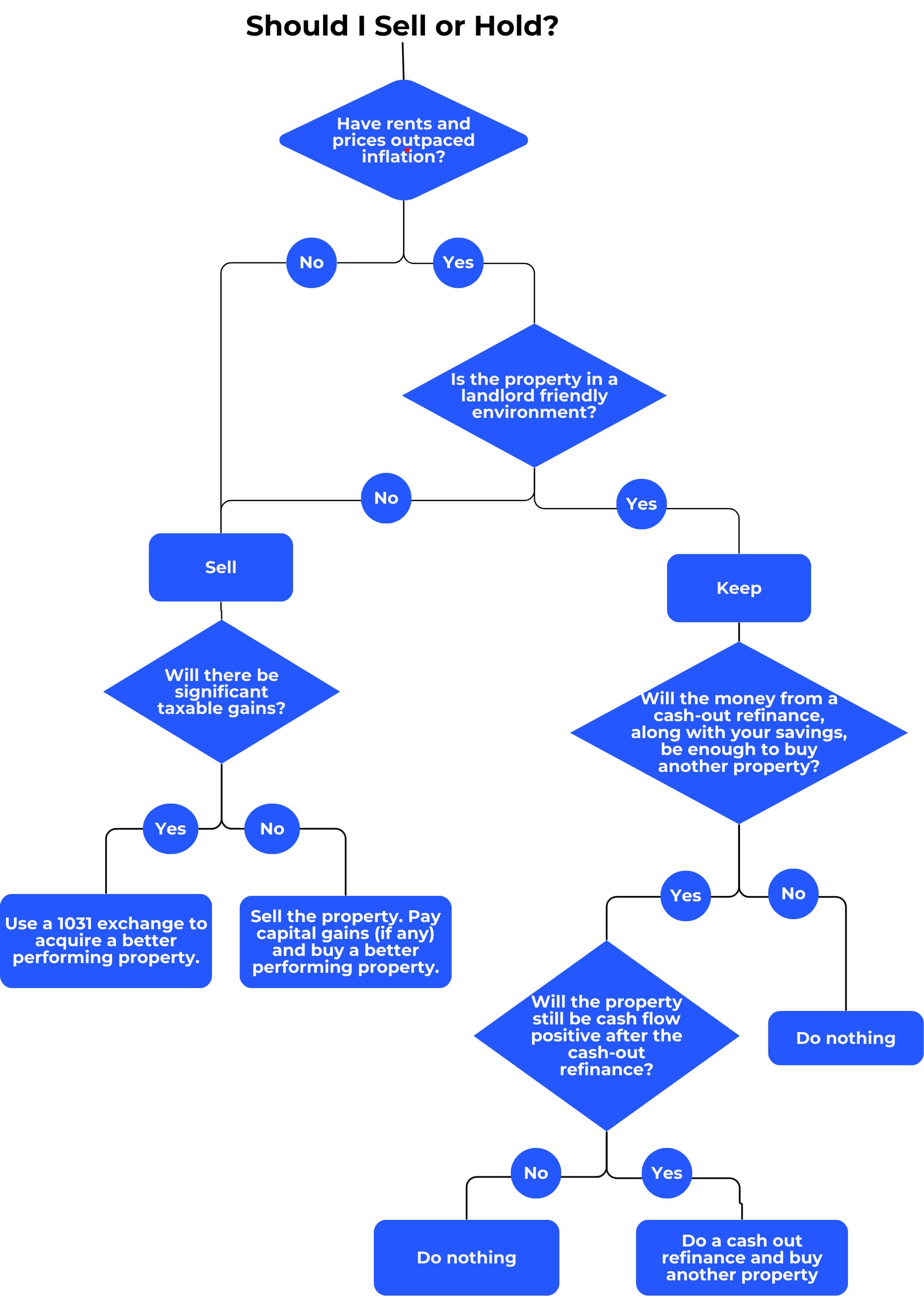
    Rents increasing faster than inflation are essential for long-term financial independence. For example, suppose your current rent is $1,000/Mo. If inflation averages 5%/Yr and rent increases by 2%/Yr, how much will the increased rent buy in today’s dollars after years 5, 10, and 15?

    • Year 5: $1,000 x (1 + 2%)^5/(1 + 5%)^5 ≈ $865
    • Year 10: $1,000 x (1 + 2%)^10/(1 + 5%)^10 ≈ $748
    • Year 15: $1,000 x (1 + 2%)^15/(1 + 5%)^15 ≈ $647

    The takeaway is that unless rents increase faster than inflation, the amount of goods and services you can purchase declines. For example, in year five, even though your rent increased to $1,104 ($1,000 x (1 + 2%)^5), it will only buy as much as $865 will today. So, no matter how many properties you own in a city where rents do not increase faster than inflation, you can not achieve long-term financial independence.

    What are the characteristics of a city where rents are most likely to outpace inflation?

    ✅ Sufficient population: cities with a metro population greater than 1M. Small towns may rely too much on a single business or market segment. Wikipedia

    ✅ Significant and sustained population growth: Never invest in any location with a static or declining population. Wikipedia

    ✅ Low crime rate: Never invest in any city on this list.

    ✅ Low operating costs:

    Local Investment Team

    Whether you are investing locally or across the country, you need to work with an experienced local investment team. No amount of reading, seminars, or online “expert” advice replaces the depth of knowledge a coordinated local team provides. A real investment team—an experienced investment realtor, a skilled property manager, and reliable renovation partners—sees what data alone can’t. Due to their experience, they know which tenant segments pay on schedule, what resources to use for a given task, and even the best channel to market your property to attract your target tenant segment.

    Working with an experienced investment team, you get local insight, resources, defined processes, and experience at no extra cost.

    FERNWOOD Team, KW VIP Realty520 Reviews
Join the conversationCreate a free account to reply, vote on answers and follow this thread.