Is AZ going to run out of water!?
Real Estate Agent · Phoenix, AZ · Member since 2018 · 127 posts · 62 votes
Where are my AZ investors at!? I want to hear your thoughts on the water shortage in AZ (Phoenix area) and what you think it means for investors?
Is it something to think about if you’re a buy and hold investor?
@Thomas Corley I remember reading about this a ton when I lived in AZ (Prescott and Tucson from 98-2003). The Hohokam people who lived in the area of what is now Phoenix from around 300-1500 AD had an elaborate system of canals and irrigation ditches from the Salt and Gila rivers. Their systems were actually too efficient at dispersing the water and ended up over-salinating the soil, causing crop failures and leading to the collapse of their civilization. Whether or not their history is repeating itself now has been a hot topic of debate ever since Phoenix was first developed. The issue certainly hasn’t gone away and doesn’t appear to be going away anytime soon. It’s definitely something to consider. The Salt and Gila River Project (basically repeating what the Hohokam did even using some of their old ditches), and the Central Arizona Project (diverts water from the Colorado River at Lake Havasu to Pima County and Tucson), have both been a disaster because of so much evaporation as the water travels across the desert, and the remaining minerals in the water making it basically useless by the time it gets to its destination. So far it seems we have not quite figured out how to avoid repeating the same fate of the Hohokam. I love Arizona personally, but perhaps there’s a natural cap on how many people should live in a place with very little water (less than 8 inches of rainfall a year on average in Phoenix).
Phoenix is referred to as “the worlds least sustainable city” by scientists mainly because of the water issues it has. Simply piping water in from other places is problematic not only due to geography and climate (it’s a hot remote desert and water evaporates crossing a desert) but also because of water law and all the places it could be pumped in from also needing that water and it already being “spoken for”. The water conversation sometimes turns to the ideas of drawing water from the Great Lakes some 2,000 miles away, or building extremely expensive desalination plants on the Pacific Ocean, but those ideas are pretty outlandish and cost-benefit studies consistently shoot them down. Water restrictions/ limits on development seem to be more likely solutions.
Phoenix already recycles a lot of waste water, but most of it is used for cooling the Palo Verde nuclear power plant to the west of the city, the largest in the US and the only one of it’s kind not located on a body of water. So the issues of electricity and water are coupled together. The water department itself is actually Arizona’s biggest electricity consumer, because it has to pump water uphill from the Colorado along miles of canals into Phoenix and Tucson. Most of that electricity previously came from the heavily polluting, coal-fired Navajo Generating Station which created a lot of problems for the Navajo Nation and was just destroyed a few days ago actually. I think the plan is for that electricity to be replaced by large solar arrays that are currently being built.
There’s a lot of debate on how to solve the water crisis in Phoenix, and none of the potential solutions are going to be cheap or easy. That’s where the saying “In the West, Whiskey is for drinkin’, water is for fightin’” comes from. Some historians even think the Hohokam disappeared not because they ran out of water but because they fought with each other over water. The Colorado River which feeds most of the reservoirs the water is drawn from, like Lake Mead, has seen drastically reduced flows over the past few decades, exacerbating the problem as the city grows. Whether or not a viable solution exists, I have no idea, but it definitely comes up in most conversations about the growth of Phoenix, so it’s definitely a factor to consider when investing there I’d say.
I don't think many experts debate on whether or not AZ will run out of water, it's just a matter of when, and which cities will run out first. How this will effect real estate, I have no idea but it's interesting to think about. I would guess it will lead to less development in certain areas, and an increase property values in others due to the cap on development, but I have no idea. Areas with more senior water rights will probably fare better and areas that rely on groundwater (Pinal County and many of the newer developments that don't get allocations from CAP) may fare worse, assuming current water rights remain in place and play a role. But who knows.
@Thomas Corley
A few years ago the azreia had a speaker from the Phoenix economic council come speak and someone posed the question. Because of modern water management and reduction of agricultural use Phoenix uses the same amount of water today as it did in the 1950s when the population was 1/10 of what it is today.
I’d be more concerned about the heat. Every year we reach a new record for number of days over 100 degrees. At what point do people stop waiting to live in the heat?
@Thomas Corley
Phoenix is one of the fastest growing cities in the country. Human beings are resourceful creatures. We put a man on the moon, we’ll figure out how to supply an important economic center with water.
@Thomas Corley I remember reading about this a ton when I lived in AZ (Prescott and Tucson from 98-2003). The Hohokam people who lived in the area of what is now Phoenix from around 300-1500 AD had an elaborate system of canals and irrigation ditches from the Salt and Gila rivers. Their systems were actually too efficient at dispersing the water and ended up over-salinating the soil, causing crop failures and leading to the collapse of their civilization. Whether or not their history is repeating itself now has been a hot topic of debate ever since Phoenix was first developed. The issue certainly hasn’t gone away and doesn’t appear to be going away anytime soon. It’s definitely something to consider. The Salt and Gila River Project (basically repeating what the Hohokam did even using some of their old ditches), and the Central Arizona Project (diverts water from the Colorado River at Lake Havasu to Pima County and Tucson), have both been a disaster because of so much evaporation as the water travels across the desert, and the remaining minerals in the water making it basically useless by the time it gets to its destination. So far it seems we have not quite figured out how to avoid repeating the same fate of the Hohokam. I love Arizona personally, but perhaps there’s a natural cap on how many people should live in a place with very little water (less than 8 inches of rainfall a year on average in Phoenix).
Phoenix is referred to as “the worlds least sustainable city” by scientists mainly because of the water issues it has. Simply piping water in from other places is problematic not only due to geography and climate (it’s a hot remote desert and water evaporates crossing a desert) but also because of water law and all the places it could be pumped in from also needing that water and it already being “spoken for”. The water conversation sometimes turns to the ideas of drawing water from the Great Lakes some 2,000 miles away, or building extremely expensive desalination plants on the Pacific Ocean, but those ideas are pretty outlandish and cost-benefit studies consistently shoot them down. Water restrictions/ limits on development seem to be more likely solutions.
Phoenix already recycles a lot of waste water, but most of it is used for cooling the Palo Verde nuclear power plant to the west of the city, the largest in the US and the only one of it’s kind not located on a body of water. So the issues of electricity and water are coupled together. The water department itself is actually Arizona’s biggest electricity consumer, because it has to pump water uphill from the Colorado along miles of canals into Phoenix and Tucson. Most of that electricity previously came from the heavily polluting, coal-fired Navajo Generating Station which created a lot of problems for the Navajo Nation and was just destroyed a few days ago actually. I think the plan is for that electricity to be replaced by large solar arrays that are currently being built.
There’s a lot of debate on how to solve the water crisis in Phoenix, and none of the potential solutions are going to be cheap or easy. That’s where the saying “In the West, Whiskey is for drinkin’, water is for fightin’” comes from. Some historians even think the Hohokam disappeared not because they ran out of water but because they fought with each other over water. The Colorado River which feeds most of the reservoirs the water is drawn from, like Lake Mead, has seen drastically reduced flows over the past few decades, exacerbating the problem as the city grows. Whether or not a viable solution exists, I have no idea, but it definitely comes up in most conversations about the growth of Phoenix, so it’s definitely a factor to consider when investing there I’d say.
I don't think many experts debate on whether or not AZ will run out of water, it's just a matter of when, and which cities will run out first. How this will effect real estate, I have no idea but it's interesting to think about. I would guess it will lead to less development in certain areas, and an increase property values in others due to the cap on development, but I have no idea. Areas with more senior water rights will probably fare better and areas that rely on groundwater (Pinal County and many of the newer developments that don't get allocations from CAP) may fare worse, assuming current water rights remain in place and play a role. But who knows.
TLDR. ;-) So, is that a "yes" or a "No"?
Haha sorry, I get carried away. The answer is definitely maybe.
You just need to tap a river!!!
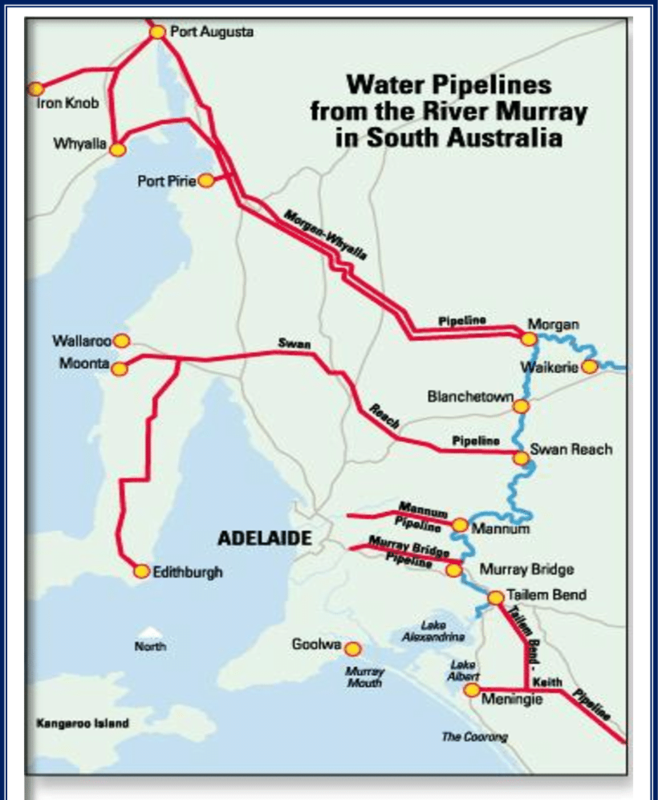
We grew up driving past this huge water pipe that supplied water from the River Murray to Adelaide & surrounds. It was a massive system, but now most of it is supplied by a large desalination plant.

@Thomas Corley there is something unsettling to me about a place where no natural water exists. If I dig a hole in my back yard, it will fill with water. I find that reassuring. I grew up in the land of 10,000 lakes, where you couldn't drive in any direction without running into a body of water in less than 10 minutes.
There is only so much water in the rivers and other states need the water too. Of course the ocean contains a large supply of water and desalination is a viable solution.
One thing phoenix could do to control the water situation is get rid of a lot of grass!. When I first lived in the phoenix area in the mid-80s I was really surprized by the amount of grass and eastern landscape there was. We also used to drive from Laveen to Phoenix past cotton fields... I just found it hard to believe there were such high water uses in the desert. Now they have planted houses in those cotton fields, I am not sure if the farming or the houses uses more water. We had flood irrigation for our grass then too. when we went back to the area we got a desert house.
@Thomas Corley I remember reading about this a ton when I lived in AZ (Prescott and Tucson from 98-2003). The Hohokam people who lived in the area of what is now Phoenix from around 300-1500 AD had an elaborate system of canals and irrigation ditches from the Salt and Gila rivers. Their systems were actually too efficient at dispersing the water and ended up over-salinating the soil, causing crop failures and leading to the collapse of their civilization. Whether or not their history is repeating itself now has been a hot topic of debate ever since Phoenix was first developed. The issue certainly hasn’t gone away and doesn’t appear to be going away anytime soon. It’s definitely something to consider. The Salt and Gila River Project (basically repeating what the Hohokam did even using some of their old ditches), and the Central Arizona Project (diverts water from the Colorado River at Lake Havasu to Pima County and Tucson), have both been a disaster because of so much evaporation as the water travels across the desert, and the remaining minerals in the water making it basically useless by the time it gets to its destination. So far it seems we have not quite figured out how to avoid repeating the same fate of the Hohokam. I love Arizona personally, but perhaps there’s a natural cap on how many people should live in a place with very little water (less than 8 inches of rainfall a year on average in Phoenix).
Phoenix is referred to as “the worlds least sustainable city” by scientists mainly because of the water issues it has. Simply piping water in from other places is problematic not only due to geography and climate (it’s a hot remote desert and water evaporates crossing a desert) but also because of water law and all the places it could be pumped in from also needing that water and it already being “spoken for”. The water conversation sometimes turns to the ideas of drawing water from the Great Lakes some 2,000 miles away, or building extremely expensive desalination plants on the Pacific Ocean, but those ideas are pretty outlandish and cost-benefit studies consistently shoot them down. Water restrictions/ limits on development seem to be more likely solutions.
Phoenix already recycles a lot of waste water, but most of it is used for cooling the Palo Verde nuclear power plant to the west of the city, the largest in the US and the only one of it’s kind not located on a body of water. So the issues of electricity and water are coupled together. The water department itself is actually Arizona’s biggest electricity consumer, because it has to pump water uphill from the Colorado along miles of canals into Phoenix and Tucson. Most of that electricity previously came from the heavily polluting, coal-fired Navajo Generating Station which created a lot of problems for the Navajo Nation and was just destroyed a few days ago actually. I think the plan is for that electricity to be replaced by large solar arrays that are currently being built.
There’s a lot of debate on how to solve the water crisis in Phoenix, and none of the potential solutions are going to be cheap or easy. That’s where the saying “In the West, Whiskey is for drinkin’, water is for fightin’” comes from. Some historians even think the Hohokam disappeared not because they ran out of water but because they fought with each other over water. The Colorado River which feeds most of the reservoirs the water is drawn from, like Lake Mead, has seen drastically reduced flows over the past few decades, exacerbating the problem as the city grows. Whether or not a viable solution exists, I have no idea, but it definitely comes up in most conversations about the growth of Phoenix, so it’s definitely a factor to consider when investing there I’d say.
I don't think many experts debate on whether or not AZ will run out of water, it's just a matter of when, and which cities will run out first. How this will effect real estate, I have no idea but it's interesting to think about. I would guess it will lead to less development in certain areas, and an increase property values in others due to the cap on development, but I have no idea. Areas with more senior water rights will probably fare better and areas that rely on groundwater (Pinal County and many of the newer developments that don't get allocations from CAP) may fare worse, assuming current water rights remain in place and play a role. But who knows.
One issue that was not mentioned in this thread, is the water pollution of the drinking wells by
polyfluoroalkyl substances, known as PFAs. I know of at least two drinking wells just north of Davis-Monthan Air Force Base that have been closed off due to this issue.
It basically come down to : "Are we having a sustainable development in Arizona (and many other parts of the country for that matter)?" And the short answer is NO (unfortunately).
How long before this affects the Real Estate Market? I don't think anyone can predict. But there is no doubt that it will eventually catch up with us.
I hope not I have a couple of rentals and a primary. The heat island is a concern though.....
I want to hear your thoughts on the water shortage in AZ (Phoenix area) and what you think it means for investors?
Think your bigger issue is what govt will do to the water rates for their own profit.
In Portland and Seattle we pay about 2x for water and we've got water all over the place.
The problem is not the amount of water that southern Arizona uses. It is the fact that all of their water comes from the Colorado River that is diverted to them through the Central Arizona Project. The CAP was built with federal money and to get California and its many Representatives on board Arizona had to accept junior water rights--so CA gets all of its water before Arizona gets any.
The issue is that the Colorado river water was over appropriated during an unusually wet period. Today water is becoming scarce and climate change is expected to make the Colorado river basin even drier... just look at Lake Mead/Lake Powell water levels over the years it is actually pretty scary. So the issue is that the California is going to divert all of their senior water rights and there is nothing left for Southern Arizona at the end of the line.
It actually worried me but no one in the area seems concerned. I think they will just kick the can down the road until its urgent and then run to Congress to try and solve their problem.
@Thomas Corley everyone needs to start paying attention. Water and tbe control of it is a huge concern. Billionaires are buying agricultural properties to control the water. Whoever controls the water has the power.
I don't have the source at my fingertips tonight but one of the local professors wrote a book about water in Phoenix and one of the major elements was that an acre of Rooftops uses less water than an acre of agriculture. With much of the Phoenix, AZ area being historically agricultural the claim could be made that the water consumption is not increasing nearly at the level some fear due to all of the agricultural ground being converted to rooftops.
Most of the Cities in the Valley of the Sun are encouraging less water consumption and often encourage the use of more desert-friendly landscaping items.
The Department of Real Estate also requires all new subdivisions to have a guaranteed supply of water prior to approval.
Groundwater pumping has been on the decline as the water table has receded causing issues which is why the reservoirs and canals are heavily used anymore instead of the old wells.
I attended a seminar back in August and they had a segment on water. The biggest concern brought up was what @Joshua Proper mentioned above about the CAP and AZ being in the junior position. 41% of greater Phx's water comes from the CAP. 30 % comes from groundwater, and 27% percent comes from the Salt-Verde rivers. The remaining 2% coming from effluent sources. There are safeguards in place, like the 100 year assured water supply for new subdivisions like what @Doug McVinua mentioned. Could there be more? Probably, when I moved here three years ago from the Midwest, I was shocked at how cheap water was. I am not too concerned about running out of water anytime soon.
They used to worry us with the same stories here in Vegas. But we use less water now than we did 20 years ago before the building boom. We took out a lot of grass, we built flood channels to capture the water, etc...
Ps. 1000 gallons of water costs me $1.10. In the FRIGGIN DESERT! I really wouldn’t care if they doubled or triple the price. I do remember the water department bitching about earning less money because we were all suing less water. So they jacked up the connection fees builders pay to connect to water/sewer.
Pps. My sewer bill is almost higher than my yearly water bill< and I have a pool. They got “smart” and charge you a constant fee whether you ever flush or not.
Here's a great video on the topic from Brad Lancaster who spends his time educating others on maximizing water use in the desert.
"Here in the desert community of Tucson, AZ, we only get 11 inches of rain a year. Yet more rain falls on the surface area of Tucson in a year than all of Tucson and all its inhabitants consume of municipal water in a year."
@Thomas Corley there is something unsettling to me about a place where no natural water exists. If I dig a hole in my back yard, it will fill with water. I find that reassuring. I grew up in the land of 10,000 lakes, where you couldn't drive in any direction without running into a body of water in less than 10 minutes.
There is only so much water in the rivers and other states need the water too. Of course the ocean contains a large supply of water and desalination is a viable solution.
I think we really put it in perspective when lake Baikal has something like 30 to 50% of all the fresh water on earth :)
Ag takes the vast majority of the water. those are the industry that will be or could be really hurt in certain areas.
and of course we need food .. and Cotton etc.
Where are my AZ investors at!? I want to hear your thoughts on the water shortage in AZ (Phoenix area) and what you think it means for investors?
Is it something to think about if you’re a buy and hold investor?
Hi Thomas.
It's not an Arizona question of water shortage. Some areas, like Sedona, have an ample (500+ yr) supply of underground crystal clear, delicious water. However, Phoenix not only does NOT have sufficient underground water, and they do NOT get enough rain for their huge and quickly growing population. Phoenix water is 99% brought in from elsewhere. Specifically, from 2 main sources: the SRP (Salt River and Verde River) & the CAP (Colorado River). Any time a huge and quickly growing population relies so extensively upon water brought from elsewhere, I think the question of "Is this sustainable?", should be asked. In this case, I'd say definitely no.
Quite a few large lakes are drying up- lakes that are supported by these rivers. This indicates a problem. These lakes are drying and might actually disappear. Lake Powell, for example, is getting quite low and still dropping. If Lake Powell disappears, Lake Pleasant will go next. And on and on.
I believe this is a solvable problem. But we aren't there, yet. I've raised concern about this Phoenix water issue repeatedly in the past. I'm concerned the problem won't be solved until quite a bit of permanent ecosystem damage is done, as well as drastically impacting some of the stunning recreational sources our state has to offer.
That being said, I see some other states struggling with the same issues. I'm hoping we see some water related breakthroughs over the next 10-15 years.
Phoenix has like 300 years of water reserves that they haven't even tapped. The city uses the same amount of water that it used 60 years ago, despite the population growing 7x.
Right now they are pushing the boundaries of direct potable reuse, but recycled water is still only 2% of their supply, because it costs about 100x more than surface water. Water is still dirt cheap there.
But keep in mind this is a place that hasn't really even tried to reduce water consumption. They don't have the same restrictions that even California has on residential use. There are no showerhead inspections required. People with older lots can still flood irrigate. They still grow alfalfa in the desert outside the city.
Thank you for your very in-depth answers. A lot of good points to think about.
Phoenix has like 300 years of water reserves that they haven't even tapped. The city uses the same amount of water that it used 60 years ago, despite the population growing 7x.
Right now they are pushing the boundaries of direct potable reuse, but recycled water is still only 2% of their supply, because it costs about 100x more than surface water. Water is still dirt cheap there.
But keep in mind this is a place that hasn't really even tried to reduce water consumption. They don't have the same restrictions that even California has on residential use. There are no showerhead inspections required. People with older lots can still flood irrigate. They still grow alfalfa in the desert outside the city.
Hi Seth.
There are also other legitimate sources that provide facts on the issue, so everyone can form their own opinion.
More relevant to Bigger Pockets as an investment support platform, regarding AZ real estate:
Every
state has it's issues. In this case, as I've been saying for several
years, AZ buyers should be in great shape, with little to no investment
impact from drought or water related issues, for quite a few years.
Areas like Sedona are on the opposite side of this problem- I get calls
all the time from buyers concerned about water, and they are happy to
pay more to buy in Sedona, knowing they get a 500+ year clean water
aquifer supply for a small population area (Not dependent upon sourcing
from elsewhere), in addition to our strong ROI's, market appreciation, and the beauty Sedona has to offer.
To clarify my investment viewpoint- Phoenix is a GREAT place to invest short and long term. I recommend the Phx market in MANY real estate investing situations. Phx has great returns, demand, lots of buying options, across the board. The water issue is simply an important thing to be aware of, so you can monitor it, if public opinion turns the Phx market sour, or if Lake Powell, Lake Mead, Lake Pleasant or others disappear, the issue will be elevated, which will in turn change public opinion which can change the market.
I invest in Arizona, because we have great returns, great growth, and landlord-friendly government. AZ Economic projections I've seen look really good. I'm informed about many of the AZ issues, so I can stay ahead.
As another example, I
also day trade in crypto- but I invest while understanding the
volatility of the cryptos I invest in. I try to stay informed about
crypto pros and cons, and support systems, as well as government and
other attempts to undermine crypto. Being informed helps me to yield a
better return, which in turn, fuels my real estate investing. I really
don't care if others invest in crypto- my point is that I will always
strive to be self-informed with pros and cons with anything I invest in.
I'm sure you do the same, as you seem intelligent and simply reading
and posting on BP is an amazing way to get informed. I love the audience
here at BP. Great attitudes and lots of energy.
Real estate investing is the bee's knees. Everyone keep it up.
I'll button up my interaction with with this particular thread, as my goal is NOT to change anyone's mind, it's to inform. But if anyone has further questions, I'm happy to answer, just reach out to me privately.