Spring, TX · Member since 2016 · 36 posts · 17 votes
Hi All,
I have a few properties with 30 year fixed mortgages in 6.5 - 6.875 % rate range which originated in the past 2 years and 2 properties with 15 year fixed mortgages in 2 - 3% range which were originated long time back with not a lot of principal left. I am currently paying additional principal ($4000-5000 per month) spread out to most of the properties but was wondering if it will be better to apply all of the additional payments to one of the house pay it off and then move to another house? Has someone done an analysis on this kind of scenario?
My long term objective is to pay off all of the houses over 8-10 years (before retiring from my W2 job).
@Patrick Roberts thanks. On purely based on numbers you are right. but given the small difference in interest the difference will be marginal.
I was thinking more on the lines of building equity in one rental at a time at an accelerated rate or in all rentals. Also, if/when rates go down what will be a better scenario in terms of refinancing? what about risk point of view?
@Patrick Roberts thanks. On purely based on numbers you are right. but given the small difference in interest the difference will be marginal.
I was thinking more on the lines of building equity in one rental at a time at an accelerated rate or in all rentals. Also, if/when rates go down what will be a better scenario in terms of refinancing? what about risk point of view?
There is 0 reason to spread extra principal payments across all of your properties equally. You should not be prepaying any principal at all on the low rate loans. Each dollar of prepaid principal should have a strategic reason behind it, such as getting a particular loan/property down to a certain LTV for a future refi or a recast. Outside of that, pay any extra principal toward the loan with the highest rate.
I'm not a fan of owning investment RE without using debt. Leverage is the primary tool that makes RE an excellent asset class.
There isn't actually a ton of savings by paying them off early. Here's why:
1. The extra payments come off at the end of the loan. Because of the amortization schedule, the payments at the end are more principal than interest. You are paying the bulk of the interest on the front end. The savings aren't real.
2. Real Estate only really makes sense if there is leverage. Your cash on cash return is higher. Otherwise invest in the stock market with less headache.
3. Cash is king. At some point you are going to have to replace major systems like roofs, HVAC, and general remodels. If you spend all your cash buying down the loan, you are screwed when these system issues arise and you don't have the cash on hand.
4. Use the additional cash to buy another property that would cash flow the difference you would have made if these properties are paid off. Easier said than done but you get the idea.
5. The only reason why you might want to pay off early is if you don't want any more rentals and heading towards retirement. Then it makes sense because you will need the cash flow.
@Rick Albert thanks for your input. I am invested in stock market and have been diversifying into real estate over the past couple of years. I have a good W2 job so I am not after cash flow at this time. I am planning to scale up the RE portfolio over the next 1-2 years and aim to pay off all/most of it over the next 8-10 years when I am closer to retirement.
Given the high interest rate at this time I am wondering if I should pay down the high interest rate loans equally or pay all the additional principal to one house and pay it off faster adn then move onto the next house. When opportunity to refinance arise which option will be better? I am not planning on selling the rental houses for a foreseeable future.
@Rick Albert thanks for your input. I am invested in stock market and have been diversifying into real estate over the past couple of years. I have a good W2 job so I am not after cash flow at this time. I am planning to scale up the RE portfolio over the next 1-2 years and aim to pay off all/most of it over the next 8-10 years when I am closer to retirement.
Given the high interest rate at this time I am wondering if I should pay down the high interest rate loans equally or pay all the additional principal to one house and pay it off faster adn then move onto the next house. When opportunity to refinance arise which option will be better? I am not planning on selling the rental houses for a foreseeable future.
If you are planning on scaling now, then don't pay off the loans sooner. That would defeat the purpose of having your tenants pay the mortgage for you. I would consider finding your retirement number and work backwards from there. Once the properties are established, then get aggressive on paying them off.
I would make all the extra payments to the property with the highest interest and pay that off first. Is better to have one house paid off than 2 with half the balance because if you need to pull money out or do any line of credit on them is harder to do it in a second position loan.
I wouldn't touch the low interest rate, you're brtter off buying another property than paying those off.
If by "scale up" you mean to buy more property, then I would keep the debt as is and save the cash to make those additional purchases when the opportunity presents itself and makes sense. I would not pay one down or off just to pay origination again to borrow the same money back again. If you have made all of your purchases and just want them paid off then by all means, pay them off. I have started the search for retirement and tax plaining software to help me with these types of decisions, perhaps there is something that can help your planning.
@Warren Powers thanks for your note. Currently I have cash flow from my W2 job and investment account to buy additional properties at the rate of 2-3 per year for the next 2-3 years. My plan is to pay for the down payment and closing and use the rent and some additional cash to accelerate mortgage payment on 30 years loan to pay it faster. Please do share if you found a good software for retirement planning. Currently I am using EMpower Personal Dashboard to keep track of my different accounts/networth but have not done anything beyond that.
I have a few properties with 30 year fixed mortgages in 6.5 - 6.875 % rate range which originated in the past 2 years and 2 properties with 15 year fixed mortgages in 2 - 3% range which were originated long time back with not a lot of principal left. I am currently paying additional principal ($4000-5000 per month) spread out to most of the properties but was wondering if it will be better to apply all of the additional payments to one of the house pay it off and then move to another house? Has someone done an analysis on this kind of scenario?
My long term objective is to pay off all of the houses over 8-10 years (before retiring from my W2 job).
Thanks a lot in advance.
On the 30 yr notes you mention above, you are not to far from being in the money on a rate/term refiances. Rates get better if you have 60% loan to value, so when you get an appraisal might consider making that extra principal payment at that time to get down to 60% LTV if you are not there already.
Is there really that significant of a rate difference between 75% and 60% LTV? I would not have imagined that. Do you typically see any linear rate difference going from 80%-->75%-->70% or does a switch more or less flip at 60%?
With respect to the 15 year 2%-3% loans, aside from maybe serving a cash out need, it seems best to ride those horses the length of the term.
Is there really that significant of a rate difference between 75% and 60% LTV? I would not have imagined that. Do you typically see any linear rate difference going from 80%-->75%-->70% or does a switch more or less flip at 60%?
With respect to the 15 year 2%-3% loans, aside from maybe serving a cash out need, it seems best to ride those horses the length of the term.
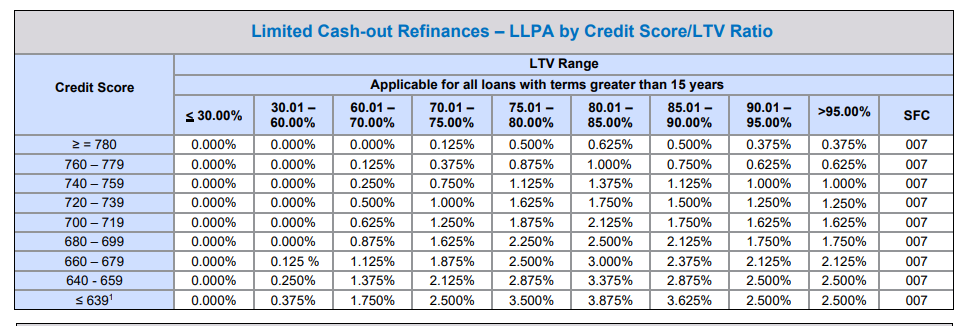
Yes, there is a difference. It is called loan level pricing adjustments. Here are the numbers for a conventional loan, but each DSCR program will have their own:
Is there really that significant of a rate difference between 75% and 60% LTV? I would not have imagined that. Do you typically see any linear rate difference going from 80%-->75%-->70% or does a switch more or less flip at 60%?
With respect to the 15 year 2%-3% loans, aside from maybe serving a cash out need, it seems best to ride those horses the length of the term.
On Conventional conforming loans and Govvy loans, there are established LLPA tables that show exactly what the pricing difference will be at each tier. DSCR loan LLPAs are all unique to the rate sheets of the source of the money - they will likely have similar LLPAs, but they will not all be the same or match other loan types.
That being said, some lenders will tinker with the LLPAs with thier own pricing adjustments to target certain ranges to compete within. It's not perfectly linear or harmonized across all lenders and loans products.
@Jay Hurst thanks a lot for the tip. I think I am close to 60% in two of the properties and around 70% on the third one. Approximately how much better the rate get compared to 25% down payment on a 30 year mortgage?
Understand on a refi it is not really a "down payment", but rather a loan to value. so, at 75% on a single family investment property rate/term refi I would be around 6.5% today with no points/no pre-pay penalty, at around 6.125% at 60% loan to value with no points/no pre-payment penalty. So it is relatively significant.
@Sartaj G. I have different advice than the majority.
Can you predict the future?
I can't:(
So, I would advise to just save all your money and put it into stable investments.
In 8-10 years if all goes well you can choose to pay off the mortgages if you desire.
Otherwise, if the economy & stock markets tank, you lose your job & can't find another one for 12+ months or you get cancer, etc., you will have liquid reserves to "weather the storm". - You could also use the cash for extremely lucarative investments deals - say you find a property the owner is desperate to get rid of that you know you could easily flip.