New Member from Las Vegas, NV

New Member from Las Vegas, NV

Las Vegas, NV · Member since 2018 · 2 posts · 1 vote

Hi Everyone! I am so excited to have found this amazing resource to help me begin my real estate investing career. I am 26 and currently work in client account management and know this is not where my heart resides. I have a love and passion for interior design and received my bachelors degree in the field in 2015. My ultimate goal is to get into flipping homes as I feel this would be a great way to use my interior design background while investing my money into something more valuable. 

I would love any input you guys might have that would help me get started. I will give you a little background as to where I am at in life to help you understand my situation a little better. 

I am currently renting a home in Las Vegas and am beginning the search of the home buying process. As I am searching for homes to purchase, the thought of an investment property is something that sounds more and more appealing, but the thought of how to get started is what is daunting me. I want to make sure I make an educated decision before jumping to something I know little about. Should I continue with the purchase of my own home instead of using that money for an investment? I am so tired of throwing my money away to someone else's mortgage, but it's also the easy way out. My current job is flexible and steady so I would likely work full time while trying to begin as I don't want to lose my consistent income. 

Thank you in advance for any input and I can't wait learn more about the BP community and all that is has to offer! :)

0Reply
63 views

Most Popular Reply

Eric FernwoodBusiness Member
Realtor · Las Vegas, NV · Member since 2014 · 995 posts · 1k+ votes
8y

Hello,

Great thread! Most of the posts seem to center around two topics:

  1. Can you still buy good investment properties in Las Vegas?
  2. What is the current state of the Las Vegas market and what is likely to happen in the foreseeable future?

I will address both topics starting with buying good investment properties.

Good Properties

Yes, we find them every day. However, they are not easy to find. Currently, good properties are about 1 in every 2000 available properties. You have to have the right tools and processes to find them. What real return (including all recurring costs and not including unrealized gain like principal pay down, etc.) can you expect with 25% down, 30 year fixed? Between 2% and 4%. Higher if you buy with cash.

Current Market Condition

The value of anything is determined by demand. For example, would you pay $100 for a half consumed bottle of water? No? Suppose you are lost in the Mohave desert and dying of thirst. You would be willing to pay $100, $1,000 or any amount of money for the same half consumed bottle of water. Such is the difference demand makes. The same is true with real estate. I look in some cities and a 1,500 SqFt single family home is selling for $15,000. The same house in some coastal cities in California would sell for $2,000,000 or more. Like the previous example, it’s the same house but different demand. So, let’s start by looking at the current Las Vegas real estate and rental demand situation today.

Current Demand

I will subdivide the demand question into sales and rentals.

Sales

The best demand barometers I know of for the current market is the trend of: days on market, $/SqFt and inventory.

Days on Market

Days on market is the number of days between when a property is listed and the date when the property is placed under contract. As you can see below, the days on market is currently about 15 days. This includes over priced properties that may well sit on the market for months or longer so 15 days is a very short period of time for real estate. The short days on market indicates a high level of demand.

$/SqFt

Price per SqFt ($/SqFt) is another indicator of demand. The chart below shows $/SqFt since 2008.

Note that while prices have increased since the bottom in 2011, we are still at about 80% of the 2007 peak prices. Also, Las Vegas has the further to go to reach pre-crash peak prices than any other major city.

Inventory

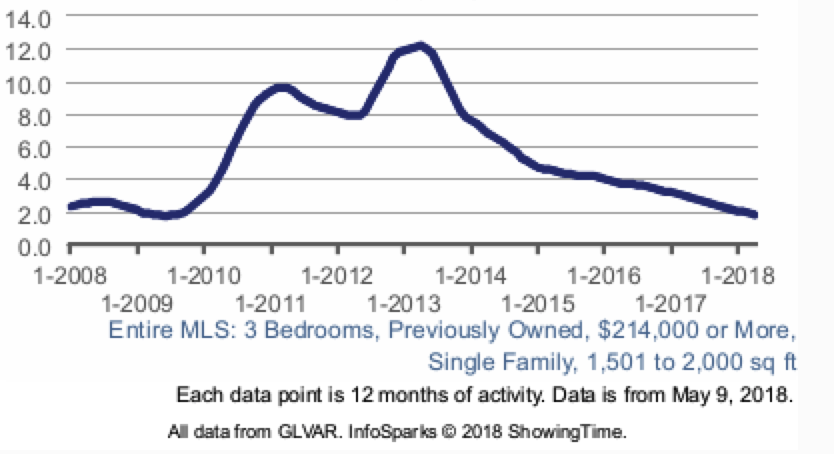
Inventory is measured in months of supply. A six month supply is considered balanced. As you can see below, current inventory levels are about 1.8 months of supply, which indicates a high level of demand.


Rentals

$/SqFt

The following data is for the entire MLS, not just the narrow property profile we target. As you can see, rents have steadily risen since 2013.

Rental Inventory

Over the last few months, total available rental properties has fallen. Below is the total number of rental properties available on the 18th of the month, by month, by type.

As you can see, rental inventory has decreased drastically since January. Note that we have not even entered the peak rental demand period of June through September.

Typically, time-to-rent is 2 to 3 weeks. Today, we are closer to 2-3 days.

Current Demand Summary

The numbers clearly indicate there is significant demand for both properties to purchase and properties to rent. Declining inventories in both sales and rentals indicate that property prices and rents will continue to increase, at least in the remainder of 2018. How about in the foreseeable future?

Future Demand

While no one can accurately predict the future, you can infer what a market is likely to do by looking at current and recent trends. Stock investors do this all the time. Fortunately, while stock prices can change almost instantaneously (sometimes due to seemingly unrelated events), real estate markets generally change very slowly, which makes trends easy to spot.

Purchase and rental demand is largely driven by:

  • Jobs - Real estate is no better than the jobs around them.
  • Population growth - More buyers means increasing demand.
  • Urban sprawl - If people are leaving an area, demand in that area will fall. This is true even if the population of the metro area is unchanged or growing.

Population growth

Las Vegas’ population grew by 2.2% in 2017. This is a healthy and sustainable growth rate. Nevada ranked 3rd in Atlas Van Lines annual migration report in terms of most popular states to move into. See the graph below. The numbers show what percentage of moves are inbound vs. outbound from the state. Greater than 50% indicates more people moved into the state than out of the state.

Below is a 2015 graphic (I was not able to find a more recent similar graphic) showing the top states from which people are moving to Nevada. Note that the population of Las Vegas is about 80% of the population of the state of Nevada so the majority of the new population is likely moving to Las Vegas. Note that while the numbers shown below may seem small if you compare them to the population of California, the total population of Las Vegas is approximately 2.3M so the number of people moving in has a big impact.

Jobs

Rental properties are no better than the jobs around it and Las Vegas is experiencing a lot of job growth. However, the quantity of jobs is only half of the story.

Job Quality

Job quality is almost as important as job quantity. For example, in many parts of the US high paying manufacturing jobs have gone away, such as the automotive manufacturing jobs for which the average pay was about $40/Hr plus benefits. Today, these same people are most likely working in the service sector. Services sector jobs typically pay between $11/Hr and $13/Hr. So, while the overall job quantity did not change, the quality did. If people are earning less, what they can afford to pay for rent will fall over time as well. What does this mean to you as a landlord?

The best metric I know of for determining overall job quality for an area is inflation adjusted per-capita income. See the chart below from the St Louis Federal reserve.

As you can see, per capita income continues to rise in Las Vegas which means quality is increasing.

Job Quantity

A good measurement is the rate of unemployment. As you can see below, unemployment is around 5%, which is great compared to what it was in 2010. How do the current number of jobs compare to pre-crash job numbers? In 2016, Nevada surpassed pre-recession employment levels with 70,000 fewer construction jobs. (Note: Las Vegas metro area is about 80% of the total state population.) Here is a report by the Federal Bureau of Labor Statistics on Las Vegas employment.

As the population of Las Vegas continues to grow, unless the number of jobs increases as well, unemployment will rise. Below is a chart showing the rate of unemployment for the metro area from the St Louis Federal reserve.

As you can see, despite the increase in population, unemployment continues to decline and per-capita income continues to increase. A very good combination for the future.

While it is hard to quantify the number of jobs generated by small to medium businesses, it is easy to quantify for large projects.

Major Projects

Below are some of the top projects under construction in Las Vegas. These projects create large numbers of both short term (mostly construction) jobs and long term employment once the projects are complete. And, every worker will need a place to live.

Other Sources Of Growth

Blue State Refugees

Since Nevada is adjacent to California, I will focus my remarks specifically on California. However, people who leave blue states due to the high cost of living will look at places like Las Vegas.

I’ve researched one segment off California population that will be greatly impacted by the 2018 Tax Act and rising prices and taxes and that is people living on a fixed income.

California has about 6M retired people. Due to the 2018 Tax Act, an unknown percentage will choose (or be forced) to leave the state and look for a lower cost of living. Las Vegas is a known location to the people of Los Angles and San Diego. The fact that it is only 4 hour drive away from friends and family is a major plus. Lets look at the numbers.

If 0.25% of the 6M retired people in California decide to move to Las Vegas and we assume that all are couples, the number of residences needed will be:

6M x 0.25% / 2 = 7,500

To put this in perspective, the total number of single-family homes sold in Las Vegas in 2017 was 34,659. If an incremental demand for an additional 7,500 residences occurs over the next coupled of years, demand will further increase sales and rental prices.

You might question whether this is only a short term situation because developers could just add thousands of new homes to meet the demand. The short answer is, “No.” The reason is a lack of available and desirable land.

Limited Land

Las Vegas is an island surrounded by federal land. See the map below. The areas in red are federal land.

See the gif below to see how the metro area has consumed the available land between 1984 and 2016.

Las Vegas is in a situation where:

  • Population is growing
  • Job quality and quantity is increasing
  • Unemployment is decreasing
  • Due to the low cost of living and no state income taxes, is very likely to attract a percentage of people seeking a lower cost of living

However, there is more to the story.

Corporate Expansion

The 2018 Tax Law reduced tax rates and encourages US corporations to expand operations within the US as opposed to overseas. Below is a small example of the factors that make Las Vegas a desirable location for businesses.

  • The fiber optic lines connecting the West and East coast run under Las Vegas Blvd.
  • Within 2 days driving distance to 20% of the population of the US, which is desirable for distribution centers.
  • Las Vegas is one of the few large metro areas with dual sources of electric power: Hoover Dam and California. This is a huge advantage for server farms, manufacturers and others who cannot afford to lose electrical power.
  • Relatively low energy cost. For example, below is a comparison between the statewide energy cost in California vs. Nevada.
  • No state income tax.
  • Nevada’s proximity to California is important for companies looking for new locations.
  • Nevada is a Right to Work state, along with 27 other states. For information on the benefits to employers, see this Wikipedia page.
  • Nevada is a business-friendly environment.

While Las Vegas is a desirable location for business expansion, what will drive large expansions? The reduced tax on repatriating funds that have been sitting in offshore accounts for years. Apple just made a $38B tax payment in order to repatriate their cash held overseas. Apple also announced plans to add 20,000 US jobs. Apple is only one of many companies who hold money overseas due to high US taxes (35%). With the 2018 tax changes, I believe more will follow Apple’s lead. Below is a list of the top 10 US companies that have funds stashed overseas.

The above are the biggest but only a small subset of the total number of US companies with overseas deposits. One article I read placed the total dollars sitting in offshore accounts at $3.1T!

If you suddenly inject close to $1T into the US economy and it is done efficiently (not by the government) this will have a huge impact on US growth. Companies will be looking to expand in the US and will be looking for new US locations. Las Vegas has enough advantages that a percentage of the expansions will be in Las Vegas, which will bring more people to the city, who will all need places to live.

Summary

Las Vegas continues to be an outstanding place to invest. However, good properties are difficult to find using traditional methods. As to the foreseeable future, if just a few of the opportunities I described above occur, Las Vegas should continue to expand for the foreseeable future.

FERNWOOD Team, KW VIP Realty520 Reviews
See this reply in the discussion

51 Replies

Jump to latestLatest
  • Professional · Anaheim, CA · Member since 2017 · 1k+ posts · 686 votes
    8y

    @Account Closed

    I am still buying. I put in multiple offers on 5 separate properties this year and got out bidded on all. The market is very competitive and rightfully so. 

    I have a buy, hold, and sell strategy. I have sell target on my 4plexs at 300k for Dec'18, but that number has been reached last month, and now I re-evaluated the market, and things still look good. I will put another target of $325k, and see what happens when Dec'18 comes around.

    Yes, interest rates are going up. I run the numbers on 5.375-5.5% 30 year fix, and already have that factored in.

    Terry

  • Professional · Anaheim, CA · Member since 2017 · 1k+ posts · 686 votes
    8y

    @Account Closed

    For someone who is an investor, you sure don't know what you are talking about. 

    I'm making decisions based on data and forecast. If you cannot grasp the below chart, then you should stay out of real estate.

    Terry

  • Professional · Anaheim, CA · Member since 2017 · 1k+ posts · 686 votes
    8y

    @Account Closed

    The above chart shows median price of SFR going up. This is great for properties that I currently own. I have a target sell point, and if it reaches it, then either I can sell or re-valuate the market, and hold longer.

    The 5 properties that I made offers on made sense from a cashflow perspective. Did I offer full list price? NO. I made offer lower than market but still made sense on paper.

    To answer you question, yes.............you do buy and sell at same time............if the deal makes sense.

    Here is a good example, I can buy a multi that needs work at a low price, fix, and flip, or hold if market is going up.

    Do investors in the stock market buy and sell at the same time? 

    If you do not look at all the possibilities, then you are short sighted and do not see what value there is.

    Terry

  • Professional · Anaheim, CA · Member since 2017 · 1k+ posts · 686 votes
    8y

    Looks like Lisa's account got closed.

    For any property I have a buy, hold, and sell strategy. I have done flips before and will continue if it is the best option.

    For example, bought a condo for $32k in Las Vegas that need about $15k repairs. I knew going in that HOA did not allow rentals. I preferred to hold, but did not want to fight HOA, so best option was to flip.

    Terry

  • Professional · Anaheim, CA · Member since 2017 · 1k+ posts · 686 votes
    8y

    For those that wondered what happened to Lisa, one of two things. She voluntarily could have closed her account due to being only a days old. Other possibility, the moderator closed her account due to trolling, or violation of Bigger Pockets policy.

    Terry

  • Eric FernwoodBusiness Member
    Realtor · Las Vegas, NV · Member since 2014 · 995 posts · 1k+ votes
    8y

    Hello,

    Great thread! Most of the posts seem to center around two topics:

    1. Can you still buy good investment properties in Las Vegas?
    2. What is the current state of the Las Vegas market and what is likely to happen in the foreseeable future?

    I will address both topics starting with buying good investment properties.

    Good Properties

    Yes, we find them every day. However, they are not easy to find. Currently, good properties are about 1 in every 2000 available properties. You have to have the right tools and processes to find them. What real return (including all recurring costs and not including unrealized gain like principal pay down, etc.) can you expect with 25% down, 30 year fixed? Between 2% and 4%. Higher if you buy with cash.

    Current Market Condition

    The value of anything is determined by demand. For example, would you pay $100 for a half consumed bottle of water? No? Suppose you are lost in the Mohave desert and dying of thirst. You would be willing to pay $100, $1,000 or any amount of money for the same half consumed bottle of water. Such is the difference demand makes. The same is true with real estate. I look in some cities and a 1,500 SqFt single family home is selling for $15,000. The same house in some coastal cities in California would sell for $2,000,000 or more. Like the previous example, it’s the same house but different demand. So, let’s start by looking at the current Las Vegas real estate and rental demand situation today.

    Current Demand

    I will subdivide the demand question into sales and rentals.

    Sales

    The best demand barometers I know of for the current market is the trend of: days on market, $/SqFt and inventory.

    Days on Market

    Days on market is the number of days between when a property is listed and the date when the property is placed under contract. As you can see below, the days on market is currently about 15 days. This includes over priced properties that may well sit on the market for months or longer so 15 days is a very short period of time for real estate. The short days on market indicates a high level of demand.

    $/SqFt

    Price per SqFt ($/SqFt) is another indicator of demand. The chart below shows $/SqFt since 2008.

    Note that while prices have increased since the bottom in 2011, we are still at about 80% of the 2007 peak prices. Also, Las Vegas has the further to go to reach pre-crash peak prices than any other major city.

    Inventory

    Inventory is measured in months of supply. A six month supply is considered balanced. As you can see below, current inventory levels are about 1.8 months of supply, which indicates a high level of demand.


    Rentals

    $/SqFt

    The following data is for the entire MLS, not just the narrow property profile we target. As you can see, rents have steadily risen since 2013.

    Rental Inventory

    Over the last few months, total available rental properties has fallen. Below is the total number of rental properties available on the 18th of the month, by month, by type.

    As you can see, rental inventory has decreased drastically since January. Note that we have not even entered the peak rental demand period of June through September.

    Typically, time-to-rent is 2 to 3 weeks. Today, we are closer to 2-3 days.

    Current Demand Summary

    The numbers clearly indicate there is significant demand for both properties to purchase and properties to rent. Declining inventories in both sales and rentals indicate that property prices and rents will continue to increase, at least in the remainder of 2018. How about in the foreseeable future?

    Future Demand

    While no one can accurately predict the future, you can infer what a market is likely to do by looking at current and recent trends. Stock investors do this all the time. Fortunately, while stock prices can change almost instantaneously (sometimes due to seemingly unrelated events), real estate markets generally change very slowly, which makes trends easy to spot.

    Purchase and rental demand is largely driven by:

    • Jobs - Real estate is no better than the jobs around them.
    • Population growth - More buyers means increasing demand.
    • Urban sprawl - If people are leaving an area, demand in that area will fall. This is true even if the population of the metro area is unchanged or growing.

    Population growth

    Las Vegas’ population grew by 2.2% in 2017. This is a healthy and sustainable growth rate. Nevada ranked 3rd in Atlas Van Lines annual migration report in terms of most popular states to move into. See the graph below. The numbers show what percentage of moves are inbound vs. outbound from the state. Greater than 50% indicates more people moved into the state than out of the state.

    Below is a 2015 graphic (I was not able to find a more recent similar graphic) showing the top states from which people are moving to Nevada. Note that the population of Las Vegas is about 80% of the population of the state of Nevada so the majority of the new population is likely moving to Las Vegas. Note that while the numbers shown below may seem small if you compare them to the population of California, the total population of Las Vegas is approximately 2.3M so the number of people moving in has a big impact.

    Jobs

    Rental properties are no better than the jobs around it and Las Vegas is experiencing a lot of job growth. However, the quantity of jobs is only half of the story.

    Job Quality

    Job quality is almost as important as job quantity. For example, in many parts of the US high paying manufacturing jobs have gone away, such as the automotive manufacturing jobs for which the average pay was about $40/Hr plus benefits. Today, these same people are most likely working in the service sector. Services sector jobs typically pay between $11/Hr and $13/Hr. So, while the overall job quantity did not change, the quality did. If people are earning less, what they can afford to pay for rent will fall over time as well. What does this mean to you as a landlord?

    The best metric I know of for determining overall job quality for an area is inflation adjusted per-capita income. See the chart below from the St Louis Federal reserve.

    As you can see, per capita income continues to rise in Las Vegas which means quality is increasing.

    Job Quantity

    A good measurement is the rate of unemployment. As you can see below, unemployment is around 5%, which is great compared to what it was in 2010. How do the current number of jobs compare to pre-crash job numbers? In 2016, Nevada surpassed pre-recession employment levels with 70,000 fewer construction jobs. (Note: Las Vegas metro area is about 80% of the total state population.) Here is a report by the Federal Bureau of Labor Statistics on Las Vegas employment.

    As the population of Las Vegas continues to grow, unless the number of jobs increases as well, unemployment will rise. Below is a chart showing the rate of unemployment for the metro area from the St Louis Federal reserve.

    As you can see, despite the increase in population, unemployment continues to decline and per-capita income continues to increase. A very good combination for the future.

    While it is hard to quantify the number of jobs generated by small to medium businesses, it is easy to quantify for large projects.

    Major Projects

    Below are some of the top projects under construction in Las Vegas. These projects create large numbers of both short term (mostly construction) jobs and long term employment once the projects are complete. And, every worker will need a place to live.

    Other Sources Of Growth

    Blue State Refugees

    Since Nevada is adjacent to California, I will focus my remarks specifically on California. However, people who leave blue states due to the high cost of living will look at places like Las Vegas.

    I’ve researched one segment off California population that will be greatly impacted by the 2018 Tax Act and rising prices and taxes and that is people living on a fixed income.

    California has about 6M retired people. Due to the 2018 Tax Act, an unknown percentage will choose (or be forced) to leave the state and look for a lower cost of living. Las Vegas is a known location to the people of Los Angles and San Diego. The fact that it is only 4 hour drive away from friends and family is a major plus. Lets look at the numbers.

    If 0.25% of the 6M retired people in California decide to move to Las Vegas and we assume that all are couples, the number of residences needed will be:

    6M x 0.25% / 2 = 7,500

    To put this in perspective, the total number of single-family homes sold in Las Vegas in 2017 was 34,659. If an incremental demand for an additional 7,500 residences occurs over the next coupled of years, demand will further increase sales and rental prices.

    You might question whether this is only a short term situation because developers could just add thousands of new homes to meet the demand. The short answer is, “No.” The reason is a lack of available and desirable land.

    Limited Land

    Las Vegas is an island surrounded by federal land. See the map below. The areas in red are federal land.

    See the gif below to see how the metro area has consumed the available land between 1984 and 2016.

    Las Vegas is in a situation where:

    • Population is growing
    • Job quality and quantity is increasing
    • Unemployment is decreasing
    • Due to the low cost of living and no state income taxes, is very likely to attract a percentage of people seeking a lower cost of living

    However, there is more to the story.

    Corporate Expansion

    The 2018 Tax Law reduced tax rates and encourages US corporations to expand operations within the US as opposed to overseas. Below is a small example of the factors that make Las Vegas a desirable location for businesses.

    • The fiber optic lines connecting the West and East coast run under Las Vegas Blvd.
    • Within 2 days driving distance to 20% of the population of the US, which is desirable for distribution centers.
    • Las Vegas is one of the few large metro areas with dual sources of electric power: Hoover Dam and California. This is a huge advantage for server farms, manufacturers and others who cannot afford to lose electrical power.
    • Relatively low energy cost. For example, below is a comparison between the statewide energy cost in California vs. Nevada.
    • No state income tax.
    • Nevada’s proximity to California is important for companies looking for new locations.
    • Nevada is a Right to Work state, along with 27 other states. For information on the benefits to employers, see this Wikipedia page.
    • Nevada is a business-friendly environment.

    While Las Vegas is a desirable location for business expansion, what will drive large expansions? The reduced tax on repatriating funds that have been sitting in offshore accounts for years. Apple just made a $38B tax payment in order to repatriate their cash held overseas. Apple also announced plans to add 20,000 US jobs. Apple is only one of many companies who hold money overseas due to high US taxes (35%). With the 2018 tax changes, I believe more will follow Apple’s lead. Below is a list of the top 10 US companies that have funds stashed overseas.

    The above are the biggest but only a small subset of the total number of US companies with overseas deposits. One article I read placed the total dollars sitting in offshore accounts at $3.1T!

    If you suddenly inject close to $1T into the US economy and it is done efficiently (not by the government) this will have a huge impact on US growth. Companies will be looking to expand in the US and will be looking for new US locations. Las Vegas has enough advantages that a percentage of the expansions will be in Las Vegas, which will bring more people to the city, who will all need places to live.

    Summary

    Las Vegas continues to be an outstanding place to invest. However, good properties are difficult to find using traditional methods. As to the foreseeable future, if just a few of the opportunities I described above occur, Las Vegas should continue to expand for the foreseeable future.

    FERNWOOD Team, KW VIP Realty520 Reviews
  • Investor · Las Vegas, NV · Member since 2013 · 8k+ posts · 10k+ votes
    8y

    Kinda sucks if good deals are “1 in 2000 available properties” and there are only 3600 available properties in Vegas. Once someone buys that one property they’ll all be gone. I know, those 3600 will turn over in a month or two, but that still means 1-2 good deals in the entire valley per month. Hope you’re not buying them. :-)

    Ps. I don’t think many people really care about the price of electricity, but if they do. You accidentally put 8 cents for Nevada power. It did drop to 11cents (plus misc fees, effectively 12 cents) here in Vegas a few years ago but I don’t think it’s ever been 8. 

    Thanks for the info. I Just wanted to help you make it more convincing for the guy/gal who’s still on the fence, you don’t need to convince me. 

  • Earth · Member since 2017 · 297 posts · 187 votes
    8y
    1/2000 property is a good deal, does not mean all the other 1999/2000 properties are bad deals. The 1999/2000 properties include bad deals, acceptable deals, market price deal, higher price renovation deals for owner-occupied etc. :)
  • Eric FernwoodBusiness Member
    Realtor · Las Vegas, NV · Member since 2014 · 995 posts · 1k+ votes
    8y

    Hello @Bill B. and @Account Closed

    Thanks for the feedback. Some comments:

    On 1/2000:

    As of yesterday morning there are 5,971 available properties on the MLS. However, this is just a snapshot of a rapidly rolling inventory. Good properties are staying on the market for only a few days.

    Bill: Are there one to 2 good deals per month? No, much more. It also depends on what you consider a good deal. We have a very well defined criteria for our client’s properties and we see 20 to 30 potentially good deals per month. Since we make offers based on return, we only get about 20% of that number.

    I define a good deal as a property that meets the following three criteria:

    • Sustained profitability - The property must generate a positive cash flow today and into the foreseeable future.
    • Likely to appreciate over time - No one knows the future but some properties/locations are more likely to appreciate than others.
    • Located in an area where you can make money and business risks are low.

    Do we buy just based on return? No. Remember that ROI and cash flow are only a snapshot in time, an estimate of how a property is likely to perform today. ROI tells you nothing about how the property is likely to perform in the future. We have a higher goal of long term profitability, not just profitability today. (Though it must cash flow positive today.) Another aspect of our property selection is the tenant pool the property targets. We select properties that "good" tenants are ready, willing and able to rent. We define a good tenant as someone who:

    • Has stable employment in a market segment that is very likely to be stable or improve over time.
    • Pays all of the rent on schedule
    • Is credit based, not cash based.
    • Takes care of the property
    • Does not cause problems with neighbors
    • Does not engage in illegal activities while on the property
    • Stays for multiple years

    We also consider factors like rehab cost, rehab risk, accessibility to jobs, long term maintenance costs, time-to-rent, crime, age, construction, location, and average length of tenant stay in that area in that price range. In short, what looks good to us might be different from what looks good to you.

    On $/KWH

    The section of the article was titled Corporate Expansion so the rate specified is for commercial. I used the comparative commercial rate data from this site. The number they stated for Nevada is 8.09/KWH. For California, the number they stated is 14.66/KWH. I choose to use $0.08/KWH and $0.15KWH respectively using normal rules for rounding numbers.

    I agree that individuals may or may not care much about energy costs. However, energy intensive companies care very much about the cost of energy. Energy cost is a fixed overhead for them. In some cases, energy (for example, data centers) is their single largest cost item. If they can significantly reduce their fixed operating cost by by moving to another state, they have and will continue to do so. Rob Roy’s designs are only one of the reasons Switch has grown so fast. The other “secret” to their success is that their data centers are located in areas with relatively low energy costs. But data centers are not the only companies that consume large amounts of energy.

    If I did not address all your questions, please post followup questions.

    FERNWOOD Team, KW VIP Realty520 Reviews
  • Huntington Beach, CA · Member since 2018 · 47 posts · 14 votes
    8y

    @Brandon L. Welcome

  • Real Estate Agent · Henderson, NV · Member since 2011 · 1k+ posts · 550 votes
    8y

    @Kristin Davey A few others have suggested the live-in flip. I think this is a great idea. Research FHA 203k loans. You can roll the rehab and purchase loan into the same loan. It might also give you the opportunity to bid higher than others on a competitive property, because they lend on the after-repair value.

Join the conversationCreate a free account to reply, vote on answers and follow this thread.